Showing posts with label Books. Show all posts

February 4, 2017

Black History Month: A Marcus Garvey Reading List

Marcus Garvey


During this year's Black History Month celebrations, I will be giving lectures and reading from my recently published YA novel, Garvey's Ghost.

Here are a few of the books about Marcus Garvey that I'd recommend for students, parents, teachers, community activists, librarians, or anyone interested in learning more about this great man. While this is by no means the definitive list, I hope it is a starting point for those who would like to learn more about this great man.

College

The Philosophy and Opinions of Marcus Garvey, Or, Africa for the Africans by Marcus Garvey and Amy Jacques Garvey. Routledge.

Garvey and Garveyism by Amy Jacques Garvey. Octagon Books.

Race First: The Ideological and Organizational Struggles of Marcus Garvey and the Universal Negro Improvement Association by Tony Martin. Majority Press.

Negro with a Hat: The Rise and Fall of Marcus Garvey by Colin Grant. Oxford University Press.

Marcus Garvey Life and Lessons: A Centennial Companion to the Marcus Garvey and Universal Negro Improvement Association by Marcus Garvey, Robert A. Hill and Barbara Blair. University of California Press.

Marcus Garvey: Anti-Colonial Champion by Rupert Lewis. Africa World Press.

Marcus Garvey and the Vision of Africa by John Henrik Clarke. Black Classic Press.

A Rastafari view of Marcus Mosiah Garvey: Patriarch, prophet, philosopher by I. Jabulani Tafari. Frontline Distribution International.

The source for Garvey scholars:

The Marcus Garvey and Universal Negro Improvement Association Papers Volumes 1-10


***

This is first serious study of Marcus Garvey. I am noting it only for its historical significance.

Black Moses: The Story of Marcus Garvey and the Universal Negro Improvement Association by E. David Cronon and John Hope Franklin. University of Wisconsin Press.


***

Fourth to Twelfth Grade

Marcus Garvey, Hero: A First Biography by Tony Martin. Majority Press.

Selected Writings and Speeches of Marcus Garvey by Marcus Garvey and Bob Blaisdell. Dover Publications.

Marcus Garvey (Black Americans of Achievement) by Mary Lawler, Nathan I. Huggins and Coretta Scott King. Chelsea House Publications.

A Man Called Garvey: The Life and Times of the Great Leader Marcus Garvey by Paloma Mohamed and Barrington Braithwaite. Majority Press.

Marcus Garvey by Suzanne Francis-Brown and Jean Jacques Vaysierres. Ian Randle Publishers.

Selected Utterances of Marcus Garvey and the Garveyites. Rootz Foundation, Inc.


***

Marcus Garvey: Black Nationalist by Peggy Caravantes. Morgan Reynolds Pub.
A few historical errors, including Garvey's name, which Caravantes lists as Malchus:

***

K-3

Marcus Teaches Us by Eleanor Wint. Trafford Press.


***

Video

The American Experience - Marcus Garvey: Look for Me in the Whirlwind 2002. PBS.
Flawed but useful: See Tony Martin's web page.


***

And for anyone seeking information about Garvey's trial: 

"Jailing a Rainbow: The Marcus Garvey Case" by Justin Hansford, Saint Louis University - School of Law


June 11, 2011

Marcus and the Amazons Launch at the Anancy Festival


Miami Dade College professor, Geoffrey Philp,  has published a new children’s e-book, Marcus and the Amazons, which will be launched during Caribbean-American Month at the Anancy Festival, Broward County Southwestern Regional Library in Pembroke Pines on June 11, 2011.

“It's become almost a tradition for me to release new work during Caribbean-American Month,” said Professor Philp. “Marcus and the Amazons is a fable that combines Caribbean and North American history, and I am sure that many readers will recognize in Marcus and The Amazons many of the values of Dr. Martin Luther King, Jr., and Marcus Garvey.
Marcus and the Amazons, a children's ebook, is about a courageous ant who saves his colony from an evil tyrant without resorting to violence or warfare.

With e-books accounting for nearly 10% of trade book sales in the U.S. in 2010, more authors are taking advantage of the ease of publishing in the new medium. Professor Philp continued, “Our children are fully immersed in the digital culture so it was only logical to release Marcus and the Amazons as an e-book."

Marcus and the Amazons may be purchased online at Smashwords and Amazon and is available on all major mobile platforms including Android, Blackberry, and iPhone apps.


Geoffrey Philp, an award winning Jamaican poet and fiction writer, teaches English at Miami Dade College, where he also chairs the College Preparatory Department. A critically acclaimed author, Philp's work has appeared in numerous journals and anthologies, including the Oxford Book of Caribbean Short Stories and the Oxford Book of Caribbean Verse. He maintains a blog at http://geoffreyphilp.blogspot.com/

Contact:
Geoffrey Philp, 786-556-7192, geoffreyphilp101 [at] gmail.com

May 11, 2009

Book Giveaway: Who’s Your Daddy?:And Other Stories.

Who's Your Daddy?What does it mean to be a Caribbean-American? This is a question that has haunted me ever since I left Jamaica over thirty years ago. Of course, mine has been a singular response and I’ve thought through the question in many of the stories in Who’s Your Daddy?:And Other Stories.

Yet, I still wonder how others feel about this question. To get as many answers as I can, I'm going to take a page from Middle Zone Musings, and ask readers to write a brief post (100 to 1000 words maximum) about the following topic:

What does it mean to be a Caribbean-American?

“To sweeten the pot” (Can a Jamaican blogger use that word without being misunderstood?), one lucky winner will receive an autographed copy of Who's Your Daddy?: And Other Stories.

The winner will be selected at random, but take a moment to read the contest rules to learn more. Plus, you gotta be older than 18, to enter. Some of the stories in Who's Your Daddy?: And Other Stories deal with "mature" subjects and I don't want to be accused of "corrupting the youth." I am also not limiting the term "Caribbean-American" to those who live in the United States. I mean Caribbean-(North) American. This includes all the folk up in cold Canada!

For Bloggers:

Write a short post (maximum 1000 words) on the topic: What does it mean to be a Caribbean-American?

Link to this post and leave a comment on this blog with your url so I’ll know that you’ve entered.


For Readers Who Do Not Blog:

Write a short post (maximum 1000 words) on the topic: What does it mean to be a Caribbean-American?

Send the post to me in the body of an e-mail (geoffreyphilp101 at gmail.com) with the subject line:What does it mean to be a Caribbean-American?

Please include a digital photo (.jpg).

***


If this topic doesn’t appeal to you, I’ll be having two other book giveaways on these topics, the second of which will culminate on Father’s Day 2009 (June 21, 2009).

Growing up Without Dad (or Pops, Papa, Dada, or SOB—whatever you call your male parental antecedent).


Growing up With Dad

In the meantime, however, let's get started on this: What does it mean to be a Caribbean-American?

April 23, 2009

World Book and Copyright Day (2009)


Buy a book (wink, wink, nudge, nudge, you know what I mean--at the top of the page) and share it with a friend!

***

April 20, 2009

Tradition and the Caribbean Writer: Version

Only a good Catholic like Pam Mordecai could have asked such troubling questions about anthologies. And yet, they must be asked. For what is an anthology, if not a method of meaning within a shared experience? In short, a hint at tradition.


But as one of my favorite e-mail interlocutors has stated in response to
recent post, “One of the problems that I have with the concept of 'tradition' and the ensuing expected respect thereof is that it can disable the recognition of and the impulse to respect/ treasure/regard our universe as a big pot of emergent phenomenon, one in which the constant influx of change defines our existence.”


With which I agree, but with a few caveats.


Tradition implies continuity, a passing of knowledge from generation to the next, as it answers these questions: Who are we? Where have we been? Where are we going? Thus, education or the transmission of knowledge is vital to the life and continuity of any culture.


We would never sit a child in front of a piano and say, “Figure it out for yourself. I’ll come back in a few years to see how you’ve been doing.” Instead, we would seek out the best piano player/teacher (two distinct areas of expertise) to educate the protégé about the history of the instrument, the best historical examples of mastery, and perhaps, notable contemporaries. The teacher would provide the student with the essential knowledge, so that even if she did not go on to be a world class pianist, she would be able to appreciate a fine performance when she heard one. And if the student were so inclined and the teacher were able, she would teach the student a few tricks of performance and composition, based on her experience and perhaps passed down from her teacher, so that her student would not have to reinvent piano performance or composition.


And this is where genius comes in. Genius takes a pre-existing form and changes it by building on the older forms or by questioning the a priori assumptions of a tradition. A prodigy absorbs/learns the old forms—sees the patterns at a faster rate than most of us—gets bored with repetition of the old, and creates something with which the rest of us can plod around.


Great composers do this all the time. They try to play the music in their heads that many of their contemporaries don’t hear—she often wonders why they can’t hear it (too much respect for tradition?), but strives ahead to manifest the music. Genius is not afraid of tradition. Their attitude is similar to
Joseph Campbell’s comment about shamans: they regard the gods as co-equals and disrupt heaven to bring back fire so that their brothers and sisters have a better way of consuming meat. The important thing to remember is that the musician usually has had some training with the instrument, so that she is able to hear the possibilities about which the older forms have given suggestions, but could not realize because the appropriate change had not occurred.


Which leads me back to Pam’s questions about anthologies. For an anthology is a textual representation of collective memory, and "
are part of our moral conversation as a society." It says these are the most important voices of the past, the ones who should not be forgotten, and represents the aesthetic zeitgeist of generation. Anthologies also present the “best” work of an artist and her era. They ask and answer: Who are we? Where have we been? Where are we going?


These are questions that every generation should ask, and as Chris Lydon in a recent interview reveals, James Carroll has been asking similar questions about Catholic tradition. In the interview, Carroll suggests that Catholicism has been held hostage by an ecclesiastical class and that the religion, in its present form, is slowly dying because of its inability to change.


A similar trend is happening with Caribbean anthologies. The ecclesiastical class of critics and a few publishers have a virtual stranglehold on the selection of writers in anthologies. And just as the role of the priest is to serve and educate the people about the revealed word, the role of the critic should be to educate students about literature. It is these critics who are teaching our children from primary to tertiary education the answers to the questions about the past, present, and future of Caribbean literature.


But a review of any number of conferences, anthologies, or books of criticism reveals that our ecclesiastical class of critics, like their medieval counterparts who used to argue about angels on the head of a pin, have become more concerned with conflicts over Derrida and Foucault or recycled papers on the “conflation of orality with the picaresque”—or whatever that means. Universities, the modern patrons of the arts, have become crowded with these literary critics who have grown fat with gold rings and critical indulgencies. Meanwhile, writers like Rachel Manley sit at the gates of the temple.


But, perhaps, these critics should not even be the ones deciding what goes into anthologies.


It is perhaps a team of writers who should decide which poets should be included in an anthology. For as
David Orr a of Words in Air: The Complete Correspondence Between Elizabeth Bishop and Robert Lowell argues that a great poet demonstrates “qualities that make poetry seem interesting and worthwhile to such a degree that subsequent practitioners of the art form have found her work a more useful resource than the work of most if not all of her peers.” Ultimately, it will be the future writers, the practitioners of the art, and not the critics who determine the ultimate “greatness” of a writer.


So why should I worry now? I can almost hear my interlocutor, a lapsed Catholic, ask. To which I would answer, if the goal of an anthology is to preserve the voices of our generation, then our present resources should be used to continue the work of artists and not their handmaidens.


For writers can and do give up because of a lack of support—material and moral. Even two giants of American literature, Elizabeth Bishop and Robert Lowell relied on each other, as Jackson Taylor in another review of Words in Air states:“In spite of, and partly because of this kind of aesthetic elitism, it is touching to comprehend how much they actually depended on one another for a certain confirmation of self, a certain calibration of culture, and a certain appreciation for what the other writes.”

It is always reassuring to think that one’s work will be vindicated in the future, but in the meantime, it remains a nagging thought that such an idea should only be the cold comfort of tyrants.

***


Reblog this post [with Zemanta]

March 16, 2009

Fifteen Books That Have Influenced Me

15 Books MemeI was going to write a post similar to Monique Roffey’s, but then, I was tagged by Lisa, so the first five books on this list are My Pentateuch: The books that I carried with me from Jamaica when I had to make a real choice about which books would come with me to America.


1. Uncle Time by Dennis Scott.

The world of the fantastic surrounds us. Portrait of the Artist as craftsman.


2. Reel from “The Life Movie” by Anthony McNeill.

It’s the music of the line that matters.


3. Another Life by Derek Walcott.

Poetry is a vocation—a calling.


4. The Arrivants by Kamau Brathwaite.

Africa is an integral part of our culture and we denigrate the continent to our own psychic peril.


5. Mimic Men by VS Naipaul.

Naipaul’s cautionary tale about a man who is so consumed by the notion of “superior” colonial culture that he demeans the beauty around him.


6. The Pond by Mervyn Morris.

Make every word, every syllable, and every sound count.


7. Portrait of the Artist as a Young Man by James Joyce.

The life of an artist, especially those from colonized countries, is fraught with perils to conform.


8. The Myth of Sisyphus by Albert Camus.

Camus’s response to our collective existential condition.


9. The Inferno by Dante (trans. Robert Pinsky).

A poet’s response to the moral crisis in his culture. I also have to thank Mr. Pinsky for allowing me to use a quotation from his translation in my novel Benjamin, my son.


10. All the King’s Men by Robert Penn Warren.

Corruption, father and son relationships, the burden of Plantation America


11. As I Lay Dying by William Faulkner.

Lyricism, the burden of Plantation America


12. Love in a Time of Cholera by Gabriel García Marquéz.

What can I say? I’m a romantic.


13. Twenty Love Poems and a Song of Despair by Pablo Neruda.

See above.


14. The Children of Sisyphus by Orlando Patterson.

A Jamaican hell.


15. The Hero With a Thousand Faces by Joseph Campbell.

Myths are intertwined/hardwired into our DNA. It is the poet’s job to revise/ renew the myths and suggest new ways.

I’m not going to tag, anyone for this meme. However, if you read it, liked it and want to jump in, come forward! The virtual pool is irie.

***

February 27, 2008

Uncle Obadiah and the Alien: Back on the Block

Geoffrey PhilpPeepal Tree Press, my publisher, received a rather large order from Trinidad, of which Uncle Obadiah and the Alien was a part--hence the new look for the cover. Uncle Obadiah was my first book of short stories and as the publisher notes, "Philp's Uncle Obadiah and the Alien very consciously takes a wide variety of short story forms (sci-fi, the Jamaican tall-tale, and the social realist story) and moods (comic, protesting, erotic, tragic) and mixes the whole like the diverse track list of a Peter Tosh album."

Here's what some others have had to say:

Robert Antoni : "If Dickens were reincarnated as a Jamaican Rastaman, he would write stories as hilarious and humane as these." Uncle Obadiah" and the other stories collected here announce Geoffrey Philp as a direct descendent of Bob Marley: poet, philosophizer, spokesperson for our next new world."

John Dufresne: "Geoffrey Philp is a literary shaman, an enchanter, a weaver of spells that reveal unexpected and marvelous things about life, that carry the news of island culture to the mainland. From the first word of the first story in this comic and touching collection, Philp lifts me out of my world and drops me into the world of his charming, beleaguered and compelling characters. Uncle Obadiah and the Alien is one of those rare treasures, a book you can't put down and won't ever forget."

Norval Edwards : "Geoffrey Philp's writing combines a poetic sensibility with finely honed narrative skills that draw on a multitude of resources: literary and oral traditions, rasta and ragamuffin flavours, science fiction and Jamaican tall tales. Philp blends them all with humour, wisdom and craft."

Preston Allen: "We have always known that Mr. Philp is in a class by himself as a poet, but now he has taken on the mantle of short story writer as well. This collection is not to be missed. The great stories in this book are important because they take us into rarely traversed ground: the experience of the Jamaican immigrant back home on the island and in the new Babylon of America. As a Caribbean immigrant myself, I have often longed for a book that is our version of The Grapes Of Wrath or The Joy Luck Club, one that tells our story with wit, intelligence, and without apology. Uncle Obadiah is it. You will be transported."

After eleven years since its first publication, I'm happy that Uncle Obadiah is still out there and being appreciated.

Give thanks, my Trini sistren and brethren.

***

February 25, 2008

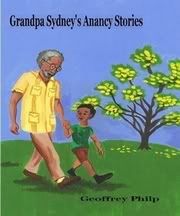
Grandpa Sydney’s Anancy Stories: Review in the Gleaner.

Geoffrey PhilpGrandpa Sydney’s Anancy Stories received a very good review in The Daily Gleaner (Sunday, February 17, 2008). The reviewer, Siobhan Morrison, praised the book’s “literary richness,” and the realism of the main characters: “The reality of the struggle most Jamaicans face trying to eke out a life in America and the important role the extended family plays in raising children come out in the book.”

I was especially pleased that the reviewer discerned one the main themes of the book: “Rather than resorting to a physical confrontation and unwilling to be seen as a 'tattletale', Jimmy turns to the cunning sheer ingenuity found in the Anancy stories, which his Grandpa Sydney reads to him every night.”

But I really liked this part:

There is richness to Philp's writing, and a literary mastery that allows him to fluidly interweave three stories within the confines of this rather thin book. In addition to the central story of Jimmy and the bully, Philp inserts the story of Anancy, Snake, and Tiger, which takes up all of chapter five. The character of Anancy is a key figure in Jamaican folklore and culture that can be traced back to our West African roots. The stories are usually passed on orally from generation to generation, very much in the same way Grandpa Sydney tells Jimmy the stories just as he had done with Jimmy's father. Known as a trickster, Anancy is not always a good character who does the right thing for children to emulate. However, in this case '... he did and that's what matters'. Children who read this book will be as entertained by Anancy as they are by Jimmy.

To read the entire review, please follow this link: Full of Lessons and Laughs

***


Technorati Tags:

February 1, 2008

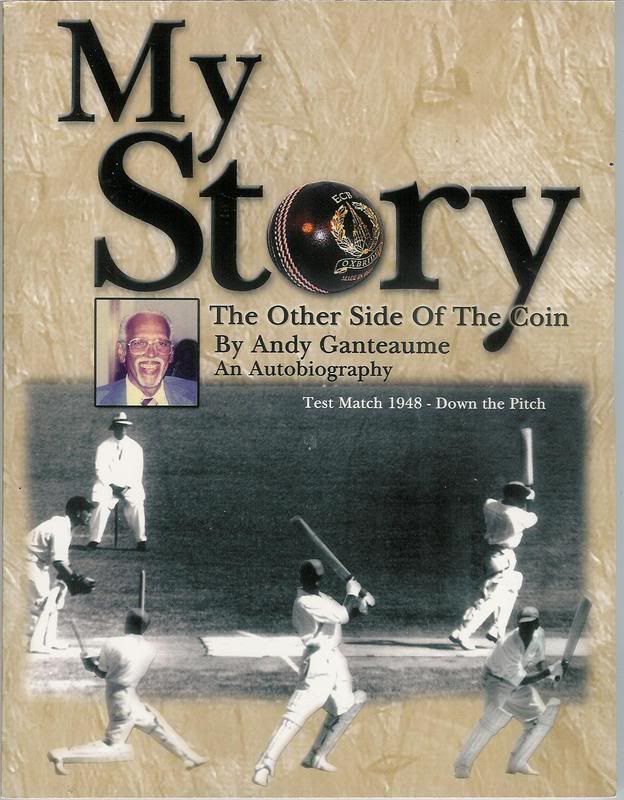
The Other Side of the Coin by Andy Ganteaume

Andy GanteaumeAndy Ganteaume’s name is not usually mentioned among his peers, the greats of West Indies cricket, that peculiar English pastime, that for a while at least, West Indians have been considered masters of the game. He played and scored a century plus – 112 runs - in only one test match against England in 1948 and was never again selected to play in another Test match. Almost sixty years later, opening batsman Andy Ganteaume has published My Story: The Other Side of the Coin - in which he reveals why, after being among the select few international cricketers who scored centuries in their maiden Test appearances, he was discarded by what he refers to as “the establishment.”

Andy’s My Story: The Other Side of the Coin was recently launched at a famous West Indies test cricket venue, the newly renovated Queen’s Park Oval members’ pavilion in Port of Spain, to an audience of cricketers, cricket enthusiasts, friends, and the local press.


Over the years Andy has in jest claimed that he has “a better test average than the Don” (Sir Donald Bradman), pausing just long enough for the unthinkable idea to register before adding much to the relief of the surprised listeners, “ but it is also my aggregate score.” That sense of humour is reflected throughout his book.


In a prepublication review, Dr. Ian Mc Donald, poet and Fellow of the Royal Society of Literature, who has written extensively on West Indies Cricket noted that, “Along with much else, he refutes conclusively the misconception, not to say smear, that in that expert and assured debut Test innings he batted “too slowly”. This is absolutely required reading. But his account of this extraordinary cricketing episode is only a part of Andy Ganteaume’s wonderfully interesting, revealing, and forthright autobiography, My Story. Especially vivid are his portraits of persons he has known well, many of them treasured friends, some of them famous personalities and others with whom sharp daggers were drawn.”


In the foreword, Sir Everton Weekes, the lone surviving member of the famous 3 Ws (Everton Weekes, Frank Worrell and Clyde Walcott) said, “The atrocities that existed and prevailed way back when the West Indies was given Test match status must be properly recorded. The injustices experienced by some players mainly because of social and economic advantages must not be allowed to go unnoticed. Thank heavens the playing field now seems to be more level.”


But Andy did not dwell on the negatives. In his Introduction he wrote, “Nothing I have said is meant to malign anyone but facts are stubborn things. As a matter of fact, to avoid seeming to “paint the lily,” I have not mentioned all I could have. Obviously, it must be left to the reader to accept or reject. I however have no fear of successful contradiction.”


In his long career as player, selector, administrator and coach, Andy’s life touched many persons some famous, some not known, many of whom became firm friends. In My Story, he paints interesting vignettes of many of them. The long list includes Sir Frank Worrell, Sir Everton Weekes, Sir Clyde Walcott, Clifford Roach, George Headley, Lord Learie Constantine, J.K. Holt, and CLR James.


In his classic book on cricket, Beyond a Boundary, CLR James traced the fruition of national West Indian consciousness through the development of cricket, where what happened inside the boundary affected life beyond it. Now, Professor Baldwin Mootoo of the University of the West Indies told the audience at the launch of My Story that Andy, “has told a unique story in this publication which we should all read if we are interested in West Indian cricket development and thus the evolution of Caribbean society.” And Everard Gordon writing in the Arena, the Trinidad Guardian sports supplement has cautioned, “It is a piece that every young man should read and not only young men, a piece that should be compulsory reading for every cricketer.”


About Andy Ganteaume:

Andy Ganteaume, now in his 87th year is a former West Indies cricketer, selector, administrator and coach. His claim to fame is that he played one test for the West Indies in 1948, scored 112, and was never selected again. His autobiography examines his relationship with the ‘colonial cricket establishment’ of the period and debunks the myth that he was dropped because he batted “too slowly.”


My Story: The Other Side of the Coin is published in Trinidad and Tobago by Medianet Ltd. It is available to Caribbean Diaspora readers on the world wide web at Amazon.com.


***

January 23, 2008

Peepal Tree Press and Sable LitMag at the AWP Book Fair

Peepal Tree Press

Peepal Tree Press
is the home of challenging and inspiring literature from the Caribbean and Black Britain. They have been publishing fiction, poetry, literary criticism, memoirs, and historical studies since 1985.

SABLE is a 132 black and white international LitMag, that has been published in the UK since 2000. It features work from emerging new writers and established writers.


OUR PUBLIC APPEARANCES


Our next public appearance will be at the AWP Bookfair at the New York Hilton from 30 Jan- 2 Feb 2008. The bookfair is open to the public on 2 February from 8.30am-5.00pm at Americas 1, Booths B74/75 where we look forward to meeting you!


Kadija Sesay, Dorothea Smartt, Koye Oyedeji, and Jeremy Poynting, publisher of Peepal Tree Press will be available to chat to you about SABLE and Peepal Tree Press throughout the bookfair.


Hilton New York (midtown)

1335 Avenue of the Americas

New York, NY 10019

Telephone: 212-586-7000

3rd Floor, Americas 1, Booths B74/75


SABLE will have T-shirts and posters available and special offer subscriptions for institutions and individuals. Purchase a subscription at AWP and get a free copy of Cotton Field of Dreams by Janis Kearney, (featured on the Essence Bestseller List, 2005).


Kwame Dawes, Associate Poetry Editor, Peepal Tree Press, will be signing his books at the Peepal Tree Press Bookstand at 3pm Thursday 31st Jan, Booths B74/75 America's Hall 1, 3rd Floor.


Dorothea Smartt , SABLE Poetry Editor will be reading from her latest book Samboo's Grave/Bilal's Grave (Peepal Tree Press) at the


Pan PALF Reading

in support of its Inaugural Writer's Conference: GHANA'08

[with]


Yusef Komunyakaa

Quincy Troupe

Patricia Jabbeh Wesley

Chimamanda Ngozi Adichi


[where]


The New School

Wollman Hall

65 W. 11th Street

Fifth Floor


[when]


Wednesday, January 30th

6:30 p.m.


Pan African Literary Forum. A literary study abroad programme.

A programme with an edge.


Tickets available at New School box office, 66W. 12th St.

$5 general public, free to New School students and alumni.


www. panafricanliteraryforum .org


***


"On my first trip to the Modern I turned a corner,
rooted before the ridged linen of a Cèzanne.

A still life. I thought how clean his brushes were!
Across that distance light was my first lesson."

~Tieoplo's Hound~
Derek Walcott

Happy Birthday, Derek Walcott!

***


January 21, 2008

Kyra and Twenty Eight Days Later

Kyra HicksCongratulations to Kyra Hicks on Martin Luther King Jr. Day. Kyra's book for children, Martha Ann’s Quilt for Queen Victoria , has been included in Twenty-Eight Days Later, a list of featured authors and illustrators organized by The Brown Bookshelf, to "shine the spotlight on the varied African American voices writing for young readers."


Here is a partial list of the books from Twenty-Eight Days Later:

February 1: Christopher Paul Curtis - Elijah of Buxton

February 4: Rita Williams-Garcia – No Laughter Here

February 8: Patricia McKissack – The All-I’ll-Ever-Want Christmas Doll

February 11: Mildred D. Taylor – The Road To Memphis

February 15: Walter Dean Myers - Game

February 18: Eloise Greenfield – The Friendly Four

February 25: Kyra E. Hicks - Martha Ann’s Quilt for Queen Victoria

February 26: Celise Downs – Dance Jam Productions and illustrator Shane Evans- When Harriet Met Sojourner

February 28 : Sherri L. Smith - Sparrow

For the complete list, please visit Black Threads in Kid's Lit.


January 16, 2008

In My Own Words: Nicolette Bethel

Nicolette BethelI never thought I'd be a non-fiction writer. I grew up reading the fantastic. The more imagination, the better. It was my brother, the question-asker, who was fascinated by facts: he was the one reading The Guinness Book of Records, National Geographic, Time, The Economist. Reality never interested me; fiction was my element.

As I grew older, though, I came to realize that fiction is shaped by fact. The books I loved to read, whether they were traditional fairy tales, children's novels, classic works of fantasy like the Narnia Chronicles or Lord of the Rings, or between-the-wars-English mysteries, were not neutral by any means. On the contrary. Many of them were actually tools of empire, reproducing the fundamental principles that justified European domination of the rest of us. In the British novels that were my companions for the first fifteen or so years of my reading life were figures who helped draw impermeable lines between us and them — the golliwogs of Blyton's nurseries, the Southrons and Easterlings on Tolkein's Pelennor Fields, and the Calormenes to the south of Narnia, or, later, the less-than-admirable persons of colour in Agatha Christie's and Dorothy L. Sayers' mysteries. The more literature I read, the more I understood that fact and fiction were not, and could not ever be, separate.

It took the study of anthropology to make me realize that the opposite was also true -- that what masqueraded as "fact" was also partly fiction. For decades, anthropologists had made the mistake that ethnography was synonymous with reality -- that what was contained in the studies of specific peoples at very particular junctures in time and space was not truth, but a literary version of the truth. Post-modernism's reflexivity may have limited application to the study of literature which inspired it, but my studies of anthropology, it was radical. My understanding of life, fact, fiction, law, and society has never been the same since.

Essays on Life began in my head long before I had a reason to write them. My return to The Bahamas after almost a decade of living abroad set off a chain of thoughts about our society and our culture that were raging to get out, and I was already contemplating approaching a newspaper to feel out interest for a series of articles on society in general, and not on political events of the day, when Larry Smith, then the editor of the Nassau Guardian, invited me to write a column. Essays on Life are the result.

I could have never imagined how widely read -- or how widely appreciated -- these essays would be. I've been writing them for five years now, and they appear not only in the Nassau Guardian (
http://www.thenassauguardian.com/), but they are also reprinted online at Larry Smith's Bahama Pundit (http://www.bahamapundit.com/%29, at The New Black: Magazine (http://www.thenewblackmagazine.com), and (of course) on my own Blogworld (http://www.nicobethel.net/blogworld/), as well as being regularly selected for readings at the College of The Bahamas. I've been asked often when I'm going to publish them. Now I have.

For a woman who never liked reading non-fiction, I've come a long, long way.


***


Essays on Life is available from Lulu and will be available from online bookstores such as Amazon and Barnes and Noble.

Link to Lulu:

http://www.lulu.com/content/281819


***

Nicolette Bethel was born and raised in Nassau, Bahamas, where she currently resides. She has lived, studied and worked in the UK and Canada, and is currently apprenticed to the Bahamian Government for her sins and others’. She is a playwright, poet, fiction writer and anthropologist. She holds a PhD in Social Anthropology from the University of Cambridge, and is a researcher in the fields of Bahamian national identity and of Junkanoo. She is the editor of Junkanoo: Festival of The Bahamas (Macmillan Caribbean, 1991), excerpted from E. Clement Bethel's M.A. thesis on Bahamian music. Her 1990 play Powercut was made into an independent film and released by Plantation Pictures in 2001. Her fiction and poetry have been published in a variety of places, including the anthologies Junction: an Anthology of Bahamian Poetry and Prose; From the Shallow Seas; and The Oxford and Cambridge May Anthologies 1993; print journals such as The Amherst Review; The Caribbean Writer; Calabash; and Social Identities; the online journals The Paumanok Review and II; and the edited collections Managing Island Life () and Junkanoo and Christianity (Media Enterprises, 2003). Essays on Life are reprinted online on Bahama Pundit (http://www.bahamapundit.com/) and The New Black: Magazine (http://www.thenewblackmagazine.com/). Since 2003 she has been a columnist for the Nassau Guardian.


December 9, 2007

Christmas Night II


The cool December breeze

wanders through the town,


aimless as shooting stars

over a pasture where a heifer


breaks the glass of a pond

and splashes toward a clear


opening, for even the goats

have come down off the stony


hillside to rest by the roots

of the allamanda--it's time;


time to wash away

the smoke of the year's turmoil,


to put aside profits, gains, losses--

the familiar ache that brings


tears in the bathroom mirror--it’s time;

time to listen to the wind's


chorus of the children's carols,

time to untie the knots in the old


men's arms, loosen the cords

around the old women's hips, crown


with poinsettias the young girls' hair,

garland the young men's shoulders--its time;


time to smooth the lines,

dampen the fires in the wrists, knees, elbows,


and pour the balm of aloe over the new

skin that we are becoming


with every flicker of candles

reflected in the circle of faces


of those here, gone, and to come,

whose only promise is joy.


***

From Twelve Poems and A Story for Christmas.