Showing posts with label James Joyce. Show all posts

June 16, 2012

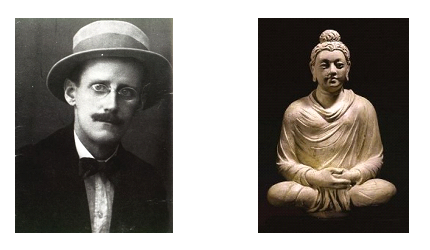
Joyce or Buddha: A Sestina


Joyce or Buddha: A Sestina

What kind of life must I lead in order to be happy?
It’s the kind of question that Gautama and Joyce would have asked,
But Gautama sat under a banyan for seven years and meditated
Until he emerged, his mind and soul cleansed, enlightened.
And with a new name to match his transformed state: Buddha,
Unbounded by the burden of previous lives and karma.

How long will I have to ride the wheel of karma
Before I’ll get to the stage that I can call my-self(?) happy?
Is it only through the Eightfold Path that I can become a Buddha?
Do I really want to know the solution to the questions I’ve asked?
To be liberated from my "monkey mind" will I have to meditate?
Is that the only way to become one of the enlightened?

My body resists while my mind yearns to be enlightened,
But the delights of Samsara hold me into the nightmare of karma
From which Joyce wanted to escape, but he wasn’t enlightened,
Or was he? If I wrote Ulysses or Finnegan’s Wake I’d be happy.
Besides, I much prefer the questions that Joyce asked.
So is my fate somewhere between Joyce or Buddha?

Finnegan’s Wake is harder to than any sutra of the Buddha,
And Joyce never followed those teachings. I doubt he even meditated,
Or if he did it was over a pint of Guinness, which he’d buy after he asked
One of his patrons for a loan to buy a round for his fellow exiles, his karma:
To suffer through the paralysis of Ireland, a land that could never be happy
Because they were addicted to suffering--not the path of enlightened.

What a curse it must have been to be the only one that was enlightened!
To wander around for years, preaching the “Middle Path,” like the Buddha
And not have a single disciple who understood what it meant to be happy.
Joyce was ecstatic when Nora, hair aflame, searched his pockets, or meditated
About some new way to get some money for the children—her karma.
“A few shillings for a good meal.” That’s the only thing for which asked.

Burning with epiphanies about the “Irish Question,” he asked
for a way out of the labyrinth, his comrades railed against being enlightened
Preferring to fight with the nets of religion and politics, their collective karma.
For they’d never find a savior, not the Pope, Parnell or even the Buddha,
No matter how much they prayed or how long they meditated
They’d be banished from Nirvana and would never be happy.

The more questions I ask, the more I realize  I’ll never be a Buddha
For to be enlightened means long hours in cross-legged meditation.
But if, like Joyce, it’s my karma to spin these words, then call me happy.


***


Reblog this post [with Zemanta]


***

June 19, 2011

Happy Father's Day (2011)


Yesterday as I walked down my driveway to pick up the Miami Herald, I noticed that rain lilies had once again bloomed after the long, dry season that we’ve had in South Florida. I’ve always regarded their appearance as almost miraculous for it seems as if they do not flower merely because they are watered (I do my fair share of lawn work), but only after rainfall. I am surmising that it takes the right sequence of events that include rainfall, humidity and other factors, and behold, Zephyranthes atamasco.

The appearance of the rain lily also has a special significance for me because it is associated with my father. I did not know my father, Sydney George Philp, very well. I was his tenth child from four marriages, so the time that I spent with him was always important to me. In the brief times that I spent with him (when I was conscious enough to understand), I realized that he was a charming, brilliant man and that combination with his “high brown” status in Jamaica must have made him irresistible to the ladies. He also had a great sense of humor. I found this out when I asked him about the name Philp (which no one can spell correctly—if I ever catch those guys, Geoffrey Philip, Geoffrey Philps, or Geoffrey Phillips, I am going to kick their collective asses for stealing my copy) and he told me about a trip to England where he met a certain young lady who told him..

Anyway, although our teenage years were difficult, our family started Philp get-togethers which were prompted (sadly) when we found out that our father was ill. We flocked to Jamaica to see the old man and to get to know each other as grown-ups. Some of my older brothers and sisters still think I haven’t grown up because I’m a writer, but that’s another story.

My favorite memory of that time was sitting on the verandah with my father and eating roasted corn, smelling the mixture of rain and earth before the showers came tumbling down Long Mountain, watching him fall asleep as the rain fell, and realizing in that moment that even though he might soon not be with us, that everything was irie.

All was not forgotten, but forgiven. For in a strange way, it had to be that way. The more I talked with my brothers and sisters, especially the ones whom I envied because they had spent so much time with him, I realized that I would not have become the man I am today if the events had not played out in that particular sequence.

My recollection of the rain lily, however, goes back to the time when I was leaving to the home of his fourth wife to go back to Mona Heights (the house that he and my mother bought), and as I was walking with him in the lane at the back of the house, he pulled up a rain lily, handed it to me, and said, “There, you can’t say I never gave you anything.” And he laughed. The old devil laughed. And all I could do was laugh and tell him that I loved him. He said, “I know.”

So, whenever the rain lilies bloom at my front door, I remember my father and those brief moments we had together—which were as brief and miraculous as the appearance of rain lilies—and I give thanks.

So, to Sydney George Philp, grand progenitor, I return the simple gesture of a rain lily.


One Heart
*
Previously posted as “Behold, the lilies of the Field.”

June 16, 2010

Happy Bloomsday (2010)


Preparatory to anything else Mr Bloom brushed off the greater bulk of the shavings and handed Stephen the hat and ashplant and bucked him up generally in orthodox Samaritan fashion which he very badly needed. His (Stephen's) mind was not exactly what you would call wandering but a bit unsteady and on his expressed desire for some beverage to drink Mr Bloom in view of the hour it was and there being no pump of Vartry water available for their ablutions let alone drinking purposes hit upon an expedient by suggesting, off the reel, the propriety of the cabman's shelter, as it was called, hardly a stonesthrow away near Butt bridge where they might hit upon some drinkables in the shape of a milk and soda or a mineral. But how to get there was the rub. For the nonce he was rather nonplussed but inasmuch as the duty plainly devolved upon him to take some measures on the subject he pondered suitable ways and means during which Stephen repeatedly yawned. So far as he could see he was rather pale in the face so that it occurred to him as highly advisable to get a conveyance of some description which would answer in their then condition, both of them being e.d.ed, particularly Stephen, always assuming that there was such a thing to be found. Accordingly after a few such preliminaries as brushing, in spite of his having forgotten to take up his rather soapsuddy handkerchief after it had done yeoman service in the shaving line, they both walked together along Beaver street or, more properly, lane as far as the farrier's and the distinctly fetid atmosphere of the livery stables at the corner of Montgomery street where they made tracks to the left from thence debouching into Amiens street round by the corner of Dan Bergin's. But as he confidently anticipated there was not a sign of a Jehu plying for hire anywhere to be seen except a fourwheeler, probably engaged by some fellows inside on the spree, outside the North Star hotel and there was no symptom of its budging a quarter of an inch when Mr Bloom, who was anything but a professional whistler, endeavoured to hail it by emitting a kind of a whistle, holding his arms arched over his head, twice.

***


Enhanced by Zemanta

October 26, 2009

How To Use Symbols


Many young writers, who after they’ve read poets such as T.S. Eliot, often think that they need to “put some symbolism” in their work. They think that if they add a dash of imagery and a few tablespoons of symbolism, the path to literary immortality will suddenly appear. For my young male poets, the ambition is even more grand: seventy-two virgins will sweep them up into literary nirvana.

As tempting as the vision may be, I’ve often had to tell them the sad truth: symbols can’t be “added” to a poem. Discovering symbols in one’s work is a process. Writing is a recursive activity and symbolism in a literary work is the result of the intellectual and emotional state of the writer before and during composition.

But let’s say, for the sake of argument, that you’ve begin to write a poem and as you are following the words across the page, you find this gem nestled between the thorns of two commas. At this point, you have at least two options.

You can stop writing and do some more research if you think you don’t know enough about the symbol, or you can finish the poem and go with the intensity of the emotion that was the spark for the poem.

Either way works.

I usually choose the second option because I never know what will survive with revision, and I’d prefer to have a workable draft of a poem than pages and pages of Wikipedia downloads with nowhere to go.

Now assuming the gem has survived the first cut and you feel that the poem has not fully explored most of the connotative possibilities of the symbol, ask yourself these questions:

What is the origin of the symbol?

Should I learn more?

How has the meaning of the symbol changed over time?

Which other writers have used this symbol? How have they used this symbol?

What are the religious, intellectual, and cultural connotations?

Is the symbol relevant to the poem? Why?

Does the symbol grow organically from the poem?

Why does the symbol appeal to me?

How is the symbol re-imagined in my poem?

The last question is important because that’s where the creativity of the poet will be demonstrated in the re-imagining of the symbol.

I’m thinking of symbol, of course, in the Jungian sense as standing “for something that is unknown and that cannot be made clear or precise.” Or in the spirit of Ferdinand de Saussure, the signifier may remain constant, but the signified may change depending on the context.

It is this arbitrariness of the signified that creates the opportunity for artists to reinterpret myth and symbols as T.S. Eliot and James Joyce did throughout their careers. In fact, T.S Eliot’s essay, “Ulysses, Order, and Myth,” confirmed Joyce’s “mythic method”--a method Eliot had used in diagnosing the spiritual ills of Europe in The Wasteland.

The use of myth as a contemplative method suddenly became clear. But I did not want to  re-heat Western mythology. The myths would have to speak to something that was happening right in front of me, so I began searching. My quest ended with The Arrivants by Kamau Brathwaite. After I read that collection, I knew what I had to do.

Brathwaite's seminal trilogy made me realize the many displacements of Yoruba mythology in the Caribbean. This became one the major themes in my work: the rediscovery of African heritage in the Caribbean, which as Brathwaite has asserted is essential to the psychic wholeness of Caribbean peoples.

For if we continue to denigrate this heritage; if we do not honor this inheritance, then the cycle of self-hatred, the wound of the Middle Passage will continue to fester. We will never be healed  and all the symptoms of this dis-ease with ourselves will continue to manifest as the various social ills, especially the high murder rates in Jamaica, we see all around us.

Looking around Jamaica and the Caribbean, I saw Xango at a stoplight geting angry with the car in front of him; Erzulie on a Friday night getting in a taxi to go to a nightclub; Papa Legba sitting on the street corner cracking jokes and telling the children riddles.

These archetypal symbols became the means by which I could interpret Caribbean life, even as many of my compatriots continued to act out the characteristics of these loas without knowing it. Indeed, it may be said that some of us are being “ridden” or possessed by Eleggua and we don’t even know it.

And sometimes we want to be ridden by the loa and begin with a meditation on the symbol—the process that Brathwaite used extensively in his collection, Words Need Love Too.

This was the approach I used in the composition of the poem, “oshun,” when I learned about the death of James Byrd, Jr. in Jasper Texas on June 7, 1998. His death was so horrific and I was filled with a hate that needed to be exorcised. That is when I remembered Michelle Cliff’s poem to Oshun and I knew only the love of Oshun could save me from my own hate:


oshun
(to michelle cliff)


this morning i could have sworn i saw oshun
rise out of the water – “she who makes her people one.”

i needed to see her this morning after james byrd junior,
my brother, was dragged to death by a truck in jasper,

texas; for i need to believe this morning – i don’t want
to be a tongueless bell – i don’t want to be burnt

up like a useless limb by my own simmering hate.
oshun, guardian of our dreams and our spirit,

lover of our dark hands, dark bodies, dark skin--
healer of wounds made by our enemies and our weapons

aimed at ourselves--my sister, protect us in this dread
hour until anger passes – wash your coolness over my head.


“oshun” needed very few revisions. I already knew about her through Michelle Cliff’s work and my own research, so that when the poem came, I was ready.

But this perhaps leads me to the penultimate question about archetypal symbols: Do we choose them or do they choose us?

Words from flickr created by kastner (Erik Kastner)

***

Reblog this post [with Zemanta]

April 8, 2009

What I Learned From Adversity

AdversityAdversity and being a writer, especially one from the Caribbean, are synonymous. And yet we continue despite the odds that financial or other types of "success" are stacked against us. Why? Perhaps its faith, stubbornness, madness, or the urge to give back to the universe beauty that has touched our lives. Who knows? But to devote one's life to a vocation that has few, if any rewards, other than the knowledge of having created a poem, short story, or novel, and then, to have it ripped apart or ignored? Who would want to do that?

It turns out that many of us do, and it may be as I wrote on John Baker's blog, "We write because of the pleasure. We write when no one is looking. We write even when the world is sleeping. To mangle Gertrude Stein’s aphorism: A writer is a writer is a writer." But that may not be altogether true. For as a person who believes in individual agency as well as the concept of Interbeing, I view writing as a means not only of personal, but also of collective liberation.

And the truth is that I like writing. It is a kind of meditation that helps to clarify my ideas and if it is done well can assist in demonstrating the emotional or intellectual consequences of an action. In fact, one of the roles that an artist plays in a healthy culture is to demonstrate through her fictions the suffering that characters encounter as a result of their actions. Not that people will stop making mistakes. There's too much fun in the drama. Besides, if they did, preachers, poets and politicians would be all out of business.

For life and art are built on conflict and adversity and these must be faced individually and collectively. And yes, "adversity often shows up in the forms of well, a person. Or three." And until we learn the lesson or if we forget, then the adversity and adversary will continue to show up in our lives until we become Buddhas.

The lesson I've been learning over and over has been never to doubt abilities and in particular, my intuition. And I won't say that I've fully overcome this kind of adversity because it's been a part of my personal and cultural matrix.

Many of formative experiences occurred at Jamaica College, and as a member of the Caribbean Boomer Generation in postcolonial Jamaica, I came of age during the birth of Reggae under the government of Michael Manley. As one of the oldest schools in the Caribbean, Jamaica College, like many schools in the region, was caught flatfooted after the island gained independence.

Many of the teachers, masters as they were called, had not thought through the implications of independence in education. For independence is not merely the lowering of one flag and raising another. It is supposed to bring about a change of entire systems and assumptions--the way that the American Revolution led to an American form of democracy or even Webster's dictionary: the realization that there was a distinctive American character and worldview. Instead, the masters at Jamaica College continued the same system of education that had been designed to keep the brightest minds in "mental slavery" and to hold the population under the domination of the British Empire.

One of the most efficient ways that the British devised was to introduce the noxious seed of doubt into the culture of the colonized. In other words, without firing a single shot--have those whom you fear doubt their own talents. This became part of the unspoken curriculum at Jamaica College and the masters, many of whom were Jamaica College Old Boys, continued this pattern in the name of "tradition."

But what is a tradition and whom does it serve? These were questions that were never asked. And if one dared to ask, it would have resulted in a box over the ears or a caning from a master. I know this. I spent most of my first form year in the principal's garden waiting for the caning master after being kicked out of my English class.

So, how does a writer or an artist grow under these conditions? Half a continent away, James Joyce's solution was "silence, exile, and cunning." It's the kind of answer that only an Irish Anancy could give. For Anancy represents that archetypal figure of the imagination that transgresses boundaries and his counterpart in Ashanti culture, Eshu, or in Haitian Voudoun ceremonies, Papa Legba, is always invoked at the start of any ceremony. It could be said that Anancy is the patron saint of writers and rebels.

For this reason, Anancy was feared on both sides on the "racial divide" in slave societies. Anancy represented rebellion against conformity and rebellion meant death. With the history of rebels under colonialism, no mother would have wanted her son or daughter to be a rebel and many in his/her family and some of the elders would have feared for his/her life. And some out of fear many rebels may have beaten or cowed into submission to save his/her life. In the name of love.

Flash forward to the seventies when I and a group of students are slowly matriculating through Jamaica College. And although I am part of the "A" stream of students, I am always reminded by the masters that there are students who are much brighter than me. And given the habit of invoking tradition from both the British and whatever vestiges of West African culture that remained in Jamaica, coupled with my fundamentalist Christian upbringing what this created in my mind was a denial of my intuitive faculties in favor of the intellectual and critical acumen of my elders. This sometimes led me to doubt my abilities. For without feedback, how do you know if your work is any good, or if you're not just plain delusional? It also led to a fear of arousing the displeasure of the masters. You could go to hell or worse.

And the masters and the prefects were quite willing to use verbal or physical abuse to herd us into the group of "the weary and those uncertain of themselves." They were not interested in the growth of the human spirit, but rather with keeping people "in their place"--whatever that meant.

Other than finding publishers for my work, this is the kind of adversity that I've had to face many times in my writing career. I’ll only list two occasions.
After the publication of my first book, Exodus and Other Poems, a certain critic in the Daily Gleaner, "Andrew Hope" pretty much decided that I was illiterate--this despite the fact that Exodus was judged the best manuscript that was submitted to the editors of The Caribbean Writer. Mr. Hope took aim at a line in one of the poems to which he devoted a column inch to criticizing my ignorance of the difference between "lie" and "lay": " the cars lay sweating/ bumper to bumper" my allusion to Robert Lowell's "Skunk Hour": "I watched for love-cars. Lights turned down, /they lay together, hull to hull." I guess Robert Lowell and I were illiterate.

A similar incident also happened with the publication of my first collection of short stories, Uncle Obadiah and the Alien. A.L McLeod not only lambasted the book in World Literature Today, (even though one of the stories, "My Brother's Keeper," was eventually included in the Oxford Book of Caribbean Short Stories), but also published a small book devoted to demolishing my book. Naively, I expected at least one critic to defend the book as I had done when William Logan unfairly criticized Derek Walcott's The Bounty. No one did. Without any critical response, I feared that McLeod may have been right and I stopped writing. I shut down.

But then, with a little help from my friends, I began to write again--only to be met by critical silence. Yet I continued, for I was determined never to be shut down by a lack of response.

Then last week I was tested again. I don't want to rehash the controversy, but all I can say is that the event had the opposite effect on me. I responded without malice to criticism that was designed "to remind me of my place." But this may have less to do with courage and more to do with age.

When I turned fifty, I promised myself that would leave certain habits and behaviors on the other side of 50. At 50, I feel that I have paid my dues. In fact, one of the reasons I continue to blog is the wish to pass on some of what I've learned to other writers so that it won't take turning 50 to give up self-defeating behaviors.

Yet I hope I am not misinterpreted. I do believe in the poetic tradition and apprenticeship. They are part of the process of learning. As Mihaly Czikszentmihalyi and his researchers have concluded, it takes about ten years of immersion in a field before one can make a meaningful change in a discipline. And that growth is aided by constructive criticism of the work and not ad hominem attacks on the person.

So I won't say that I'm 100% free of the immobilizing doubt, that fear that I am not as good as my masters' opinions of me, but after last week and with the response of so many friends, I know I am a lot closer.

This is part of a series on "What I Learned from Facing Adversity" @ Middle Zone Musings.

***


Reblog this post [with Zemanta]

March 16, 2009

Fifteen Books That Have Influenced Me

15 Books MemeI was going to write a post similar to Monique Roffey’s, but then, I was tagged by Lisa, so the first five books on this list are My Pentateuch: The books that I carried with me from Jamaica when I had to make a real choice about which books would come with me to America.


1. Uncle Time by Dennis Scott.

The world of the fantastic surrounds us. Portrait of the Artist as craftsman.


2. Reel from “The Life Movie” by Anthony McNeill.

It’s the music of the line that matters.


3. Another Life by Derek Walcott.

Poetry is a vocation—a calling.


4. The Arrivants by Kamau Brathwaite.

Africa is an integral part of our culture and we denigrate the continent to our own psychic peril.


5. Mimic Men by VS Naipaul.

Naipaul’s cautionary tale about a man who is so consumed by the notion of “superior” colonial culture that he demeans the beauty around him.


6. The Pond by Mervyn Morris.

Make every word, every syllable, and every sound count.


7. Portrait of the Artist as a Young Man by James Joyce.

The life of an artist, especially those from colonized countries, is fraught with perils to conform.


8. The Myth of Sisyphus by Albert Camus.

Camus’s response to our collective existential condition.


9. The Inferno by Dante (trans. Robert Pinsky).

A poet’s response to the moral crisis in his culture. I also have to thank Mr. Pinsky for allowing me to use a quotation from his translation in my novel Benjamin, my son.


10. All the King’s Men by Robert Penn Warren.

Corruption, father and son relationships, the burden of Plantation America


11. As I Lay Dying by William Faulkner.

Lyricism, the burden of Plantation America


12. Love in a Time of Cholera by Gabriel García Marquéz.

What can I say? I’m a romantic.


13. Twenty Love Poems and a Song of Despair by Pablo Neruda.

See above.


14. The Children of Sisyphus by Orlando Patterson.

A Jamaican hell.


15. The Hero With a Thousand Faces by Joseph Campbell.

Myths are intertwined/hardwired into our DNA. It is the poet’s job to revise/ renew the myths and suggest new ways.

I’m not going to tag, anyone for this meme. However, if you read it, liked it and want to jump in, come forward! The virtual pool is irie.

***

June 30, 2008

Wanted: The Transformation of a Trickster/ Warrior

WantedThis weekend my family and I went to see Wanted, one of the best written Trickster movies in recent years. Well, it's not a pure Trickster movie. It's more of a Trickster/Warrior movie. This is all right with me because these are the two dominant archetypes in Jamaican culture.

To a certain extent, Wanted follows the pattern in James N. Frey's, The Key: How to Write Damn Good Fiction Using the Power of Myth which applies Joseph Campbell's insights into the structure of the so-called "monomyth" to creative writing. Many avid moviegoers will recognize the elements which have been used in films such as Star Wars, The Matrix, and Harry Potter.

1.The story opens with the hero, usually male, functioning badly in the Everyday World and desiring something (he doesn't know what he wants) to escape from his mundane life (Neo's wake up call in The Matrix)

2. A Herald bursts into the hero's life with a Call to Adventure: to go on a Quest to recover/retrieve something that has been lost or stolen (Princess Leia in Star Wars)

3. The hero may or may not answer the Call to Adventure. If he refuses the call, he will suffer. This is the plight of many of the characters in James Joyce's Dubliners.

4. For novels and full length films, the hero accepts the Call (sometimes reluctantly) and meets a Mentor (Morpheus in The Matrix or Dumbledore in Harry Potter) who introduces the hero to the Armorer and the Magical Helper (Mouse, Apoc, and Tank in The Matrix)

5. A Threshold Guardian appears at this moment and warns the hero of the dangers. Cypher in The Matrix: "Little piece of advice: you see an Agent, you do what we do; run. Run your ass off." If the hero ignores the advice, he crosses The Threshold and enters the Mythological Woods. The hero has begun The Initiation.

6. During the Initiation, the hero will be Tested and will learn all the rules of the new environment. Morpheus's advice to Neo: "This is a sparring program. Similar to the programmed reality of the Matrix. It has the same basic rules . . . rules like gravity. What you must learn is that these rules are no different than the rules of a computer system. Some of them can be bent. Others can be broken."

7. The hero may have a Sidekick (Trinity in The Matrix) and encounters many variations of the female archetype: Mother, Goddess, Witch, Whore, Femme Fatale (The Oracle, Persephone, Niobe in The Matrix and The Matrix:Reloaded)

8. The hero will also be in conflict with the Evil One (Valdemort in Harry Potter) or his willing surrogates. (The Merovingian in The Matrix: Reloaded)

9. The hero will be betrayed, have a change in consciousness, fall in love, or lose a loved one to death.

10. The hero will undergo a Death and Rebirth. (Neo's death and rebirth in The Matrix)

11. Confrontation with the Evil One in his or her environment (Neo and The Architect)

12 The hero fails or triumphs (momentarily) over the Evil One (Neo and The Architect in The Matrix: Reloaded)

13. The hero returns to the community and is Retested.

14. During the return, there is another confrontation with the Evil One and the hero gains the prize.

15. Once the hero is reintegrated back into the community, the prize may be rejected or an imposter may take the credit.

The most important element of the monomyth is the transformation of the hero (through time) over the course of the adventure and to witness his becoming aware of his change. In other words, the prize is unimportant--it's a MacGuffin.

So, Wanted could be called The Education/Transformation of an "apathetic nobody" into an "unparalleled enforcer of justice" and we watch in fascination as Wesley Gibson accepts the call to adventure, is initiated into a fraternity of Trickster/ Warriors, and his confrontation with the Evil One played by Morgan Freeman.

I was also intrigued by the use of Trickster symbolism and its connection with Yoruba and Akan mythology:

1. X of Eshu (Eleggua, Papa Legba), God of the Threshold

2. The web/loom of Anancy mythology

3. The circles used in Akan and Yoruba mythology and the necessary creative irruption that causes dis-equilibrium and the appearance of the Trickster

And if that wasn't all, the visual effects and stunt scenes were remarkable and managed to disrupt my analysis/enjoyment of the film as I was watching it.

And, of course, there was Angelina Jolie

***
Technorati Tags:

May 14, 2008

How To Use Allusions


One of the questions that I am asked by my students in creative writing workshops is "How do I use allusions in my work?" The first thing that I try to explain is that the use of allusions is not confined to literary work--they are parts of language and life and extensions of our linguistic imagination. Eavesdrop on any conversation (this is what writers do) on any street corner anywhere in Jamaica, and you will hear people making all kinds of allusions to the Bible, proverbs, and folktales. Sometimes they even spice up their storytelling with metaphors when they are telling jokes with sexual content. Songs such as "Ketchy Shuby" by Peter Tosh and "Stir it up" by Bob Marley are not just about children's games and cooking. In other words, allusions like any other literary device such as symbolism grow organically out of language and the writer uses these devices to heighten the effect of the work.

Most writers use allusions when they realize the similarity in theme or tone between the poem, short story, or novel that they are working on with another writer's work within a literary tradition. For example, the wandering of Leopold Bloom through the streets of Dublin in Ulysses by James Joyce is a direct allusion to the wandering of Ulysses in Homer's Odyssey. Several episodes such as Nausicaa and Calypso have given literary scholars enough material to keep them "busy for three hundred years."

In my own work as I was going through the pre-writing of the novel, Benjamin, my son, I realized that both my personal situation and the subject of my work mirrored that of Dante Alighieri. At the time of composition, I realized several parallels between my life and Dante's: we were in the "middle of life's journey" and because of the war between the "Whites" and the "Blacks," we were living in exile and remembering the moral outrages that plagued our homelands--the direct causes of the war. The situation seemed tailor-made for what was I was writing about--the purgatorial experiences of Jamaicans--and like Dante, I assigned several types of people, based on the moral universe of the Seven Deadly Sins, to a circle in my Jamaican hell.

As a cautionary note, I always stress with my students that the telling of the poem, short story or poem comes first. The Art of Fiction by John Gardner calls this "the creation of a vivid and continuous dream." The poem, short story, or novel must first adhere to the inherent craft of the genre and the dumping of metaphors or allusions into the text will not make them "better." I also remind them that the writer always has the option of playing with the allusion. In the case of Ulysses, Bloom is Jewish and Joyce is making a reference to the myth of the "wandering Jew." In Benjamin, my son, Virgil becomes the dreadlocked Rastafari, Papa Legba, drawn from the Vodoun pantheon, and whose antecedent is Eleggua or as we know him in Jamaica--Anancy.

Allusions, symbolism, and metaphors when used correctly expand the meaning of a literary work and depending on the reader's ability to understand these devices, adds depth to the story. It's not just a one time reading. The reader, engaging the text by thinking about the plausibility of the action, examining the complex patterns, making comparisons and contrasts to his or her life, and evaluating the text to determine if all elements come together seamlessly, keeps coming back for more. Think about songs by Bob Marley such as "I Shot the Sheriff" or the poem, "Mass Man" by Derek Walcott and you get an idea of what makes a work approach literary immortality. Every time you reread the story, you gain a greater understanding to the work, yourself, and how much you have grown with respect to the work and your understanding or yourself. It's a recursive activity hat not only adds richness to reading, but to life itself.

***


Reblog this post [with Zemanta]

September 13, 2006

One Book Meme

Geoffrey Philp's libraryMichael J. West tagged Stephen and I got into this book meme because it looked like fun. So here goes!

1. Book that changed your life:

Another Life by Derek Walcott made me realize the grandeur of verse and the power of poetry. He also mythologized the Caribbean and dignified the lives of common folk. More importantly, he wrote about growing up as an artist in the Caribbean and his trials and tribulations as a young man grappling with the big issues of friendship, art, death, and love. Walcott made me realize that I could live the life of an artist, but I would have to be tenacious and daring.

2. Book you've read more than once:

There are so many! The top ten would be these:
  1. A Portrait of the Artist as a Young Man by James Joyce

  2. The Power of Myth by Joseph Campbell

  3. King James Version of the Holy Scriptures

  4. Uncle Time by Dennis Scott

  5. Reel from the “Life Movie’” by Tony McNeill

  6. Awakening the Heroes Within by Carol Pearson

  7. Shar by Kamau Brathwaite

  8. The Art of Fiction by John Gardner

  9. The Star-Apple Kingdom by Derek Walcott

  10. Love in Time of Cholera by Gabriel Garcia Marquez

3. Book you'd take to a desert island:

Boat Building for Dummies.


4. Book that made you laugh:

VS Naipaul’s, The Suffrage of Elvira, made me laugh so hard my sister, Judith, came rushing outside to the verandah because she thought something was wrong with me. Well, Judith always thought something was wrong with me. Let’s just say, what else was wrong with me.

5. Book that made you cry:

There are two books that made me bawl: The History of Tom Jones: A Foundling and Tess of the d’Urbervilles by Thomas Hardy. I read Tom Jones when I was eighteen, and although I was hardly a libertine, when Tom thinks that he has slept with his own mother, or in Tess when she prostitutes herself to support her family—that was it for me! They registered a shock to my nervous system and pulled me out of my naïve world. Could the world be like this? Yes, these books seemed to say. My sense of justice was outraged and because the characters seemed to near to me (fatherless, poor, or powerless) that made these fictional stories even more real.


6. Book you wish you had written:

My first choice a couple of years ago would have been, Miguel Street by VS Naipaul. For although Miguel Street is funny, The Duppy by Anthony Winkler is hilarious and sublime. Many non-Jamaican may not get the humor (some Jamaicans don’t get it either), but Winkler is one of the finest, funniest writers I’ve ever read. My favorite chapter in the book was when Baps gets to heaven and begins talking to God about the universe and the goings on in Jamaica.


7. Book you wish had never been written:

I generally don’t deal in regret because once the milk is spilled, there’s no use crying. Clean up the mess and move on. I also believe that everything that happens to us shapes us in every way, so if you pull one string of causation, then the present reality fall apart. And right now, everything is irie. So I will deal with this hypothetically. There is an e-book dedicated (I mean this in the Rastafarian sense of the word) to bashing my first book of short stories, Uncle Obadiah and the Alien. It’s from a World Literature review of Uncle Obadiah that was then made into an e-book: Uncle Obadiah and the Alien: An article from: World Literature Today by A.L. McLeod. I mean, it’s one thing to write a bad review about a book, but to follow it up with an e-book? And a first book of short stories? C’mon, man! I’m not saying that as a reviewer, I haven’t met my fair share of bad books, but I’ve usually passed on reviewing the book without putting bile into print.

8. Book you're currently reading:

Cinema Nirvana: Enlightenment Lessons from the Movies by Dean Sluyter. If you have any interest in Buddhism and the movies, this is a great book filled with interesting insights about movies and aikido. For example, Sluyter asks in the preface” “What can Casablanca teach us about bodhichitta, selfless commitment to the enlightened happiness of others?” I’m on the chapter, “Dare to be Dopey.”

9. Book you've been meaning to read:

The Odyssey: A Modern Sequel by Nikos Kazantzakis is still sitting on my shelf. I’ve read about 100 pages, but it’s slow going. I’m not averse to epics, but Walcott showed in Omeros that epics can also be funny and daring and wise.

10. Tagging: In the spirit of democracy, if you’ve read this, you’ve been tagged. So, go ye forth and write your own book memes. You’re on the honor code. If you continue the meme, good luck will happen to you in the next 48 hours. If you break the meme, I don’t even want to think about what may happen to you. But it’s your life. My hands are clean.

***
, , , , ,
, ,

August 17, 2006

Happy Birthday, Marcus Garvey


One of the great pleasures I’ve had over the past five years is teaching a course at MDC where I use the book, Awakening the Heroes Within. After teaching the elementary rules of essay writing, my students and I explore the biographies of historical and cultural figures such as Gertrude Stein, Simone de Beauvoir, and Dr. Ben Carson and assess the archetypal significance of their life and work. I usually try to steer my students toward writing papers on Zora Neale Hurston, James Baldwin, or Marcus Garvey, but invariably, they end up writing about Nelson Mandela, the Warrior or Pablo Picasso, the Creator. I’ve often suspected the reason why they have not written about Hurston, Baldwin, or Garvey, and I finally had a group with enough courage to tell me the truth. They didn’t know enough about Hurston, Baldwin, or Garvey to write a research paper that would be graded. And they need good grades, especially now since the Florida legislature has imposed new academic standards and has threatened to limit the amount of credits for which the state will pay even though approximately 82% of our students enter our college academically under prepared.

Yet as a teacher who encourages intellectual risk, it’s disappointing when my students refuse to confront an academic challenge. It is even more disheartening that despite Oprah’s efforts, Zora Neale Hurston, a Florida native, remains in virtual obscurity. And in these times of increased hurricanes, Hurston’s, Their Eyes Were Watching God, should be a must read, for she was one of the first writers who explored the metaphorical meaning of a hurricane.

James Baldwin, author of Go Tell it on the Mountain, The Fire Next Time and Blues for Mr. Charlie and one of America’s finest writers, has also suffered a similar fate. These are two great African-American writers who have been relegated to the margins of American cultural life.

It is also painful, but not surprising, that none of my students know anything about Marcus Garvey. In fact, I once taught a class in which Garvey’s great, great grand____ put up his hand and said he knew the name Marcus Garvey. My ears perked up. But when I probed further, he said he really didn’t know much about his great relative’s accomplishments—he only knew that he’d done something. For the first time in my teaching career, I assigned a mandatory subject to a student. He passed the class.

As we neared the end of the semester, my students asked me why I was so interested in Marcus Garvey. I explained that my interest in Garvey was not merely because I am a secular Rastafarian, but the type of leadership that Garvey embodied still holds relevance for us today, and his life holds many lessons for us in the twenty-first century. Garvey, despite his flaws, was one of the first Black leaders in the Western Hemisphere to articulate a vision of greatness for people of African descent, and through the power of his words re-imagined the future of Black people. But words were not enough for Garvey. He put his words into action, faced the adversity that came with being a pioneer, and thus modeled the greatness, integrity, and excellence that he desired to see in the world.

A few weeks later, I showed my students the video, Look for me in the Whirlwind. The film traced Garvey’s birth in St Ann’s, Jamaica (1887) to his death in London, England (1940). What emerged from the video was a figure who from his earliest days was fascinated by the power of words: “As a boy, Garvey imagined himself delivering speeches to adoring crowds. He spent hours reading, and even bet his friends they couldn't pick a single word from the dictionary that he didn't know” (Whirlwind). So, by the time he was forced under the colonial system to leave school, he became a printer’s apprentice and “quickly earned the status of master printer. In the print shop, he learned the power of controlling the written word and published his first newspaper, Garvey's Watchman” (Whirlwind).

Then, using the skills he had mastered in his youth, “Garvey started The Negro World newspaper with a cover price of 5 cents. The paper carried essays, poetry, and articles on Black history and world events… By the end of 1919, Garvey claimed over three-quarters of a million followers and The Negro World was the most popular black newspaper in the United States” (Whirlwind).

Ironically Garvey’s quest began in his adolescence when one of his closest friends and white neighbors, Joyce Rerrie, was told never to speak to Garvey again and she was sent away to England because her father said Garvey was a “nigger”: “[It was] the first time that he heard and became aware of this idea of being black and what it meant.” (Whirlwind).

Then in 1914, Garvey after reading Booker T. Washington’s, Up From Slavery, traveled through Central America, and concluded: “the situation facing black people was a global one…. I was determined that the black man would not continue to be kicked about, as I had seen in Central America, and as I read of it in America. Where is the black man's government? Where is his King and his kingdom? Where is his President, his country, his men of big affairs? I could not find them, and then I declared, 'I will help to make them.' My brain was afire” (Whirlwind).

Thus, Garvey commenced on the monumental task of reversing the negative thinking, images, and stereotypes associated with Blacks in the Americas (I mean this in the widest sense). As Charles Mills, explained: “To begin with, Africa was called the "Dark Continent". And the pictures that, we got of Africa in those days were cannibals running around in the jungles, puttin' people in pots. Garvey changed all of that” (Whirlwind). Estelle James addressed the issue more cogently, “You was oppressed and depressed and disgusted that you were born in the wrong race of people because of your color. Whatever was left, that's what you got. Only what was left. And we were at the lowest ebb at that time” (Whirlwind).

Garvey also began honing his oratorical skills, “And all of a sudden this golden voice from the Caribbean came and stood on the corners in Harlem and began to talk about self-esteem, holding up your back bone, you know, no wish bones” (Whirlwind). In 1920, Garvey gave a speech in Madison Square Gardens to twenty-five thousand people where he told Europeans to give Africa a wide berth because “We are coming home” (Whirlwind).

In abandoning the Eurocentric view of race and color, Garvey dismissed the idea that the history of Black Americans began in slavery. Like all great leaders, he located himself and his people within a historical continuum and realized that if Black people were capable of great things in the past, they could do even greater things in the future: “Be as proud of your race today as our fathers were in the days of yore. We have a beautiful history. And we shall create another in the future that will astonish the world. I can advise no better step toward racial salvation than organization among us. We have been harassed, trampled upon, and made little of because of our unfortunate condition of disorganization. Our racial program of today is a united, emancipated, and improved people” (Whirlwind).

Then, to paraphrase one of his spiritual descendants, Garvey "put his vision to reality" (Marley). He empowered people of African descent not only with ideas, but also through the United Negro Improvement Association (UNIA), he funded businesses so that Black people could have a stake in their economic future. This led to many other enterprises, including the ill-fated Black Star Line. At the turn of the twentieth century when North America was divided by racial segregation, Garvey was expanding the level of expectancy for people of African descent and moving beyond the negative self-images.

Long before the New Age evangelists with their chorus of self-acceptance as the prerequisite for psychological wholeness, Garvey announced to his followers, “Always think yourself a perfect being…and be satisfied with yourself” (Whirlwind). Sister Samaad reported on change that Garvey’s words had on his audience, “You would almost see them -- metamorph into something else. You would see it. They'd suddenly get very tall because the smallest man in the uniform still looked like a giant. I can tell you that from experience. They were gorgeous. The black men were gorgeous” (Whirlwind).

Garvey early on realized that success had to be taught, and he used the UNIA to do this: “Garvey's idea of the UNIA was that it would teach success. It was going to be a vehicle to communicate and demonstrate that black people could be successful. This idea of success was now translated into a whole series of commercial ventures, laundries, restaurants, newspapers” (Whirlwind). These are timeless values and principles that have to be taught and modeled within a community by the teachers, elders, mothers, and fathers. Otherwise, hopelessness sets in. People within the community may have all the book knowledge and skills in the world, but if they don’t believe that they will be successful when facing adversities that surely will come, they may just conclude, “What’s the point?” and give up. This is one of those timeless lessons that Garvey’s leadership ushered into the Black community. And those who doubt the relevance of Garvey’s message should not be surprised at the length of time that Jamaican economic recovery has taken because of the exodus of the middle class during the seventies. Nor should they be shocked that the current generation of young Black men, who have grown up largely fatherless and listening to the LPs their fathers left behind, have chosen bling-bling over becoming.

Realizing that Black nation could only be healed through the imagination—the same power that held Black people captive would be the same power that liberated them--Garvey never succumbed to the belief (sometimes reflected in American blues) that the troubles of the world can overwhelm an individual. He believed that he was greater than any circumstance and never gave his consent to anything that would lead him to adopt a victim mentality. In the midst of one of the harshest adversities that he faced as prisoner #19359 in the Atlanta Federal Penitentiary, he urged his followers in song to “Keep Cool. Keep Cool”

From this principled stand that was grounded in his historical viewpoint, Garvey had a real sense of his value. He exuded a sense of integrity that was reflected in his dress (sometimes to excess when he appeared in public like a governor-general and called himself the “Provisional President of Africa”), in his speech and actions. Garvey never acted in a manner that would denigrate himself or his people. Rather, he systematically changed how Black people thought about themselves and from that transformed consciousness taught them how to manifest their vision.

This is not to say that Garvey was not a severely flawed man. His excesses, his almost megalomaniacal ambition, and stubbornness were nothing compared to his most serious defect. Garvey trusted no one. In the PBS video, there are some reasons that are given for Garvey’s mistrust of others, but they belong more to pop psychology than to the realm of serious inquiry. There was and is a serious lack of trust in the Black community. It is this lack of trust based on ignorance that continues to tear the Black nation apart. An example of this is found in an exchange between the Jamaican journalist John Maxwell and an African American man over fifty years ago.

Nearly 50 years ago, on my first visit to the United States I was challenged by a black shoemaker in Washington DC, literally within the shadow of the Capitol. He was puzzled by my accent and wanted to know where I came from. When I told him he asked me:


"They got anybody like me where you come from?"
I didn't understand him. Yes, they
had shoemakers in Jamaica, I said.
“No man, they got any niggers there?"


I was totally flabbergasted. He and I could easily have been blood brothers; our hair was the same, our skin colour was the same. If anything he was a shade or two lighter-skinned than I. We even looked a little bit alike, I thought. We settled the historical and ethnic questions over a pitcher of beer in a nearby bar. Why, I asked him, didn't he think I was a nigger?


"Because you don't talk like a nigger, man, and you don't walk like a nigger." (Jamaica Observer)

Being a nigger, clearly, was a social construct so deeply embedded even in blacks that they could not recognise a fellow soldier even when we wore the same uniform. (Jamaica Observer)


Yet, paradoxically, Garvey’s betrayal came from within his circle of confidantes: “Garvey was betrayed by the few people he trusted to get the Black Star Line afloat. The man he asked to inspect the Yarmouth turned out to be an informant for J. Edgar Hoover. And his hand-picked Captain, Joshua Cockburn, convinced Garvey to pay six times what the ship was worth -- and then took a kickback from the purchase price” (Whirlwind).

Then, the FBI under the leadership of J. Edgar Hoover hired some of its first Black field agents who reported all of Garvey’s activities to the Bureau: “Edgar Hoover had long relied on casual informants. But now, in his determination to go after Garvey, Hoover hired the first full-time black agent in the Bureau's history….He was known by a code number. All his reports were signed, ah, "800". That was his code. And his job was to go into Harlem and to infiltrate the Garvey Movement to try and find evidence that could be used to build the legal case for ultimately getting rid of Garvey”(Whirlwind). Hoover was determined to stop this “notorious Negro agitator”. Garvey was trapped by the judicial system on one side and by conspirators on the other: “As things spun out of control, Garvey confided in Herbert Bowlin, the owner of the Berry & Ross Doll Company. To Garvey, Bowlin was one of a few real friends. To J. Edgar Hoover, he was Agent P-138” (Whirlwind).

Garvey was ultimately sacrificed to the American system of jurisprudence and he spent several years in prison before he was sent back to Jamaica where he was hounded again by the justice system and he ended up in England where he died.

Garvey’s message still fuels the hope for personal and political liberation. Sister Samaad stated eloquently, “The organization left a legacy of "I am," simply, "I am", with no apology. “ I am." We had never had that up to that time. We belonged to churches where we sang, but Garvey made you stand tall and quiet, looking into the future. And that's a great legacy” (Whirlwind). This legacy is preserved in many ways. Garvey’s visage is preserved within the Jamaican monetary system, but his message needs to be broadened beyond the scope of Rastafari who regard him as a prophet.

For Garvey was also a model of leadership—its glories and pitfalls He diagnosed a problem (the lack of unity among peoples of African descent), acted upon his beliefs (creating an educational and entrepreneurial system that improved opportunity and choice), and his transformational leadership changed the consciousness of his followers from a victim mentality of learned helplessness to economic and educational empowerment. Garvey by his commitment to his beliefs gave himself totally to a cause greater than himself. According to the definition given by Joseph Campbell in The Power of Myth, Garvey should also be considered a hero (150).

Garvey, Baldwin, and Hurston and all the other Black heroes need to re-introduced into the consciousness of the Black community and American cultural life, so that as we approach another African American History Month, our children will not become caricatures, like those mentioned in the famous Chris Rock skit, who only know the names, Rosa Parks and Martin Luther King, Jr. We owe their memories more respect. And besides, we’re bigger than that.

First published in Jamaicansrus, 11/28/05: “Marcus Garvey Words Come to Pass.”

***

Related post @ Villager: Marcus Garvey