Showing posts with label Fatherhood. Show all posts

September 16, 2014

"Cry to Me": Fatherhood and Domestic Violence


The prevalence of violence, especially domestic violence with Caribbean families, has been one of the themes in my two short story collections, Uncle Obadiah and the Alien and Who's Your Daddy? 

In the short story, "Cry to Me," from Who's Your Daddy, which I've republished as an eBook, I've combined domestic violence with fatherhood in the story of David Hamilton, a respected professor, whose life is disrupted when his daughter becomes a victim of domestic violence.


I think "Cry to Me" is a precursor to a darker story that I am currently working on in which fatherhood turns ugly. Stay tuned.

December 19, 2012

Noah's Shoes


I can only imagine Noah’s shoes
That a favorite uncle helped him lace
While tussling his hair, wild as the stories
He told his sisters before he raced

Out of the house into the twilight, heedless
Of his mother's cries, "That boy, he'll be
The death of me," or his father's nod
That knew despite his mother’s fears, if he

Fell, he would pick himself up and run
Again. But now his father must enter a cold
Room where his son, hair neatly combed, lies
In the suit that his mother has picked;

He must rub scuff marks off the shoes
That Noah will wear when they close the casket,
Sealed with his mother's tears, "Don't mind me,
Child, go from this dark world into blue skies."


***

Blog Disclosure Policy


Geoffrey Philp’s Blog Spot receives a percentage of the purchase price on anything you buy through links to Amazon, Shambala Books, Hay House, or any of the Google ads or Google Custom Search.


***

Disclaimer of Endorsement


The documents posted on this Web site may contain hypertext links or pointers to information created and maintained by other public and private organizations. These links and pointers are provided for visitors' convenience. I do not control or guarantee the accuracy, relevance, timeliness, or completeness of any linked information. Further, the inclusion of links or pointers to other Web sites or agencies is not intended to assign importance to those sites and the information contained therein, nor is it intended to endorse, recommend, or favor any views expressed, or commercial products or services offered on these outside sites, or the organizations sponsoring the sites, by trade name, trademark, manufacture, or otherwise.

Reference in this Web site to any specific commercial products, processes, or services, or the use of any trade, firm or corporation name is for the information and convenience of the site's visitors, and does not constitute endorsement, recommendation, or favoring by this blog.

December 3, 2012

Brother to Brother: Marcus Garvey and the "Father Wound"


I'm very excited about the Brother to Brother program that has been spearheaded by Professor Isabel Rodriguez-Dehmer in College Prep, North Campus, Miami Dade College.

Professor Rodriguez-Dehmer has invited me to speak to her students, a group of young, Black males, who have been taking classes at the Carrie P. Meek Entrepreneurial Education Center in Liberty City.

Our discussion will include excerpts from Brother to Brother along with some of my short stories in Who's Your Daddy?, and we will think about the following questions:

  1. If you had a chance to speak to the young Black middle school student what would you say about having goals and dreams?
  2. "It’s hard to choose a pathway in life until you have a value system in place"   What do you value?
  3. Question yourself. Does your value system lift you and the world up, or bring you down?
  4. What is the "father wound"? How does the "father wound" affect the characters in Brother to Brother and Who's Your Daddy?
  5. Who was Marcus Garvey?
  6. What are some of the values that Garvey espoused?


Brother to Brother

December 3, 2012
10:00 to 11:00 a.m.
Carrie P. Meek Entrepreneurial Education Center
6300 NW 7th Avenue
Miami, Fl 33150

                                                                                             
Thank you Professor Rodriguez-Dehmer for inviting me to your class and for giving me this opportunity to speak with these young brothers.

***


Blog Disclosure Policy


Geoffrey Philp’s Blog Spot receives a percentage of the purchase price on anything you buy through links to Amazon, Shambala Books, Hay House, or any of the Google ads or Google Custom Search.


***

Disclaimer of Endorsement


The documents posted on this Web site may contain hypertext links or pointers to information created and maintained by other public and private organizations. These links and pointers are provided for visitors' convenience. I do not control or guarantee the accuracy, relevance, timeliness, or completeness of any linked information. Further, the inclusion of links or pointers to other Web sites or agencies is not intended to assign importance to those sites and the information contained therein, nor is it intended to endorse, recommend, or favor any views expressed, or commercial products or services offered on these outside sites, or the organizations sponsoring the sites, by trade name, trademark, manufacture, or otherwise.

Reference in this Web site to any specific commercial products, processes, or services, or the use of any trade, firm or corporation name is for the information and convenience of the site's visitors, and does not constitute endorsement, recommendation, or favoring by this blog.

November 7, 2012

I Love You

Sydney PhilpThree simple words. But they are the most difficult words to say to a friend or partner and especially within Black and Caribbean families. This became painfully clear to me as I sat on a panel to discuss Reaching up for Manhood by Geoffrey Canada.

The panel, comprised mainly of Black, male professionals in Miami, came from many different social and cultural backgrounds. Some were born in California, Georgia, Florida, and St. Vincent. Others were policemen, lawyers, teachers, and writers. Yet many of us shared a similar predicament: we were raised by single mothers and we were now parents who were trying to figure out how to be good fathers.

Part of the difficulty in our circumstances was compounded by the fact that we rarely heard these three simple words and as a result, found it difficult to say them ourselves.

This was made painfully clear in the experience of one of the panelists who told the story about growing up in New York, after moving from St. Vincent, and watching season after season of The Cosby Show. After the third season of watching the Huxtables hugging each other and saying, "I love you," he finally had the courage to ask his mother a question.
While she was washing the dishes in the kitchen, he sat down by the dining room table and said, "Mama, do you love me?"
His mother in mid-stroke of cleaning a dish, turned off the water.
"What do you mean by 'Do I love you?'"
"I mean, do you love me?"
She put the dish back in the sink, wiped her hand in her apron, and turned to him.
"Boy, who has been buying all those clothes for you to go out to the mall with your friends? Who's been buying all those sneakers for you so that you can play basketball? Who's been working as extra job so that you can go to camp?"

Notice that despite all the protestations, she never said the words he longed to hear.

There is a hard pragmatism in single mothers. There has to be. She is both nurturer and disciplinarian. And in the case of a boy, especially when he enters his teens, his mother often leans hard on him, so he rarely sees her nurturing side.

If the boy had grown up in a dual parent household and if the parents were clever, the roles (some children never figure that these are roles) would fall to the father as disciplinarian and the mother as nurturer or they may even be reversed depending on the tendencies of the parent. Someone has to be the "bad cop."

But the roles are important because after being disciplined, you still need someone to tell you that X still loves you and X really cares for you and that everything will be all right. This is difficult to believe when X just beat the hell out of you and now wants to comfort you.

Many children in the Caribbean grow up in situations like this and are often exposed to the parent (read mother) who seems to have a split-personality. One minute the mother is all luvvy duvvy and the next minute she wants to kill you.

And the sad truth is that this has been happening in Caribbean communities for a long time.

There are many reasons for single parent households in the Caribbean. One could go back to the days of slavery when families were intentionally broken up and even if one never experienced the trauma, the fear of separation on a personal level was enough to cause hesitation--the fear of losing that which you hold most dear. Then, there were the economic factors that continue to plague Caribbean families and lead to all kinds of diasporas. These two factors combined with the absence of males in the community who could demonstrate what it means to be a father, continued to be passed on, almost genetically, from generation to generation and is the state in which we now find ourselves.

But some things need to end and begin with us. Right now.

We can say no to many things and we have. In my own case, the "arse-tearings" that I used to get ended with me. I have also seen in many of my friends that wonderful male nurturing known as fatherhood emerge in remarkable ways. These changes have been happening and even when there has been divorce, I have seen them step up to the plate and continue the role of nurturer, protector, and friend--a beautiful thing to behold.

And some--I count myself among them--have even been able to say to our children, the three magical words that some of us never heard from our parents: "I love you."
***


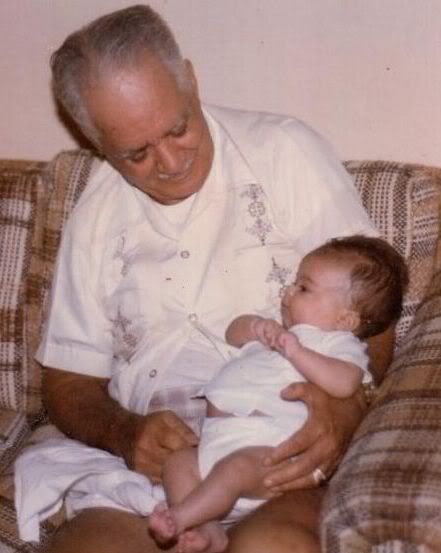
Photo: My father, Sydney George Philp, and my daughter.

Reblog this post [with Zemanta]

July 14, 2012

Geoffrey Philp: Interview With La Estrella de Panama


A few weeks ago, Luis Pulido Ritter interviewed me for La Estrella de Panama. We talked about homophobia, fatherhood, Marcus Garvey, and the influence of Rastafari on my work. Luis also wrote an insightful review of the title story for Who's Your Daddy?  and made some interesting comments about the collection's relevance to the literature and history of the Caribbean.

http://www.laestrella.com.pa/online/impreso/2012/07/08/legado-rastafario.asp


http://www.laestrella.com.pa/online/impreso/2012/07/08/sin-reemplazo-para-un-padre.asp


Here are Google Chrome translations of the interview and review:

No replacement for a parent:
http://issuu.com/geoffreyphilp/docs/no_replacement_for_a_parent___news_of_panama___the

Rastafarian Legacy:
http://issuu.com/geoffreyphilp/docs/rastafarian_legacy___news_of_panama___the_star_onl
***
On this rainy Wednesday morning in Miami, I am giving thanks to Luis and La Estrella de Panama for giving me the opportunity to be published in Panama--something which I hope my older cousin, Roy McCatty, whose paternal grandfather James McCatty worked on the Panama Canal, will be proud.

Blog Disclosure Policy


Geoffrey Philp’s Blog Spot receives a percentage of the purchase price on anything you buy through links to Amazon, Shambala Books, Hay House, or any of the Google ads or Google Custom Search.


***

Disclaimer of Endorsement


The documents posted on this Web site may contain hypertext links or pointers to information created and maintained by other public and private organizations. These links and pointers are provided for visitors' convenience. I do not control or guarantee the accuracy, relevance, timeliness, or completeness of any linked information. Further, the inclusion of links or pointers to other Web sites or agencies is not intended to assign importance to those sites and the information contained therein, nor is it intended to endorse, recommend, or favor any views expressed, or commercial products or services offered on these outside sites, or the organizations sponsoring the sites, by trade name, trademark, manufacture, or otherwise.


Reference in this Web site to any specific commercial products, processes, or services, or the use of any trade, firm or corporation name is for the information and convenience of the site's visitors, and does not constitute endorsement, recommendation, or favoring by this blog.
June 17, 2012

Man Up! 5 Lessons on Manhood from Bob Marley's Music


By Geoffrey Philp


The kid was bawling his eyes red. The father, towering over his son's small frame, screamed, "Man up! Man up!" I guess he was trying to tell his son to be courageous. I don't think it was working. The more the father thundered, the smaller the son became.

But I don't think the father was trying to be cruel. Without the proper context, the father's actions in themselves don't make him a bad father. For sometimes we need what my father used to call "intestinal fortitude." But tears do not weaken us. In some cases, they may be a way of mourning something that no longer serves our idea of who we are. But merely saying "Man up," without an explanation is almost like a situation that I had with my son.

My son was helping me to paint a wall in our home. I showed him how to hold the brush and how to do some simple brushstrokes. Then, I turned my back and began to work on my side of the wall. After a few minutes, I sensed something was wrong. I turned around and my son had done an excellent job of painting the wall, but the floor was splattered with paint. I was just about to get angry when I remembered that I hadn't showed him that first he had to cover the floor and then, begin painting. I had assumed that he would have been following my example of putting down newspaper first and then, painting. Boy, was I wrong.

That was one of the most important lessons I learned as a young father. Never assume anything with your children. For although that may be watching and listening, as I later learned that my daughter listened to all of Bob Marley's CDs on her road trip from Seattle to Miami on her way home, sometimes you have to spell it out for them.

So, here are a few of the things that I learned from Bob Marley about being a man and hopefully, a good father.

"Dready's got a job to do and he's got to full fill that mission." ("Ride Natty, Ride"). Bob's life was livicated to love and he expressed his love through music. He had found his purpose for living. Music was his life and his life was music. His values of respecting his life and the life of others is what endeared him to many fans. He just didn't sing his songs, he lived the words: "Every man got a right to decide his own destiny" ("Zimbabwe").

"Most people think great God will come from the sky/ Take away everything and make everybody feel high" ("Get up. Stand up"). No one is coming to rescue you. Not your father, your mother, uncle, aunt, niece, nephew, girlfriend, or boyfriend. Not even the mailman. It may sound harsh, but like me, you're on your own in creating your life. So stop waiting for miracles to happen, and for outside magical people and things to save you. It ain't gonna happen. The only miracles are those that you will create with your own two hands: ""But if you know what life is worth/You would look for yours on earth /And now you see the light/ You stand up for your right."

"If I am guilty, I will pay." ("I Shot the Sheriff"). There comes a point in all our lives when we will have to face the consequences of our actions. This isn't a bad thing. The more we take responsibility for our actions by choosing to live and love ourselves and others consciously, then our choices to live in the present expand and there are rewards: "And what is to be must be."

"Forget your sorrows and dance." The past will hurt you, but only if you let it. "Forget your troubles and dance." And if you think these are idle words, listen again to "Them Belly Full (But we Hungry)" on the Live Forever CD and realize that just hours before he recorded that song, Bob had been told by his doctor that he only had a few months to live. I can't think of a bigger problem than a physical death sentence. Yet, after a three-hour sound-check where he sang, "I'm Hurting Inside," over and over again, Bob went out and gave the performance of a lifetime. "Them Belly Full" had always put my "sorrows" in perspective and Bob's performance in Pittsburgh redefined courage for me. In the face of ill-health and death, Bob continued to live joyously with the time he had: "Forget your sickness and dance."

"Live for yourself, you will live in vain/ Live for others and you live again" ("Pass it on"). Your life is your story and stories are never complete unless they are shared. Share your story by word and example with those around you and those who will come after: "Help your brothers in their need/ Pass it on."

So, keep your stories to yourself and shed a few tears for the times you thought you'd be rescued and didn’t have to take responsibility for your life. "Cry to me" over not living joyously in the present or because you're afraid to do what you really want to do with your life.

And then, man up!


Happy Father's Day!


***


Blog Disclosure Policy


Geoffrey Philp’s Blog Spot receives a percentage of the purchase price on anything you buy through links to Amazon, Shambala Books, Hay House, or any of the Google ads or Google Custom Search.


*** 

Disclaimer of Endorsement


The documents posted on this Web site may contain hypertext links or pointers to information created and maintained by other public and private organizations. These links and pointers are provided for visitors' convenience. I do not control or guarantee the accuracy, relevance, timeliness, or completeness of any linked information. Further, the inclusion of links or pointers to other Web sites or agencies is not intended to assign importance to those sites and the information contained therein, nor is it intended to endorse, recommend, or favor any views expressed, or commercial products or services offered on these outside sites, or the organizations sponsoring the sites, by trade name, trademark, manufacture, or otherwise.

Reference in this Web site to any specific commercial products, processes, or services, or the use of any trade, firm or corporation name is for the information and convenience of the site's visitors, and does not constitute endorsement, recommendation, or favoring by this blog.

May 7, 2012

My Blog in 5 Categories


Based on readership, here are the top 5 categories on my blog:
 
Bob Marley & Rastafari
Caribbean Literature & Writing
Marcus Garvey
Children
Fatherhood
 
Dig through and enjoy!


***


If you enjoyed this post, check out my page on Amazon. I’d also be very grateful if you’d help it spread by emailing it to a friend, or sharing it on Twitter or Facebook.


Follow Me on Pinterest


Thank you!


Image source: http://blackfathers.org/

May 2, 2012

Fatherhood in Caribbean Fiction


Figuring the Father in Contemporary Caribbean Fiction
by 
Jennifer Rahim


The figure of the father has long troubled the Caribbean’s imagination. This unease is perhaps most demonstrated in the fact that, across the disciplines, fatherhood has often been represented in various states of absentia: not so much completely missing, as relegated to the margins of literary and cultural studies. The region’s matriarchal construction has generally been given more attention, and understandably so. Edith Clarke’s foundational  1957 study,  My Mother Who Fathered Me, evokes this well-circulated feature of the Caribbean’s social landscape. Clarke’s title alludes to George Lamming’s novel,  In the Castle of My Skin  (1953), where the protagonist G. praises the almost hermaphroditic heroism of his mother: “My father who had only fathered the idea of me left me the sole liability of my mother who really fathered me” (11). From the beginning of the 1990s, a new cadre of novels from the Anglophone Caribbean that gives prominence to fathers and fatherhood suggests this trend has shifted. Some of these include Shani Mootoo’s Cereus Blooms at Night and  Valmiki’s Daughter, Nalo Hopkinson’s  Brown Girl in the Ring  and  Midnight Robber, Lawrence Scott’s Night Calypso, Merle Hodge’s For the Life of Laetitia, Jamaica Kincaid’s Mr. Potter, Martin Mordecai’s Blue Mountain Trouble and Patricia Powell’s The Fullness of Everything. 


***


If you enjoyed this post, check out my page on Amazon. I’d also be very grateful if you’d help it spread by emailing it to a friend, or sharing it on Twitter or Facebook. Thank you!

April 30, 2012

MDC Freedom Tower Will Go Blue in Support of Child Abuse Prevention


Miami Dade College (MDC) will illuminate its National Historic Landmark Freedom Tower in blue in commemoration of Amigos For Kids’ annual month-long activities during National Child Abuse Prevention Month in April. The Tower will be illuminated at sundown on Saturday, March 31, and then again on Monday, April 30, to mark the beginning and end of activities.


Amigos For Kids, a non-profit dedicated to preventing child abuse, will kick-off festivities with its Second Annual Celebration for Friendship Luncheon at the Four Seasons Hotel at 11:30 a.m. on Mar. 31.


Amigos For Kids is a 501(C) 3 nonprofit corporation founded in 1991 to respond to the diverse needs of South Florida’s abused abandoned, neglected, and less-fortunate children and their families, through education, abuse prevention, and community involvement. To fulfill its mission, Amigos relies on the support of dedicated volunteers and donors throughout the community. Throughout the year, the organization creates awareness of its cause through public service campaigns, fundraising events, and community efforts such as the Amigos For Kids, There’s NO excuse for child abuse! ® campaign.


Miami Dade College is the nation’s largest institution of higher education with an enrollment of more than 174,000 students. It is also the nation’s top producer of Associate in Arts and Science degrees. The college’s eight campuses and outreach centers offer more than 300 distinct degree programs including several baccalaureate degrees in education, public safety, supervision and management, nursing and others. In fact, its academic and workforce training programs have served as national models of excellence. MDC is also renowned for its rich cultural programming. It is home of the Miami Book Fair International, Miami International Film Festival, the Cultura del Lobo performing arts series, the National Historic Landmark Miami Freedom Tower, a sculpture park and a large art gallery and theater system. MDC has served nearly 2,000,000 students since it opened its doors in 1960.


MDC and Amigos for Kids to Light Up Freedom Tower in Blue


WHEN: Saturday, Mar. 31, 7:00 PM - 7:30 PM
WHERE: MDC’s Freedom Tower 600 Biscayne Blvd.
MDC and Amigos for Kids to Light Up Freedom Tower in Blue


WHEN: Monday, Apr. 30, 7:00 PM - 7:30 PM
WHERE: MDC’s Freedom Tower 600 Biscayne Blvd.


For tickets, or more information regarding Amigos for Kids events, please call 305-279-1155, or visit www.amigosforkids.org.


***


If you enjoyed this post, check out my page on Amazon. I’d also be very grateful if you’d help it spread by emailing it to a friend, or sharing it on Twitter or Facebook.


Follow Me on Pinterest


Thank you!

April 29, 2012

Celebrate El día de los niños/El día de los libros (Children's Day/Book Day)


Tomorrow is El día de los niños/El día de los libros (Children's Day/Book Day), "a celebration every day of children, families, and reading that culminates yearly on April 30. The celebration emphasizes the importance of advocating literacy for children of all linguistic and cultural backgrounds."

The new Dia site lists several ways you can help with spreading the word:

Download the Dia Resource Guide: http://dia.ala.org/sites/default/files/ResourceGuide%20UPDATED1-18-12.pdf

Download book recommendations: http://dia.ala.org/sites/default/files/Spanish%20brochure%20-%20FINAL3-28-12.pdf

Send an e-card: http://www.readingrockets.org/content/e-cards/setup.php?photo_id=4


Tomorrow will be a day to share our stories with children and to celebrate our community.


***


If you enjoyed this post, check out my page on Amazon. I’d also be very grateful if you’d help it spread by emailing it to a friend, or sharing it on Twitter or Facebook.

Follow Me on Pinterest

Thank you!

April 24, 2012

Children's Book Fest @ South Regional/ Broward College Library


***


If you enjoyed this post, check out my page on Amazon. I’d also be very grateful if you’d help it spread by emailing it to a friend, or sharing it on Twitter or Facebook.

Follow Me on Pinterest

Thank you!

April 9, 2012

Why I Donated to Crayons Count


My mother would have been disappointed with this post. For years, she donated to many charities and it wasn't until after her death when letters of condolence began flooding my mailbox that I discovered the names and stories of the many children from all over the world whom she had supported financially and in-kind. She believed in giving the way the Bible admonishes: "But when thou doest alms, let not thy left hand know what thy right hand doeth."


For the most part, I've followed my mother's example of giving without drawing attention to myself. But Crayons Count is different kind of charity and my sole purpose for writing this post is to spread the word as best as I can about this noteworthy cause. And Crayons Count is important charity for many reasons:


Child-centered charity
Educational: Book Based
Support for literacy
Non-Governmental
Homegrown
Building Civil Society


In my post about Mona Heights, I described the kind of community that existed in Jamaica before the undeclared civil war of the 70s. Crayons Count is a step in the right direction of restoring that kind of civil society. But it won't happen by a miracle. It won't happen unless we put our hearts, minds, and money into projects like these.


I also like that Crayons Count is book based. I hope it will expand to include local authors and build on the children's awareness of our regional literature. Our children need to know from an early age that there are storytellers in our midst. If this happens, I believe literacy rates would increase and we could broaden the children's appreciation of our regional literature.


A classic regional literature appeals to the moral imagination and accomplishes what George Lamming in his lecture "The Present Future of Caribbean Literary & Cultural Studies," describes as "the education of feeling": "Art is the most civilizing instrument or tool in the education of feeling…the nurturing of a consciousness to respond sympathetically to a world of people and customs that are different from your own… and to approach the Other with respect."


The last point is very important. Because of our history and geography, Jamaica and the other islands in the Caribbean are uniquely qualified to discuss Otherness and respect. For example, although the book is above the reading level of the target audience of Crayons Count, Dog-Heart by Diana McCaulay imaginatively recreates the distinct worldviews of two characters from both ends of the Jamaican social spectrum. I'm not saying the novel is a panacea, but it points toward a solution.


We can respond imaginatively to others who are seemingly different without fear or violence. By expanding the scope of the readings, Crayons Count may be one of the building blocks of extending our conversations about topics that are relevant to our culture. As Lamming explained further: "Books stay alive when they are talked about in a variety of situations by people who recognize that the books are talking about them and may have originated with them."


Crayons Count is a program that works toward unifying Jamaicans in the care of our island's treasure: our children. It may also become that necessary bridge between race and class, the past and the future, which keeps our cultural gifts in circulation. This is why I used the Amazon link to make my donation:


I hope my mother will forgive me.


***


If you enjoyed this post, check out my page on Amazon. I’d also be very grateful if you’d help it spread by emailing it to a friend, or sharing it on Twitter or Facebook.


Follow Me on Pinterest


Thank you!

April 5, 2012

Call for Papers: ‘Children’s Literature from the Commonwealth of Nations’


We invite submissions for a Special Issue of Bookbird in conjunction with the Commonwealth Education Trust (CET). The CET has promoted education, literacy and literature throughout the member states of the Commonwealth of Nations for 125 years. Their work has much in common with IBBY. Papers are invited on the literatures of Commonwealth countries, as well as on literacy education, the development of the imagination and critical thinking through reading, and other practical uses of literature. Papers of 4000 words are invited on, but not limited to, the following topics: 


  • National identity in literature for children and teens
  • Literacy programmes which incorporate children’s literature
  • Thematic developments in national literatures
  • Indigenous and diasporic literatures for children
  • Multilingual children’s literature
  • The impact of colonization and/or Empire on national literatures for children
  • The oral tradition and/or literary retellings
  • Trends in illustration techniques
  • Prizes for children’s literature
  • Non-fiction publishing for children and teens


Titles and abstracts of 250 words should be sent to both editors by 15th May 2012. Roxanne Harde rharde@augustana.ca and Lydia Kokkola lydia.kokkola@utu.fi

The full papers will be expected by 30th June 2012. Please see Bookbird’s website at www.ibby.org/bookbird for full submission details.

In addition, short reviews of recently published children’s literature (c.a. 300 words) or of research on children’s literature (c.a. 750 words) are warmly welcomed.

Papers which are not accepted for this issue will be considered for later issues of Bookbird.


Bookbird: A Journal of International Children's Literature (ISSN 0006 7377) is a refereed journal published quarterly by IBBY


***


If you enjoyed this post, check out my page on Amazon. I’d also be very grateful if you’d help it spread by emailing it to a friend, or sharing it on Twitter or Facebook.


Follow Me on Pinterest


Thank you!

April 2, 2012

Crayons Count: A Building Block in Jamaica's Civil Society


There have been so many times when I have been invited to meetings with Jamaicans in the diaspora when the conversation has devolved into fevered rants about "all the things that are wrong with Jamaica."


Yes, the crime rate and garrison communities are atrocious. Yes, the decline in public morality is a cause for concern. But there are bright spots that shine beyond Jamaica's geographical boundaries.


One of these lights is Crayons Count.


As the founder of Do Good Jamaica, "an online information portal for and about civil society organizations in Jamaica," Deika Morrison is the driving force behind Crayons Count, "a project designed to support the early-childhood education programme and is endorsed by the Early Childhood Commission (ECC) and has two primary objectives:


1. To put a learning kit of materials in all early-childhood institutions (i.e. basic and infant schools as recognised by the ECC) across Jamaica at back to school in September 2012. Each basic kit contains: 240 crayons, 10 books, two balls, two sets of blocks, four children's scissors, four puppets, four tubs of play dough and four packs of paper.


2. The complete kit: made up of four puzzles, four manipulatives, four sets of children's paint, eight children's paint brushes, eight glue sticks.


According to The Daily Gleaner: "These kits represent the basic starter material required by the basic and pre-schoolers, to set them on their way to a life of learning, that will eventually result in a more educated society and a change in the existing culture of the embracing of ignorance and the dependency syndrome that the culture breeds."


So many memes within our culture encourage "ignorance" and a "dependency syndrome." Jamaica's first national hero, Marcus Garvey, livicated his life to our emancipation from this type of "mental slavery." Crayons Count is one more step toward our liberation.


Marcus Garvey would have been proud.

***


There is a well-known Chinese proverb, "It is better to light a candle that to curse the darkness." Here's one way to "light a candle."


Crayons Count has a link to Amazon so that those in the diaspora may also help with this remarkable project: http://www.amazon.com/registry/baby/16XZFCOMX3V8U

Related Link: http://www.jamaicans.com/articles/primeinterviews/deikamorrisondogoodjamaica.shtml


***


If you enjoyed this post, check out my page on Amazon. I’d also be very grateful if you’d help it spread by emailing it to a friend, or sharing it on Twitter or Facebook.


Follow Me on Pinterest


Thank you!

March 28, 2012

Consulate General launches Jamaica Independence Essay competition


Hon. Sandra Grant Griffiths


The Consulate General of Jamaica in Miami is now accepting entries for its Annual Essay Competition to mark Jamaica’s Independence Anniversary.


The competition is open to all Jamaican children, first and second generation, residing in Florida State, and forms part of the celebrations to observe the nation’s 50th anniversary of Independence throughout the Florida communities.


There are several topics of choice for the competition, launched this year under the theme of Jamaica’s responsibility, as stated in the National Pledge, of “advancing the welfare of the whole human race” and the merit in this project is to advance Diaspora Community awareness in a state that promotes diversity, while exposing our youth to their Jamaican culture and heritage. 


As they research and prepare compositions, applicants are given the opportunity to reflect on the nation’s history and culture; record how their Jamaican roots have impacted their upbringing; and the positive events that have catapulted the image of Jamaica and her outstanding Diaspora in the global arena. 


According to the Consul General, the Hon. Sandra Grant Griffiths, “Children of the Diaspora are being invited and encouraged to participate in the essay competition, to be inspired by our island’s rich history and cultural heritage and to take pride in the many accomplishments at home and abroad by the people of the island of our origin”.


The deadline for the submission of entries is Friday, July 6, 2012. The winner in each category will be awarded with a plaque by the Consul General on Friday, July 27, 2012.


Eligible students can choose from a selection of topics related to the island’s cultural heritage some of which include community leadership, entertainment, education, history, cultural heritage, geography and national development.


Applicants must be between five and eighteen years of age, normally resident in the State of Florida, and submit entries in one of three age categories - five to eight (5-8); nine to twelve (9-12); and thirteen to eighteen (13-18).


For information on the competition interested persons may contact the Consulate General of Jamaica in Miami located at 25 Southeast Second Avenue, Suite 609, telephone (305-374-8431 ext. 232); email INFO@JAMAICACGMIAMI.ORG or visit the Consulate’s website at WWW.JAMAICACGMIAMI.ORG


***


If you enjoyed this post, check out my page on Amazon. I’d also be very grateful if you’d help it spread by emailing it to a friend, or sharing it on Twitter or Facebook.


Follow Me on Pinterest


Thank you!

March 22, 2012

Trayvon Martin's Killing Comes Home


When my children were growing up, they'd ask me if they could watch films like Dumbo. I'd let them watch the movie, but I'd interrupt their watching during scenes that were based on racist stereotypes. I didn't want to spoil the movie for them, but I didn't want my children to grow up unaware of the insidious nature of racism.

I wanted them to stay alive.


Maybe I've come close, but I don't think I've never given any of my children the kind of explicit advice that Jonathan Capehart's mother gave him:


"Don’t run in public.” Lest someone think you’re suspicious.
“Don’t run while carrying anything in your hands.” Lest someone think you stole something.
“Don’t talk back to the police.” Lest you give them a reason to take you to jail or worse.


As a father, I have tried to protect as best as I could from the evils of racism.

Sometimes, I know they thought that I was overdoing it. Maybe I did.


But now the killing of Trayvon Martin has brought racism home. Trayvon went to the same school as my children and my "adopted" children: Dr. Michael Krop Senior High School.


Trayvon Martin could have been one of my children. He could have been one of the young men in my neighborhood who play along with the deejays on "Power 96's “Black, White, Hispanic or Other” where the DJ’s will read out the details of a stupid criminal act and the caller will then guess the nationality of the criminal."

Trayvon could be one of the young men at the college where I work.


Trayvon was killed and his only "crime" was being black in America.


My heart goes out to Trayvon's parents. And there is nothing more that I can say. I can only grieve.


***


March 7, 2012

Book Review: Island Princess in Brooklyn


As parents, we struggle to instill values in our children that are important to us. We often turn to books as a means of continuing our conversation about values, which we believe will enable them to become successful members of our community. But what happens when a child is uprooted and placed in an unfamiliar setting? What values will they discard or retain? This is the predicament of Princess McQueen in Island Princess in Brooklyn by Diane Browne.


Written in the first-person, Island Princess begins in medias res with Princess McQueen at the JFK terminal. From the opening sentence, we get a glimpse of the estrangement between Princess and her mother: "Would my mother be there? This thought kept bouncing around in my brain like an echo in a cave, over and over again, even though I tried to keep it away" (1). This uneasy prologue is just the start of Princess's yearlong sojourn in Brooklyn where she attempts to reconcile the American Dream with the real issues of trying to fit in to a new neighborhood and school.


Although Princess has difficulty in adapting to a new neighborhood, nothing has prepared her for her schoolyard in Brooklyn where she must reconcile the hard earned wisdom of her grandmother with whom she spent her formative years as one of the many "barrel children" in Jamaica, and the everyday rough and tumble of school in America. Yet, this precocious "Island Princess" as she is called by her classmates, soon makes friends with other children from different ethnic backgrounds: Latoya (African American), Esperanza (Hispanic), Simply Red (Caucasian) and Chunkie Bear (Biracial).


As she learns to negotiate the racial and social differences in the schoolyard, Princess's knowledge comes with a price. Princess is forced to balance her commitment to speaking the truth against loyalty to her friends when her friend Chunkie Bear is tripped while walking across the yard. She must also weigh the value of honesty that she has learned from her grandmother against her mother's practical advice of remaining neutral, "No interfering in what don't concern you. For the last time I am telling you, you are a migrant and a foreigner! Story end right now!" (85).


Her mother's advice, punctuated with the colloquial, "Story end right now!"—a sure sign that their discussion had come to an end--is only one of the many charms of Island Princess in Brooklyn. Throughout the book, Diane Browne conveys the confusion in Princess's mind as copes with the changes that accompany displacement. Princess's bewilderment is captured in her description of the subway:


It was a scary underground place of sudden flashing lights: sometimes narrow, with walls close on either side, looking damp; or wide, where other passing trains rocked thundering by, windows alight, slipping by one after the other, with disappearing ghostly figures inside, all caught up in the wind and noise. The subway was like a large underground nest of moving metal minsters. (38)


In this midst of this turmoil, Princess yearns for the security of home in Jamaica even as she tries to heal the relationship with her mother. Princess makes lists of the things she misses in Jamaica, but as another of her friends, Jamal, reminds her, "your mind is always on what's missing, not what is nice about being here?" (156)


It's those snippets of wisdom from the conflicts between the characters and the realistic treatment of Princess's dilemma that make Island Princess a delightful read. Island Princess in Brooklyn is a welcome addition to the conversation within the diaspora about communal values values and the problems our children face while growing ups as "strangers in a strange land."


***


***


If you are searching for posts about Bob Marley, Marcus Garvey, Rastafari, or Dennis Scott, please check the archives.


Also, if you enjoyed this post, check out my page on Amazon. I’d also be very grateful if you’d help it spread by emailing it to a friend, or sharing it on Twitter or Facebook. Thank you!

February 28, 2012

Launch of Caribbean Literature Action Group


The NGC Bocas Lit Fest, British Council, and Commonwealth Writers have announced a new partnership that will work towards enhancing the Caribbean literary scene and help kick-start an infrastructure to support writers, writing, and publishing. The Caribbean Literature Action Group (CALAG) will be launched in Port of Spain at a one-day brainstorm workshop on Wednesday 25 April, on the eve of the 2012 NGC Bocas Lit Fest.

The Caribbean has produced some of the world’s greatest contemporary writers, including three Nobel Prize laureates. Its literature is one of the region’s most celebrated cultural products. But Caribbean writers continue to migrate to North America and Europe in order to obtain financial support for their work and to achieve the highest level of international recognition. Literary publishing within the region remains in an embryonic state, and talented writers who choose to stay “at home” often find it difficult to access international publishers, or find opportunities for local publication and promotion.

In light of these common interests, the British Council and Commonwealth Writers have now developed a plan to work in partnership with the NGC Bocas Lit Fest and other literary professionals in the region. The first stage is to assemble a small, results-oriented action group of professionals from all areas of the Caribbean literary sector: writers, publishers, editors, teachers, booksellers, and organisers of festivals and writing programmes. (See a full list of participants below.)

Facilitators for the action group include Nicholas Laughlin (editor of The Caribbean Review of Books), Linda Leith (founder of Blue Metropolis Bleu in Quebec), Anita Sethi (writer), and Susie Nicklin (Director of Literature, British Council).


“The NGC Bocas Lit Fest was established to promote Caribbean writers and writing. Joining forces with the British Council and Commonwealth Writers, two entities dedicated to advancing literature in many other regions of the world, presents a real opportunity to help push forward development in the region’s publishing sector. We are delighted to be able to work with fellow Caribbean people who share the same ambition.”
—Marina Salandy-Brown, Festival Director and Founder, NGC Bocas Lit Fest


“The British Council is privileged to have been invited to join such a distinguished group to address issues of concern, not just to the Caribbean but to writers across the Americas. With the Council’s global remit I hope that my experience and expertise will be helpful, but I expect to learn far more than I can teach from such vibrant and accomplished people.”
— Susie Nicklin, Director of Literature, British Council


“Commonwealth Writers is excited to be part of this timely action group to generate practical ideas to help shape a dynamic publishing infrastructure across the Caribbean. We hope that the initiatives which emerge from CALAG will in the longer term be transferable to other regions where opportunities for writers are scarce.”
— Lucy Hannah, Programme Manager, Culture, Commonwealth Foundation


Participants in the inaugural CALAG meeting, 25 April, 2012:


Lisa Allen-Agostini, Trinidad and Tobago: writer, founder of the Allen Prize for Young Writers
Ellah Allfrey, UK: deputy editor of Granta
Funso Aiyejina, Trinidad and Tobago: writer, Dean of Humanities at UWI St. Augustine, co-ordinator of the Cropper Foundation Writers' Workshop
Donna Benny, Trinidad and Tobago: editor, head of StarApple Books
Nicolette Bethel, the Bahamas: writer, editor of tongues of the ocean, head of the Shakespeare in Paradise theatre festival
Alwin Bully, Dominica: writer, co-founder of the Nature Island Literary Festival
Gracelyn Cassell, Montserrat: chair of the Alliougana Festival of the Word
Shruti Debi, India: literary agent, Aitken Alexander Associates
Justine Henzell, Jamaica: co-founder of the Calabash International Literary Festival
Kendel Hippolyte, St. Lucia: writer, co-ordinator of the Word Alive Literary Festival
Mitchell Kaplan, US: bookseller, founder of Books and Books, co-founder of the Miami Book Fair
Antonia MacDonald-Smythe, St. Lucia/Grenada: senior associate dean, School of Arts and Sciences, St. George's University
Kellie Magnus, Jamaica: writer, head of Jackmandora Publishing, executive member of the Book Industry Association of Jamaica
Kei Miller, Jamaica: writer, professor of creative writing at the University of Glasgow
Esther Phillips, Barbados: writer, editor of BIM, head of the BIM Literary Festival
Jeremy Poynting, UK: founder of Peepal Tree Press
Monique Roffey, Trinidad and Tobago/UK: writer, writing instructor
Patricia Saunders, Trinidad and Tobago/US: professor of literature, University of Miami
Lasana Sekou, St. Martin: writer, founder of House of Nehesi Publishers, co-founder of the St. Martin Book Fair

Linda Speth, Jamaica: head of the University of the WI Press


***


If you enjoyed this post, check out my page on Amazon. I’d also be very grateful if you’d help it spread by emailing it to a friend, or sharing it on Twitter or Facebook. Thank you!