Before the song, there was the speech.
Marcus Garvey stood before crowds that numbered in the tens of thousands and told them something no one in power wanted them to believe. He told them the mind was sovereign territory. He told them that the first battle was interior, that a race schooled in shame could not build what a race standing in its own dignity could imagine. “Take advantage of every opportunity,” he wrote in Philosophy and Opinions, “where there is none, make it for yourself” (Garvey 18). The statement describes a people who must construct the conditions of their own freedom because no existing structure was built to hold them.
Garvey understood that political programs without a psychological grounding fail at the root. The Universal Negro Improvement Association was a counter-curriculum. It taught Black people to look at themselves differently before asking the world to look at them differently. The sequence mattered to him. Inner sovereignty first. Then the nation.
Bob Marley received this teaching the way the ocean receives rain.
He did not encounter Garvey as a historian encounters a subject. He encountered him as Rastafari encounter prophecy, as something already true before it was spoken aloud. What Bob did with that inheritance was not translation in the ordinary sense. He did not simplify Garvey’s arguments for mass consumption. He transmuted them. He moved Garvey’s program from the podium to the body, from the pamphlet to the marrow. A person who had never heard of the UNIA, who could not have located Kingston on a map, could stand in a field in Zimbabwe or a stadium in London and feel, in the music, the precise weight of what Garvey had written decades before.
The specific transformation is worth naming.
Garvey’s critique of colonial power was structural and documented. He named the systems. He identified the mechanisms. He argued from evidence, from economic analysis, from the historical record of the empire’s cruelties against weaker peoples (Philosophy and Opinions 18–19). Bob took that critique and gave it a sound.
In “Babylon System,” the colonial structure becomes a vampire that “suckin’ the children day by day” (Marley, “Babylon System”). Where Garvey wrote of systems, Bob built the word Babylon into something felt before it was understood. The concept passed through the ear before it reached the intellect. That is not a lesser achievement. It is a different instrument playing the same score.
The theme of African return demonstrates how the two men’s work interlocks.
Garvey’s “Africa for the Africans” was a political program with legal and economic architecture behind it. He wanted ships, land, governance, and sovereignty. He wrote in Message to the People that the race must build a nation as other nations are built, through organized effort and unified purpose (Garvey 9).
Bob heard that call and rendered it as spiritual yearning and cultural gravity. In “Africa Unite,” he declared the movement “right out of Babylon” and toward a father’s land (Marley, “Africa Unite”). In “Exodus,” the repatriation becomes the movement of a whole people, not a policy brief but a tide (Marley, “Exodus”). The political and the spiritual are not in competition here. They are different frequencies carrying the same signal.
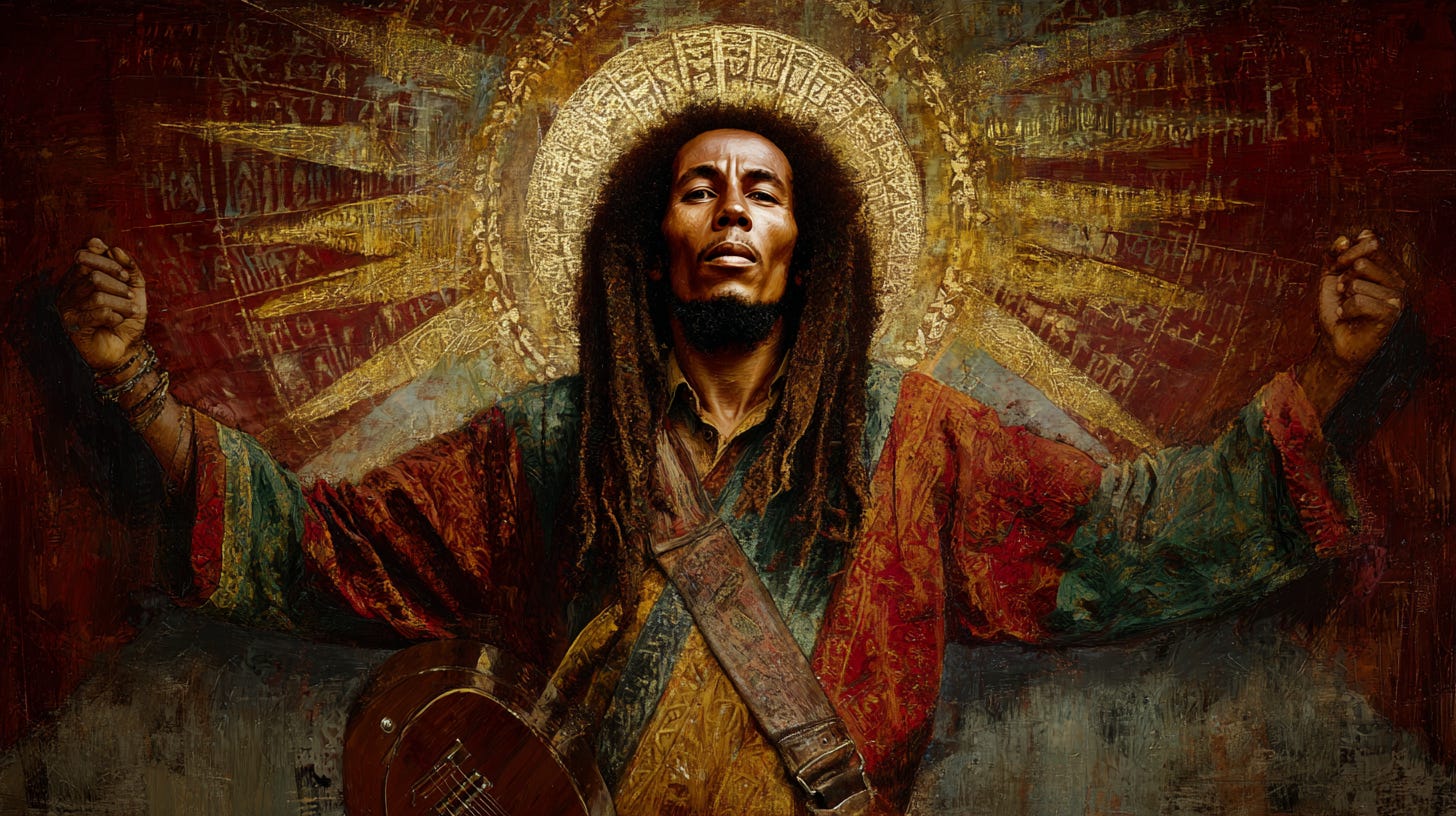
And then there is “Redemption Song.” Bob sang, “Emancipate yourselves from mental slavery / None but ourselves can free our minds” (Marley, “Redemption Song”). Garvey had already said it. He had written that the greatest stumbling block in the way of progress was the mental lethargy of those who refused to think for themselves, who accepted the verdicts of their oppressors as truth (Philosophy and Opinions 18). Bob took that argument and stripped it to the bone. Two lines. No apparatus. Sung to an acoustic guitar at the end of a life. The simplest delivery is sometimes the most devastating.
What Garvey wrote in the early twentieth century, Bob sang to audiences in the late twentieth century who had never read a word of Philosophy and Opinions. And many of those audiences, having heard the music, went looking for the text. The song became the door. Garvey’s doctrine was what waited on the other side.
Bob was not a popularizer in the diminished sense. He was a maker working in a different form, bringing to his form the same rigor Garvey brought to his. The reggae cadence is not decoration. It is the argument. The space between the bass and the offbeat is where the meaning lives, in the pause, in the thing left incomplete because completion would be dishonest. Garvey’s speeches hold that same open space. He named the wound without pretending the healing was finished.
Two instruments. One doctrine. The liberation is still in progress.
References
Garvey, Marcus. Message to the People: The Course of African Philosophy. Majority Press, 1986.
---. Philosophy and Opinions of Marcus Garvey. Majority Press, 1986.
Marley, Bob. “Africa Unite.” Survival, Island Records, 1979.
---. “Babylon System.” Survival, Island Records, 1979.
---. “Exodus.” Exodus, Island Records, 1977.
---. “Redemption Song.” Uprising, Island Records, 1980.
via The Garvey Classroom https://ift.tt/UOwQdme Follow The Garvey Classroom on Substack for weekly lessons on mental sovereignty, Pan-African history, and the teachings of Marcus Garvey.


No comments:
Post a Comment