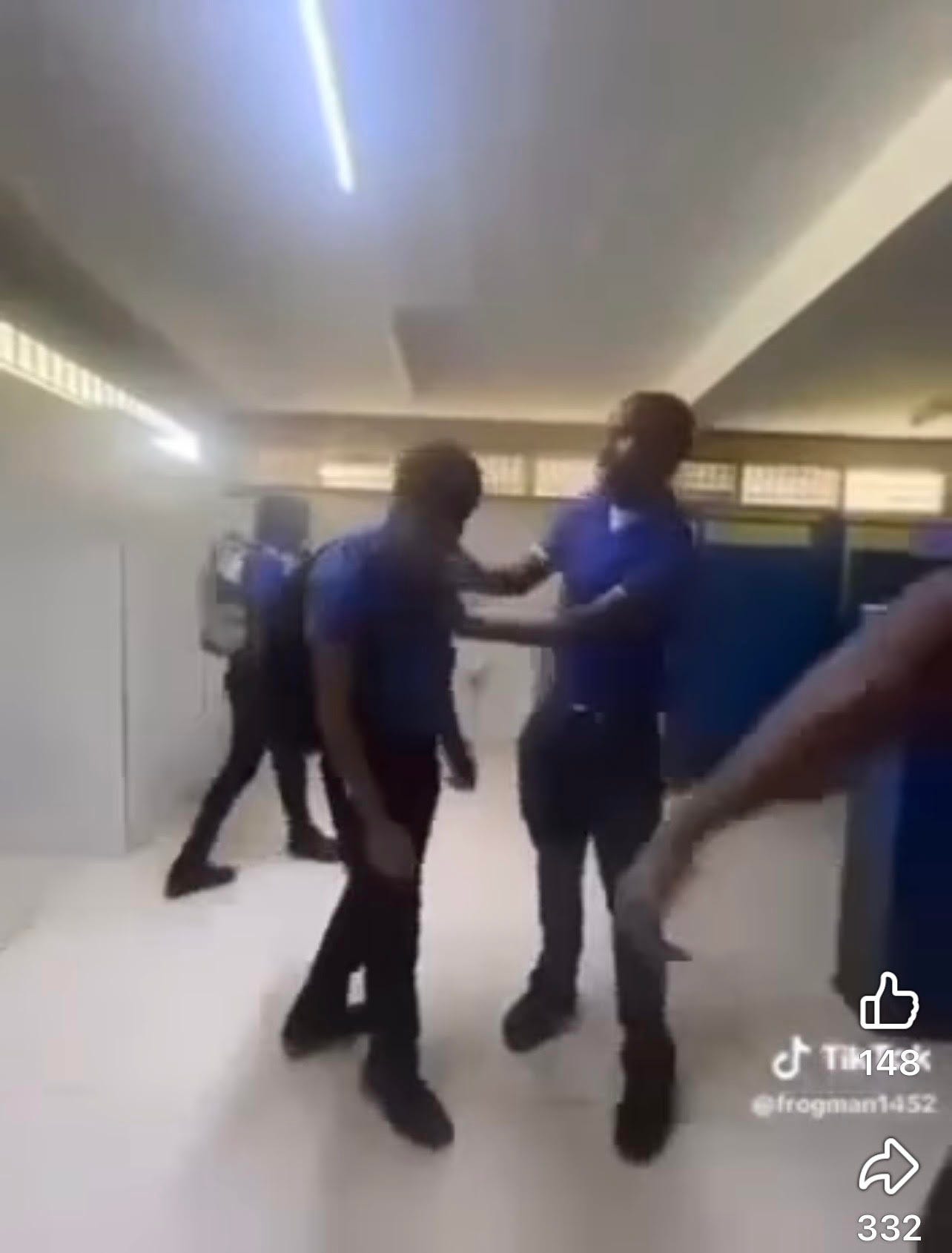
The violence, the bullying, was always there, but we called it a different name. Tradition.
When I was in first form at Jamaica College--a school so great they named the country after us--any older boy from second form to sixth form could walk up to you and say, “Eh, bwai, sing for me,” and you had to. Or else. They would hold you down and beat you up.
Then there was the candle waxing at the end of the school year, when older boys would hold you down and light a candle over your head, letting the wax drip into your hair. Many a good afro was ruined this way.
Then there was the caning. If a master, and yes we still used that word, decided you had committed a gross infraction against the school rules, he would send you with a letter to the caning master, some of whom took sadistic pleasure in asking you to choose your instrument of torture. The big fat bamboo cane or the thinner whippy one. There was even one master who, after caning, would say, “You may rub your buttocks if you wish.”
So in one way the incident at Jamaica College came as no surprise. And yet in another way it did.
Dr. Leo Gilling, in his essay When Violence Becomes Performance, watched the video and noticed what most viewers missed. The first slaps were measured, almost restrained. Then the boy delivering them glanced at the camera, and the intensity escalated. Another student held a belt, moving strategically, waiting for an opening. Others stood positioned around the scene in a way that looked like containment. Gilling’s word for what he saw was “performance.” The recording did not capture the act. The recording shaped it.
He is right. And he is reading one frame of a longer film.
The candle wax dripped onto one afro at a time. The phone drips the humiliation onto every screen in the diaspora. The technology changed. The pedagogy did not. The boy in the video learned what to do from somewhere. He did not invent the choreography. He inherited it.
These are forms of violence we’ve accepted as the norm.
Especially from the police. The boy who learned at JC that draping up the weaker was manhood becomes the constable who drapes up the youth on the corner in August Town. Same choreography. Same cultural permission. The video shocked the nation because it happened at Jamaica College. It does not shock anyone when it happens on Spanish Town Road.
The catalog does not stop at the school gate.
The belt on the kitchen counter. The switch from the guinep tree. The pastor who preaches obedience on Sunday while the deacon beats his wife on Monday. The uncle who terrorizes the household and is called “strict.” “Murder and murderer” are the signatures of Jamaican music on the internet.
Each has been accepted. Each is norm.
Dr. Leahcim Semaj, writing in response to the same crisis, says it plain in his title. “School Violence Is Not Indiscipline — It Is Distress Speaking Loudly.” He points to what happens inside the body of a child living in this catalog. The amygdala stays hyperactivated. The prefrontal cortex goes offline. The nervous system runs on survival. By the time the child reaches the classroom, the home has already failed to regulate emotion, the community has already normalized aggression, the nation has already modeled conflict without resolution. The school becomes the last pressure point where everything collapses.
Semaj is right. And his diagnosis stops one generation short.
The home that failed to regulate the child was raised by a home that failed to regulate it. The community that normalized aggression normalized it across centuries, not decades. The nation that models conflict without resolution was built on a plantation that resolved conflict with the whip and called it order. The nervous system Semaj describes is not malfunctioning. It is functioning exactly as the inheritance designed it to function. Survival mode is the plantation’s gift to the great-grandchildren of the people it owned.
This is what Marcus Garvey understood a century ago and what we keep refusing to learn. Mental emancipation is the work of recognizing that the violence we call tradition is the plantation continuing to operate through us. We are the institutions now. We are the masters with the canes. We are the older boys with the candles. We are the constables on the corner. The plantation does not need to come back. It never left.
I want to go back to the bully in the video. As Peter Tosh sang, “Yu cyaan blame di yute.” He is acting on what in his mind it means to be a Jamaican man. The violence he is enacting is endemic. To be a man means you can drape up a bwai if im do yu a ting, an bax im fi show im who is the boss. Yu is a man and im is a bwai.
I already hear the voices in my head. “We always know yu was saaf. Probably a battyman too.” Homophobia is part of the enforcement. It is one of the ways the inheritance polices itself. The boy who refuses to drape up the weaker is suspected of something the culture has decided is worse than violence. So the violence continues, partly because the alternative is unspeakable.
Forty-some years ago, our resident historian, assistant principal, and JC Old Boy, James “Jimmy” Carnegie, refused to cane any boy who had violated school rules. Amps, as we called him, invented other ways. He would assign tasks. Picking up bottle caps between the tuck shop and the bathroom. He said to me on one occasion, “Mister Philp, I want you to think about what you have done. And why you did it. Now I want you pick up all the bottle caps between Tucky and Tushy.”
It didn’t mean Amps was letting me off the hook. We are always accountable for our actions. But he also said something that stayed with me for over forty years. He wanted us to become Jamaican gentlemen.
I never quite figured out what he meant. I guess that was the beauty of it. We had to invent for ourselves what it meant to be a Jamaican gentleman, and what it meant to be a man.
Carnegie was doing decolonial work inside the classroom. He refused the cane because he refused the inheritance. He invented a pedagogy that made the boy think instead of bleed. He left the definition of gentleman open because a closed definition would have become another rule to transmit, another tradition, another form of violence we accepted as the norm.
Although he never publicly stated it, Amps understood what Garvey understood. The first act of mental emancipation is naming the thing accurately. Tradition is what violence becomes when we stop interrogating it. Tough love is what violence becomes when it travels through the bloodline. The renaming is how the plantation survived emancipation. The unnaming is where freedom begins.
The question is not only what is wrong with the boy in the video. The question is what we will refuse to transmit to the next first former who walks through the gates? What we will refuse to call tradition? What we will refuse to laugh about at the old boys’ reunion? What we will refuse to defend when our own sons reach for the belt?
Gilling is right that the recording changed the act. Semaj is right that the nervous system is in collapse. Carnegie was right forty years ago and is still right now. Garvey was right a century ago and is still right now.
The question revolves around values. What does it mean to be a Jamaican? What does it mean to be a Jamaican man? This is especially important because many graduates of Jamaica College have become leaders in our country.
But this isn’t only a JC problem. It is a national challenge that must be addressed until acts like these become unthinkable.
The boy in the video is not the problem. The boy in the video is the message. The message is that we have inherited a pedagogy of violence and we have agreed to call it Jamaican, which is reflected in our music and nearly every facet of our culture. The question that we refuse to answer and one that will never go away until we answer it.
Who are we?
Sources
Barrett, Livern. “Update | JC Student in Viral Assault Video Charged.” The Gleaner, 24 Apr. 2026.
Gilling, Leo. “When Violence Becomes Performance: The Jamaica College Video Reveals More Than Bullying.”
Semaj, Leahcim. “School Violence Is Not Indiscipline — It Is Distress Speaking Loudly.”
via The Garvey Classroom https://ift.tt/L89OzfI Follow The Garvey Classroom on Substack for weekly lessons on mental sovereignty, Pan-African history, and the teachings of Marcus Garvey.


No comments:
Post a Comment