Showing posts with label Essays. Show all posts

November 11, 2013

How Have my DNA Results Changed my Life?


The final post in the three part series.


Any change in the information about our bodies will have an effect on how we see ourselves. The results of my DNA test were no different. I am still processing how they will affect the balance of the competing claims of African and European influences in my life and work.

From my earliest memories, there has always been this conflict. I grew up in Mona Heights, a middleclass, multicultural enclave in St Andrew, where my friends and I were expected to behave like civilized children—like little English boys and girls. But from the age of five, I also went to school with my mother at Seaward Primary—a “browning” in a school filled with Jamaicans of African descent. My mother also made sure that my sister and I made regular trips to her birthplace in Westmoreland, so we could see for ourselves what “country life” was all about. All kinds of folk lived, worked, and died on that postage stamp of Jamaican soil.

We also grew up in a family with a rich religious background. For although I had grown up as a Seventh Day Adventist (before my mother became a Jehovah’s Witness), I was thoroughly immersed in Rastafari who taught me that the worst thing that a light-skinned bredrin could do was to align oneself with Babylon and the downpression of Africans at home and abroad.

But this was only the start of my education and balancing. During high school at Jamaica College, I met Dennis Scott and read Tony McNeill’s Reel from the Life-Movie and Mervyn Morris’s, The Pond, where I first saw the phrase, “Afro-Saxon.”  By the time I read Kamau Braithwaite’s The Arrivants, my literary imagination was Africanized. These poets had provided models, but it wasn’t until I read Derek Walcott’s Another Life and his anguished poem, “A Far Cry from Africa” that I began to conceive a synthesis that would balance Europe and Africa.

Indeed, Benjamin, my son, was my first attempt in fiction at a sustained synthesis of African and European influences. Using Dante’s Inferno as the basis of the narrative, I set the story in Jamaica. However, instead of Virgil as the psychopomp, I inserted an archetypal Trickster, who appears in various guises as Èù and Anansi in West Africa and Eleggua and Papa Legba in the Caribbean. I chose the name Papa Legba, who was also Rastafari, in order to link Jamaica and Haiti in the historical struggle for equal rights and justice in the Caribbean.

Similarly in my latest completed novel, Garvey’s Ghost, the narrative contrasts the rape culture inherent in the myth of Persephone and the vision of unity in the marriage of Shango and Oshun.

The use of these myths and stories and stories from Europe and Africa is not arbitrary. And it should not be surprising that they share thematic concerns. What the myths and stories suggest is that humans are hardwired with certain archetypal patterns that we use through culture to interpret our response to our environment.

In other words, my fiction, like my DNA, represents the synthesis of cultures in the Caribbean that acknowledges and celebrates African roots.

It is this celebration of African roots that prompted my petition for the exoneration of Marcus Garvey. As far as I am concerned, Garvey’s exoneration is part of a larger struggle for the redemption Africans at home and abroad. It is not about hating white people. If I hated white people, I would have to hate my white ancestors. And an Akan proverb states, “Only a fool points at his origins with his left hand.”

However, one big change has occurred. I hear Africa calling. I must confess that I didn’t always feel like this. When my friends used to tell me about their trips to Ghana and Nigeria, their travels didn’t spark anything in my imagination.

Now I feel differently. And especially after rereading one of my earliest poems, “Neptune,” where I used the phrase “bangles from Benin” purely from the alliterative value, Benin has taken on an added dimension. I want to go to Benin. Jah willing, I shall.


In the meantime, whenever someone calls me “Mr. Chin,” I will continue to smile and go on with my business because I have bigger things on my mind. If Jamaica, Mali, Benin, and Togo ever make it to the World Cup quarterfinals, which team will I cheer for?


***

Part One: How My DNA Set me Free

Part Two: Surprises in my Genealogical Search

November 4, 2013

Surprises in my Genealogical Search


Part Two of a Three Part Series

When I received my first DNA results from AncestryDNA, I was very disappointed. For whereas I could trace my European ancestry, nation by nation, for my African ancestry, I could only get a broad reading of West Africa, which included Mauritania, Senegal, Guinea, Mali, Ivory Coast, Ghana, Benin/Togo, and Nigeria. I wanted specifics.

I began researching other options such as 23andMe, Family Tree DNA,  and National Geographic Geno 2.0  Project. I also contacted Richard Hill, author of Finding Family and a nationally recognized authority on genetic testing. I emailed Mr. Hill, who maintains the DNA Testing Adviser site, and sent him a message via Facebook. Mr. Hill graciously answered all my questions and pointed me to one of the pages on his DNA Testing Adviser site, African DNA Test, which has a wealth of information on DNA testing for peoples of African descent.

23andMe had many favorable reviews. 23andMe is the company that Dr. Henry Louis Gates, Jr. used on the PBS series Finding Your Roots to help celebrities map their heritage and discover their global origins. 23andMe also offers reports on over two hundred and forty health conditions and traits such as carrier status, drug response, health tools, and inherited traits.

Just before I made the decision to go with 23andMe, AncestryDNA upgraded their DNA database and sent me my revised DNA results. According to Richard Hill: "AncestryDNA recently rose to the top of this list. Both men and women can take the test and it will identify other people in the database who share common ancestors with you. The test includes an Ethnicity Estimate that summarizes the percentage contributions of different regions of the world to your overall ancestry. That estimate now breaks African Ancestry into nine regions: Africa North, Senegal, Ivory Coast / Ghana, Benin / Togo, Cameroon / Congo, Mali, Nigeria, Africa Southeast Bantu and Africa South-Central Hunter-Gatherers.” I stayed with Ancestry.com.

I couldn't wait to see the results for my African ancestry. My brother, Richard, had told me that our great-grandmother had claimed to be Ashanti, but that wasn't necessarily true. It’s like how everyone from Jamaica claims to be from Kingston.  I wanted the facts and AncestryDNA gave them to me. Here's the breakdown of my African ancestry:

Benin/Togo 24%
Mali 19%
Trace Regions: 8% (Cameroon/Congo 3%
Nigeria 3% 
Africa South-Central Hunter-Gatherers< 1%,
Ivory Coast/Ghana< 1%)

From the looks of it, I am West Africa! But what did this mean? Would this information change my self-identity?


Next week: Have my DNA Results Changed my Life?


***


As part of the Bob Marley: Messenger exhibition, Gerald Hausman and I will be reading Jamaican Tales at HistoryMiami on November 9, 2013.


Geoffrey Philp @Jamaican Tales

Grandpa Sydney's Anancy Stories

2:00—3:00 p.m
.
November 9, 2013

HistoryMiami

101 West Flagler Street

Miami, Florida 33130


October 28, 2013

How my DNA Set me Free

How my DNA set me free


For the past fifty years, I have been living under the shadow of a lie. I think it has to do with the shape of my eyes. From the time that I was in primary school, my friends and classmates thought that I was part Chinese. In high school at Jamaica College, one of the boys in Cowper, the upper house to Murray, called me a “Tappa shop Chinee bwai.” The name calling didn’t bother me. Growing up in Mona Heights with Jamaicans of African, English, Chinese, and East Indian ancestry, I knew that Jamaicans of Chinese descent (especially our fathers) were just as crazy as everyone else.

Yet even after I graduated from Jamaica College and I moved to Miami, the mistaken identity followed me. I just smiled whenever someone called me, “Mr. Chin,” and went on with whatever I was doing. However, when a Chinese-Jamaican cashier at our local supermarket asked me how I was going to celebrate the New Year—she meant the Chinese New Year—I decided to research to create a family tree.

This was not as easy as it seems. My father was married four times and I have brothers and sisters living in Jamaica, Canada, England, and Switzerland. My mother’s family is even more complicated with cousins and aunts living in Jamaica, Cuba, Canada, and Panama. Piecing together a family tree under these circumstances was going to be a challenge.

With the help of my brother, Ricky, who lives in Canada and who had already begun putting together the Philp family tree, I began working on the Lumleys, my mother’s side of the family.

Using Ancestry.com, I created a family tree and traced my roots to the early nineteenth century when the Philp and Lumley males came to Jamaica from Great Britain and began marrying Jamaican women. Both Philp and Lumley males were also very religious and left behind family Bibles and other artifacts. My great-grandfather, Frederick Andrew Lumley, Sr. was one of the earliest founders of the Seventh Day Adventists in Jamaica and one of my grandaunts, Marie Evelyn Jones née Lumley, “is thought to be the first Negro to enroll at Loma Linda University.”

But then my research came to a halt. Using immigration records, the males on both sides of my family could be traced back to Scotland and England, but the females on either side ended up in slavery as property. I always knew I had African ancestry, but  after being called “Mr. Chin” for so many years, I wanted to know if there was even a trace of Chinese blood flowing through my veins. After collecting the email and snail mail addresses of my relatives, I asked the question, “Do we have any Chinese ancestry?”

All the answers came back negative. This I suspected could have been due to the prejudice that many Chinese Jamaicans have faced. I continued asking what could have been perceived by my relatives as uncomfortable questions, but I wanted to know the truth. Despite making connections with living first, second, third, fourth, fifth and sixth cousins, many of whom I had never known before, I kept hitting genealogical dead ends.

I was just about to give up when Ancestry.com introduced AncestryDNA, which promised an accurate reading of my DNA. I purchased the kit and within a few days, it arrived on my door step. After following the instructions, I returned the kit and waited for the results.

A few weeks later, I received an email from AncestryDNA. My ancestry was 51% West African and 49% European (36% Great Britain, 5% Scandinavian, 3% Ireland 3%, 2% Italy/Greece, < 2% Iberian Peninsula, and < 1% Finnish/Northern Russia.  

Scandinavian? I guess that’s where I got my "Chinee eyes" or the epicanthal fold found in Europeans such as Poles and Scandinavians.

The DNA test had lain to rest all the doubts about my so-called Chinese ancestry. But now a new set of questions opened up before me. Which part of Africa did my ancestors come from?


***


As a part of the Bob Marley: Messenger exhibition at Miami History,  Cedella Marley, Gerard Hausman and Geoffrey Philp will be reading Jamaican Tales at MiamiHistory on November 9, 2013

HistoryMiami, 101 West Flagler Street, Miami, FL


September 17, 2013

Marcus Garvey: Human Rights Champion

Exonerate Marcus Garvey


One of the remarkable outcomes of the first International Convention of Negro Peoples of the World hosted by the Universal Negro Improvement Association at Madison Square Gardens in August 1-31, 1920, was the adoption and signing of the “Declaration of the Rights of the Negro Peoples of the World.”

This groundbreaking document protested “the wrongs and injustices” against peoples of African descent and proposed a solution ‘to demand of all men in the future.”

Guided by Garvey’s scholarship, the “Declarationof the Rights of the Negro Peoples of the World,” asserted not only the rights of African peoples, but also the inalienable rights of humankind:

25. We further demand free speech universally for all men.
27. We believe in the self-determination of all peoples.
28. We declare for the freedom of religious worship

These three rights in particular would eventually be recognized twenty-eight years later in the Universal Declaration of Human Rights, which would be ratified by the United Nations on December 10, 1948. It has now become cliché, but Garvey was indeed a man ahead of his times.

***


Drafted and adopted at Convention held in New York, 1920, over which Marcus Garvey presided as Chairman, and at which he was elected Provisional President of Africa.

Declaration of Rights of the Negro Peoples of the World

Preamble

Be it Resolved, That the Negro people of the world, through their chosen representatives in convention assembled in Liberty Hall, in the City of New York and United States of America, from August 1 to August 31, in the year of our Lord, one thousand nine hundred and twenty, protest against the wrongs and injustices they are suffering at the hands of their white brethren, and state what they deem their fair and just rights, as well as the treatment they propose to demand of all men in the future.

We complain:

I. That nowhere in the world, with few exceptions, are black men accorded equal treatment with white men, although in the same situation and circumstances, but, on the contrary, are discriminated against and denied the common rights due to human beings for no other reason than their race and color.
We are not willingly accepted as guests in the public hotels and inns of the world for no other reason than our race and color.

II. In certain parts of the United States of America our race is denied the right of public trial accorded to other races when accused of crime, but are lynched and burned by mobs, and such brutal and inhuman treatment is even practiced upon our women.

III. That European nations have parcelled out among themselves and taken possession of nearly all of the continent of Africa, and the natives are compelled to surrender their lands to aliens and are treated in most instances like slaves.

IV. In the southern portion of the United States of America, although citizens under the Federal Constitution, and in some states almost equal to the whites in population and are qualified land owners and taxpayers, we are, nevertheless, denied all voice in the making and administration of the laws and are taxed without representation by the state governments, and at the same time compelled to do military service in defense of the country.

V. On the public conveyances and common carriers in the Southern portion of the United States we are jim-crowed and compelled to accept separate and inferior accommodations and made to pay the same fare charged for first-class accommodations, and our families are often humiliated and insulted by drunken white men who habitually pass through the jim-crow cars going to the smoking car.

VI. The physicians of our race are denied the right to attend their patients while in the public hospitals of the cities and states where they reside in certain parts of the United States. Our children are forced to attend inferior separate schools for shorter terms than white children, and the public school funds are unequally divided between the white and colored schools.

VII. We are discriminated against and denied an equal chance to earn wages for the support of our families, and in many instances are refused admission into labor unions, and nearly everywhere are paid smaller wages than white men.

VIII. In Civil Service and departmental offices we are everywhere discriminated against and made to feel that to be a black man in Europe, America and the West Indies is equivalent to being an outcast and a leper among the races of men, no matter what the character and attainments of the black man may be.

IX. In the British and other West Indian Islands and colonies, Negroes are secretly and cunningly discriminated against, and denied those fuller rights in government to which white citizens are appointed, nominated and elected.

X. That our people in those parts are forced to work for lower wages than the average standard of white men and are kept in conditions repugnant to good civilized tastes and customs.

XI. That the many acts of injustice against members of our race before the courts of law in the respective islands and colonies are of such nature as to create disgust and disrespect for the white man's sense of justice.

XII. Against all such inhuman, unchristian and uncivilized treatment we here and now emphatically protest, and invoke the condemnation of all mankind. In order to encourage our race all over the world and to stimulate it to a higher and grander destiny, we demand and insist on the following Declaration of Rights:

1. Be it known to all men that whereas, all men are created equal and entitled to the rights of life, liberty and the pursuit of happiness, and because of this we, the duly elected representatives of the Negro peoples of the world, invoking the aid of the just and Almighty God do declare all men women and children of our blood throughout the world free citizens, and do claim them as free citizens of Africa, the Motherland of all Negroes.

2. That we believe in the supreme authority of our race in all things racial; that all things are created and given to man as a common possession; that there should be an equitable distribution and apportionment of all such things, and in consideration of the fact that as a race we are now deprived of those things that are morally and legally ours, we believe it right that all such things should be acquired and held by whatsoever means possible.

3. That we believe the Negro, like any other race, should be governed by the ethics of civilization, and, therefore, should not be deprived of any of those rights or privileges common to other human beings.

4. We declare that Negroes, wheresoever they form a community among themselves, should be given the right to elect their own representatives to represent them in legislatures, courts of law, or such institutions as may exercise control over that particular community.

5. We assert that the Negro is entitled to even-handed justice before all courts of law and equity in whatever country he may be found, and when this is denied him on account of his race or color such denial is an insult to the race as a while and should be resented by the entire boy of Negroes.

6. We declared it unfair and prejudicial to the rights of Negroes in communities where they exist in considerable numbers to be tried by a judge and jury composed entirely of an alien race, but in all such cases members of our race are entitled to representation on the jury.

7. We believe that any law or practice that tends to deprive any African of his land or the privileges of free citizenship within his country is unjust and immoral, and no native should respect any such law or practice.

8. We declare taxation without representation unjust and tyrannous, and there should be no obligation on the part of the Negro to obey the levy of a tax by an law-making body from which he is excluded and denied representation on account of his race and color.

9. We believe that any law especially directed against the Negro to his detriment and singling him out because of his race or color is unfair and immoral, and should not be respected.

10. We believe all men entitled to common human respect, and that our race should in no way tolerate any insults that may be interpreted to mean disrespect to our color.

11. We deprecate the use of the term "nigger" as applied to Negroes, and demand that the word "Negro" be written with a capital "N."

12. We believe that the Negro should adopt every means to protect himself against barbarous practices inflicted upon him because of color.

13. We believe in the freedom of Africa for the Negro people of the world, and by the principle of Europe for the Europeans and Asia for the Asiatics; we also demand Africa for the Africans at home and abroad.

14. We believe in the inherent right of the Negro to possess himself of Africa, and that his possession of same shall not be regarded as an infringement on any claim or purchase made by any race or nation.

15. We strongly condemn the cupidity of those nations of the world who, by open aggression or secret schemes, have seized the territories and inexhaustible natural wealth of Africa, and we place on record our most solemn determination to reclaim the treasures and possession of the vast continent of our forefathers.

16. We believe all men should live in peace one with the other, but when races and nations provoke the ire of other races and nations by attempting to infringe upon their rights, war becomes inevitable, and the attempt in any way to free one’s self or protect one’s rights or heritage becomes justifiable.

17. Whereas, the lynching, by burning, hanging or any other means, of human beings is a barbarous practice, and a shame and disgrace to civilization, we therefore declared any country guilty of such atrocities outside the pale of civilization.

18. We protest against the atrocious crime of whipping, flogging and overworking of the native tribes of Africa and Negroes everywhere. These are methods that should be abolished, and all means should be taken to prevent a continuance of such brutal practices.

19. We protest against the atrocious practice of shaving the heads of Africans, especially of African women or individual of Negro blood, when placed in prison as a punishment for crime by an alien race.

20. We protest against segregated districts, separate public conveyances, industrial discrimination, lynchings and limitations of political privileges of any Negro citizen in any part of the world on account of race, color, or creed, and will exert our full influence and power against all such.

21. We protest against any punishment inflicted upon a Negro with severity, as against lighter punishment inflicted upon another of an alien race for like offense, as an act of prejudice injustice, and should be resented by the entire race.

22. We protest against the system of education in any country where Negroes are denied the same privileges and advantages as other races.

23. We declare it inhuman and unfair to boycott Negroes from industries and labor in any part of the world.

24. We believe in the doctrine of the freedom of the press, and we therefore emphatically protest against the suppression Negro newspapers and periodicals in various parts of the world, and call upon Negroes everywhere to employ all available means to prevent such suppression.

25. We further demand free speech universally for all men.

26. We hereby protest against the publication of scandalous and inflammatory articles by an alien press tending to create racial strife and the exhibition of picture films showing the Negro as a cannibal.

27. We believe in the self-determination of all peoples.

28. We declare for the freedom religious worship.

29. With the help of Almighty God, we declare ourselves the protectors of the honor and virtue of our women and children, and pledge our lives for their protection and defense everywhere, and under all circumstances from wrongs and outrages.

30. We demand the right of unlimited and unprejudiced education for ourselves and our posterity forever.

31. We declare that the teaching in any school by alien teachers to our boys and girls, that the alien race is superior to the Negro race, is an insult to the Negro people of the world.

32. Where Negroes form a part of the citizenry of any country, and pass the civil service examination of such country, we declare them entitled to the same consideration as other citizens as to appointments in such civil service.

33. We vigorously protest against the increasingly unfair and unjust treatment accorded Negro travelers on land and sea by the agents and employees of railroad and steamship companies and insist that for equal fare we receive equal privileges with travelers of other races.

34. We declare it unjust for any country, State or nation to enact laws tending to hinder and obstruct the free immigration of Negroes on account of their race and color.

35. That the right of the Negro to travel unmolested throughout the world be not abridged by any person or persons, and all Negroes are called upon to give aid to a fellow Negro when thus molested.

36. We declare that all Negroes are entitled to the same right to travel over the world as other men.

37. We hereby demand that the governments of the world recognize our leader and his representatives chosen by the race to look after the welfare of our people under such governments.

38. We demand complete control of our social institutions without interference by any alien race or races.

39. That the colors, Red, Black and Green, be the colors of the Negro race.

40. Resolved, That the anthem "Ethiopia, Thou Land of Our Fathers," etc., shall be the anthem of the Negro race.

41. We believe that any limited liberty which deprives one of the complete rights and prerogatives of full citizenship is but a modified form of slavery.

42. We declare it an injustice to our people and a serious impediment to the health of the race to deny to competent licensed Negro physicians the right to practice in the public hospitals of the communities in which they reside, for no other reason than their race and color.

43. We call upon the various governments of the world to accept and acknowledge Negro representatives who shall be sent to the said governments to represent the general welfare of the Negro peoples of the world.

44. We deplore and protest against the practice of confining juvenile prisoners in prisons with adults, and we recommend that such youthful prisoners be taught gainful trades under humane supervision.

45. Be it further resolved, that we as a race of people declare the League of Nations null and void as far as the Negro is concerned, in that it seeks to deprive Negroes of their liberty.

46. We demand of all men to do unto us as we would do unto them, in the name of justice; and we cheerfully accord to all men all the rights we claim herein for ourselves.

47. We declare that no Negro shall engage himself in battle for an alien race without first obtaining the consent of the leader of the Negro people of the world, except in a matter of national self-defense.

48. We protest against the practice of drafting Negroes and sending them to war with alien forces without proper training, and demand in all cases that Negro soldiers be given the same training as the aliens.

49. We demand that instructions given Negro children in schools include the subject of "Negro History," to their benefit.

50. We demand a free and unfettered commercial intercourse with all the Negro people of the world.

51. We declare for the absolute freedom of the seas for all peoples.

52. We demand that our duly accredited representatives be given proper recognition in all leagues, conferences, conventions or courts of international arbitration wherever human rights are discussed.

53. We proclaim the 31st day of August of each year to be an international holiday to be observed by all Negroes.

54. We want all men to know we shall maintain and contend for the freedom and equality of every man, woman and child of our race, with our lives, our fortunes and our sacred honor.

These rights we believe to be justly ours and proper for the protection of the Negro race at large, and because of this belief we, on behalf of the four hundred million Negroes of the world, do pledge herein the sacred blood of the race in defense, and we hereby subscribe our names as a guarantee of the truthfulness and faithfulness hereof in the presence of Almighty God, on the 13th day of August, in the year of our Lord one thousand nine hundred and twenty.

Marcus Garvey, James D. Brooks, James W. H. Eason, Henrietta Vinton Davis, Lionel Winston Greenidge, Adrion Fitzroy Johnson, Rudolph Ethelbert Brissaac Smith, Charles Augustus Petioni, Thomas H. N. Simon, Richard Hilton Tobitt, George Alexander McGuire, Peter Edward Baston, Reynold R. Felix, Harry Walters Kirby, Sarah Branch, Marie Barrier Houston, George L. O'Brien, F.O. Ogilvie, Arden A. Bryan, Benjamin Dyett, Marie Duchaterlier, John Phillip Hodge, Theophilus H. Saunders, Wilford H. Smith, Gabriel E. Stewart, Arnold Josiah Ford, Lee Crawford, William McCartney, Adina Clem. James, William Musgrave La Motte, John Sydney de Bourg, Arnold S. Cunning, Vernal J. Williams, Frances Wilcome Ellegor, J. Frederick Selkridge, Innis Abel Horsford, Cyril A. Crichlow, Samuel McIntyre, John Thomas Wilkins, Mary Thurston, John G. Befue, William Ware, J. A. Lewis, O. C. Thurston, Venture R. Hamilton, R. H. Hodge, Edward Alfred Taylor, Ellen Wilson, G.W. Wilson, Richard Edward Riley, Nellie Grant Whiting, G. W. Washington, Maldena Miller, Gertrude Davis, James D. Williams, Emily Christmas Kinch, D. D. Lewis, Nettie Clayton, Partheria Hills, Janie Jenkins, John C. Simons, Alphonso A. Jones, Allen Hobbs, Reynold Fitzgerald Austin, James Benjamin Yearwood, Frank O. Raines, Shedrick Williams, John Edward Ivey, Frederick August Toote, Philip Hemmings, F. F. Smith, E. J. Jones, Joseph Josiah Cranston, Frederick Samuel Ricketts, Dugald Augustus Wade, E. E. Nelom, Florida Jenkins, Napoleon J. Francis, Joseph D. Gibson, J. P. Jasper, J. W. Montgomery, David Benjamin, J. Gordon, Harry E. Ford, Carrie M. Ashford, Andrew N. Willis, Lucy Sands, Louise Woodson, George D. Creese, W. A. Wallace, Thomas E. Bagley, James Young, Prince Alfred McConney, John E. Hudson, William Ines, Harry R. Watkins, C.L. Halton, J. T. Bailey, Ira Joseph Touissant Wright, T. H. Golden, Abraham Benjamin Thomas, Richard C. Noble, Walter Green, C. S. Bourne, G. F. Bennett, B. D. Levy, Mary E. Johnson, Lionel Antonio Francis, Carl Roper, E. R. Donawa, Philip Van Putten, I. Brathwaite, Jesse W. Luck, Oliver Kaye, J. W. Hudspeth, C. B. Lovell, William C. Matthews, A. Williams, Ratford E. M. Jack, H. Vinton Plummer, Randolph Phillips, A. I. Bailey, duly elected representatives of the Negro people of the world.

Sworn before me this 15th day of August, 1920.

[Legal Seal]            JOHN G. BAYNE.

Notary Public, New York County.
New York County Clerk's No. 378; New York County Register's No. 12102. Commission expires March 30, 1922.

Excerpt from Amy Jacques-Garvey, ed. Philosophy & Opinions of Marcus Garvey. New York: Athenaeum, 1969


***

The Coalition for the Exoneration of Marcus Garvey is petitioning Senator Bill Nelson, Representative Frederica Wilson, and the Congress of the United States of America for the exoneration of Marcus Garvey:

http://www.causes.com/actions/1722148-urge-congress-to-exonerate-civil-rights-leader-marcus-garvey 

We are also petitioning President Barack Obama to exonerate Marcus Garvey:

http://signon.org/sign/exonerate-marcus-garvey?source=c.url&r_by=4631897
Thank you for your support.

November 13, 2012

Will Real Jamaican Men Stand Up?


Editor's Note: The beating of a gay student in Jamaica, which was videotaped and posted online, has embroiled the island in discussions about Jamaican masculinity, homophobia, and gender roles. These discussions are long overdue. Yet instead of encouraging diverse points of view, the mainstream newspapers in Jamaica have decided to ignore some of the core issues.

Here is a letter by Yvonne McCalla-Sobers that was rejected. 

Dear Editor:

Straight people should be fighting to end homophobia because of the damage done by beliefs about how a “real man” is expected to behave.

For example, a school youth invites homophobic bullying if he is polite and considerate, respects his parents, attends to his lessons, gets good grades, dresses neatly, shows an interest in arts and culture, and is still a virgin in Grade 8 let alone 10. In particular, he risks being called a sissy if he shows emotion – he is expected to “man up” even under trauma. 

So a savvy youth – straight or gay – will find ways to avoid the bullying. He will be crude and disrespectful, under-perform at school, support the violent and abusive elements in our culture, and sleep with (or pretend to sleep with) a growing list of females. Naturally he shows no emotion; he mostly deals with stress by smoking a ganja spliff or engaging in high-risk behavior such as unsafe sex or fast driving. To protect his macho reputation, he develops only superficial relationships with males. 

For the youth who is in conflict with his same-sex inclination, the disguise is complete when he joins in bullying those alleged to be gay. 

The adult male risks being considered gay if he values books apart from those needed for his faith or his job, and if he speaks as if he is widely read and able to think critically. He can be labelled gay if he is nurturing and considerate (especially to women), seems sexually responsible, and has non-sexual friendships with women. He will know better than to show physical affection to his son, or to have male bonding activities (apart from sports) with male friends or relatives. Too often, he affirms his macho identity in domestic violence, serial infidelity, unplanned fatherhood and other anti-social behaviour. No matter what, the behaviour of the “real man” must be the antithesis of all that is feminine. 

The closeted gay male can divert attention from his sexual orientation by adopting cultural norms for the way a “‘real man” behaves. A straight woman trapped in a marriage with a closeted gay male can expect mixed messages and hidden resentment from someone in denial or unable to disclose his true identity. Sex will be sporadic if at all, and absence of emotional connection can make the wife mentally or physically ill. If the male meets his sexual needs on the “down low”, the wife risks contracting HIV.

The society is in trouble when being intelligent, law-abiding, and able to show appropriate emotion is seen as gay, and where gay men are forced to live a lie for the sake of survival. The distorted image of the “real man” may well be contributing to rising violence against women, increasing alienation of young males from academic pursuits, increasing marital failure, rising use of illegal drugs, and increasing violent death or incarceration of males. The recent mob violence toward a gay man on the UTech campus could well be related to the student mob’s perception of what it means to be a “real man”.

Straight people need to begin to see that their self-interest requires an end to the distortion of masculinity that prevails in a homophobic society. 

Yours truly,
Yvonne McCalla Sobers


About Yvonne McCalla-Sobers

Yvonne McCalla Sobers is a Jamaican author. Her most recent book is Lifelines: The Black Book of Proverbs, published by Random House with a foreword by the Archbishop Desmond Tutu.

She has also written a cookbook - Delicious Jamaica! Vegetarian Cuisine, published by Book Publishing Company in 1996.

She is a former educator and management consultant. 


***


Blog Disclosure Policy


Geoffrey Philp’s Blog Spot receives a percentage of the purchase price on anything you buy through links to Amazon, Shambala Books, Hay House, or any of the Google ads or Google Custom Search.


***

Disclaimer of Endorsement


The documents posted on this Web site may contain hypertext links or pointers to information created and maintained by other public and private organizations. These links and pointers are provided for visitors' convenience. I do not control or guarantee the accuracy, relevance, timeliness, or completeness of any linked information. Further, the inclusion of links or pointers to other Web sites or agencies is not intended to assign importance to those sites and the information contained therein, nor is it intended to endorse, recommend, or favor any views expressed, or commercial products or services offered on these outside sites, or the organizations sponsoring the sites, by trade name, trademark, manufacture, or otherwise.

Reference in this Web site to any specific commercial products, processes, or services, or the use of any trade, firm or corporation name is for the information and convenience of the site's visitors, and does not constitute endorsement, recommendation, or favoring by this blog.

November 7, 2012

I Love You

Sydney PhilpThree simple words. But they are the most difficult words to say to a friend or partner and especially within Black and Caribbean families. This became painfully clear to me as I sat on a panel to discuss Reaching up for Manhood by Geoffrey Canada.

The panel, comprised mainly of Black, male professionals in Miami, came from many different social and cultural backgrounds. Some were born in California, Georgia, Florida, and St. Vincent. Others were policemen, lawyers, teachers, and writers. Yet many of us shared a similar predicament: we were raised by single mothers and we were now parents who were trying to figure out how to be good fathers.

Part of the difficulty in our circumstances was compounded by the fact that we rarely heard these three simple words and as a result, found it difficult to say them ourselves.

This was made painfully clear in the experience of one of the panelists who told the story about growing up in New York, after moving from St. Vincent, and watching season after season of The Cosby Show. After the third season of watching the Huxtables hugging each other and saying, "I love you," he finally had the courage to ask his mother a question.
While she was washing the dishes in the kitchen, he sat down by the dining room table and said, "Mama, do you love me?"
His mother in mid-stroke of cleaning a dish, turned off the water.
"What do you mean by 'Do I love you?'"
"I mean, do you love me?"
She put the dish back in the sink, wiped her hand in her apron, and turned to him.
"Boy, who has been buying all those clothes for you to go out to the mall with your friends? Who's been buying all those sneakers for you so that you can play basketball? Who's been working as extra job so that you can go to camp?"

Notice that despite all the protestations, she never said the words he longed to hear.

There is a hard pragmatism in single mothers. There has to be. She is both nurturer and disciplinarian. And in the case of a boy, especially when he enters his teens, his mother often leans hard on him, so he rarely sees her nurturing side.

If the boy had grown up in a dual parent household and if the parents were clever, the roles (some children never figure that these are roles) would fall to the father as disciplinarian and the mother as nurturer or they may even be reversed depending on the tendencies of the parent. Someone has to be the "bad cop."

But the roles are important because after being disciplined, you still need someone to tell you that X still loves you and X really cares for you and that everything will be all right. This is difficult to believe when X just beat the hell out of you and now wants to comfort you.

Many children in the Caribbean grow up in situations like this and are often exposed to the parent (read mother) who seems to have a split-personality. One minute the mother is all luvvy duvvy and the next minute she wants to kill you.

And the sad truth is that this has been happening in Caribbean communities for a long time.

There are many reasons for single parent households in the Caribbean. One could go back to the days of slavery when families were intentionally broken up and even if one never experienced the trauma, the fear of separation on a personal level was enough to cause hesitation--the fear of losing that which you hold most dear. Then, there were the economic factors that continue to plague Caribbean families and lead to all kinds of diasporas. These two factors combined with the absence of males in the community who could demonstrate what it means to be a father, continued to be passed on, almost genetically, from generation to generation and is the state in which we now find ourselves.

But some things need to end and begin with us. Right now.

We can say no to many things and we have. In my own case, the "arse-tearings" that I used to get ended with me. I have also seen in many of my friends that wonderful male nurturing known as fatherhood emerge in remarkable ways. These changes have been happening and even when there has been divorce, I have seen them step up to the plate and continue the role of nurturer, protector, and friend--a beautiful thing to behold.

And some--I count myself among them--have even been able to say to our children, the three magical words that some of us never heard from our parents: "I love you."
***


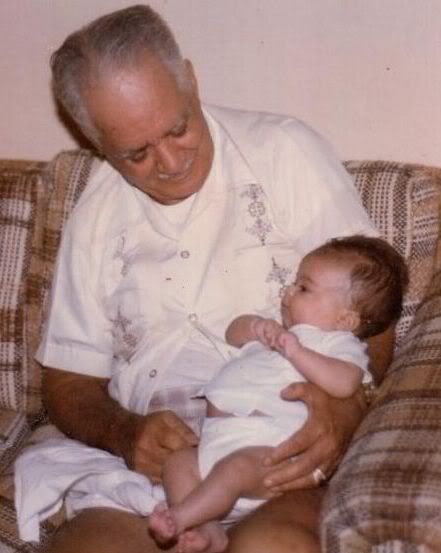
Photo: My father, Sydney George Philp, and my daughter.

Reblog this post [with Zemanta]

November 5, 2012

Shoot the Sheriff: How to Overcome Writer’s Block

"And by the way, everything in life is writable about if you have the outgoing guts to do it, and the imagination to improvise. The worst enemy to creativity is self-doubt.” ~ Sylvia Plath.

So, there I was in front of the students at Zelda Glazer Middle when an aspiring writer asked the dreaded question: "How do you overcome writer's block?" 

Ah, youth! She probably didn't know that her innocent query was the equivalent of asking an actor about the Scottish play in a theatre. It is verboten. 
 
Still, I was kind and answered from my own experience. 

Whenever I have suffered from writer's block, it's because I have smalled-up myself. Usually it's a reaction to post-publication depression, anemic royalties, and/or unfair/devastating reviews. If all three happen at the same time, watch out! 

But even in the midst of disaster, I've noticed a pattern of expectations versus results. It takes an enormous amount of energy to conceive and finish a poem or short story. Imagine what it takes to complete a book of poems, short stories or a novel and then, to encounter critical and/or commercial failure? 

Don't get me wrong, I love writing. It's the most fun you can have without taking your clothes off. And writing, like making love, which requires tenderness and attention, should be approached with anticipation and joy. If it feels like a chore, then you're in the wrong business. 

Whenever I've gone through a period of writer's block, it feels as if I've dried up. It's no longer pleasurable. Then, insidious questions begin to flood my mind:  What makes you think that your writing is any good? Is this rejection and public humiliation worth the effort?
 
Writers from every culture face these kinds of questions and life is hard enough just being human. But when you add racism and historical/cultural influences--some people are entitled to speech and some are not--then, the questions take on an added dimension. We doubt our right to speak or to promote our own work. We lack confidence in our own voice.

And given the reticence in Jamaican/Caribbean culture, which is a direct result of 400 years of colonial propaganda designed for convince us that our lives are inferior to those in the "mother country," other questions bubble up: Who the hell do you think you are?
 
I've heard it in my head whenever I picked up a pen. I've felt it when I've read in front of an audience, especially in Jamaica. We are notoriously hard on each other and it's a symptom of tendency nurtured by either fear or envy, "Sammy plant piece a corn down a gully," that fears success and will kill anyone who does not conform or dares to let her light shine. 

On the Plantation, we have proverbs that caution against success, "The higher monkey climb," and names for the ones that drag others down, "Crabs in a barrel." Or the really nasty one, "Neyga cyaan see neyga prosper." But more, anon. 

To make the choice "to stay eager," I've had to figure out ways to bring myself back to writing without the thought of publishing because writing and publishing are two different processes. 

Whenever I am writing verse, I am only thinking about finding the right word, metaphor, and rhythm that best express the ideas and emotions in the poem. I like to think that I am writing from the Spirit. 

Publishing is another matter. Publishing plunges me into the world of samara where measuring, competition, and ego rule. Any writer who says she is not competitive is a boldfaced liar. We all have bills to pay and would sell our mothers for a lucrative publishing contract. 

So, as with everything else in life, it's a balance between the Spirit and Ego--your life's passion and material desires. Both should be acknowledged. We drive ourselves crazy when we step over into the chaos of ego/samsara and forget to create out of who we are. Writer's block is an affliction not only of the mind, but also of the spirit. 

In those dark moments when envy and anger cloud my mind and I feel as if I am drowning in self-pity, the self-defeating voices creep in: "Look at X, she is getting all of that fame, attention, and money, and all I have is my cat. And on some days, not even he likes my company." 

We crave validation from others because writing is a form of communication, which implies exchange/ transfer with at least one other person. Sometimes it's hard to find that ONE person. Your mother doesn't count. 

How do I climb out of the hellhole of thoughts that I've created in my own mind? How do I big-up myself, even when the world seems so huge and I am so small? 

Here are some starters: 

Breathe deeply and reorient myself. Just as there is a time to reap, there is a time to sow. Seventy-five percent of the living, reading, and researching never makes it into a finished piece of writing, so every now and then, it's necessary to step back from the writing, change my routine, and dig deeper into listening, reading, resting, and living. In those times, I remind myself with the wisdom of my mother who would say to me with her Rock of Ages voice, “This, too, shall pass, my son. This, too, shall pass. Be kind to yourself.” 

Spend time with my friends and family. Writing is a solitary vocation that takes up much of my daily life. There have been occasions when I've viewed writer's block as a blessing. It gave me time to reconnect with my friends and family who reassured me that I was not alone--even if the cat wouldn't come near me. 

I count my blessings. I am grateful for all the opportunities I've had over many years of writing and publishing. I am proud of every book that I've published. I've never published a book merely to say that I'm a published author. 

Remember my heroes. In particular, I think about what Bob Marley said at the "Smile Jamaica" concert: "The people, who were trying to make this world worse... are not taking a day off. How can I? Light up the darkness." Occasionally, this increases my anxiety about writing, but it has proven, at least on one occasion, to be an inspiration with Bob Marley and Bradford's iPod.
 
 
Sheriff John Brown always hated me
For what I don't know.
Every time I try to plant a seed.
He say 'Kill it before it grow'

Fear is a natural part of human life. It has kept the species alive for millennia. But, then, there's irrational fear that paralyzes healthy living. "We're all weird." But some of us are still stuck in the zeitgeist of the Plantation. We fear if one cog goes loose, the culture will fall apart. It won't.

Enter the Deputy or anyone from your past/present who says you are not good enough or you'll never make it. I don't have to go on. You know your own daemon better than I do. It's not their fault. They merely provide the triggering event. You can take it from there. 

Freedom came my way one day
And I started out of town, yeah!
All of a sudden I saw Sheriff John Brown
Aiming to shoot me down,
So I shot - I shot - I shot him down and I say:
If I am guilty I will pay. 

The problem is the Sheriff and for your survival, you have to shoot the Sheriff or the inner critic--whatever you want to name her. Or 

Trick the Sheriff. Sooner or later, if you are passionate about writing (as opposed to the idea of being a writer), you will feel the urge to write again, but your heart won't be in it. You'll have to fall in love with the process of creating to regain your confidence.

If the part of my mind that generates creative work through poetry by using rhythm and metaphor has shut down, I turn to non-fiction by writing articles and blogging. It gets the juices flowing because I'm going through the creative process of researching, distilling, and combining information about something that I am passionate about while at the same time being of service.

Then, follow the advice of Mary Heaton Vorse: "The art of writing is the art of applying the seat of the pants to the seat of the chair."
 

Here are a few other sites that may help you to overcome writer's block: 

 
I mean, who wants to end up living here?