January 29, 2008

"Colonization in Reverse”: The Louise Bennett-Coverley Reading Festival

Miss LouThe Friends of the South Regional /BCC Library, Broward Community College and the Jamaican Folk Revue, invite the South Florida community to the launch of a two-day reading festival, "Colonization in Reverse,” to honor and study the life and works of the Hon. Louise Bennett-Coverley – author, comedienne, social commentator and cultural ambassador.


The two – day event, under the patronage of the Jamaican Consulate General in Miami, will take place at 7300 Pines Boulevard, Broward Community College, South Campus.


Thursday, January 31st, 6:30 – 8:00 p.m.

Panel Discussion -“Perspectives on the Life and Work of the Hon. Louise Bennett-Coverley”

Multi-media Auditorium of the Library,

Location -7300 Pines Blvd.

Admission is free.


Panelists will include Mervyn Morris (UWI, Mona,) who contributed editorials and introductions to Miss Lou’s books; Joan Andrea Hutchinson (actress, author, and comedienne, who produced Miss Lou’s last CD, Lawd de Riddim Sweet; Dr. Susan Davis; Marlon Hill, J.D.; Dr. Marva McClean, and George Lewis, JD.

The following areas will be discussed:

The Politics of the Language, Empowerment, and Identity

Education and the Impact of the Culture on the Caribbean Diaspora

Creolization –Linguistics and Etymology

The Political Humor of Miss Lou

Louise Bennett-Coverley – The Next National Heroine of Jamaica.

The moderator will be Dr. Marcia Magnus (FIU) a well-known educator and Diaspora Board member, and the audience will be able to participate in a question and answer period following the discussion.


Friday, Feb 1st, 7:00 to 9:00 p.m.

Concert honoring Miss Lou and celebrating the first Birthday of the South Regional/BCC Library in the new LEED certified “Green” building.

Location – BCC South Campus, Performing and Cultural Arts Center, 7300 Pines Blvd.

Admission - A $10.00 donation to the “Hon. Louise Bennett-Coverley Scholarship for the Performing Arts”

The February 1st concert, headlined by Joan Andrea Hutchinson, will be hosted by well-known tenor and music impresario, Steve Higgins and also marks the beginning of the Library’s Black History Month celebrations.


A supporting cast of local South Florida talent: Malachi Smith, Jeanne Powell, Tallawah Mento Band, Hyacinth Penso, Jamaica Folk Revue, Sophia Nicholson and the Sierra Norwood Calvary Baptist Church, Early Childhood Center and Fashions from “Kulture Klothes by Isis,” insures an evening of unparalleled “bellyful kulcha.”


The major Sponsors of this exciting, multidisciplinary event are the
Publish Post Jamaica Tourist Board, Caribbean Today, American Airlines, Broward Community College, and Friends of the South Regional Library. Current contributors are Joan Seaga- Gonzalez and the Jamaica Folk Revue.


For more information please contact Marjorie Hall –Friends of the South Regional Library- (954) 201-8828/ E-mail –marjoriehp@aol.com or Jamaica Folk Revue (305) 235-8410.

Copies of Miss Lou’s Books, DVD’s, and CD’s will be on sale at both functions.

***

Related Post:

"Miss Lou" Celebrations for South Florida


January 28, 2008

Virtual Yardies: A Hypertext Novel

Virtual YardiesImagine a novel that takes place in cyberspace.

Now imagine a group of mainly Jamaican bloggers who have never met each other and they plan a meet-up in Negril and one of them is murdered. Then, they find out that the murderer, a Jamaican Cotton Mather, has plans to kill all of them to rid the island of "fornication, corruption, and battymanism."

This is the premise of my hypertext novel, Virtual Yardies, of which ten chapters are now available online.

Give thanks to Tobias, Nicholas, and Georgia for spreading the word about this first of its kind novel.

Click here for Virtual Yardies!

***

Related Posts:

A New Novel: Virtual Yardies

Does it Already Exist? An Internovel? A Nog?

The Novel 2.0

***

Reblog this post [with Zemanta]

January 27, 2008

Ishmael Reed on the Obama/ Clinton Conflict

Although I have lived in the US for almost twenty-nine years, there are still some subtleties of American life and politics that elude me. Oftentimes, I have to rely on the insights of writers such as Ishmael Reed to decipher the meaning of certain events:

When Mrs. Clinton, during a debate, commented that voters found Obama more "likeable" than Mrs. Clinton, Obama said that Mrs. Clinton was "likeable enough." Obama's reply prompted an Ante Bellum white man, Karl Rove, to refer to Obama as "a smarmy, prissy little guy taking a slap at her." He said that this exchange threw the primary victory to Mrs. Clinton. Notwithstanding the irony of Karl Rove referring to someone as "smarmy," if a reply as mild and innocuous as Obama's leads to his being flogged by Clinton and reprimanded by one of the Establishment's Black tokens, Obama is going to be restricted in his ability to take on the political brawlers and hit persons aligned with Clinton like Don Imus's buddy, James Carville, a man who sneers at people who live in trailer parks, and who practices a no-holds-barred political strategy

To read the entire text, please follow this link: Going Old South On Obama: Ma and Pa Clinton Flog an Uppity Black

***

Related post:

One Vote for Barack Obama

Toni Morrison Endorsement of Obama

January 25, 2008

Anancy at Model City Library

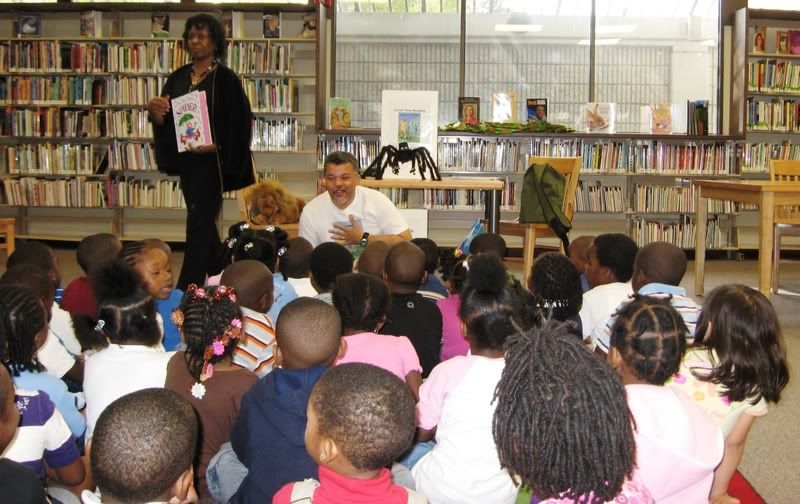
Black History MonthWho'd have thought that when I wrote Grandpa Sydney's Anancy Stories that I'd be reading to approximately fifty or sixty children at the Model City Library? Yet, there I was at a kickoff event for Black History Month hosted by the Miami Dade Public Library System.

Now, I'm not even going to pretend that it was easy to keep their attention. Many of the children, I suspected, were not used to being read to, or maybe it was the subject matter--they'd never heard about Anancy. Which makes me think I need to get to work on that Anancy picture book that I've been thinking about.


Whatever the case, I had lots of fun and I think the children did too. I also hoped that the children learned something about themselves. You see, I wrote Grandpa Sydney's Anancy Stories because I worry about our children's self-esteem. I meet the broken ones every day.


When I wrote Grandpa Sydney's Anancy Stories, I hoped that the children would see a child who looks like them in the book. I wanted them to see an author who looks like them on the cover of the book. I wanted children to see that books were not distant things locked away in libraries or expensive bookstores where strange people drink mocha lattes or order a grande cup of just nonfat milk foam and eat it with a spoon.


I also hoped that they would identify with the main character and, like Jimmy, use their intelligence, and not their fists, to solve problems.For it's no use lecturing to them about the heroes of my imagination (Bob Marley, Derek Walcott, Kamau Brathwaite, Dennis Scott, and Tony McNeill ) when they get to college. By that time it may be too late. By that time we may have already lost too many"immature warriors."


I want these children to imagine possibilities that I have not dreamed about.


***


Related Posts:
Anancy


***

For more photos of the event, please follow this link: Anancy @ Model City Library


***

Technorati Tags:


January 24, 2008

Derek Walcott's Eulogy for Elizabeth Hardwick

Derek WalcottDerek Walcott's prodigious gifts, even in the face of tragedy, continue to amaze me. When Elizabeth Hardwick, one of America's preeminent writers, passed away during last year's Christmas holidays, Walcott wrote a moving eulogy. Hardwick, according to Bruce King's Derek Walcott: A Caribbean Life, first met Walcott when she and her former husband, Robert Lowell, "stopped in Trinidad during June 1962 on their way to Brazil under the auspices of the Congress for Cultural Freedom" (188). They became lifelong friends.

Here is an excerpt of the letter to
The New York Review of Books "sent by Derek Walcott from his home in St. Lucia and read by Hilton Als at a memorial service in New York City on December 16, 2007, for Elizabeth Hardwick, co-founder and advisory editor of The New York Review since 1963 and contributor of more than one hundred reviews, articles, reflections, and letters to these pages."

Distance requires formality, but I cannot be distant writing about Lizzie Hardwick since everything has come alarmingly closer—the curls, the infectious chuckles, the drawl like poured-out honey, the privilege of sharing her astute delight, and the benign devastations of her wit. Because she hated pomposity she was more fun than any American writer I have known. She preferred gaiety to malice and had the laugh to go with it. Memories of her rise like butterflies from a bush, all darting, elate, and light; the use of three adjectives is the signature of her style, perhaps because of the precise languor of her Kentucky accent.

To read the entire statement, please follow this link: New York Review of Books.

***

Related Posts:

Derek Walcott

January 23, 2008

Peepal Tree Press and Sable LitMag at the AWP Book Fair

Peepal Tree Press

Peepal Tree Press
is the home of challenging and inspiring literature from the Caribbean and Black Britain. They have been publishing fiction, poetry, literary criticism, memoirs, and historical studies since 1985.

SABLE is a 132 black and white international LitMag, that has been published in the UK since 2000. It features work from emerging new writers and established writers.


OUR PUBLIC APPEARANCES


Our next public appearance will be at the AWP Bookfair at the New York Hilton from 30 Jan- 2 Feb 2008. The bookfair is open to the public on 2 February from 8.30am-5.00pm at Americas 1, Booths B74/75 where we look forward to meeting you!


Kadija Sesay, Dorothea Smartt, Koye Oyedeji, and Jeremy Poynting, publisher of Peepal Tree Press will be available to chat to you about SABLE and Peepal Tree Press throughout the bookfair.


Hilton New York (midtown)

1335 Avenue of the Americas

New York, NY 10019

Telephone: 212-586-7000

3rd Floor, Americas 1, Booths B74/75


SABLE will have T-shirts and posters available and special offer subscriptions for institutions and individuals. Purchase a subscription at AWP and get a free copy of Cotton Field of Dreams by Janis Kearney, (featured on the Essence Bestseller List, 2005).


Kwame Dawes, Associate Poetry Editor, Peepal Tree Press, will be signing his books at the Peepal Tree Press Bookstand at 3pm Thursday 31st Jan, Booths B74/75 America's Hall 1, 3rd Floor.


Dorothea Smartt , SABLE Poetry Editor will be reading from her latest book Samboo's Grave/Bilal's Grave (Peepal Tree Press) at the


Pan PALF Reading

in support of its Inaugural Writer's Conference: GHANA'08

[with]


Yusef Komunyakaa

Quincy Troupe

Patricia Jabbeh Wesley

Chimamanda Ngozi Adichi


[where]


The New School

Wollman Hall

65 W. 11th Street

Fifth Floor


[when]


Wednesday, January 30th

6:30 p.m.


Pan African Literary Forum. A literary study abroad programme.

A programme with an edge.


Tickets available at New School box office, 66W. 12th St.

$5 general public, free to New School students and alumni.


www. panafricanliteraryforum .org


***


"On my first trip to the Modern I turned a corner,
rooted before the ridged linen of a Cèzanne.

A still life. I thought how clean his brushes were!
Across that distance light was my first lesson."

~Tieoplo's Hound~
Derek Walcott

Happy Birthday, Derek Walcott!

***


January 22, 2008

Vernice Stubbs Higher Education Sustaining Scholarships

THE CARIBBEAN EDUCATION FOUNDATION IS ACCEPTING APPLICATIONS FOR FOUR ACADEMIC SCHOLARSHIPS FOR UNIVERSITY STUDENTS IN JAMAICA TO AID WITH JANUARY 2008 SCHOOL TERM


The Caribbean Education Foundation, Inc. (CEF) is accepting scholarship applications for the Vernice Stubbs Higher Education Sustaining Scholarship from students at the University of the West Indies (UWI) and University of Technology (UTECH) in Jamaica.

Vernice Stubbs Higher Education Sustaining Scholarships are awarded to qualified and talented university and technical students enrolled full-time and pursuing a first undergraduate degree, but who might be in danger of withdrawal due to lack of financial resources.


The Vernice Stubbs Sustaining Scholarships will pay scholars’ residence boarding fees for the January through June 2008 term. Each scholarship will range from $45,000 to $51,000 according to boarding fees for on-campus residence.


Applicants must be Jamaican Nationals who reside in Jamaica and meet the listed qualifications criteria: (1) High academic performance; (2) Financial need; (3) Resides in urban or rural depressed community; (4) Leadership Qualities/Community Service/Other activities and (5) Production of a prescribed essay (6) Interview of Finalists. Required documents include: Official University Transcripts, Curriculum Vitae, Evidence of Financial Need, et cetera.

Applications are available at both UWI and UTECH student financial aid offices. All completed applications should be delivered to the designated university office and held in sealed envelopes for pick-up by official CEF personnel:


APPLICATION DEADLINE: January 25, 2008


NOTE: All completed applications should be delivered to designated school office and held in sealed envelopes for pick-up by an official CEF Chief.


For more information, visit our website at www.educatechild.org

Email us at info@educatechild.org

Nikiki T. Bogle, Esq.
Chief Executive Officer
Caribbean Education Foundation, Inc.
276 Washington Street, No. 334
Boston, MA 02108
Phone: (800) 677-0839 Ext. 105

Fax: (800) 677-0839
Email: nbogle@educatechild.org

Website: www.educatechild.org


***

January 21, 2008

Kyra and Twenty Eight Days Later

Kyra HicksCongratulations to Kyra Hicks on Martin Luther King Jr. Day. Kyra's book for children, Martha Ann’s Quilt for Queen Victoria , has been included in Twenty-Eight Days Later, a list of featured authors and illustrators organized by The Brown Bookshelf, to "shine the spotlight on the varied African American voices writing for young readers."


Here is a partial list of the books from Twenty-Eight Days Later:

February 1: Christopher Paul Curtis - Elijah of Buxton

February 4: Rita Williams-Garcia No Laughter Here

February 8: Patricia McKissack The All-I’ll-Ever-Want Christmas Doll

February 11: Mildred D. Taylor The Road To Memphis

February 15: Walter Dean Myers - Game

February 18: Eloise Greenfield The Friendly Four

February 25: Kyra E. Hicks - Martha Ann’s Quilt for Queen Victoria

February 26: Celise Downs Dance Jam Productions and illustrator Shane Evans- When Harriet Met Sojourner

February 28 : Sherri L. Smith - Sparrow

For the complete list, please visit Black Threads in Kid's Lit.


January 18, 2008

So, You Want to be a Writer?

Preston AllenHere's a great opportunity to begin a conversation with Preston L. Allen, author of All or Nothing (Akashic Books 2007). Preston will field your questions with his characteristic wit and tangent. All you have to do is read these books and become a regular visitor to this blog: http://allornothingthenovel.blogspot.com/

A. Manette Ansay: Blue Water

A. Manette Ansay: Vinegar Hill

Alice Munro: Hateship, Friendship, Courtship, Loveship

Alice Sebold: The Lovely Bones

Alice Walker: The Color Purple

Angie Cruz: Let It Rain Coffee

Anne Rice: Interview With the Vampire

Bernays Painter: What If?

Carol Taylor: Wanderlust

Carolyn Ferrell: Don't Erase Me

Chris Abani: Song for Night

Christopher Moore: Lamb

Colin Channer: Iron Balloons

Dedra Johnson: Sandrine's Letter to Tomorrow

Dennis Lehane: Mystic River

Felicia Luna Lemus: Like Son

Geoffrey Philp: Uncle Obadiah and the Alien

Gonzalo Barr: Last Flight of Jose Luis Balboa

Gordon Parks: The Learning Tree

Hallema: Mass Deception

Ivonne Lamazares: The Sugar Island

James W. Hall: Gone Wild

Jarret Keene: Las Vegas Noir

JK Rowling: Harry Potter & The Deathly Hallows

John Cheever: The Stories of John Cheever

John Dufresne: Lie That Tells a Truth

John Dufresne: Johnny Too Bad

John Rechy: City of Night

Junot Diaz: Drown

Kwame Dawes: She's Gone

Laura Valeri: The Kinds of Things Saints Do

Leonard Nash: You Can't Get There From Here and Other Stories

Les Standiford: Miami Noir

Les Standiford: Meet You in Hell

Lewis Nordan: Music of the Swamp

Lynne Barrett: Secret Names of Women

Martha Frankel: Hats and Eyeglasses

Michael Craig: The Professor, the Banker, and the Suicide King

Pat MacEnulty: From May to December

Philip Roth: Human Stain

Preston L. Allen: Come With Me Sheba

Preston L. Allen: Hoochie Mama

Preston L. Allen: All or Nothing

Preston L. Allen: Churchboys and Other Sinners

Richard Wright: Native Son

Sapphire: Push

Simon Winchester: The Professor and the Madman

Stephen King: On Writing

Stephen King: Different Seasons

T Cooper: Lipshitz Six

Uzodinma Iweala: Beasts of No Nation

Vicki Hendricks: Cruel Poetry

William Goldman: Boys and Girls Together

William Zinnser: On Writing Well

Yann Martel: Life of Pi

No question is out of bounds. E-mail him at PrestonTheWriterAllen@gmail.com, and be prepared to laugh and learn. Preston also posts a growing list of some pretty great and often unusual books that you should read if you want to be a writer.


Preston L. Allen, who was born on Roatan (Honduras), is the author of the novels Hoochie Mama, Bounce, Come with Me, Sheba, and the short story collection Churchboys and Other Sinners. His stories have also appeared in several of the Brown Sugar series. Preston is the winner of the Sonja H. Stone Prize in Literature and a recipient of a State of Florida Individual Artist Fellowship in Fiction. He lives in Miami, Florida.

***


January 16, 2008

In My Own Words: Nicolette Bethel

Nicolette BethelI never thought I'd be a non-fiction writer. I grew up reading the fantastic. The more imagination, the better. It was my brother, the question-asker, who was fascinated by facts: he was the one reading The Guinness Book of Records, National Geographic, Time, The Economist. Reality never interested me; fiction was my element.

As I grew older, though, I came to realize that fiction is shaped by fact. The books I loved to read, whether they were traditional fairy tales, children's novels, classic works of fantasy like the Narnia Chronicles or Lord of the Rings, or between-the-wars-English mysteries, were not neutral by any means. On the contrary. Many of them were actually tools of empire, reproducing the fundamental principles that justified European domination of the rest of us. In the British novels that were my companions for the first fifteen or so years of my reading life were figures who helped draw impermeable lines between us and them — the golliwogs of Blyton's nurseries, the Southrons and Easterlings on Tolkein's Pelennor Fields, and the Calormenes to the south of Narnia, or, later, the less-than-admirable persons of colour in Agatha Christie's and Dorothy L. Sayers' mysteries. The more literature I read, the more I understood that fact and fiction were not, and could not ever be, separate.

It took the study of anthropology to make me realize that the opposite was also true -- that what masqueraded as "fact" was also partly fiction. For decades, anthropologists had made the mistake that ethnography was synonymous with reality -- that what was contained in the studies of specific peoples at very particular junctures in time and space was not truth, but a literary version of the truth. Post-modernism's reflexivity may have limited application to the study of literature which inspired it, but my studies of anthropology, it was radical. My understanding of life, fact, fiction, law, and society has never been the same since.

Essays on Life began in my head long before I had a reason to write them. My return to The Bahamas after almost a decade of living abroad set off a chain of thoughts about our society and our culture that were raging to get out, and I was already contemplating approaching a newspaper to feel out interest for a series of articles on society in general, and not on political events of the day, when Larry Smith, then the editor of the Nassau Guardian, invited me to write a column. Essays on Life are the result.

I could have never imagined how widely read -- or how widely appreciated -- these essays would be. I've been writing them for five years now, and they appear not only in the Nassau Guardian (
http://www.thenassauguardian.com/), but they are also reprinted online at Larry Smith's Bahama Pundit (http://www.bahamapundit.com/%29, at The New Black: Magazine (http://www.thenewblackmagazine.com), and (of course) on my own Blogworld (http://www.nicobethel.net/blogworld/), as well as being regularly selected for readings at the College of The Bahamas. I've been asked often when I'm going to publish them. Now I have.

For a woman who never liked reading non-fiction, I've come a long, long way.


***


Essays on Life is available from Lulu and will be available from online bookstores such as Amazon and Barnes and Noble.

Link to Lulu:

http://www.lulu.com/content/281819


***

Nicolette Bethel was born and raised in Nassau, Bahamas, where she currently resides. She has lived, studied and worked in the UK and Canada, and is currently apprenticed to the Bahamian Government for her sins and others’. She is a playwright, poet, fiction writer and anthropologist. She holds a PhD in Social Anthropology from the University of Cambridge, and is a researcher in the fields of Bahamian national identity and of Junkanoo. She is the editor of Junkanoo: Festival of The Bahamas (Macmillan Caribbean, 1991), excerpted from E. Clement Bethel's M.A. thesis on Bahamian music. Her 1990 play Powercut was made into an independent film and released by Plantation Pictures in 2001. Her fiction and poetry have been published in a variety of places, including the anthologies Junction: an Anthology of Bahamian Poetry and Prose; From the Shallow Seas; and The Oxford and Cambridge May Anthologies 1993; print journals such as The Amherst Review; The Caribbean Writer; Calabash; and Social Identities; the online journals The Paumanok Review and II; and the edited collections Managing Island Life () and Junkanoo and Christianity (Media Enterprises, 2003). Essays on Life are reprinted online on Bahama Pundit (http://www.bahamapundit.com/) and The New Black: Magazine (http://www.thenewblackmagazine.com/). Since 2003 she has been a columnist for the Nassau Guardian.


January 13, 2008

Calling all Loas

Papa LegbaAttibon Legba

Attibon Legba
Ouvri bayi pou' moi
Ouvri bayi pou' moi


One of my most memorable trips with Félix Morisseau-Leroy, who introduced me to many aspects of Haitian life and culture, was during a car ride in 1993 when we were scheduled to read at a Black History Month celebration at the Broward County Main Library. We'd been listening to the local news, and near the end of the announcements, the reporter made a brief mention of the sinking of the Neptune off the coast of Haiti. At first, I didn't pay much attention to the report. But when I glanced over at Morisseau-Leroy, I saw that he had been visibly moved by the news and was angry at the casual tone of the reporter. Morisseau-Leroy's anger made me realize my complicity in the disregard for the loss of Haitian lives at sea. I, like the reporter, had become so inured to the daily reports of bodies washing up on South Florida beaches that the loss of over a thousand lives in a single event barley registered in my mind. For Morisseau-Leroy, the news had a different effect. Those were his people who were dying on the high seas and when we arrived at the library, he made sure that all of us knew about what had happened.


Morisseau-Leroy loved his brothers and sisters and they repaid that love in a mural in Miami where he is seated with the loas in an imaginary village in Haiti. I repeat the story here not only as a cautionary tale about how easily our sensibilities can be dulled when faced with the daily loss of life, but also how Morisseau-Leroy's love for his people, even though he was living in exile, moved him to memorialize their lives.


Imagine, then, my concern after reading in The Gleaner about the lynching of goat thieves in Westmoreland (the birthplace of my mother and father) and reading a post by the influential Caribbean blogger, Francis Wade, about accepting the actions of what I like to call "immature warriors." I was surprised even more by the tone of his post because Moving Back to Jamaica is usually filled with practical ideas and contains many insightful posts about the Jamaican character and our "warrior spirit."


Now, I am not complaining about our propensity to "chuck badness." In the past, this "warrior spirit," identified in the Yoruba cosmology as Shango, served us well in the fight against British imperialism. It was this "warrior spirit" that Marcus Garvey evoked when he urged his followers to have "backbones and not wishbones,"and through the work of the UNIA transformed "immature warriors" into "mature warriors."


But now that the colonizers have been physically removed from our shores and this "warrior spirit" has not been channeled through education into the long-term fight against illiteracy and ignorance, we have turned this energy against ourselves and the results have been disastrous.Or as Moving Back to Jamaica says "we are a people itching for a fight, but .... we can't find a good one to fight."


So, every day we read in the newspapers, the effects of ignorance in the lives of "immature warriors" who use force and violence to gain narrow personal goals. And as they grow in numbers and our education systems fail us, all we can expect is a slow descent into a state of "red in tooth and claw" and where life becomes "nasty, brutish, and short."


But do we want to change? I can't even change myself, and as one of my dear friends always tells me, "People, without any kind of intervention never change."


So, I say,go with what we are: a nation of Xangos. But educate the young warriors. Show them the difference between "immature warriors" for whom every problem is a nail and they hold the hammer, and"mature warriors" who uphold ideas of honor and justice and who resort to the use of force as a last resort when all other options have failed. In other words, expand their sense of self--a little less Xango and more Eshu--whose world is ruled by shadows and light where intelligence prevails.


And if we insist on change, then we must believe. We must believe that ideas matter and that once these ideas are registered in the consciousness, they merely wait for an opportune time to manifest themselves. Anyone who has been seduced can attest to this.


But we must also refuse to accept any idea that does not hold every human life as priceless.I refuse to accept the loss of even one life to senseless violence. Every life counts.


For just as the epiphanies of poets such as Morisseau-Leroy, begin with the feeling that they are loved/supported n every cell by their brothers and sisters, so too the education of the young begins with the feeling that they are worthy and their lives count. Every single one should be able to say, "I am gifted." Then, Marcus Garvey's words will surely come to pass: "Rise, you mighty people."


***