Showing posts with label Jamaican diaspora. Show all posts

October 4, 2013

Jamaican Authors Connect with Home


(L-R Colin Channer and Kwame Dawes)

by Claire Rocastle.

Many of the celebrated Jamaican authors who have been published in the last 50 years have made their homes abroad, in a diasporic wave, fanning out from their homeland in the Caribbean. The effects of this diaspora appeal to contemporary writers and become important themes in their work. The Jamaican literary voice has always been strong, reaching out to audiences all over the world, yet the writing has its roots in home and continues to connect authors and readers with their past.

Literary Tradition

The Calabash Literary Festival in Jamaica gives Jamaican writers a voice each year and in 2012 the event celebrated 50 years of independence, with the theme of ‘jubilation’. Among the writers asked to speak was Kerry Young, who still calls Jamaica her home despite having lived over 40 years in the UK. Her novel Pao was nominated for the Commonwealth Prize in 2012.

Many other writers make their homes abroad, such as Orlando Patterson and Olive Senior, and Kwame Dawes, an Emmy award-winning poet who teaches at the University of Nebraska. Dawes explained that, despite the diasporic nature of Jamaica, its people find each other and connect again in anthologies and at festivals and that it has always been this way. Novelist Colin Channer claims that the diasporic pattern has led to a literary boon for Jamaican writers and their culture, because they are exposed to so many different types of people and this gives them a platform within global literature, rather than striving for national identity.

Brave New Writing

Channer edited an anthology for the Calabash festival entitled Kingston Noir, exploring the darker side of Jamaican life and showcasing a variety of exciting writers. Most of them were born in Jamaica and came together to explore the different facets of Kingston life and the way its boundaries crisscross. The anthology highlights the outsider’s experience of Jamaica and it turns the images of sunshine, sea and reggae on their heads, revealing instead an underworld that threatens the peace and tranquillity of the country.

One of the stories in Kingston Noir focuses on adolescent girls and their school daydreams that are shattered when a classmate disappears. Writer Marlon James evokes the loss of innocence very well in this short story, as do others in their contributions that take from hard-boiled fiction and gangster themes.

The New York Times featured an article on Jamaican writers becoming much more emboldened by their culture, particularly the influence of Reggae, and literally exploding onto the pages of fiction with their voices. Reggae has tuned the world into Jamaican culture much more and since 1962, and the country’s independence, writers have become confident and multinational. Kwame Dawes explains that literature in the Caribbean was reacting to colonialism in the 20th Century, as writers left the country to seek their education abroad. Being taken away from this landscape, Dawes claims, meant that writers had to try to ‘recapture the Jamaican experience’.

Busting Out


Marlon James again features in Iron Balloons, an anthology with universal themes but with Jamaica at its heart. The title refers to performers in music terms who are unable to bust out and claim the success that should come their way. James claims the Calabash workshops in Jamaica encouraged him to try to publish his novel John Crow’s Devil, which had received between 70 and 80 rejections from publishers at that time. Finally it was bought by an independent publisher in Brooklyn called Akashic, specializing in Caribbean writers. James’ novel subsequently became a finalist for the Commonwealth Writers’ Prize as well as the Los Angeles Times Book Prize.

Opportunities for writers are highly competitive today. There are various reputable sites offering genuine freelance work to talented writers, such as writing for wait.co.uk, and these are good for flexing your literary muscles in between novel writing.  In addition, global writing prizes are becoming more popular and are recognizing diverse voices within different categories of the literary marketplace. 

The Windham Campbell Prizes was launched at Yale University earlier this year and it has become one of the largest prizes for fiction, nonfiction and drama in the world, with nine $150,000 prizes being awarded. Among the fifty-nine writers nominated from around the world were participants from Jamaica, India, Trinidad and Tobago and South Africa. The prize has given minor writers an important voice. Zoe Wicomb, a finalist who wrote a collection of Apartheid era stories, said the prize was a validation she hadn’t dreamt of and that it would support her through her future writing efforts.

Brave new voices are finding that there is an audience out there, and it is one that values original, thought provoking fiction with its roots in ‘home’.

November 30, 2011

The Jamaica-born Grandmaster of Chess: Maurice Ashley


By Opal Palmer Adisa
 
“Chess is an intellectual discipline masking as a game,” says Maurice Ashley, who is touted as the first African-American International Chess Grandmaster in the history of the game. But Ashley is actually Jamaican, born in Kingston, where he attended Seaward Elementary School. His formative years were spent in Tower Hill, where his grandmother raised him and where he came to know himself. At the impressionable age of nine, his older brother taught him how to play chess, but Ashley remarks, “Back then, it was just a game. I liked it, but I didn’t know at that time that the game was going to be my destiny.” He later attended Wolmer’s High School for Boys before immigrating to the USA, at the age of twelve, to join his mother. 
 
Excitement about living with his mother for the first time with his two siblings was partially tempered by his new environment that belied the American dream. “Coming out of poverty in Jamaica, the mere fact that you are standing on American soil, is an advantage, but the reality was a lot of day-to-day violence --the level was worse in Brownsville, Brooklyn. There were drug-dealers and prostitutes,” Ashley recalls. However, he learned to navigate and steer clear of the numerous traps that were everywhere in his new community.
 
School gave Ashley direction, and because of the friendships he formed, his keen interest in chess grew. “I started to take it seriously in high school in Brooklyn. I thought I was smart, until I lost to a friend. Then I saw a book in the library and I started reading. I didn’t know there was a strategy to chess. My friend had also read all of these books. He had been reading and playing, and that’s when I knew knowledge is power.” So Ashley became an avid student of chess and was determined to be at the top of his game. He studied and taught himself.
 
Still, Maurice Ashley did not recognize his talent until he was a student at City College, New York. His passion and love for the game spews from his mouth as he recounts his journey. “I was so in love with chess, I was doing it all the time. It was like a force. I would beat people and I loved the feeling of beating people, and I just wanted to keep doing it. I never thought of chess as a profession.”
 
Chess became not only a profession for Ashley, but also the very foundation of his life. In 1993 when he was only 20 years-old, Maurice Ashley, as a result of coaching the National Champions from Harlem to victory, became the first ever African American Master in US History. In 1999 Ashley was honored as the first Black person in history to become an International Grandmaster.
 
Maurice Ashley’s love for chess and his international recognition, has led him to his mission: to share chess with young people around the world. The release of his book, Chess for Success: Using an Old Game to Build New Strengths in Children and Teens, serves as a cornerstone of his advocacy.


Ashley’s success begs the questions: How does a Jamaican boy from an impoverished neighborhood, without a father present, become a chess master? Is it simply destiny or are there other forces at work? Ashley contributes his success to his mother, who left him as an infant, and labored hard in the USA for ten long years so that he and his two siblings could eventually join her and be united as a family. 

And despite the vices in their immediate surroundings that could have mitigated their success, Ashley states categorically: “My mother made sure that I understood coming from Jamaica that you hold on to your opportunities. She kept us focused. You had to go to college; all of us were going to college.” And indeed Maurice Ashley and his two siblings all went to college and are at the top of their respective fields.
 
Perhaps an additional secret to his success is connected to dogged determination. In chess, Ashley found his passion, and a drive to beat his opponents, which led him to study and practice continuously. His assiduousness paid off when in 2002, he became the first African-American in history to qualify for the US Chess Championship. The crowning event came in 2003, when United States Chess Federation awarded him the title of Grandmaster of the Year. 
 
But Ashley still identifies as a Jamaican, and his bond to this island and its culture is deeply embedded in the food, especially ackee and salt-fish with roast breadfruit, and of course jerk chicken that he loves. However, his Jamaican-ness goes deeper, and he stays committed to his culture and the development of the island.
 
In an interview on October 13, 2011, I asked the following questions:
 
OPA: What do you love about Jamaica or being Jamaican? 
 
MA: The fact that we are some of the hardest working people on the planet. Give us an opportunity and we will run with it. Just try to catch us and you won’t.
 
OPA: What are you hopes for Jamaica? 
 
MA: That our people become well-educated and using initiatives like chess to bolster that effort, we can show the world the advanced skills of which we are capable. I think a polished and comprehensive educational system has to be developed in Jamaica, where we can use our talents as a means of helping bigger countries to carry out some service that they may needed. That means we have to create an extremely comprehensive educational base, so those countries do not automatically link Jamaica with tourism --that Jamaica becomes known for technology as well. I hope that Jamaica goes the way of some of those countries in Asia --finding our niche in technology. 
 
I don’t think more advanced techniques are available to the general population, like what I do with chess: deep thinking. When you start with a platform with young people, it will magnify in a few years.

OPA: Why should children learn to play chess? 
 
MA: All the skills we want our children to have, problem solving, analytical reasoning, focus and concentration, are embedded in the game itself, in the playing of the game itself, so kids have fun and learn at the same time and they don’t even know it.
 
Chess strategy doesn’t begin until you realize that there is another mind playing against you. Most people are about themselves, but the competition is about someone trying to beat you, so you have to take that into consideration. 
 
The great thing about chess is that you are punished for bad thinking; you are punished for impatience. You have to stop and plan ahead before you move, or else you are going to lose the game. Kids don’t want to lose, so if they have a good coach they begin to play and play well, and those are skills they can use in life to be successful.
 
OPA: What was the biggest challenge you had to overcome to succeed?


MA: I believe that life is a series of challenges that we are consistently overcoming. I am challenged even now in my life. I embrace challenges--that is the way you become successful by embracing the challenges of life.

With every challenge one gains experience that has to be harnessed in order to move to the next level. Ashley uses these stepping-stones, and that has helped him to navigate his life. These are the lessons that he has honed as a man, and that he wants to impart to young people. The proud father of two children, a seventeen-year-old daughter who is an "A" student and a nine-year-old son, Ashley models his practice on his children. “I started teaching my children chess when they were three years-old. I made sure they both had a foundation for chess. My daughter didn’t pursue it, but she is good. Now my son and I do chess puzzles every day.”
 
Until very recently, Ashley had stopped playing chess to be a full time, stay-at-home father, so that his wife, who had put her career on hold to allow him to travel, had the opportunity to pursue some of her dreams, including being principal of a school. But Ashley is excited to be playing chess again. Back on the chess trail, Ashley is embarking on a six-island tour to promote chess in the Caribbean for young people, and visited Jamaica from November 10-12, 2011.
 
Ashley says, “I am bringing chess technology, much of which is donated, to assist the chess efforts in these countries, to lend the voice to the idea that chess is great for kids and it should be supported.”
 
In addition to being a Grandmaster, an author, and an inventor, Maurice Ashley is also the designer of a smart phone application: “Maurice Ashley Teaches Chess,” which was launched in 2010 and has sold in more than 25 countries. Still he remains close to his cause, which is to promote chess as a viable mode of education for young people. To this end, he has traveled widely to speak to, and encourage youth in indigent neighborhoods throughout the USA, South Africa, and Central America.

 
Ironically, Maurice Ashley says he isn’t sure in what concrete ways he contributes to Jamaican society, but acknowledges that when people know that he is Jamaican it engenders a sense of pride. Reflecting more he adds, “I support chess initiatives in Jamaica, and what they are trying to do to build up chess on the island. I do what I can to support the Jamaica Chess Federation.”
 
Whenever someone does something, great or small, it reflects on his family, as well as his country. Maurice Ashley’s achievements are but more evidence of the global contributions of Jamaicans. Perhaps it is the yams as sports fanatics have been attributing to Usain Bolt’s phenomenal achievements; maybe it’s in our water, in the very air, or maybe it is in the foundation and dreams that have been instilled in us by parents and others who made endless sacrificed to keep us focused, and made us dream beyond what could even be imagined.
 
Regardless of the source of our greatness, Jamaicans such as Maurice Ashley are helping to create a more diversified and accomplished profile of who Jamaicans are and the new frontiers we are traversing. 
 
As Maurice Ashley says, “Knowing that chess is a blessing for kids helps me to keep spreading that message.” So I invite you to introduce a child in your life to chess as well as other endeavors that could guide them towards success.
 
Learn more about Maurice Ashley and all that he is doing to promote chess and keep the Jamaican flag waving high by visiting his website: www.mauriceashley.com
 
Please contact Opal Palmer Adisa at 50jamaicans@gmail.com if you have a story to share. She plans to do a profile of 50 Jamaican women and men, living in the greater Jamaica Diaspora who have had exceptional accomplishments. Also, Adisa’s novel, Painting Away Regrets, is set to release this November 2011.

November 18, 2011

"First Light (for Shara McCallum)"


First Light
 (for Shara McCallum)

Dawta, the blood that spilled bright
on blades of sawgrass, a scent like rust

rising in your nostrils, twisted
into your terrible locks. I wish I could

have turned your head away, for you not
to have witnessed the slow slump of the body

on the earth that greeted the thud
of the shell when the soul becomes one

with the light around the tamarinds.
But like thunder on the surf whose rage


shatters sand dollars that crumble
in our hands, you can no longer take refuge

in the mangroves' memory of wholeness,
your flight into an orphaned sun.


© Geoffrey Philp 2011


Shara McCallum will read at the Miami Book Fair International on Saturday, November 19, 2011

July 8, 2011

JIS Annual Jamaica Independence Essay Competition-2011


 Entries are now being accepted for the 11th annual Independence Essay Competition of the Jamaica Information Service (JIS) in Miami. The competition forms part of the celebrations observing Jamaica’s 49th anniversary of Independence and Emancipation across the Florida communities.

The contest is open to all Jamaican children, first and second generation, and residing in Florida State, The deadline for participating entries is Friday, July 22nd. The winner in each category will be awarded with a plaque from the Jamaica Consulate General, and a monetary gift presentation from the Partners for Youth Foundation, a South Florida non profit organization committed to the enhancement and development of young women locally, and in Jamaica, through the performing arts and cultural development.

The merit to the annual Essay competition is to advance community awareness while exposing our youth to their Jamaican culture and heritage. As they research and prepare the compositions, applicants are given the opportunity to reflect on the nation’s history and culture; look at the impact of their Jamaican roots on their upbringing; and the positive events that have catapulted Jamaica and its Diaspora in the global arena. This year, selection of topics will focus on Jamaica’s 50th anniversary of Independence to be celebrated next year.

Children in the Diaspora are being encouraged to take interest in the annual Essay Competition realizing that the occasion would inspire young Jamaicans to more seriously consider learning the island of their origin.

Students can choose from a selection of topics related to the island’s cultural heritage some of which include community leadership, entertainment, education, history and culture, geography and national development.

Applicants must be between five and eighteen years of age and resident here in Florida. There are three age categories for the responses five to eight (5-8); nine to twelve (9-12); and thirteen to eighteen (13-18).

For information on entering the contest, interested persons can contact the JIS office at the Jamaica Consulate General in Miami located at 25 Southeast Second Avenue, Suite 609, telephone (305-374-8431--ext. 232) email JISMIAMI@BELLSOUTH.NET or the Consulate’s website at WWW.JAMAICACGMIAMI.ORG

JAMAICA INFORMATION SERVICE - JAMAICA INDEPENDENCE ESSAY COMPETITION – 2011 OVERVIEW

Essay topics are as follows:

  1. Talk about your experience in Jamaica as a tourist. Briefly share your adventure about one of your favorite places visited – for example a place of recreation, a historic landmark or even time spent with a Jamaican family.
  2. How can the Jamaican youth in the Diaspora best contribute to Jamaica’s national development.
  3. After 50 years of gaining Independence from Great Britain, would you say that Jamaica has achieved any of its goals for example political and economic freedom, and social equality.
  4. Briefly describe the events that led to Jamaica’s gaining its Independence from Great Britain on August 6, 1962.
  5. As Jamaica prepares for its 50th year of Independence, what are some of the achievements that have been made by Jamaicans worldwide. For example, describe the accomplishments of any one outstanding Jamaican.
  6. How would you like to see Jamaica’s 50th anniversary of Independence celebrated in your community.
  7. What is your opinion of reggae music today, and explain the role that this genre of music has played in Jamaica’s social, cultural and economic development.
  8. Briefly describe the significance of Jamaica’s six national symbols.


Each entrant must choose only one topic. The response must NOT exceed two pages and should be double-spaced.

Essays can be emailed to JISMIAMI@BELLSOUTH.NET or mailed to the Jamaica Information Service, 25 SE Second Avenue – Ste 609, Miami, FLA 33131.

Each entry must be accompanied by the contestant’s name, address, telephone number and age. There are three age categories for entrants: five to eight (5-8); nine to twelve (9-12); thirteen to eighteen (13-18). The deadline for entries is Friday July 22nd.

June 6, 2011

Book Review: This Strange Land by Shara McCallum


In a recent article in the Daily Gleaner, “Story Of The Song: Lyrics, Literature Trace Emigration Of Jamaicans,” the author claimed: “There is one wave of emigration which has not made its way into literature and music to the extent of the Latin American and Windrush generation exoduses of largely unskilled labourers. As political turmoil hit a peak in the 1970s, many middle- and upper-class Jamaicans pulled up stakes amid fears of not only violence but also that Michael Manley was taking the country along a Communist path.” This Strange Land by Shara McCallum, who was born in 1972, the year when Michael Manley came to power and who left Jamaica on the day of Bob Marley’s funeral, seems to answer the challenge. But rather than create another paean of exile, McCallum reframes the catastrophic events of the period from the perspective of gender roles in Jamaican culture.

This Strange Land, which is divided into three parts, “Dear History,” “Fury,” and “Dear Hours.” begins with the signature psalm of diasporas, Psalm 137. But McCallum’s “Psalm for Kingston,” rendered in the confessional mode of the collection, captures Kingston in her unique voice: “City of schoolchildren in uniforms playing dandy shandy/ and brown girl in the ring--tra-la-la-la-la--.” This particular recollection is telling. For as a “brown girl,” growing up in Jamaica, whose physical appearance would seem to link her with the “middle and upper class,” McCallum clearly identifies with the black urban sufferahs of Marley’ music. In the title poem of the section, “Dear History,” McCallum revisits one of the more senseless murders during the height of the political warfare when a young girl was murdered in Kingston for wearing “the wrong colour smock/ in the wrong part of town”:

I did not know death could come to a girl
walking home, stick in hand,

tracing circles in the dirt
singing as she went along.

I did not know death
would find someone

for wearing the wrong colour smock
in the wrong part of town.

The pages of This Strange Land are punctuated by the atrocities of the era: the Orange Lane fires, the stoning death of the poet Mikey Smith, and the violence of election days. Yet, what unifies “Dear History,” is the crone wisdom of “Miss Sally” whose salient counsel offers a counterpoint to the prevailing madness that surrounds her:

Mi dear, in all mi years, I never imagine
is so low we would stoop
For a people who know
what it is to be the lamb
how we go lead our own
to slaughter?

“Miss Sally,” as a Caribbean matriarch, stands in the breach of the poet’s responses to the atrocities and the family drama, especially her relationship with her parents. “Dear History,” presents a series of portraits about the kind of childhood the poet had--estranged from her father, surrounded by violence, anchored by the wisdom of a living grandmother--which propels the “Fury” section and seems to ask, what kind of woman will I become?

 “Fury,” has an undercurrent of betrayal and anger. The young poet in the process of creating an identity experiments with various guises, including temptress: “Emerging from the club near dawn, we stand on Ocean Drive, the air humid and I in nothing but bra and jeans. At twenty, I think I will change the world with lace-edged black satin.” She also imagines her mother in classic mythological roles: Persephone, Narcissus, and Penelope. But then, in a tone reminiscent of Derek Walcott’s “Sea Grapes,” “The classics can console. But not enough,” McCallum echoes another poem by Derek Walcott, “The Schooner Flight, “either I'm nobody, or I'm a nation,” and concludes in “My Mother as Penelope”:

Listen, after years of waiting,
I tire of the myth I’ve become.

If I am not an ocean,
I am nothing.

“Dear Hours,” begins with an ominous epigraph from Sylvia Plath’s “Morning Song”: “Love set you going like a fat gold watch.” For if every major West Indian male poet can trace his lineage to T.S. Eliot, then Sylvia Plath is surely a strand in the poetic DNA of our female poets. The poems in this section detail the suburban life in North America and the poet’s growing awareness of her body: “Then I came to see my body as science fiction/ imagined myself an alien sprouting wings.” Pregnancy will do that to you.

But with the birth of her children, the poems in “Dear Hours,” seem to ask, what kind of mother will I be? The query is answered in the title poem, “Dear Hours”:

Today your mouth, cheeks, the single curl
escaping your woolen hat

conjure a snapshot of me at your age:
bangled baby, head in a kerchief,

propped on a dark green lawn,

And with the admission of growing religious belief, the poet looks back on her life:

I turn to see the woman I’ve become
reflected in the window’s glass: a stranger

moving her finger across my cheek, trying to decode
an old storey, etched as if in Braille on my flesh.

The themes culminate in the masterful “From the Book of Mothers”:

the smell of your skin fades
            I forget your heft in my arms,

your hand reaching up to cup my face
            as you nurse, curling into sleep.

Of course, the images of the terrible mother disturb the poet’s vision of maternal bliss:

Dark Mother, you appear to me
as mad. Mistress of blood, death,

and the death of death,
you surface from the Ganges, pregnant

stoop to give birth on shore,
then devour your child.

The collection ends with “History is a Room” where the poet confronts the horrors of her past and uses the wisdom of her mother and “Miss Sally”: “Here, I brandish weapons that serve an art my mother and grandmother knew: how to make of plantain and eggs a meal.”

In Jamaica, the period between 1972 and 1981 was marked by unprecedented violence, which accounts for many of the conditions in the island today. This Strange Land as a poetic biography presents a coherent vision of the era in a remarkable sequence of interlocked themes and images. McCallum’s journey from estranged child to devoted mother also offers a tentative solution for the survivors of the period: devotion to the family and acceptance of received personal and religious wisdom. The poems in This Strange Land reveal the private world of a sensitive witness to the atrocities of Jamaica’s undeclared civil war.

***


About Shara McCallum


Shara McCallum was born in Jamaica to Afro-Jamaican and Venezuelan parents and moved to the U.S. at the age of nine. She earned a B.A. from the University of Miami, an M.F.A. from the University of Maryland, and a Ph.D. in Poetry and African American and Caribbean Literature from Binghamton University in New York. 


Her books of poetry include Song of Thieves (University of Pittsburgh Press, 2003) and The Water Between Us (1999), winner of the 1998 Agnes Lynch Starrett Prize. Her poems have won a college prize from The Academy of American Poets, been nominated for several Pushcart Prizes, and appeared in several journals, including The Antioch Review,Chelsea, The Iowa Review, and Verse. McCallum's poems have been anthologized in The New American Poets: A Bread Loaf Anthology (ed. Michael Collier, 2000) and Beyond the Frontier: African American Poetry for the Twenty-First Century. She is the recipient of a Tennessee Individual Artist Grant in Literature and a grant from the Barbara Deming Memorial Fund. McCallum lives in Pennsylvania and teaches and directs the Stadler Center for Poetry at Bucknell University. She is also on the faculty of the Stonecoast Low Residency MFA program.


***

Enhanced by Zemanta

May 9, 2011

New Book: This Strange Land by Shara McCallum


This Strange Land
by
"These are poems of ruin and rebirth, of the joys and damage a mother knows...This is a marvelous collection filled with a lovely and evocative music. Highly recommended."
 —Library Journal, starred review

“Jean Rhys could be the presiding spirit of this moving collection, which mines deep veins of loss and displacement. The personal and the political converge in new ways in these finely crafted poems, and readers should be prepared for unexpected turns and genuine surprises.”
 —Lorna Goodison

This Strange Land is a remarkably accomplished book, ranging from childhood to parenthood, Jamaica to America, in a way that feels integrated and organic. With mature hindsight, Shara McCallum revisits early experience with a piercing clarity (even in dialect, as in the wonderful 'Miss Sally' poems), exposing its undercurrents in the present. Intimate, serious, and beautifully crafted, these poems scrutinize the griefs and beauties of familial life and memorialize them with meticulous care.”
Chase Twichell


“Chinua Achebe spoke of a literature of the future in which the ‘horizon extends to include all the world.’  Shara McCallum's dazzling new work brings that oceanic sky-line close. Exploring the specifics of a marginalized culture, she challenges and deepens the idea of the universal.  She has the poet's gift to complicate your stance towards your own language and times. This Strange Land might turn out to be home after all—McCallum's creation is not just an overwhelmingly real place, but a confrontation with history, an exploration of the maelstrom of the family, and a poetics of extraordinary lyricism and urgency.”
D. Nurkse

Psalm for Kingston
If I forget thee, O Jerusalem
—Psalm 137
City of Jack Mandora—mi nuh choose none—of Anancy
    prevailing over Mongoose, Breda Rat, Puss, and Dog, Anancy
        saved by his wits in the midst of chaos and against all odds;
    of bawdy Big Boy stories told by peacock-strutting boys, hush-hush
but loud enough to be heard by anyone passing by the yard.

City of market women at Half-Way-Tree with baskets
    atop their heads or planted in front of their laps, squatting or standing
        with arms akimbo, susuing with one another, clucking
    their tongues, calling in voices of pure sugar, come dou-dou: see
 the pretty bag I have for you, then kissing their teeth when you saunter off.

City of school children in uniforms playing dandy shandy
    and brown girl in the ring—tra-la-la-la-la
        eating bun and cheese and bulla and mangoes,
    juice sticky and running down their chins, bodies arced
in laughter, mouths agape, heads thrown back.

City of old men with rheumy eyes, crouched in doorways,
    on verandahs, paring knives in hand, carving wood pipes
        or peeling sugar cane, of younger men pushing carts
    of roasted peanuts and oranges, calling out as they walk the streets
and night draws near, of coconut vendors with machetes in hand.

City where power cuts left everyone in sudden dark,
    where the kerosene lamp’s blue flame wavered on kitchen walls,
        where empty bellies could not be filled,
    where no eggs, no milk, no beef today echoed
in shantytowns, around corners, down alleyways.

City where Marley sang, Jah would never give the power to a baldhead
    while the baldheads reigned, where my parents chanted
        down Babylon—Fire! Burn! Jah! Rastafari! Selassie I!
where they paid weekly dues, saving for our passages back to Africa,
while in their beds my grandparents slept fitfully, dreaming of America.

City that lives under a long-memoried sun,
    where the gunmen of my childhood have been replaced
        by dons that rule neighbourhoods as fiefdoms, where violence
    and beauty still lie down together. City of my birth—
if I forget thee, who will I be, singing the Lord’s song in this strange land? 

Published by Alice James Books

Price: $19.95 (paperback w/ CD)

ISBN: 978-1-882295-86-9


http://www.alicejamesbooks.org/pages/book_page.php?bookID=158


About Shara McCallum


Shara McCallum was born in Jamaica to Afro-Jamaican and Venezuelan parents and moved to the U.S. at the age of nine. She earned a B.A. from the University of Miami, an M.F.A. from the University of Maryland, and a Ph.D. in Poetry and African American and Caribbean Literature from Binghamton University in New York.

Her books of poetry include Song of Thieves (University of Pittsburgh Press, 2003) and The Water Between Us (1999), winner of the 1998 Agnes Lynch Starrett Prize. Her poems have won a college prize from The Academy of American Poets, been nominated for several Pushcart Prizes, and appeared in several journals, including The Antioch Review,Chelsea, The Iowa Review, and Verse. McCallum's poems have been anthologized in The New American Poets: A Bread Loaf Anthology (ed. Michael Collier, 2000) and Beyond the Frontier: African American Poetry for the Twenty-First Century. She is the recipient of a Tennessee Individual Artist Grant in Literature and a grant from the Barbara Deming Memorial Fund. McCallum lives in Pennsylvania and teaches and directs the Stadler Center for Poetry at Bucknell University. She is also on the faculty of the Stonecoast Low Residency MFA program.

Source: http://www.poets.org/poet.php/prmPID/438
Image: http://www.bucknell.edu/x3695.xml

***

Related Posts


December 25, 2010

Christmas and Nostalgia


All men come to the hills
Finally…
Men from the deeps of the plains of the sea—
Where a wind-in-the sail is hope,
That long desire, and long weariness fulfills—
Come again to the hills.

“All men come to the hills” by Roger Mais

I had no intention of writing this morning. But then, old habits die hard, and when I could no longer stay in bed, I went downstairs as usual to check my e-mail. Was I surprised!

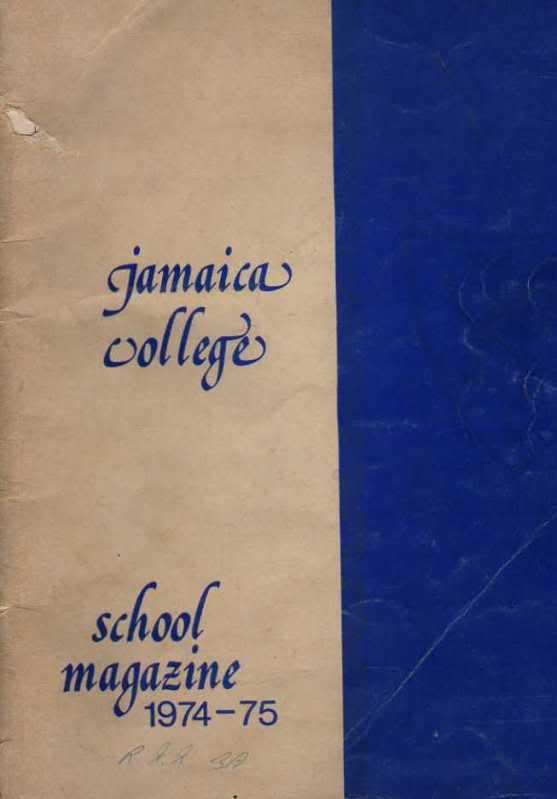
Sitting at the top of the list was an e-mail from Harold Mitchell, who had been searching the Net for the names of old friends, when he stumbled upon my blog. I hadn’t seen nor had I heard from him in years! In fact, had to dig through my copy of the Jamaica College ('75) yearbook, of which I was the literary editor, to recall his face.

A flood of memories of Jamaica at Christmas (including the poem by Roger Mais—it’s as if those old poets always knew we would be a wayfaring people) came back: football, the Mona Heights fair, and friends.

Yes, I know, memory is selective. But sometimes that is a good thing. In this case, I have used my memories of Jamaica to rebuild my life in Florida. I have taken the best that living in Jamaica has taught me to recreate a life here.

So, although I can no longer go to the fair nor do I play football, I still have a few friends with whom I can share some great memories. Here’s the post that Harold found:


***

April 12, 2008

Jamaican Memory Joggers

Jamaican Flag Now that I've turned fifty, I think I can indulge myself in this e-mail that my brother, Burt, sent me, which has been compiled via e-mail chain.

I've decided to publish it because I've written about so many of these people, places, and events in my poetry collections, Exodus and Other Poems, Florida Bound, hurricane center, xango music; my novel, Benjamin, my Son, and short stories, Uncle Obadiah and the Alien.

Interestingly, these topics (many of which I've had to add to my dictionary in Microsoft Word) have also been the subject of a few posts (see below) that I've written about on this blog. And while some are specific to Jamaica, they are also transglobal, generational memories that bloggers such as Rethabile and Stephen Bess share.

Yet, even as I write this, I realize that this is not merely nostalgia. These memories shaped what I have called the Reggae/Rastafari Generation (Benjamin) or the Jamaican Baby Boomers, many of whom are now part of the Jamaican Diaspora.

One of a writer's duties (see how non-American I am) is to memorialize and analyze--name--the people, places, events, lives, and light (genius) of his/her people. The bad, the good, and the ugly. To put into words what others have seen, heard, tasted, smelled, and felt in a way that only s/he can.

And even though these memories are selective, they tell us about who we are/were (class divisions and aspirations) and about our expectations of what a "good life" should be.


People

Miss Lou

Sister Maureen Clare at Immaculate (I Can't Have Sex) with her ruler and flashlight for separation at the fetes

Radcliffe Butler on RJR with 'The Butler Did It', 'Midnight Mood'.

Dorothy La Croix (Dottie Dean).

Mr. Mac gas station at the bottom of Old Hope Road with the foul mout parrot.

On Radio, Charlie Babcock, CB, the cool fool, the man about town.

Mista Chin, who told Charlie Babcock, "Yu nuh cool fool, yu damn fool, call man at 5 o'clock in the mawning"

Lannaman's Lollipop Land for Children with Dorothy Hosang.

Half Pint, Pint Bottle - pronounced (Hep pint, pint bakkle) by the man on his donkey cart.

The Rasta man selling 'cobweb' brooms on Sundays with his "Brooman" shout.

Shrimpy man on his big head Honda 50 .... selling more than just shrimp!

Runna ... he used to run naked up Wellington Drive towards Mona Dam.

Wayne Chin - "Win Chin say man who ride and dilly dally, end up on hospital trolly". "Win Chin say, man who go to bed with stiff problem, wake up with sticky solution".

InCrowd (Peter Phillips) - never did understand why they played "Chirpy Chirpy Cheep Cheep"!!

The "walker" on Hope Road with the bruk foot and stick

Fudgie – fudge man

Gleeeeeeeeeeeeeeaner! – Gleaner man!

Starrie – Star man

Spoogie – DJ

Barry G – DJ

Francois – DJ

Maas Ran

Reverend V. B.

Boops: "See im deh… im still de bout"

Jacket

Three Piece Suit an Ting

Places

If the rocks at Mona Central Park could talk!

Port Royal tower by the police station.

Cable Hut beach

Riding a Honda to Cable Hut to hear Mystic Revelation of Rastafari

Roy Reid - 'Reid at Random'.

Monty's Drive-In after Harbour View movies.

Bath Botanical Gardens in St. Thomas.

Sharkey's.

Gino's Fast (Fart) Food.

Theophany

Dizzy's

Topsies.

Tropics.

Epiphany, when it was run by Evon Williams.

Tuck Shops!

Turn Table Time' with E.T.

Bob singing at Dizzy's

Getting lost in the Maze at Hope Gardens

Empty lots in Harbour View

Four lines of bumper to bumper into Harbour View Drive In

Thursday Nights drag racing in front of Epiphany (when Barry Lee was the Manager)

When you were leaving on a flight from Palisadoes to go to Miami for one week and the whole family would turn out to wave from the Waving Gallery?

Lime night at Mona Church youth group

Turn Table Club – Merritones

CONEY PARK!

When Mother's was one of only 5 fish & festival stalls at Hellshire

Sports Clubs – the hang out in our young professional adulthood – every company worth its salt had one for during the week after work limes domino etc NCB Sports Club,

Myers Fletcher, JPS, Citizens Bank

Suzette – Bus to greater Portmore

Milkshake at Dairy Farmers

Banana Split at Oxford Pharmacy

Monty's Drive Inn

Kelly's soft drinks

Shakey’s Pizza

Events

JC boys descending on St. Andrew High school "events," and Ms. Reader going berserk!

Day Fete – party we can go to in the day since we were not allowed out to late night party

Ring Ding

Jonkanoos who actually came to your house at Independence.

Chukka Mo ... ice cream bar

Drag racing in New Kingston & Red Hills gully

When your phone had a party line

5 digit phone numbers

Long walks home with friends after crashing a party in Hope Pastures, Barbican, and Graham Heights.

Jamaica Omnibus Service.--Jolly Joseph and Patty Pan bus

Palisadoes airport.

When you could actually swim at Gunboat Beach.

When Havendale was the place to live.

When JBC Radio 2 played commercial free music.

When you could walk yards out into the crystal clear waters at Hellshire.

Boulevard Drive Inn (now JPS).

Burgerman on Trafalgar Road (I believe it is now called Veranda).

Brooks Shoppers Fair on Washington Boulevard.

Ford Anglia motorcars.

Morris Minors with the indicators that flipped out.

Times Stores.

Standing on your roof and listening for the direction the music was coming from to crash the party.

Where It's At (Not)

Matilda's Corner barber (where the Texaco gas station is now)

The milkman and the bread man delivering in the cart then van

When 22 and 67 were the new bus routes

Teenage hikes to New Castle and Hardware Gap

Taking the train to MoBay

When you got to a party, not knowing how you were getting home at 3 or 4 in the morning.

Going home from the party with 10-12 people in the same car OR walking home.

Idle-nights (Thursday nights).

Not knowing what a gun-shot sounded like (not even knowing they existed?).

Independence.

TV just coming in -- black & white of course!

Bike-back (don't forget the lean).

The huge black telephones with round dials that moved as you dialed the number.

Watching Bonanza and the Cartwrights on Friday nights

Silver Slipper Shopping Center

Carib, Regal and Premier Cinemas

"Bumming" a ride

When people used to dress up in their Sunday best to go a farin.

Portable record players - 45s and LPs

Swimming at Cable Hut beach then going to Cane River to wash off.

Swimming at the far beach pass Hellshire and the twin caves above Hellshire.

Hanging out at Doctor's Cave beach in the summer.

Hanging out at Silver Slipper Plaza after school.

Saturday afternoon movies at the movie theatre on Constant Spring Road, a muss!!

San Diego shopping bus parked on Constant Spring Road with de black 'merican guy, listening to Santana and burning incense...

Hiding people in the back seat of the car to get in cheaper at the Harbour View Drive-In

Going to Harbour View drive in just for the food and the 'lime'

Girls champs and Boys Champs (they were separate then) - nuff cheering in Grandstand

The long circuitous route home after Mona Youth Club (Friday nights)

York Pharmacy/Oxford pharmacy for ice cream sodas and hot dogs

Manor Park pharmacy with the soda fountain (like in Happy Days).

Romper Room on JBC.

Festival floats and going to Stadium to watch them during Independence.

Thruppence, sixpence and shilling.

Style

"Crepe sole boot" or "boogas" now called "sneakers"

The perfectly shaped Afro

Hot pants and platform shoes

Finishing the dress just 15 minutes before being picked up to go to the party ("spot")

Tony C – hairstyle

Napoleon – hairstyle

The chukkie (speng length, drewters etc) vs. soul boy (bellbottoms, platforms etc) identity/fashion clash

"Stepping" and doing the Hustle at parties and night clubs to show off.

"Blues" Dance at University Union and Stand Pipe when every one was defending Rasta and dressing with Dreads, "Speng" pants, tam and a rag

Music & Dance

Turn Table when they "fly" the gate at 2pm. and you get in and step to Nina Simone's "My Baby Don't Care.

Getting the latest 45 or LP from Derrick Harriot's or Record Plaza

The Jackson 5 were HOT!

Billy Dee Williams in Lady Sings the Blues...or anything, for that matter......sorry...Denzel has now taken over!

Everything MOTOWN......Diana, Supremes, Smokey, Four Tops, Temptations, Stevie Wonder, Marvin etc....it doesn't get any better!!

Knowing the words to all the Delfonics hits

Being stuck for 13 minutes and 42 seconds with the wrong guy when the put on Isaac Hayes' "I Stand Accused"

The Emotions

Listening to the latest 45 or 33 in a sound booth at the record shop.

Crystal Blue Persuasion

Rent-a-tile

Red Red Wine.

"Late night at the Party" anthems: "Oh Carolina," "Satta," "Reasons," and others?


If you can think about any other, please add them to the Comments...


Related Posts:

Mona Heights, Stand Pipe, August Town

http://geoffreyphilp.blogspot.com/2006/03/where-in-world-is-mona-heights-jamaica.html

http://geoffreyphilp.blogspot.com/2006/03/podcast-of-domino-scene-from-benjamin.html

http://geoffreyphilp.blogspot.com/2006/12/jamaican-christmas-story.html

http://geoffreyphilp.blogspot.com/2007/10/my-jamaican-touch.html

http://geoffreyphilp.blogspot.com/2007/12/my-jamaica-part-two.html

http://geoffreyphilp.blogspot.com/2007/11/my-jamaica-part-one.html

http://geoffreyphilp.blogspot.com/2006/03/dominos.html


Jamaica College (JC)

http://geoffreyphilp.blogspot.com/2006/04/not-exactly-art-but.html

http://geoffreyphilp.blogspot.com/2007/06/reasonable-men-living-in-unreasonable.html

http://geoffreyphilp.blogspot.com/2006/12/happy-birthday-dennis-scott.html

http://geoffreyphilp.blogspot.com/2006/03/how-i-became-herbert-spliffington-esq.html


Music

http://geoffreyphilp.blogspot.com/2008/03/five-songs-i-must-have-for-my-i-pod.html

http://geoffreyphilp.blogspot.com/2007/06/artist-and-tragic-muse.html

http://geoffreyphilp.blogspot.com/2007/02/grooving-down-state-road-nine-this.html

http://geoffreyphilp.blogspot.com/2007/01/terrible-beauty-is-born-jamaica-in.html