Showing posts with label Olive Senior. Show all posts

January 10, 2019

Geoffrey Philp's Blog: A Recap of 2018


I'm beginning to worry about my blog. Last year, I only had 26K visitors, which is down 9.97% from the previous year. However, the standouts from previous years are still holding strong. Here, then, are the top ten posts from 2018:

1. The Meaning(s) of Bob Marley's Songs"
2. "Little Boy Crying" by Mervyn Morris: An Appreciation
3. "Colonial Girls School" by Olive Senior: An Appreciation
4. "Ode to Brother Joe" by Tony McNeill (Read by Geoffrey Philp)
5. Marcus Garvey's Crime (Part One)
6. "Uncle Time" by Dennis Scott (Read by Geoffrey Philp)
7. Happy Independence Day, Haiti!
8. Garveyism is an Outdated Ideology: A Rebuttal
9. 25 Foundational Rocksteady Songs: Winston Barnes
10. "Boat People" by Felix Morisseau-Leroy

I've also picked up more visitors from South Africa than the previous year, which is up by 24.2%. and I'm happy that "Boat People" by Felix Morriseau-Leroy has finally made it into the top ten.  The work of Felix Morisseau-Leroy should never be forgotten.


A big thank you to all the visitors, especially those who have continued to support the books on my Amazon page, and I wish for you all the happiness, joy, and peace that you can imagine. 

***


March 10, 2013

Women's History Month: Caribbean Women Writers

Caribbean Women Writers 
(L to R)

In celebration of Women's History Month, here are a few of the Caribbean women writers whose work has been featured on this blog:


Caribbean Women Writers 

***

I am also giving thanks for the many women who have helped, guided, and inspired me through the years: Merty Philp (nee Lumley), Nadezka Philp (nee Ferro), my two daughters, aunts, sisters, my mother and sisters-in-law, Andrea Shaw, Andrene Bonner, Sokari Ekine, Barbara Makeda Blake Hannah, Yvonne McCalla-Sobers, Ida Does, Vanessa Woodward Byers, Michelle McGrane, Marva McClean, Ludy Rodriguez, Josett Peat, Donna Aza Weir-Soley,  Patti Harris, Gina Cortes-Suarez, Lou Skellings, Malou Harrison, Hannah Bannister, Dawn Marache-Allen, Heather Russell, Hazel Campbell, Diane Browne, Cynthia James, Jean Lowrie-Chin, Karean Hailey Williams, and Audrey Hadley.


 I am blessed to have known the pleasure of your company.

1Love,
Geoffrey


***

Enhanced by Zemanta

October 8, 2012

Bocas in Miami!

Bocas Lit Fest

The body of water Miami faces is the Atlantic Ocean, but — 180 miles from Nassau, 220 miles from Havana — there’s no doubt it’s also a Caribbean city. And for a few days in mid-October, Miami will also be a major hub for Caribbean literary scholarship, as the University of Miami hosts the 31st annual West Indian Literature Conference, with the theme “Imagined Nations, 50 Years Later: Reflections on Independence and Federation in the Caribbean.”

And the NGC Bocas Lit Fest will be part of the mix! We’ll be hosting a reading by five remarkable writers of different generations, as part of the closing night events of the WILC — and everyone is invited. The details:

Nations and Imaginations: An Evening with the NGC Bocas Lit Fest in Miami
Featuring 2012 OCM Bocas Prize winner Earl Lovelace, 2013 OCM Bocas Prize chair Olive Senior, Edwidge Danticat, Edward Baugh, and Lisa Allen-Agostini.

Saturday 13 October, 8 pm
Books and Books, 
265 Aragon Avenue, Coral Gables

The event is free and open to the public. Bocas fans in Miami, hope to see you there!

***

Blog Disclosure Policy


Geoffrey Philp’s Blog Spot receives a percentage of the purchase price on anything you buy through links to Amazon, Shambala Books, Hay House, or any of the Google ads or Google Custom Search.

*** 

Disclaimer of Endorsement


The documents posted on this Web site may contain hypertext links or pointers to information created and maintained by other public and private organizations. These links and pointers are provided for visitors' convenience. I do not control or guarantee the accuracy, relevance, timeliness, or completeness of any linked information. Further, the inclusion of links or pointers to other Web sites or agencies is not intended to assign importance to those sites and the information contained therein, nor is it intended to endorse, recommend, or favor any views expressed, or commercial products or services offered on these outside sites, or the organizations sponsoring the sites, by trade name, trademark, manufacture, or otherwise.

Reference in this Web site to any specific commercial products, processes, or services, or the use of any trade, firm or corporation name is for the information and convenience of the site's visitors, and does not constitute endorsement, recommendation, or favoring by this blog.

May 25, 2012

Calabash Jubilation! Begins Today


JUBILATION! 50 is a celebration of Jamaica's 50th anniversary of independence. The selection of authors and performers come from Nigeria, Ethiopia, South Africa, the UK, USA, and Jamaica.

May 25-27, 2012, 
 Jake's Resort 
Treasure Beach
St. Elizabeth, Jamaica.
Authors

Chimamanda Adichie.
The Admiral
Wayne Armond
Jacqueline Bishop
Loretta Collins
Carolyn Cooper
Michael “Ibo” Cooper
Christine Craig
Fred D'Aguiar
Marcia Douglas
Garfield Ellis
Carolyn Forche
Steve Golding
Vivien Goldman
Colin Grant
Laura Henzell
Paul Holdengraber
Melissa Jones
Sadie Jones
Ronnie Kasrils
Victor Lavalle
Shara McCallum
Alecia McKenzie
Maaza Mengiste
Anis Mojgani
Orlando Patterson
Patricia Powell
Claudia Rankine
Olive Senior
Seretse Small
Sonjah Stanley Niaah
Ian Thomson
Kerry Young
Kevin Young


Please follow this link for the schedule: http://www.calabashfestival.org/2012/schedule.html


***

Blog Disclosure Policy


Geoffrey Philp’s Blog Spot receives a percentage of the purchase price on anything you buy through links to Amazon, Shambala Books, Hay House, or any of the Google ads or Google Custom Search.


***

Disclaimer of Endorsement


The documents posted on this Web site may contain hypertext links or pointers to information created and maintained by other public and private organizations. These links and pointers are provided for visitors' convenience. I do not control or guarantee the accuracy, relevance, timeliness, or completeness of any linked information. Further, the inclusion of links or pointers to other Web sites or agencies is not intended to assign importance to those sites and the information contained therein, nor is it intended to endorse, recommend, or favor any views expressed, or commercial products or services offered on these outside sites, or the organizations sponsoring the sites, by trade name, trademark, manufacture, or otherwise.


Reference in this Web site to any specific commercial products, processes, or services, or the use of any trade, firm or corporation name is for the information and convenience of the site's visitors, and does not constitute endorsement, recommendation, or favoring by this blog.

February 21, 2012

Call for Papers: The Caribbean Poetry Project


The Caribbean Poetry Project, is a pioneering collaboration between Cambridge University Faculty of Education, the Centre for Commonwealth Education, and the University of West Indies at Mona (Jamaica), St Augustine (Trinidad) and at Cave Hill (Barbados). Through a joint research and teaching programme, this three-year project will encourage engagement with Caribbean poetry, and improve the teaching and learning of Caribbean poetry in both British and Caribbean schools.


Peepal Tree Press is delighted to be a partner and associate member of the CPP team, collaborating on a poetry anthology. This will focus very much on contemporary caribbean poetry, the aim of the collection is to introduce young people to Caribbean poets and new work. Students and teachers taking the Teaching Caribbean Poetry Course in Jamaica, Trinidad, Barbados and the UK will participate in the selection of work. The anthology will be edited by Jeremy Poynting, Peepal Tree Press, and Dorothea Smartt, poet and Peepal Tree's CPP advisory panel representative.

CARIBBEAN POETRY PROJECT

The Power of Caribbean Poetry - Word and Sound
A conference on Caribbean poetry,
Homerton College, Cambridge University, Faculty of Education
Thursday 20 – Saturday 22 Sept 2012

Speakers / performers include: John Agard, Beverley Bryan, Kei Miller, Mervyn Morris, Grace Nichols, Velma Pollard, Olive Senior, Dorothea Smartt

The first two days of this international gathering will take the form of an academic conference, the final day having a more educational focus and therefore likely to appeal to teachers as well as scholars. Members of the Caribbean Poetry Project from Cambridge University Faculty of Education and the University of West Indies will be hosting the conference and disseminating its outcomes. Marilyn Brocklehurst’s bookshop will be available throughout the conference and some project partners, such as the online Poetry Archive and Peepal Tree Press, will be represented.


CALL FOR PAPERS

·      Caribbean poetry and the word
·      Origins and histories of Caribbean poetry
·      Particular poets e.g. appreciation of the work of Derek Walcott / Kamau Brathwaite
·      Re-reading Caribbean poetry
·      Caribbean poetry and music
·      Ecocriticism and Caribbean poetry
·      Caribbean landscapes
·      Poetry as emancipation
·      Caribbean British poetry
·      Approaches to learning and teaching Caribbean poetry
·      Migration and location in Caribbean poetry
·      Gender in Caribbean poetry
·      Caribbean poetry and postcolonial theory
·      Caribbean poetry and the curriculum

Abstracts (300 words approx.) should be sent to Bryony Horsley-Heather (bsjh2@cam.ac.uk) by the end of MARCH 2012.

Conference fees including lunch, dinner, tea & coffee will be £200. Day rate £75 for 20th, £100 for 21st and £70 for 22nd for bookings before May 1st 2012. Accommodation available at Homerton College at £60 per night. Online registration will be available via the website from November 2011 - See http://caribbeanpoetry.educ.cam.ac.uk/ for updates.

For further information, contact Morag Styles (ms104@cam.ac.uk) or Bryony Horsley- Heather (bsjh2@cam.ac.uk) or visit http://caribbeanpoetry.educ.cam.ac.uk


***


If you enjoyed this post, check out my page on Amazon. I’d also be very grateful if you’d help it spread by emailing it to a friend, or sharing it on Twitter or Facebook. Thank you!

October 10, 2010

Save the Date: Geoffrey Philp Reads DUB WISE @ Books & Books


Tuesday, October 19, 2010
8:00 pm
265 Aragon Avenue
Coral Gables, Fl 33134
305-442-4408

Geoffrey Philp is a poet and fiction writer who teaches English at Miami Dade College, where he also chairs the North Campus' College Preparatory Department. Born in Kingston, Jamaica, he attended Mona Primary and Jamaica College, where he studied literature under the tutelage of Dennis Scott. When he left Jamaica in 1979, he went to Miami Dade College and after graduating, studied Caribbean, African and African-American literature with Dr. O.R. Dathorne and creative writing with Lester Goran and Isaac Bashevis Singer at the University of Miami, where he earned both a baccalaureate degree and Master of Arts in English. In 1991, he returned to the U. of Miami as a James Michener Fellow and studied poetry under Kamau Brathwaite and fiction with George Lamming.

Prof. Philp has published five collections of poetry; a children's book; two books of short stories, Who’s Your Daddy? and Uncle Obadiah and the Alien, and a book of poems and short stories titled Twelve Poems and a Story for Christmas. His master's thesis, Benjamin, My Son, was published by Peepal Tree Press in 2003. A critically acclaimed author, Philp's work has appeared in numerous journals and anthologies, including  Small Axe, Gulf Stream, Canopic Jar, Wheel and Come Again: An Anthology of Reggae Poetry, the Oxford Book of Caribbean Short Stories, the Oxford Book of Caribbean Verse, tongues of the ocean and St. Somewhere Journal.

This evening, Geoffrey Philp will read excerpts from his newest collection of poems, Dub Wise. Scheduled to be released by Peepal Tree Press in late September, it has already garnered praise from other poets:

“Without losing the joy of play or the play of the rhythms, Dub Wise celebrates the burdens and delights of love, friendships and the responsibility of being at home in the world.”--Olive Senior

“Geoffrey Philp...sensitively explores his complex heritage, alert to the environment he has entered and to his Jamaican roots.” --Mervyn Morris

“Above all, there is the continuing infolding of a ‘Jamaica Tradition’ as being established in the voices of Morris &  Dawes, plus also the acknowledgment of McNeill, Baugh, Mikey Smith & Garvey, and the NL of Jean Binta Breeze.” --Kamau Brathwaite.

***


March 11, 2010

Olive Senior in Bermuda


I want to feel

though you own

the silver tea service

the communion plate

you don't own

the tropics anymore.


From: Meditation on Yellow

"I don't know enough about the situation in Bermuda to really comment on writing here," said Mrs. Senior. "I find it interesting how Bermudians define yourselves. 


"You are not necessarily Caribbean. You are between American and British culture.

"That is an interesting space for writers. You have a fascinating history. It is for the writers to help to define what you are.

"In Jamaica, writers were part of the whole postcolonial movement and defining the nation. This is probably where you are now." 


Mrs. Senior will be doing a reading and book signing in the Bermuda College between 6 p.m. and 8 p.m. on March 18. The event will be sponsored, in part, by the Department of Community and Cultural Affairs.


***
Thanks, Rethabile!

October 20, 2009

The Cropper Foundation: 2010 Workshop


THE CROPPER FOUNDATION
&
The Departments of Creative & Festival Arts and Liberal Arts
The University of the West Indies, St. Augustine

Residential Workshop for Caribbean Creative Writers

Are you the next Walcott? Naipaul? Lamming? C.L.R. James? Olive Senior? The 6th Caribbean Creative Writers’ Residential Workshop sponsored by THE CROPPER FOUNDATION, and organised in partnership with the Department of Creative and Festival Arts, and the Department of Liberal Arts, The University of the West Indies, St Augustine, will take place from July 5th to July 23rd 2010 in Trinidad and Tobago.

Fifteen writers who have not published a novel or collection of short stories, poems or plays will be chosen from across the Caribbean to join this year’s residential workshops.

The 2010 Workshop will focus on fiction, playwriting and poetry and will be facilitated by Professor Funso Aiyejina and Dr. Merle Hodge at a secluded writing-inducing setting location somewhere in Trinidad. Support for Caribbean Writing is an ongoing programme of The Cropper Foundation that seeks to contribute to the development of the Caribbean on many levels and in different areas of interest. The writers' workshop is part of the Foundation's effort to encourage new Caribbean literary voices by providing practical advice on the craft of writing. The workshops this year will culminate with the Launch of the first Anthology of Cropper Foundation participants’ writings – ‘Moving Right Along...’ as well as a celebration of the 10th Anniversary of THE CROPPER FOUNDATION.

Over 80 writers from Antigua, Bahamas, Barbados, Belize, British Virgin Islands, Commonwealth of Dominica, Guyana, Jamaica, Trinidad and Tobago, and the Caribbean Diaspora (Canada, USA, France, and UK) have competed to take part in these workshops held so far in Grand Riviere and Balandra on the eastern end of Trinidad's north coast, on Gasparee Island off Trinidad’s northwest peninsula, and in Tobago. From the participants of this workshop series, Lelawattee Manoo-Rahming (Bahamas) and Lenworth Burke (Jamaica) went on to win the Commonwealth Short Story Competition and the Jamaica Observer's Annual Fiction Award respectively; Ruel Johnson (Guyana) has won the Guyana Literature Prize 2003, Krishna Ramsumair (T&T) has published a number of short stories in local and international journals; Robert Clarke (T&T) received a Trinidad Guardian Writer of the Month award, as well as an EMA 2003 Green Leaf Award for journalism; and Tiphanie Yanique is now an Editor with Calabash and Story Quarterly.

For this year's Workshop, a maximum of fifteen participants will be selected from entries only from the Caribbean. The moderators will be novelist Dr. Merle Hodge (Crick, Crack Monkey and For the Life of Laetitia) and poet and short story writer Professor Funso Aiyejina, winner of the 2000 Commonwealth Writers Prize (Africa) for The Legend of the Rockhills and Other Stories. They are both lecturers at UWI, St Augustine, in the Faculty of Humanities and Education.

Participants will engage with published authors and professionals from the publishing industry, as well as speakers from a variety of other disciplines including history, culture and political science. Applicants, twenty years and above, who are Caribbean nationals residing in the Caribbean, are invited to submit application forms and samples of their writing (five pages only) no later than November 15th 2009 to the following address: Writers Workshop, Department of Creative & Festival Arts, The University of the West Indies, St. Augustine, Trinidad. Works of prose fiction, playwriting or poetry, either published or unpublished, will be considered for this workshop.


For application forms and further information, please call Dr. Dani Lyndersay (868) 663-0442; Ms. Rhoda Bharath (868) 779-7457 or Ms. Marissa Brooks 662-2002 ext. 3040 at The University of the West Indies, or email: MarissaUWI@gmail.com.

***

Reblog this post [with Zemanta]

September 25, 2008

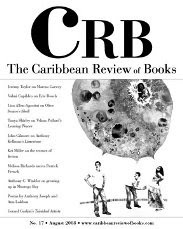
The Caribbean Review of Books: August 2008

The Caribbean Review of BooksYesterday evening I got my anxious hands on the latest copy of The Caribbean Review of Books which I began reading immediately.


Here are a few highlights from August 2008 issue:


Marcus Garvey

Hail to the Chief

Jeremy Taylor on Negro with a Hat: The Rise and Fall of Marcus Garvey, by Colin Grant


Olive Senior

What Lies Within

Lisa Allen-Agostini on Shell, by Olive Senior


Lorna Goodison


I Know the Language is True

Lorna Goodison talks to Nicholas Laughlin about writing her family memoir From Harvey River


My reading lasted way into the night—hence the brevity of this post. Even the marginalia was great!


***

Source of photos: The Caribbean Review of Books

September 17, 2008

"Flying" by Olive Senior

Olive Senior

For those longing to read a good short story grounded in Caribbean reality, history and mythology, check out “Flying” by Olive Senior at The Maple Tree Literary Supplement.


Here’s a taste:


His father had bought him a return ticket, first class at that, but as the plane banked sharply for its descent, he wondered if airlines reimbursed for the portion unused in case of death. He knew he would never return on that ticket. He was twenty-six years old, and he had come back to the island to die. His father didn’t know that, although he had recognised he was ill enough to warrant the comfort of first class. He was touched: his father was normally tight-fisted. Perhaps he did know. Perhaps everyone knew. Family, friends, strangers on the street. Everybody knew but nobody wanted to know.


Olive Senior was born in 1941 to peasant farmers in Trelawny, Jamaica, the seventh of ten children, and later migrated to Canada. She is the author of several collections of short stories: Summer Lighting (1986), Arrival of the Snake-Women (1989), and Discerner of Hearts (1995); collections of poetry Talking of Trees (1986), Gardening in the Tropics (1994), and Over the roofs of the world (2005); and non-fiction about Caribbean culture: A-Z of Jamaican Heritage (1984) – greatly expanded and republished in 2004 as The Encyclopedia of Jamaican Heritage – and Working Miracles: Women’s Life in the English Speaking Caribbean (1991).

***

September 10, 2008

Soon Come: A Primer on Jamaican Poetics and Religions

Soon ComeBesides having a highly readable style, Hugh Hodges' Soon Come (University of Virginia Press) provides a useful context for understanding Jamaican religions such as Myal, Kumina, Revivalism, and Rastafari and their connection with the work of poets such as Mervyn Morris, Dennis Scott, Pam Mordecai, Anthony McNeill, Lorna Goodison, Olive Senior, and other post-Independence writers*. By his examination of these two important facets of Jamaican life, Hodges has created a true work of criticism by completing the feedback loop and revealing the premises upon which many Jamaican poets base their work.

Hodges begins his analysis with the earliest settlements in Jamaica and the impact of the slave trade on the Jamaican worldview. From the growth of Myal with its emphasis on communal rites and the work of the Baptists with their emphasis on freedom and personal experience, what emerged was an ethos that combined the personal and the communal into a potent mix that continues to shape the Jamaican character.

What intrigued me was the connection that Hodges was able to establish among Myal, Revivalism, and Rastafari, the role of the individual and the community, and the concept of "I and I": "The functions of prophet, healer, and redeemer are shared by "I and I." In the Rastafarian worldview there can be no uplift of "I" without the uplift of "I and I" (135). Although I still believe that InI was part of the mystic revelation of Rastafari, the historical linkage of Myal, Revivalism, and Rastafari cannot be overlooked.

It is, however, his analysis of the salient features of the Jamaican worldview that drew my attention: "The belief in the mystical power of the spoken word; the related belief in the eudaemonic power of music; the belief that divine rewards and punishments will be meted out in this life, and the conviction that all things are religious" (133).

For me, this was like staring into a mirror and recognizing myself for the first time.

As artists we only know that we are intuitively driven to write a poem this way or to tell a story that way. We work with images and dramatic situations that are suggested by our imaginations to create our fictions, and because we are concentrating so much on our craft (words, images, plot, imagery and rhythm), we are quite often blind to the full meanings of our work. The images and characters that flit into our imagination are usually formed during our formative years when we unquestioningly accepted these influences.

But the whole point of being an artist is to question these images. Our methodology, however, has a fatal flaw: we are using the same methods (image, character, and symbol) to decipher our experiences. and to create a text. Soon Come fills the gap between our art and our meanings and provides the critical vocabulary and the distance to chart new directions for artistic growth.

Hodges has given me a criterion, not only to understand my own work, but also that of my contemporaries, and for anyone wishing to learn more about the connection between Jamaican religious thought and Jamaican poetry, I highly recommend Soon Come.

***

*Full disclosure: Soon Come gives a favorable mention to some of my poems.

April 26, 2007

Forthcoming Titles from Peepal Tree Press

Peepal Tree
"I Love The River’s Song! It was so hard to put it down! Gloria’s coming-of-age story is warm and true and bittersweet. Hers is no wide bridge over the river but a rocky path to womanhood, to friendships made and lost and to the knowledge that love also requires navigation. The River’s Song is a song we’ve all heard before, but never with such force and clarity as this."~Olive Senior


You know you're in for something special...

The River's Song a novel by Jacqueline Bishop

Gloria, living with her mother in a Kingston tenement yard, wins a scholarship to one of Jamaica’s best girls’ schools. She is the engaging narrator of the at first alienating and then transforming experiences of an education that in time takes her away from her mother, friends and the island; of her consciousness of bodily change and sexual awakening; of her growth of adult awareness of a Jamaica of class division, endemic violence and the new spectre of HIV-AIDS.

The novel’s strengths lie in the pace, economy and shapeliness of its page-turning narrative; in its poetic descriptions of urban and rural Jamaica; and above all in the quality of its characterisation and the dramatisation of Gloria’s relationships with her mother, grandmother and the girls she has always known in her grandmother’s rural village, with Rachel, their neighbour in the yard who is Gloria’s rock of understanding, and, at the heart of the novel, with Annie, the purest and indivisible love of her adolescent years.

The book will be available in early May, so for now please enjoy this extract.

Click here for the extract: Gloria's first day at High School

Also Coming Soon from Peepal Tree Press

Jennifer Rahim
Songster and Other Stories
ISBN: 1-84523-048-5, Price: £7.99
Rahim’s stories move between the present and the past to make sense of the tensions between image and reality in contemporary Trinidad.


Lynne Macedo & Kampta Karran
No Land, No Mother
ISBN: 1-84523-020-5, Price: £12.99
The essays in this collection focus on the rich dialogue carried out in David Dabydeen’s increasingly diverse and critically acclaimed body of writing.

Laurence A. Breiner
Black Yeats: Eric Roach and the Politics of Caribbean Poetry
ISBN: 1-84523-047-7, Price: £17.99
Laurnce Breiner's study not only provides the materials for an enhanced reading of Roach's poetry and a persuasive argument for its importance, but also shows Roach's life and work to have been at the centre of the cultural politics of Caribbean writing.

Karen King-Aribisala
The Hangman's Game
ISBN: 1-84523-046-9, Price: £8.99
A slave rebellion in nineteenth century Guyana and a military dictatorship in recent Nigeria intercut and merge in unsettling ways as the characters in the historical novel-within-a novel erupt into their Caribbean author's life in Nigeria.


Peepal Tree Press
17 King's Avenue
Leeds, West Yorks LS6 1QS


Phone: +44 (0) 113 2451703

E-mail:
contact@peepaltreepress.com


***

April 16, 2007

"Colonial Girls School" by Olive Senior: An Appreciation


In Frances-Anne's post, she wrote, "Creation is a form of Terror, particularly when you come from a colonial context and background in which Empire (read: a sense of inferiority) was imposed through education, language, culture, as much if not more than through the barrel of a gun." This insult to our minds, hearts, and bodies is one of the themes of Olive Senior's, "Colonial Girls School," and the erasure of sense and sensibility by suppression of the natural, denial of the native, and the implied superiority of "northern eyes" is masterfully woven through the text with use of the prefix-de. The poem's iconoclastic language relies on the metaphor of "images" that are shattered at the end of the poem, "How the mirror broke," and the word play on "pale."


Colonial Girls School
For Marlene Smith MacLeish


Borrowed images
willed our skins pale
muffled
our laughter
lowered our voices
let out our hems
de
kinked our hair
denied our sex in gym tunics and bloomers
harnessed our voices to madrigals
and genteel airs
yoked our minds to declensions in Latin
and the language of Shakespeare

Told us nothing about our selves
There was nothing at all


Throughout the first stanza and the refrain, the speaker uses the language of servitude and slavery with the words, "muffled," "lowered," and "harnessed." The girls' bodies "our skin, " and minds have been "yoked" to a system that is foreign to their way of being.


How those pale northern eyes and
aristocratic whispers once erased us
How our loudness, our laughter
debased us.
There was nothing left of ourselves
Nothing about us at all


The speaker continues to show the effects of the "pale northern eyes" on the girls and the subsequent reduction of self-esteem.


Studying: History: Ancient and Modern
Kings and Queens of England
Steppes of Russia
Wheatfields of Canada

There was nothing of our landscape there
Nothing about us at all


The next stanza is a turning point in the poem after the catalogue of injustices wrought by colonialism that resulted in the speaker's inability to "see" herself history, the landscape and literature, or even to appreciate herself because "There was nothing at all." Racism and patriarchal colonialism result in a kind of invisibility that was fully explored in Ralph Ellison's, Invisible Man.

Marcus Garvey turned twice in his grave.
'Thirty- eight was a beacon. A flame.
They were talking of desegregation
In Little Rock, Arkansas, Lumumba
and the Congo. To us mumbo-jumbo.
We had read Vachel Lindsay's
vision of the jungle.

Feeling nothing about ourselves
There was nothing about us at all


Months, years, a childhood memorising
Latin declensions
(For our language
--'bad talking'--
detentions)

Finding nothing about us there
Nothing about us at all

So, friend of my childhood years
One day we'll talk about
How the mirror broke
Who kissed us awake
Who let Anansi from his bag


For isn't it strange how
northern eyes
in the brighter world before us now


Pale?


With the introduction of Marcus Garvey and the Trickster, Anancy (Eshu) there is a reversal of the former condition. Senior masterfully demonstrates the transformation with a change of meaning of the word "pale." The "pale" northern eyes" that once denigrated the speaker's humanity have now become "pale" in significance.

"Colonial Girls School" is one of Olive Senior's best known poems and a study of her short stories and poems reveals a writer who has been grappling with the "decolonization of the mind."

Olive Senior was born in 1941 to peasant farmers in Trelawny, Jamaica, the seventh of ten children, and later migrated to Canada. She is the author of several collections of short stories: Summer Lighting (1986), Arrival of the Snake-Women (1989), and Discerner of Hearts (1995); collections of poetry Talking of Trees (1986), Gardening in the Tropics (1994), and Over the roofs of the world (2005); and non-fiction about Caribbean culture: A-Z of Jamaican Heritage (1984) – greatly expanded and republished in 2004 as The Encyclopedia of Jamaican Heritage – and Working Miracles: Women’s Life in the English Speaking Caribbean (1991).

***

If you are searching for posts about Bob Marley, Marcus Garvey, Rastafari, or Dennis Scott, please check the archives.

Also, if you enjoyed this article, please visit my Author page @ Amazon.com 

 or  donate to this site: 

February 15, 2007

Caribbean Writing Today

A sample issue of Caribbean Writing Today is available online and features poetry, fiction, and non-fiction from the Caribbean and the various diasporas. Edited by Wayne Brown, the journal features the work of Edward Baugh, Mervyn Morris, Olive Senior, Pamela Mordecai, Ramabai Espinet, and lesser known writers such as Sharon Leach, James Aboud, Jacqueline Bishop, Anu Lakham, and Amanda Smyth.

There is also a reprint of CLR James’ “Kanhai: A Study in Confidence” which examines cricket and Caribbean identity.

***