Showing posts with label C. L. R. James. Show all posts

June 25, 2012

Caribbean-American Values


Graphic by Don Rico Ricketts


By Geoffrey Philp


During this year's Haitian Flag Day ceremony at Miami Dade College, Beatrice Louissaint, CEO of the Southern Florida Minority Supplier Development Council, spoke eloquently about the values that have helped her to achieve her much deserved success. In her speech, Ms. Louissaint drew upon her experience of leaving Haiti "equipped with 6 words of English and a strong family heritage," and attributed her meteoric rise with the Caribbean-American community to her "Six Great Loves": "God, family, self, education, hard work, community and country."


It was a moving speech and for many Caribbean-Americans in the audience, it was a confirmation of the values to which many of us have committed our lives. These values have shaped our identity and have laid the foundation for our success.


Yet, the list is incomplete. For I would add justice.


Justice has been the cornerstone of the Haitian/Caribbean revolution, which began in Bois Caiman under the leadership of the Jamaican mystic, Boukman, and was guided by the Haitian general, Toussaint L'Ouverture. As C.L.R. James argued in The Black Jacobins, one of the first official acts of Toussaint L'Ouverture was to put an end to slavery, the greatest injustice of the era: "Slavery was forever abolished. Every man, whatever his colour, was admissible to all employments, and there was to exist no other distinction than that of virtues and talents" (263).


Justice is a human value and gives meaning to our lives. Without justice, we are reduced to existence that is "poor, nasty, brutish, and short." It is this love of justice that is echoed in many national anthems of the Caribbean and in the lyrics of beloved songwriters such as Peter Tosh: "I don't want no peace/I need equal rights and justice" ("Equal Rights").


It is because of the grave injustice that was committed against a leader of the first and largest economic justice movement in the USA, Marcus Mosiah Garvey, that many of us are petitioning President Barack Obama to exonerate Mr. Garvey and to clear his name of any criminal wrongdoing.


If you are a lover of justice, please add your name to the petition:


We are petitioning President Barack Obama to exonerate the Rt. Excellent Marcus Mosiah Garvey, leader of the first and largest economic justice movement in the USA and the world, and the first named National Hero of Jamaica.

On January 12, 1922, Marcus Garvey, founder of the UNIA, was arrested by the Bureau of Investigation and charged with mail fraud. In 1925, Marcus Garvey began serving a five-year sentence in the US penitentiary in Atlanta, Georgia. After several appeals, his sentence was eventually commuted by President Calvin Coolidge, and he was deported to Jamaica. It is now abundantly clear (and legal scholars agree) that Garvey did not commit any criminal acts, but as Professor Judith Stein has stated, “his politics were on trial."

We think the President will agree that this year, 2012, the 125th anniversary of Marcus Garvey's birth, is a most timely moment to correct this historic miscarriage of justice.


***

Blog Disclosure Policy


Geoffrey Philp’s Blog Spot receives a percentage of the purchase price on anything you buy through links to Amazon, Shambala Books, Hay House, or any of the Google ads or Google Custom Search.


***

Disclaimer of Endorsement


The documents posted on this Web site may contain hypertext links or pointers to information created and maintained by other public and private organizations. These links and pointers are provided for visitors' convenience. I do not control or guarantee the accuracy, relevance, timeliness, or completeness of any linked information. Further, the inclusion of links or pointers to other Web sites or agencies is not intended to assign importance to those sites and the information contained therein, nor is it intended to endorse, recommend, or favor any views expressed, or commercial products or services offered on these outside sites, or the organizations sponsoring the sites, by trade name, trademark, manufacture, or otherwise.


Reference in this Web site to any specific commercial products, processes, or services, or the use of any trade, firm or corporation name is for the information and convenience of the site's visitors, and does not constitute endorsement, recommendation, or favoring by this blog.

October 11, 2010

CLR James Library: Saved!


A few years ago, I posed a question about the efficacy of blogging and social media: “Can Blogging Effect Change?”  Even though the results were positive, I still had my doubts because many of the participants were, shall we say, biased?  Today, I've given up those doubts. 

Based on this event,  I now believe that blogging, as a part of the new social media, can bring about change, but there has to be a concerted effort by the stakeholders.

I just received this e-mail from the BEMA Network:

It was just over six weeks ago that BEMA launched the campaign to ensure that the CLR James Library in Dalston, Hackney retain the name when the library is relocated to a new £4.4 million development.

We knew we would get support – after all CLR James was a writer, historian and social activist who had an impact on every continent in the world. The fact that his name was being dropped with no consultation with the black community of Hackney or his widow was an outrage. Yet even we were overwhelmed by the amount of support we received via the petition, emails and phone calls. The support proved just how important it was that Hackney reaffirms its commitment to CLR James and the African Caribbean community in Hackney.

We were also very pleased with the support we got from the local press and radio that covered this story in great detail. The national and international press coverage we received also helped raise the profile of the campaign and brought pressure to bear on the council. Local residents, trade unionists and community groups also played their part.

After meeting with councillors and council officers last week we are pleased to announce that they have seen sense and are now committed to keeping the name of CLR James attached to the library when it relocates. They have also agreed to work with BEMA to create a permanent exhibition at the new library fitting of CLR’s memory. We will also be working with them to devise an annual event in celebration of CLR James and his legacy.

We once again would like to like to thank everyone that signed the petition and showed support. We shall keep everyone posted re
 developments – and if we need to at any stage will call on you for support again in this matter.

Thanks also to Margaret Busby OBE who provided the picture of her alongside CLR at his 80th birthday celebration reprinted here. If anyone else has pictures, writings or memories of CLR James that they want to share please get in touch by emailing us at: bemaadmin@hcvs.org.uk

Please see links below that give just a taste of the support the campaign has received.

* The petition - now signed by close to 3,000 people. Please read some of the heart-felt and heart-warming contributions that people made from around the world. The petition will be closed once Hackney Council has finished their consultation and issue a joint statement with BEMA re their intentions.
http://www.ipetitions.com/petition/saveclrjameslibrary

* Our open letter to the council – signed by notables including Selma James, widow of CLR.http://www.globalwomenstrike.net/content/clr-james-librarylondon-open-letter-against-proposed-name-change

* Hackney Citizen – Comprehensive coverage of what the campaign was all about –
http://www.hackneycitizen.co.uk/2010/10/08/hackney-council-signals-u-turn-clr-james-library-row/

* Hackney Council’s statement via Hackney Hive - http://www.hackneyhive.co.uk/index/2010/10/library-to-keep-the-clr-james-name/

*Hackney Gazette – The local paper that gave support to the campaign - http://www.hackneygazette.co.uk/news/campaigners_succeed_in_saving_the_name_of_dalston_s_clr_james_library_1_676146 

* Dalston People – news outlet reports on Hackney Council apologising to CLR James’ widow.http://www.dalstonpeople.co.uk/groups/developingdalston/Hackney-Council-responds-CLR-James-Library/story-10003437-detail/story.html

* The campaign even made Trinidadian TV - http://www.youtube.com/watch?v=vpMgRzr6fSk

* Community coalition Hackney Unites (BEMA are co-founders) – show support for CLR -http://www.hackneyunites.org.uk/2010/09/save-name-of-clr-james-library.html

* Local MP and BEMA patron Diane Abbott shows support for the campaign www.dianeabbott.org.uk/news/press/news.aspx?p=102631 

* On line support from local news source East London Lines
http://www.dalstonpeople.co.uk/groups/developingdalston/Hackney-Council-responds-CLR-James-Library/story-10003437-detail/story.html
Congratulations to all!

***
Enhanced by Zemanta

September 22, 2010

SAVE THE CLR JAMES LIBRARY!


C.L.R. James
. . . it is appalling to learn that the C.L.R. James Library in Hackney (a borough of London) is going to be renamed the Dalston Library and Archives, after the neighborhood in which it is located. James was there when the library was christened in his honour in 1985. The authorities insist that, in spite of the proposed change, they will continue to honour James. But this seems half-hearted and unsatisfying . . .
— Scott McLemee on the campaign to stop the renaming of the C.L.R. James Library in London. He includes a link to an online petition, which your Antilles blogger has already signed. 


I have also signed the online petition.

Via: http://caribbeanreviewofbooks.com/2010/09/22/transformative-reading/

***

From
The Arrivants through Trench Town Rock to Born to Slow Horses, Kamau Brathwaite has lamented that we live in an "Age of Dis": "By now the Age of Dis. Distress Dispair & Disrespect. Distrust Disrupt Distruction."


 ***

Enhanced by Zemanta

April 4, 2007

Desire, The Secret, and Literary Fictions

BodhidharmaBuddha gathered his disciples at a lake on Gridhakuta for instruction. His adherents sat in a circle about him eagerly awaiting his teachings. Wordlessly Buddha reached into the muck and pulled up a single lotus flower. He then held it high for all to see.

Practically everyone was bewildered. But then the disciple Mahakashyapa began to laugh.

Finally, Buddha handed the lotus flower to Mahakashyapa and said, “What can be said I have said to you, and what cannot be said, I have given to Mahakashyapa.” (Via Copyblogger)

What makes an action significant? Is an action inherently significant or does it depend on the actors or the perception of the observers? The interchange between the Buddha and Mahakashyapa could have been perceived as one person giving another person a flower, but when the contextual clues of teacher and student are added, we understand why this simple action led to Mahakashyapa's realization of Zen. Does the difference between significance and insignificance rest on the intentionality of the actors and the ability to perceive the meaning of the action within the framework of the contextual clues?

In the story above, the disciples of the Buddha were expecting a lecture on being and the Buddha pulled up a lotus-- a flower that had profound cultural significance. Yet only Mahakashyapa realized the profundity of the action. The significance resulted from the Buddha's intentionality (a sign on a focused consciousness) and the meaning was expanded by metaphor. The significance of the action was created by the Buddha's focused consciousness and not from the perception of the observers. In an alternative story I would have written, the Buddha in another incarnation had tried the same lesson, but it didn't work, so he was left with a dead flower in his hand. And even though he knew he was enlightened, he was still sad as he walked down the hill because he knew that he would have to go through another lifetime before one disciple got it, but he was still focused.

In literature, as in life, it is this focused concentration on the significant actions within a community's memory that distinguishes literary from non-literary fictions. The result of this concentration is manifested in sentences, characters, plot, and narrative, and the entire work is marked by an awareness of the complexity of choice within the cultural/historical tradition of a community. In a work of fiction, the desire of the protagonist propels the drama and necessarily invites the presence of an antagonist. This antagonist can be external, internal or external representations of the protagonist's internal conflicts. Is it me, them, or there is no "them," Spoon Boy? Either way, if there is no desire, there is no drama.

Writers and prophets tread the same hallowed ground of desire and often ask the same questions: what is the nature of desire? What is the relationship between ethics and desire? At what cost should the desired object be achieved? Are some actions inherently "wrong" or "right" or should those questions be considered only within the context of the gaining the desired object and the ability/willingness of the protagonist to live with the consequences of his/her actions? The difference between a writer and a prophet is that the prophet usually wants to change the listeners' views about desire and the writer is fascinated by the effects.

Quite often, the writer begins from the proposition, I wonder what would happen if the hero of my novel, I'll call him Bobby, who wants______ were to_____. But then, _____ happens. The drama begins with desire, and as the Buddha teaches desire, even if fulfilled, is the cause of suffering. The writer may know this, but it's Bobby we're worried about. Bobby really wants X. This begs the question, why does Bobby want X?

This leads us to questions of identity:
Who am I?
Where have I been?
Where am I going?

Methods of gaining the desired object:
How will I get X?
How did people in the past get X?
Did it work?
Is R, the way of my people, the only may of getting X?
How about using Y?

The context of the community's identity and memory;
This is who we are.
This is where we have been.
This is where we are going

The community's methods of gaining X:
R is how we have gained X in the past and R is how we will gain X in the future.
Only ___________ should gain or have X

Non-literary fiction or popular fiction doesn't concern itself with these questions. Commercial fiction is only prepared to ask two questions, will Bobby get X? What happens next? And we read along just to find out if Bobby will get X because Bobby is a fine fellow who has ___ hair, ___ eyes, brushes his teeth, combs his hair, lives in ______, doesn't smoke, works out regularly, and has a sense of humor, so he's named his dog, Woof!

Bobby never asks complex questions--he's too busy worrying about his hair. And if Bobby does think about these questions, his partner usually says, "Why are you worrying about that? I just want to dance. C'mon, dance with me Bobby! Dance with me! You're still not thinking about Y, are you?"

For the minute Bobby thinks about Y, then the creator has a choice: either to continue with the same old script (which may not be working) or use what s/he knows to write a new script. If the creator decides to follow Bobby on his quest of discovering how using Y will get X, then we have the possibility of a literary novel. For if Bobby tries a new way, he must now confront his past, the community's memory of the past, and the upholders of Y-NOT! Allusion is one method that writers often use to demonstrate the protagonist's plight within the literary tradition. The strength of literary fictions often depends upon the writer's ability to make the connection between the past and contemporary events and to create complex metacognitive patterns that are reflected in the choice of words, sensory details, and figurative language. And it's not complexity for complexity's sake, but a thorough examination of metaphor--a signature beauty that is often not present in commercial fiction.


For example, a popular novel could be about a man who went to fight in Iraq because he thought that this would make his parents and the girl whom he loves proud of him. Bobby goes to the war and sees many bad things. On his journey home, he meets some interesting people and then comes home. His parents are proud of him and he marries the girl at the dance.

A literary novel on the other hand could show the connection between Bobby's journey and the mother of all war veteran's journey, the Odyssey, and if the characters are emotionally appealing, the plot is believable, and the sentences are rich with sensory and emotional details that engage the reader, then the writer may have written a book that a school teacher will force on her students. This is why we have Cliffs Notes.

But what if the creator is obsessed about desire, the nature of desire, and its relationship to ethics? In other words, what is the price that Bobby must pay to achieve X? What must Bobby do to achieve X? What if the community of which Bobby is a part deems that his methods of achieving X are "unethical"? What if his community has said that people like Bobby shouldn't get X and will defend their right to deny Bobby X? What if Bobby hasn't been trained or mentored to achieve X and isn't prepared for the consequences of using R? What if after Bobby has achieved X, the cost and unintended consequences of achieving X are more than Bobby can bear? As a sidenote, this is the part that the creators of The Secret (which verges on a kind of solipsism) have left out, but these questions have been a part of our literary tradition in the plays of Shakespeare and in Orson Well's classic, Citizen Kane.

In Hamlet, the protagonist, who has been studying in another country, wants to discover who killed his father, but he has not been trained by his society in the methods of achieving this goal. The only surviving mentor available is an old fool who prattles traditional platitudes. Hamlet's knowledge of the murderer's culpability was not arrived at by his community's usual methods of judging guilt or innocence. Yet he trusts that intuitive knowledge which leads him to the truth, but his method gives the murderer enough time to plot against him. In the midst of this, although he is committed to bringing his father's killer to justice (not merely vengeance), he questions his community's ethics and values. Hamlet is focused on his goal, but he gives his antagonist enough time to react, which leads to his demise. Hamlet is in new territory, but when he doubts his methods and actions, he shows that he doesn't have a sense of entitlement that a young prince should have. Was he doomed from the start to deal with situations like this? Shouldn't he have been trained from childhood to become the king and to deal with similar situations? Shakespeare gives us an answer in Prince Harry who knows exactly what he wants, but when he leaves Falstaff, his beloved mentor, we realize the terrible price he has paid in order to become the king. Similarly, Orson Well's, Citizen Kane (the hero's final word is "Rosebud"--a reference to his childhood), also demonstrates the unintended consequences of achieving a goal for which the protagonist is emotionally unprepared. The weight of history crushes the hero.

The burden of history takes many forms. In Caribbean literary fictions, as the books from the Top Ten Caribbean Novels demonstrate, the protagonist's struggle against history in the forms of slavery, colonialism, and patriarchy, and the ethical dimensions seems to haunt the narratives. The ethical questions of the actions are usually judged within the context of the Judaeo Christian morality. (In the oral tradition, many of Bob Marley's lyrics derive their appeal from his allusions to Judaeo-Christian morality and its connection to the events in his life.) But many of the novels the Top Ten Caribbean Novels are over thirty years old and some of the questions that they raised are now historical curiosities.

If a writer's task is to demonstrate the emotional consequences of action within a cultural and historical context, where are the literary fictions in the Caribbean that highlight our current preoccupations (desires) within the literary tradition of Naipaul, Kincaid, Danticat, Mais, Lamming, Hopkinson, CLR James, Schwarz-Bart, Patterson, Lovelace and Rhys? If they are not present, do we really want this? Why? Why not?

The question of desire is as old as Gautama and all the Buddhas before him, and a healthy literary tradition asks questions about the means of achieving goals. The tentative answers provided within literary fictions are always conditioned by time and place because if it was "right" for Hamlet to kill the king to achieve his goal, then why is it "wrong" for Macbeth to kill the king to achieve his goal? Are authenticity and intentionality the only means of judging actions? Should we be judging at all? Do ethics matter at all? Are all ethical questions conditioned by time and place? What is ethical in a postcolonial setting? Is a focused, driven life the only way to achieve success or is there such a thing as serendipity? What if someone either by natural or cultural disposition, like the Caribbean Hamlet, Ralph Singh in Naipaul's Mimic Men, is hesitant, will this always lead to failure? Are there cultures that are predisposed to failure in the twenty-first century? What if someone who was born into one of these cultures tried to change the cultural dispositions, would she achieve success? Who should achieve success? These are some of the questions we could be asking or finding ways to ask new questions. Are we listening or do we just want to dance?
***
I'll be taking a break for Easter. See you on Monday.

***

April 2, 2007

Results of the Voting for the Top Ten Caribbean Books

Caribbean writersFirst, give thanks to all who participated in the voting for the "Top Ten Caribbean Books" which closed on Friday evening. The results have been very interesting and I've posted the raw data here: Results.


I have not ranked the books because as Frances-Anne pointed out, each book has its own audience and appeal. Overall, however, the books are fairly representative of the majority of readers of this blog: North American/Caribbean and between the ages of 25 and 55.


Here are the books:


A House for Mister Biswas by V.S. Naipaul.

Annie John by Jamaica Kincaid

Breath, Eyes, Memory by Edwidge Danticat

Brother Man by Roger Mais.

In the Castle of My Skin by George Lamming

Miguel Street by VS Naipaul

Minty Alley by CLR James

The Children of Sisyphus by Orlando Patterson

The Dragon Can't Dance By Earl Lovelace

Wide Sargasso Sea by Jean Rhys


Sir Vidia had two books in the running, A House for Mr. Biswas and Miguel Street, and three of the books were written by women. I couldn't help but notice the thread of social realism that connects some of these works. If you notice any other similarities or you'd like to comment on the process or the books, please leave a comment.


I've also made a comparison between this list and my choices, and five out of the ten are on my Top Ten List. I could have had six, but Danticat's, The Dew Breaker, is a much richer book in terms of exploring Haitian culture and my relationship with the characters was far more complex. I was more willing to empathize with the characters in The Dew Breaker than with Sophie in Breath, Eyes, Memory for whom I could feel only sympathy.


And this is a crucial difference and perhaps Edwidge's breakthrough in what the booksellers call "minority" or "World Literature" which usually posits race, gender and class as the cause of suffering, and begins from a premise of victimhood rather than having a central character as John Gardner states in The Art of Fiction, " [Who] is struggling for his or her own goals" (65).


In The Dew Breaker, the cause of the character's suffering is not because she is female and Haitian, but is caused by a discovery about her father which is complicated by the fact that she is female (a daughter) and Haitian. These complications work against her discovering the truth because she is a doting daughter and Haitian society is closed to inquiry about subjects such as the Ton-Ton Macoutes. This is what makes a fiction like The Dew Breaker "universal" because Danticat book explores the relationship between a father and daughter, and ranks as "world class" literary fiction.

For more on this, look out my upcoming post this Wednesday(4/4/07): "Desire, The Secret, and Literary Fiction."


***

I've just published four poems, including "poltergeist or the duende's gift," over at the Concelebratory Shoehorn Review.


Enjoy!


***


March 18, 2007

Vote for Your Top Ten Caribbean Novels

Vote for Caribbean NovelsFirst, give thanks to all those who submitted your choices to the “Top Ten Caribbean Novels” which closed on Friday, March 16, 2007 @ 4:30 pm. The voting begins today and will end on March 30, 2007 @ 4:30 pm.


I’ve posted the list of submissions here and they are listed alphabetically here. I could have organized the voting based on the actual choices in each category, but I decided that the most equitable method was to list any book that received two or more submissions.


Now I realize that some caveats need to be listed:


1. The submissions were limited (as far as I can tell) to readers of Allyuh, Caribbean Beat, BlogWorld, and my blog.


2. Although I have problems with book polls and surveys (I agree with Eliot’s thesis in “Tradition and the Individual Talent”), there were two reasons why I decided to run this series:

a. Intellectual curiosity

b. Create expanded readership for the blog


3. In the post, which was a response to a meme, I should have said that my choices were based on the direct influence that these books had on my own work. Those aside, I submitted the names of twelve books that were not included in that post.


4. I did not submit any of my work nor the work of my friends. We’re big people. We can take care of ourselves.


These are the final choices from the submissions. I am very interested in any comments about this process and especially about the books that made the final cut.

Coda (3/19/2007): You can now make up to 10 choices.

Please do not be intimidated by the list or if you haven't read all 12. Vote for what YOU got!


Vote for Your Top Ten Caribbean Novels

A House for Mister Biswas by V.S. Naipaul.
Annie John by Jamaica Kincaid
Breath, Eyes, Memory by Edwidge Danticat
Brother Man by Roger Mais.
In the Castle of My Skin by George Lamming
Midnight Robber by Nalo Hopkinson
Miguel Street by VS Naipaul
Minty Alley by CLR James
The Bridge of Beyond by Simone Schwarz-Bart.
The Children of Sisyphus by Orlando Patterson
The Dragon Can't Dance By Earl Lovelace
Wide Sargasso Sea by Jean Rhys
Free polls from Pollhost.com


***


February 15, 2007

Caribbean Writing Today

A sample issue of Caribbean Writing Today is available online and features poetry, fiction, and non-fiction from the Caribbean and the various diasporas. Edited by Wayne Brown, the journal features the work of Edward Baugh, Mervyn Morris, Olive Senior, Pamela Mordecai, Ramabai Espinet, and lesser known writers such as Sharon Leach, James Aboud, Jacqueline Bishop, Anu Lakham, and Amanda Smyth.

There is also a reprint of CLR James’ “Kanhai: A Study in Confidence” which examines cricket and Caribbean identity.

***

May 29, 2006

Liming in Cyberspace

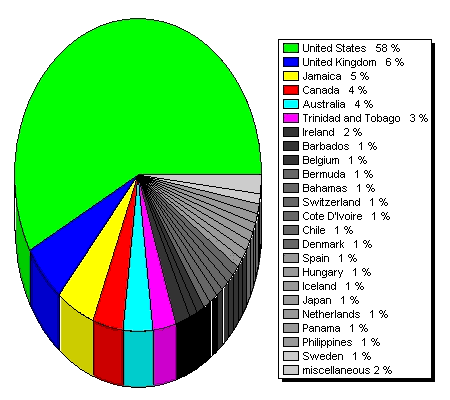
I am relatively new to blogging. In fact, I only began in December 2005 when my daughter, who has been blogging for at least five years now, suggested that I begin. Since then, I have written about 100 posts. On April 6, 2005, I began using Site Meter and I’ve recorded 1,100 visitors or 25 visitors per day from at least twenty countries (see Fig 1). Of course, when a blogger such as Maud Newton barely mentions my site (192 hits in one day), web traffic increases exponentially. On Saturday, since I began preparing this post, the site now has an average of 29 visitors--this does not take into account the Memorial Day weekend (readerships usually falls on the weekend) and 60% of my visitors originate in the US (Fig.1) From the statistics alone, it is clear that blogging provides exposure, but it also gives me access to ideas, and a sense of community.


Without exposure a writer might as well give up. My publisher, Peepal Tree Press, has a limited (more like zero) PR budget, so when one of my books, Benjamin, my son, is reviewed by The Daily Gleaner, Caribbean Beat, or The Caribbean Writer, I am always grateful because my book is in competition with other books from the publishing conglomerates in London and New York. In a way, blogging provides the kind of exposure that Caribbean Voices, produced by Henry Swanzy, gave writers such as Sam Selvon, George Lamming, VS Naipaul, Kamau Brathwaite, and Sam Selvon. According to George Lamming, “Swanzy was a struggling writer’s dream.” And although an individual blogger does not have the authority of Caribbean Voices, when a site such as Global Voices links to one of my posts (87 hits in one day), then my site gains an aura of respectability--something which is vitally important to peoples of the Caribbean who still look to “official” sources for information.

But blogging bypasses the gatekeepers of Caribbean culture who control the importation of books and publicity*. If the gatekeepers don’t import the books (for whatever their reasons) or a writer cannot even garner copy beside the Star’s Hottie for the Week, then many people, who have scant regard for anything “local,” conclude that your work “cyaan good,” and then “dawg eat yu supper.” This is the Goliath that each writer/blogger faces because we are always being asked, “Who the hell do you think you are?”

Blogging alaso challenges the elitism that pervades the Caribbean and is a great experiment in the democratization of data. To be sure, a digital divide exists, but anyone with access to a computer and an email address can set up an account at Blogger and become a blogger. It’s that easy. This is very disturbing to some people, who as Bob Marley once said, “Still want to divide the people. But how can they divide the people when them don’t have four foot?” It should be noted that early in his career, Bob faced similar problems with exposure from the gatekeepers of the record industry. He couldn’t get any airplay on the radio stations and a highly respected Caribbean bandleader once said that he would never play reggae because it was ghetto music. Of course, when Chris Blackwell began producing Bob Marley and the Wailers, then everybody was convinced that it had to be great because the music was being produced in England. Similarly, the careers of Lamming, Brathwaite, Walcott, and Naipaul (who are great writers by any standard), would have taken different paths had it not been for Caribbean Voices which gave them the exposure with the authority of the BBC behind them. To be honest, Caribbean Voices was produced by the BBC because of their commitment to Commonwealth culture that continues to this day, but the level of attention during the fifties was also due to colonial guilt. That guilt has now disappeared and many of us now have to depend upon the “kindness of strangers” because our own governments/ countries cannot (will not?) support activities in the arts. This is not only because of limited budgets, but limited minds. Blogging provides the kind of freedom that is anathema to many gatekeepers who want to control the flow of information throughout the Caribbean.


To get the official news about the Caribbean, I read the Miami Herald, Daily Gleaner, Jamaica Observer and sometimes the Trinidad Guardian, but I read even more assiduously the blogs written by Mad Bull, Guyana Gyal, Jono’s Blog, Francis Wade, Nalo Hopkinson, Tobias Buckell, and Caribbean Beat. I get viewpoints that I normally would not have thought about while living in Miami, Florida or from reading the Miami Herald. The gatekeeper syndrome is also present here. If I want to know what’s really happening in Guyana, then I won’t read the Gleaner, Guardian or Observer, I will read Guyana Resource Center or Guyana Gyal. For there is a certain purity in blogging (at least with my blogging) that is very liberating,

No one could pay me (what am I saying?) to do this. Let me explain. If I sit down to write a poem, short story or novel, once I reach the revision stage, I have Walcott, Brathwaite, Scott, and Naipaul, breathing on my neck and saying, “No, boy, don’t do that! No wonder nobody wants to read your work!” But blogging is a candid, public transmission of private thoughts--which also raises a host of legal, moral and ethical issues that are too broad for the scope of this post. But if I want real information about a writer’s life, I can go to Nalo’s site or if I want to know about the practical aspects of a writer’s life, I click on Tobias Buckell’s site. Or if I want to join a public conversation about the West Indian canon or Caribbean genius, I visit Caribbean Beat. For just as our list of Favorites on browsers gives us a picture of our preoccupations and the shape of our minds, so do our links. A cursory glance at the links that I provide on my site should tell you about my interests: Caribbean, literature, music, and politics which sometimes takes me out of the Caribbean to sites such as John Dufresne, Moorish Girl, Valve, Bookslut, Literary Saloon, and many others that I provide on my web page and blog space. For I am also a teacher and I take that role very seriously. In the Caribbean, we don’t have any way to share what we’ve learned and we’ve reinvented the wheel too many times in
the Caribbean. By now in terms, the wisdom that luminaries such as CLR James, Leonard "Tim" Hector, and Rex Nettleford, have given us, we should be driving a Caribbean “Rolls Royce.” Instead we are driving Cowrollas. Blogging provides instant access to ideas that can be expanded upon, discussed, cussed, and reviewed. In many ways, blogs could be called a digital place for “liming.”


And we love “liming” in the Caribbean. Governments have fallen because of “liming” sessions. Poems, short stories, and novels have been born during “liming” sessions, for it is not a space not only for su-su, but a meeting place to "suss" out ideas. “Liming” creates or is supported by a community. For example, in Struie, Jamaica, if you wanted to hear about herbs and medicines, you would go to an old lady named, Miss Pin Pin who regularly held court on her verandah. Similarly if I want to read a down-to-earth conversation about The Da Vinci Code without any literary doublespeak, I go to Mad Bull’s Blog. Or if I want a fresh perspective on business in the Caribbean, I go to Francis Wade’s, Chronicle from a Caribbean Cubicle. The comments sections on these blogs also allow visitors to speak their mind on taboo subjects such as homosexuality. Global Voices and Caribbean Beat provide necessary conversation about literature, arts, and culture in the Caribbean. For while we are known for our music, sprinters, and drug dealers, very little is known about our literature and culture. And artists, like the griots in West Africa whose work is shaped by call and response, need feedback in the form of book reviews. A reviewer should be someone who has read widely and reads closely. And although the criticism is still subjective, it is a means for evaluating one’s work. For example, after Bob Marley released Natty Dread and Rastaman Vibration and the death threats came because he was being “too revolutionary,” he produced Kaya (which had songs such as “Running Away” and “She’s Gone”) and when he heard that he had gone “too soft” with Kaya, he came back with Survival. Here was an interaction between an artist and his audience that altered his work and had beneficial results. His work was appreciated within an audience of listeners—a community, if you will.


Blogging may just be the solution to the lack of connectedness, exposure, access, and community that has arisen out of the African and Caribbean diaspora. As Chris Blackwell said in an interview, “The key is to find yourself a place that has got some soul. If you find yourself a place like that, then you get yourself totally plugged in. It's never been possible before but now it is possible. You can work from a place that is meaningful to you. Technology makes a joke of geography." We may settle in places that will support us emotionally and financially, but with blogging we may be able to turn around Swanzy’s famous opening lines to Caribbean Voices and say, “World, this is the Caribbean calling.”


Coda


*
I don’t know if it’s been bad luck or karmic retribution, but somehow my name (I can understand the misspelling) usually get’s chopped from copy. As a friend of mine remarked, “Is who fa white fowl you kill?” I don’t know, but if it takes a sea bath at Falmouth to shake this off, then I’m ready for it.

Fig.1
Jamaican cowrolla


The Toyota Cowrolla picture was sent to me by my sister. The source is unknown.
The pre-liming picture is from Caribbean Tales


April 24, 2006

Lecture/Reading @ Davidson College, North Carolina

Geoffrey PhilpMy story begins with what the Barbadian writer George Lamming called “dynastic hubris”. It was a statement by Prime Minister Michael Manley, the son of Premier Norman Washington Manley, who declared in 1974: “Jamaica has no room for millionaires. For anyone who wants to become a millionaire, we have five flights a day to Miami,” and thus began what is now known as the Jamaican Diaspora.

But to borrow a phrase from the dancehall (which I am sure is no longer used and shows my age): “Haul and pull up! Rewind, my selector!”


***

My story really begins with me trying to write poems to a girl with whom I was head over heels in love and she was tiring of my fake Khalil Gibran poems. I had to look for inspiration elsewhere. At that time Bob Marley’s music was everywhere, and Dennis Scott had resumed teaching at my alma mater, Jamaica College. I began reading Uncle Time, then The Pond by Mervyn Morris, Reel from the ‘Life Movie’ by Tony McNeill, The Arrivants by Kamau Brathwaite and Another Life by Derek Walcott. I now wanted to write poems with the vision of Marley, the intelligence of Scott, the wit of Morris, the lyricism of McNeill, the experimentation and afro-centrism of Brathwaite, and the imagery of Walcott while maintaining the integrity of my own voice.

And then in 1979, my family and I left Jamaica to become millionaires in Miami.
So, there I was in Miami trying to write poems in a landscape that I could neither read nor understand. Yet, Florida in many ways resembled the rest of the Caribbean. It was history-less. In Florida, there isn’t a cumulative voice, a tradition that one sees in writers such as Hawthorne or Lowell who feel the burden of history, and their writing is an attempt to exorcise the past in order to tell the story of their generation. It’s almost as if they long for the kind freedom exemplified in Ginsberg’s Howl or Kerouac’s On the Road. For I had always been struck by Frantz Fanon’s statement in The Wretched of the Earth: “Each generation out of relative obscurity must discover their destiny and either fulfill it or betray it.”

What was the mission of my generation? Imagine the despair that I felt that I was in Miami wanting to be a writer and having neither the skill in dub poetry that Oku Onoura, Mutabaruka, Mikey Smith, and Malachi possessed, and feeling that I would be left out of telling part of the story because of an accident in geography.

I decided to be brave despite the obstacles and what I saw as my obvious limitations. I did not have the gifts nor the intelligence of the writers of the previous generation nor did I have the talent of the dub poets. I did what I could do. I began writing poems and stories about my experiences of moving from Jamaica to South Florida with the hope that they would find resonance.


But the questions still haunted me: What was the mission of my generation? Who were we? How did I end up here in Miami? Why did I end up in Miami? Was this a part of a larger pattern? How long had this been going on?

My answer to these questions came in the form of Exodus and Other Poems and Florida Bound which examined the following: How did we end up here? Was this part of a larger pattern? Uncle Obadiah and the Alien (the title story originally published in The Caribbean Writer was my initial foray into what is now known as speculative fiction) told the stories of Jamaicans at home and in Miami.

Then came Benjamin, My Son (the thesis for my Master of Arts from University of Miami, which wasn’t published until seventeen years later) where I examined characters, sounds and images that were uniquely Jamaican within the context of Christianity and Rastafari, West African archetypal deities, and the gun/political gang culture using the framework of Dante’s Inferno and the murder/ mystery genre which has now become the staple of South Florida fiction (James Hall, Edna Buchanan and Preston Allen).

As I settled into the Florida landscape I began to see the connections between Miami and the Caribbean and I wrote a sequence of poems, hurricane center, to mirror the yearly round and used the image of the hurricane (with its meteorological and metaphorical implications) and its impact on memory and the attempt to memorialize in a history-less environment. As I furthered my study of Carl Jung and Joseph Campbell, I realized the archetypal significance of West African deities such as Xango, Ọṣun, Ogun, Eshu/Anancy, and Yemoja, and I wrote xango music.

Recently, I have gone back to the question of memory in a novel, A LoveSong for Kathryn, about a woman Kathryn Coleman, a single mother, who is trying to raise her daughter, Jasmine (she belongs to the second generation of Jamaicans that Malachi calls the Jah-Mericans) in Miami. Jasmine, in order to resolve her identity issues, has run away from her mother’s home and joined a New Age cult. The action begins at the start of the hurricane season with the Everglades on fire.

The movement then has been outward in answering: What is the mission of my generation? My tentative answer on a personal level has been to write about the experiences of Jamaicans who have settled in South Florida (which is either first or the final stage of the journey to and from Jamaica). However, on a larger level, I think the mission of my generation is to record, preserve and institutionalize the intellectual and artistic legacy of writers and intellectuals such as Scott, Lamming, McNeill, Marley, Morris, Naipaul, CLR James, Selvon, Felix Morriseau-Leroy, Maryse Conde, Lydia Cabrera, and Fanon, for as Norman Washington Manley once said, “Tradition is something which we have to foster and create and it is a deliberate act of intelligence. It is one of the most powerful forces in the development of the character of a people”.

Recently, the Caribbean Beat blog had two posts about Caribbean genius and a Caribbean canon to which I added my two cents. The post about Caribbean genius asked: What is a genius? and offered some definitions. But I think we have to go a bit further. The appearance of genius is one thing—it’s almost a biological imperative for genius to appear to insure the survival of a population. A larger question remains: Will genius be allowed to survive? The biblical stories about Pharaoh, the Assyrians, and the Babylonians (written by people intent on survival, yet threatened at every turn) are about the preservation of Jewish memory and genius. I’ve added the biblical examples because we are a People of the Book (witness the latest examples of theocracy in Jamaica), but I also believe that be do not have to be bound by the stories in the Book (“Some say we’re just a part of it/ We’ve got to fulfill the Book”). We have the power and the imagination to write our own stories.

This is why I applaud Caribbean Beat, The Caribbean Writer, and the Calabash Literary Festival for their bravery despite seemingly insurmountable obstacles to publish and record the work of Caribbean writers. But does it stop here?

Steven Covey, author of The Seven Habits of Highly Effective People, in his latest book The 8th Habit: Moving from Effectiveness to Greatness, posits that there are four desires common to humanity: to live, learn, love and leave a legacy. Without getting into an argument about the validity of the statement or its correspondence to Maslow’s hierarchy, we still investigate the following: How will we live? How should we live? What are the things we love? What are the things we must learn and unlearn? What should we teach our children to love? What will be our legacy?

The answer to these questions affects our self-esteem and more importantly, the self esteem of our children. For slavery and colonialism have been woven into our hair, food, and language, and we have to ask ourselves: Are we worth anything? Are our children worth anything? How do we measure worth? Is value only measured by GDP and per capita? How do we demonstrate our worth? Are our stories/voices are worth preserving?

Caribbean culture, even as I speak, is being formed by HBO, cell phones, guns, reaggaeton, evangelical fundamentalists, AIDS, homophobia, and drugs, but the shaping of the culture—the work of the naming within the culture remains largely unfulfilled. We must respond to these questions for as Norman Washington Manley also said: “We must dig deep into our own consciousness and accept and reject only those things of which we from our own superior knowledge... (We) need to be the best judges”. Artists perform a vital function in a society because they translate on a sense/emotional level the ideas and aspirations of a people. As Colin Channer has noted, our musicians have done this with reggae and calypso, but as far as the sustained analysis of novels are concerned, there has been a noticeable silence.

The attempt to memorialize is also problematic for the Caribbean because of the yearly round of destructive hurricanes (on the physical and psychic level), the history-lessness which combined with the fact that the Caribbean does not have a surviving indigenous population (with the exception of Guyana and a few pockets) whose myths and stories have not been fully incorporated into the larger story of the region. Our philistinism (our attempt to measure our worth by the accumulation of personal wealth) has meant a neglect of the arts. As Caryl Phillips (part of the Black British writers which include Linton Kwesi Johnson, Zadie Smith, and Benjamin Zephaniah--part of the Caribbean Diaspora?) has said about the Caribbean, “It’s a literate society, but not a literary one”.

Some of this is understandable. The majority of books and movies still being produced are an insult our intelligence. This is why I sometimes get upset with writers such as VS Naipaul, who instead of using his prodigious talent to uplift has now turned to denigration of the Caribbean. I mean that in every sense of the word. And it’s not the diagnosis of a culture that is not welcome. Sparrow and Lord Kitchener skewered you alive. It’s Naipaul’s tone. It’s like when Black comedians use their talent against the weakest among us: Black, gay men. But c’mon. “Help the weak if you are strong.” And don’t get me wrong. I learned to write stories by reading Naipaul. But there is a world of difference between Miguel Street, The Suffrage of Elvira and A Bend in the River.

It comes back again to self-worth which is tied the Word: How do we speak about ourselves? How do we define ourselves? The issue of language is very important. The poorest among us speak only one language: Jamaican or in Haiti, Kreyol. A language, according to Norman Washington Manley, is an act of intelligence, but there are some who would look down on people who speak only Jamaican or Kreyol as unintelligent or “linguistically challenged”, whereas I see it as a lack of education/opportunities. In the Lent section of hurricane center, Jesus confesses to his mother that he was hurt when his friends called him “Joseph’s jacket”. I imagined a Jamaican Jesus (wasn’t he?) and what his friends would say using Jamaican. For the non-Jamaicans, a “jacket” is an illegitimate child. The phrase “Joseph’s jacket” keeps the allusion to Joseph with his famous Technicolor coat and the rumor that was present at Jesus’ time: “Is this not Mary’s son?” (Pagels)

Using Jamaican with its rich tradition of double entendre and Rastafarian worldview is one of the ways that I think that the legacy can be preserved, and I refuse to belittle my brothers and sisters just because they don’t know how to speak the Queen’s English. I also refuse to take on the burden of The Other (Said, Orientalism), for if you come to my country and ask for exotic fruit, I will offer you Canadian apples, strawberries or kiwi. The rest I won’t say because we are in polite company.

Luckily, as my Sabbath school teacher used to say, there are now a “mighty cloud of witnesses” in contemporary Caribbean writing: Robert Antoni, Junot Diaz, Ricardo Pau-Llosa, Claudia Rankine, Lorna Goodison, Ivonne Lamazares, Margaret Cezair-Thompson, Adrian Castro, Marcia Douglas, Marlon James, Christine Craig, Virgil Suarez, Patricia Powell, Dany Laferriere, Nalo Hopkinson, Opal Adisa, Kwame Dawes, Jennifer Rahim, Edwidge Danticat, Colin Channer, Brenda Flanagan, and many, many more. So, as Brother Bob would say, “The preaching and talking is done/we’ve got to live up.”
So, what will be our legacy to our children? Will we be able to say as Norman Washington Manley said at his retirement: "I say that the mission of my generation was to win self-government for Jamaica. To win political power which is the final power for the black masses of my country from which I spring. I am proud to stand here today and say to you who fought that fight with me, say it with gladness and pride: Mission accomplished for my generation." Will we be able to say the same?

***


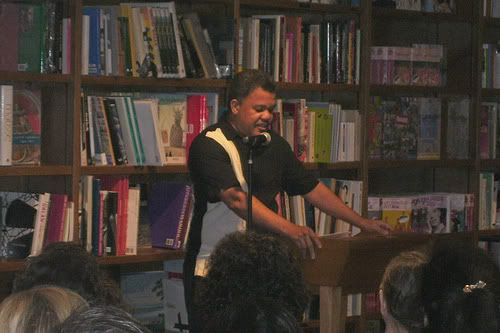
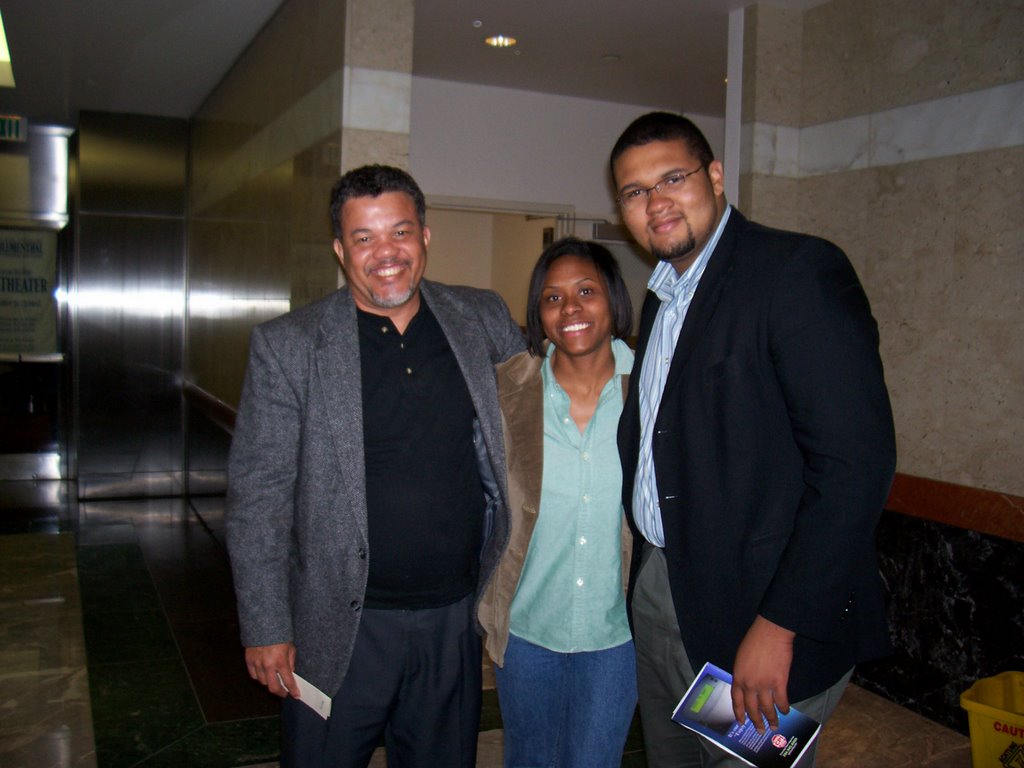
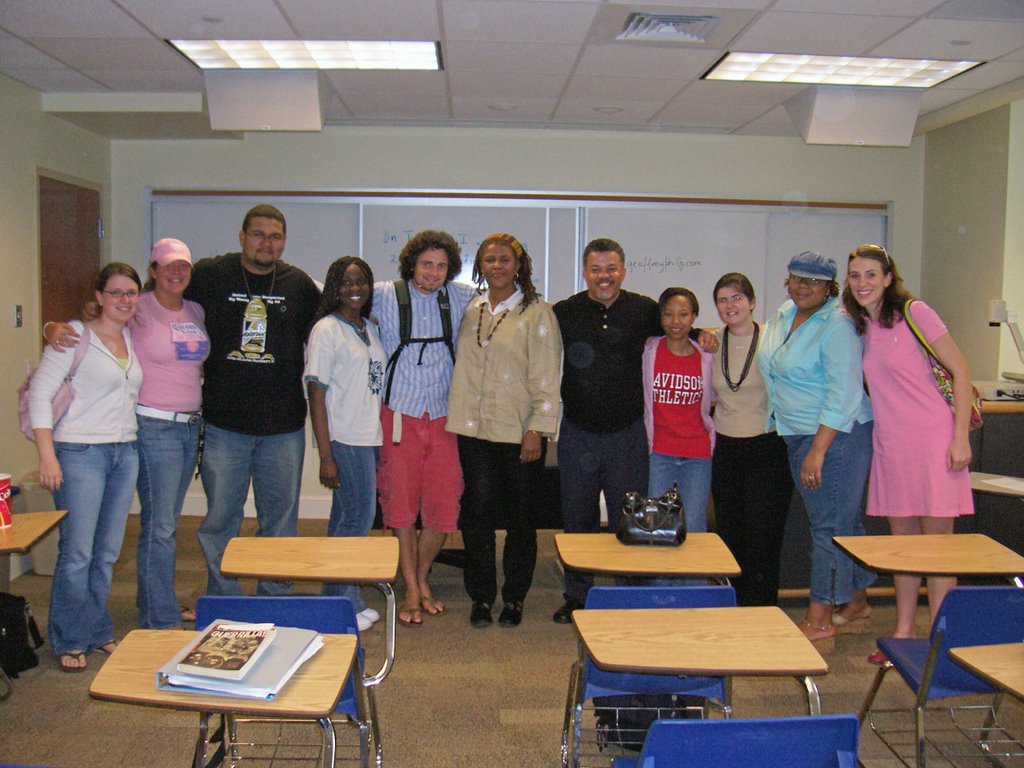
Geoffrey Philp and students

Geoffrey Philp at Davidson College


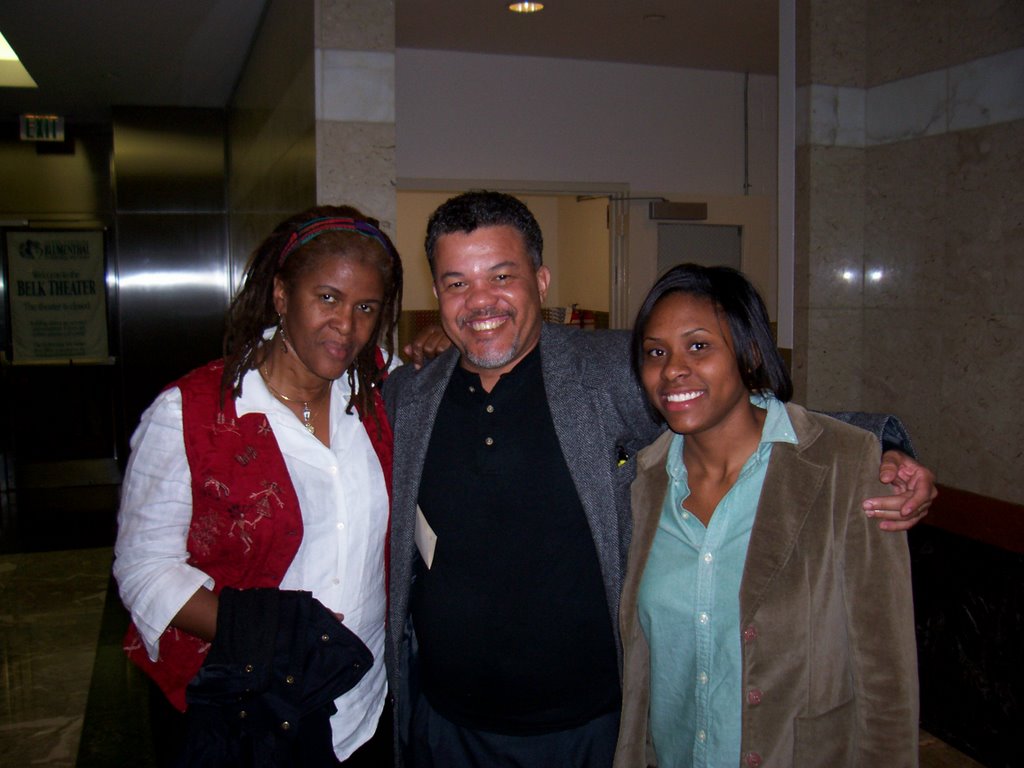
Geoffrey Philp


For more photos of Davidson College, follow this link: http://www.flickr.com/photos/51858402@N00/sets/72057594114278078/show/


Books by Geoffrey Philp