Showing posts with label Movies. Show all posts

May 19, 2012

A Matrix Jingle: Shoot the Sheriff/ Architect


If Neo in The Matrix 3
Had shot the Architect, he'd have been free.
Then, he wouldn't have had to die,
He'd have become RastafarI


***

If you enjoyed this post, check out my page on Amazon. I’d also be very grateful if you’d help it spread by emailing it to a friend, or sharing it on Twitter or Facebook.


August 4, 2010

Inception, Dreams, and Caribbean Culture


Over the weekend, my family and I went to see Inception and like Don Florio at the end of the movie, I was forced to ask: Was this all a dream? Whose dream?”


This is not to say I disliked Inception. Compared to Memento, one of Christopher Nolan’s earlier films, Inception is a further exploration of “the ways memory, identity and narrative shape our lived reality.” And like its first cousins, Blade Runner and The Matrix, Inception has already yielded several differing interpretations, including a Buddhist analysis of the film.


In this sci-fi thriller, Nolan has found a clever way to illustrate how ideas (memes) can either help or hurt us.


The plot revolves around Dominic Cobb (Leonardo di Caprio), a dream “extractor,” and his attempt to infiltrate the subconscious of Robert Fischer, (Cillian Murphy), heir to his father’s business empire. But instead of extracting information from his target, Cobb’s client, Saito (Ken Watanabe), requests a different strategy. Saito wants a meme to be placed in Fischer’s subconscious—an idea that will ultimately lead to the dissolution of his father’s business empire. Cobb assembles a team of dream architects and doctors to carry out their plan, which involves creating dreams within dreams on varying levels.


That’s just the first thirty minutes of the thrill ride.


And although the plot is muddled by an overreliance on mimesis, Inception left me, as a creator of memes within Caribbean writing, with more questions than I could answer.


Which, I suspect, was the point of the film?


1.
Inception is the act of invading someone's dreams for the sole purpose of planting an idea. It is the opposite of extraction, which is the process by which one gathers important information from the subject’s subconscious. Inception is thought by some to be impossible because the inceptee's mind has an uncanny ability to trace the planted idea back to the person who planted it. For example, if someone tells you “Don’t think about elephants,” you may think of elephants, but this fails as inception because the originator—the person who ordered you not to think about elephants—can be traced as the source too easily.
http://www.vanityfair.com/online/oscars/2010/07/25-questions-can-you-enjoy-inception-if-youre-not-very-smart.html
2.

“What is the most contagious parasite?”
What is the most resilient parasite? Bacteria? Virus? Intestinal worm? An idea. Resilient and highly contagious. Once an idea has taken hold in the brain, it’s almost impossible to eradicate.  An idea that is fully formed, fully understood, that sticks. [pointing to his forehead] Right in there somewhere.
An idea is like a virus...the smallest seed of an idea can grow to define, or even destroy you.”

This section of dialogue is the one that stuck with me the most and it made me realize that human beings are biological and spiritual memeplexes. Our health or lack depends upon surveillance of the memes we take into our minds and bodies. The journalist, John Maxwell, once compared the free press to the "central nervous system of the body politic" and I believe writers and artists fulfill the same function.


Kwame Dawes likes to say, "All memory is fiction," and I agree. History, literature, songs are all forms of memory--complex memes about who we are, where we came from, and where we are going.


Caribbean history, literature, and music are filled with memes, some of which have helped us and some that have hurt us. The most damaging meme, which has been perpetuated by writers such as VS Naipaul, is that the Caribbean is populated by uncreative, barbaric people who are less than human and are destined for failure.


Luckily, we have had many other writers to counter Naipaul's poison with memes that continue to define us:


Marcus Garvey:  New World Africans have fallen asleep in their former masters’ dreams and have forgotten the nobility of their ancestry. This has led to all kinds of behaviors that are not only harmful to our bodies, but also to our minds and spirits. Garvey urged, ‘Rise, ye mighty people!”


Derek Walcott: The beauty of the Caribbean should be celebrated in the same way that the landcapes in Greek, Roman, and British literature have been portrayed. The grandeur of Walcott’s diction (some would say “florid”) exemplifies his desire to honor people, who despite the tragedies of history, lead heroic lives.


Kamau Brathwaite: The history and literature of New World Africans began in West Africa. The roots of the music, language, rites, and mythology can be traced back to this rich heritage. His video Sycorax style is a visual representation and reclamation of an aural tradition.


Lorna Goodison: Caribbean women are strong and resilient. This strength comes from the stories women have told each other while sewing their children's clothes, cooking a meal, growing a garden or burying their loved ones. Goodison’s compassion is woven into the fabric of stories passed from hand to mouth and mouth to hand.


3.

Cobb: "I will split up my father's empire.” Now, this is obviously an idea that Robert himself will choose to reject. Which is why we need to plant it deep in his subconscious. The subconscious is motivated by emotion, right? not reason. Which is why we need to find a way to translate this into an emotional concept.
Arthur: How do you translate a business strategy into an emotion?
Cobb: That's what we're going to figure out. Fischer's relationship with his father is stressed to say the least.
Eames: Can we run with that? We could suggest breaking up the company as a "screw you" to the old man.
Cobb: No, because I think positive emotion trumps negative emotion every time. We all yearn for reconciliation. For catharsis. We need Robert Fischer to have a positive emotional reaction to all this.
Eames: Well, why don't we try this? "My father accepts that I want to create for myself, not follow in his footsteps."
Cobb: That might work.
http://en.wikiquote.org/wiki/Inception_(film)#Dialogue

Memes work when a “positive emotion trumps negative emotion.” This is where the work of singer/ songwriter such as Bob Marley transforms a culture. The Wailers uprooted many negative memes in pop culture and gave us memes to which we could dance. Songs by the Wailers were almost like the spiritual practice of affirmations and renunciations whose aim is to bring about psychic wholeness: “Now you see the light/ Stand up for your right!”


Bob Marley:  InI is a man/son of the Most High Jah Rastafari in whose image/likeness InI have been created. InI claim I birthright in the face of Babylon: “Wake up and Live!”


Contrast Marley's meme to the meme that was introduced during slavery.  Stripped of their humanity by coercion, New World Africans accepted these memes as self-definitions:


I am man because of the many children I have sired.
I am a woman because of the many children to whom I have give birth.


Compare this to the dancehall meme:


I am a man because of my sexual prowess.
I am a woman because of my sexual prowess.


I don’t see much difference between the slavery meme and the dancehall meme. Do you?


4.


“Your mind is the scene of the crime.”
http://en.wikiquote.org/wiki/Inception_(film)


Whose dream are you living?


***

Enhanced by Zemanta

February 5, 2009

25 Random Things About Me: Geoffrey Philp

Philp & Luciano


1. I am a writer.
2. I am married to gorgeous woman and we have three children.
3. I sleep with my feet outside the covers.
4. I have a new collection of short stories, Who’s Your Daddy?, coming out in April.
5. I’m reading at the Calabash Literary Festival.
6. I went to the best high school in Jamaica and the Caribbean: Jamaica College.
7. I teach English and creative writing at Miami Dade College where I am the chairperson of the College Prep. Department.
8. I love football. In fact, I once played for my high school Manning Cup team
9. I am Pi.
10. I was born in Kingston, Jamaica and I used to live in Mona Heights.
11. I love to eat naseberries!
12. I’ve lived in Miami for 30 years now.
13. I’ve always worried about my kids and continue to do so.
14. I have 12 brothers and sisters who are scattered over the globe.
15. According to my grandmother, I have Arawak blood.
16. I love Reggae.
17. Color blindness runs in my family, so I’m worried about my daughter who is a graphic artist.
18. I’m starting to play tennis again.
19. I used to be a Jehovah’s Witness before I moved to America and lost my religion.
20. One of my favorite places at the University of Miami was the Rathskellar.
21. I sometimes have nightmares about being back in gradual school.
22. The first mention of a PHILP in the Doomsday book was because of drunk and disorderly conduct: "I'm just carryin' on an old family tradition."
23. I don’t Twitter as much as I should.
24. I’ve watched The Matrix a million times.
25. I have a new manuscript of poems, DUB WISE, that I’m hoping will find a good home.

***

If you would like to be tagged, then, consider yourself to be...

June 30, 2008

Wanted: The Transformation of a Trickster/ Warrior

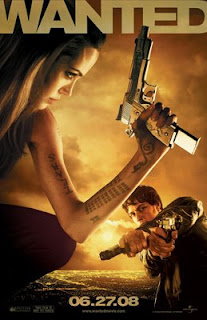
WantedThis weekend my family and I went to see Wanted, one of the best written Trickster movies in recent years. Well, it's not a pure Trickster movie. It's more of a Trickster/Warrior movie. This is all right with me because these are the two dominant archetypes in Jamaican culture.

To a certain extent, Wanted follows the pattern in James N. Frey's, The Key: How to Write Damn Good Fiction Using the Power of Myth which applies Joseph Campbell's insights into the structure of the so-called "monomyth" to creative writing. Many avid moviegoers will recognize the elements which have been used in films such as Star Wars, The Matrix, and Harry Potter.

1.The story opens with the hero, usually male, functioning badly in the Everyday World and desiring something (he doesn't know what he wants) to escape from his mundane life (Neo's wake up call in The Matrix)

2. A Herald bursts into the hero's life with a Call to Adventure: to go on a Quest to recover/retrieve something that has been lost or stolen (Princess Leia in Star Wars)

3. The hero may or may not answer the Call to Adventure. If he refuses the call, he will suffer. This is the plight of many of the characters in James Joyce's Dubliners.

4. For novels and full length films, the hero accepts the Call (sometimes reluctantly) and meets a Mentor (Morpheus in The Matrix or Dumbledore in Harry Potter) who introduces the hero to the Armorer and the Magical Helper (Mouse, Apoc, and Tank in The Matrix)

5. A Threshold Guardian appears at this moment and warns the hero of the dangers. Cypher in The Matrix: "Little piece of advice: you see an Agent, you do what we do; run. Run your ass off." If the hero ignores the advice, he crosses The Threshold and enters the Mythological Woods. The hero has begun The Initiation.

6. During the Initiation, the hero will be Tested and will learn all the rules of the new environment. Morpheus's advice to Neo: "This is a sparring program. Similar to the programmed reality of the Matrix. It has the same basic rules . . . rules like gravity. What you must learn is that these rules are no different than the rules of a computer system. Some of them can be bent. Others can be broken."

7. The hero may have a Sidekick (Trinity in The Matrix) and encounters many variations of the female archetype: Mother, Goddess, Witch, Whore, Femme Fatale (The Oracle, Persephone, Niobe in The Matrix and The Matrix:Reloaded)

8. The hero will also be in conflict with the Evil One (Valdemort in Harry Potter) or his willing surrogates. (The Merovingian in The Matrix: Reloaded)

9. The hero will be betrayed, have a change in consciousness, fall in love, or lose a loved one to death.

10. The hero will undergo a Death and Rebirth. (Neo's death and rebirth in The Matrix)

11. Confrontation with the Evil One in his or her environment (Neo and The Architect)

12 The hero fails or triumphs (momentarily) over the Evil One (Neo and The Architect in The Matrix: Reloaded)

13. The hero returns to the community and is Retested.

14. During the return, there is another confrontation with the Evil One and the hero gains the prize.

15. Once the hero is reintegrated back into the community, the prize may be rejected or an imposter may take the credit.

The most important element of the monomyth is the transformation of the hero (through time) over the course of the adventure and to witness his becoming aware of his change. In other words, the prize is unimportant--it's a MacGuffin.

So, Wanted could be called The Education/Transformation of an "apathetic nobody" into an "unparalleled enforcer of justice" and we watch in fascination as Wesley Gibson accepts the call to adventure, is initiated into a fraternity of Trickster/ Warriors, and his confrontation with the Evil One played by Morgan Freeman.

I was also intrigued by the use of Trickster symbolism and its connection with Yoruba and Akan mythology:

1. X of Eshu (Eleggua, Papa Legba), God of the Threshold

2. The web/loom of Anancy mythology

3. The circles used in Akan and Yoruba mythology and the necessary creative irruption that causes dis-equilibrium and the appearance of the Trickster

And if that wasn't all, the visual effects and stunt scenes were remarkable and managed to disrupt my analysis/enjoyment of the film as I was watching it.

And, of course, there was Angelina Jolie

***
Technorati Tags:

May 5, 2008

Children of the Matrix

Generation YAbout two weeks ago, I was part of a group presentation at Miami Dade College on “The Millennial Generation” or as I like to call them, “Children of The Matrix.” Basically these are the children of the Baby Boomers who are now entering the work force and unlike their parents who are Digital Immigrants, the Millennials are Digital Residents. According to Reynol Junco and Jeanna Mastrodicasa ^, the Millennials share many of these characteristics:


97% own a computer
94% own a cell phone
76% use Instant Messaging.
15% of IM users are logged on 24 hours a day/7 days a week
34% use websites as their primary source of news
28% own a blog and 44% read blogs
49% download music using peer-to-peer file sharing
75% of college students have a Facebook account
60% own some type of portable music and/or video device such as an iPod.


One of the more interesting characteristics that the Millennials share with their Boomer parents is that they already being “dissected, analyzed, and pitched to by modern marketers," who will reinforce a sense of “generational distinctiveness.” (Wikipedia)

Now although "generational distinctiveness" is “shaped by the events, leaders, developments and trends of its time” (Wikipedia: Generation Y), I would also add economics, culture and geography. For although Jamaican Boomers, who like their North American counterparts grew up with television shows such as Father Knows Best, Bonanza, The Avengers, and Dr. Who, the Jamaican Boomers' musical tastes were grounded in reggae rather than rock and roll and therefore have different perspectives on community, politics, and aesthetics*

Another important difference is unlike North American Boomers who grew up with the knowledge of their demographic/economic/ political power and have institutionalized their desires for change into the “environmental movement and the women's movement,” Jamaican/ West Indian Boomers, except in the area of music, have not had the same scale of impact on their society. I’m thinking specifically about the gap between the revolutionary insights of Rastafari and the ethos of reggae that haven’t changed much with respect to agriculture and buying patterns in the economy, nor have they been translated into socio-economic/political models. Sure, there are pockets of progressive thinking here and there, but on the whole things haven’t changed, especially in the area of sexual preference.

Perhaps its because of the conservatism and the time needed to gain control of the party machineries that are obstacles to change. And although the Caribbean Boomers are slowly gaining power: Bruce Golding (Jamaica) 1947; Patrick Manning (Trinidad) 1946, and David John Thompson (Barbados) 1961, I wonder if they still have the “fire in the belly” that is necessary to mobilize the people, especially now that like several other island states, we face many environmental crises.

The North American Millennials seem prepared to do this because of their being “peer oriented and for seeking instant gratification.” In other words, they know how to build community and they want everything now. They have been told from the time that they were born that they can do anything. What they are also discovering something similar to Morpheus’s advice to Neo: “What you must learn is that these rules are no different than the rules of a computer system. Some of them can be bent. Others can be broken." Some of them are already exploring the outer edges of race relations through music and lifestyles and it will be interesting to see what other kinds of changes they will bring with them.

It will also be interesting to see if Jamaican/ Caribbean Millennials, who have grown up in a time when as Chris Blackwell said, “technology makes a joke of geography,” will have the same attitudes towards nationalism as my generation had. Will they be as bold as their North American brothers and sisters have been in demanding change in environmental policies? Will they have the patience which in the past has been necessary for real change. Or will they, as many in my generation, adopt the same old tired “rules” from colonial times that have nothing to do with freedom, but with the advancement of very narrow class interests and waiting for things to happen. Or for a crisis to change things.

Either way, the Millennials are here and by sheer numbers they’re gonna shake some things loose.


***


*As an interesting side note, judging by a survey on this blog, the majority of the readers are either belong to either Generation X ( Digital Adaptives) or Generation Jones (Digital Immigrants). I also wonder, given these demographics, what kind of readership my hypertext novel, Virtual Yardies, will have. Time will tell.
***

Technorati Tags:


Reblog this post [with Zemanta]

August 14, 2006

Frank and the Internet

More of our continuing saga in 60 words.

***

“Frank and the Internet”

Noises at 3 am in the computer room. I went downstairs to cuss. Frank had pushed the furniture into the middle of the room and was sitting calmly.

“This sounds like something out of The Matrix, but the Internet is like God--impersonal, always answering requests. But like Google, you gotta be persistent and specific.”

I went back to bed.

July 28, 2006

A Fable of Freedom: "I Shot the Sheriff"

Bob MarleyWesterns and the King James Version are two of the main staples of the Jamaican imagination. This is understandable because both share a similar plot and a cast of recognizable characters. The King James Version and most Westerns begin with trouble (original sin or “bad guys” in Dodge City), a “good guy” or hero emerges in the middle of the feud (Samson or Wyatt Earp), and an alignment of forces leads to a final showdown (OK Corral or Valley of Megiddo). The bad guys (Satan or the Clantons) are annihilated; the good guys win and ride off into the sunset on their white horses. 

The fictions that have emerged from Jamaica also follow a similar pattern. But given the history of colonialism and racism in Jamaica, the stories sometimes parody the conventions. For example, in the classic Jamaican film, The Harder They Come, there are clearly discernible “bad guys” (record producers) and a “good guy,” Ivan, a singer who is willing to make any sacrifice for his music. Because of the unfair treatment by the record producers, Ivan’s crimes begin small, but then escalate when he takes the law into his own hands. This leads to a showdown on a North Coast beach. To a certain extent, the actions that lead up to Ivan’s shootout with the police are inevitable because Ivan was thrust into an unjust system and given his temperament, the resulting bloodbath was to be expected. Yet, what is made clear in the film is that Ivan’s original sin was being born Black.

“I was born with a price on my head,” said Bob Marley in a 1978 interview (Bob Marley in His Own Words by Ian McCann). It is interesting to note that Marley uses the language of the “Wanted” poster to describe an almost fatalistic viewpoint which seems uncharacteristic with his usual positive viewpoints and the teachings of Rastafari. Yet, both these themes are also evident in one of this most popular song, "I Shot the Sheriff.”

The song begins with the speaker already in trouble, “All around in my home town/ They are trying to track me down/ They say they want to bring me in guilty/ For the killing of a deputy/ For the life of a deputy.” The speaker knows the system is stacked against him because he is to be brought in “guilty” for a crime he would never deign to consider, “the killing of a deputy.” Deputies are not in his league. He knows he killed the “Sheriff” and it is a “capital offense.” But he has an explanation.

“Sheriff John Brown always hated me/ For what I don't know/Ev'ry time I plant a seed/ He said, "Kill it before it grows."/ He said, "Kill them before they grow." The anonymity of “Sheriff John Brown” makes it clear that the “Sheriff’s” influence is pervasive (almost like Agent Smith in The Matrix), and the speaker’s plight has been brought about not by anything that he has done, but by the enmity that “Sheriff John Brown” has towards him for a Kafkaesque crime for which the speaker knows there is only one possible ending: death. The "seed" is metaphorical and could stand for any on the "dangerous" ideas that Rastafari espouse: humans as god or each human as ultimately responsible for his/her choices. These ideas would be a threat to any sytem of dominance and control represented in the Bible as Pharoah, Herod, or Nebuchadnezzar or in the speech of Rastafari as Rome or Babylon and would have to be "killed" or stopped before they could spread among the populace who would embrace these ideas of freedom. Something has to give.

The key to understanding the lyric comes in the final stanza: “Freedom came my way one day/ And I started out of town/ All of a sudden I saw Sheriff John Brown/ Aiming to shoot me down/ So I shot, I shot, I shot him down/ And I say, if I am guilty I will pay.” This was not a fight that the speaker wanted, but the situation was created by the “Sheriff.” The speaker was willing to leave, but the “Sheriff” was about to kill him, so he acted in self-defense. The speaker concludes his ballad with a complex blend of Rastafari and Jamaican mythology and folklore.

"The Sheriff," then represents the antithesis of freedom--the repressive codes of conduct that have been codified into laws that serve the oppressors and have been internalized as the "proper" codes of conduct. In Western mythology, it's the dragon that must be slain.

“Reflexes had the better of me/And what is to be must be/Ev'ry day the bucket a-go-a well/One day the bottom a-go drop out.” The speaker’s defense rests on his claim: “Reflexes had the better of me.” It is to be noted that within Rastafarian mythology, for the Nya man of Africa, the natural, original man who lives in complete harmony with life and his surroundings, “reflexes” are not a crime (Rastafari: An Ancient Tradition). Reflexes are part of his natural makeup and his right to self-hood is expressed in the concept of InI—the mystical union of man with the divine. The Rastaman’s lifelong mission is to reflect the African Nya man in his choice of right foods and right actions (Iwa in the Yoruba religion). In Bob’s vocabulary, Nya man could also be substituted for “higher man” (“We are the children of the higher man”)—the idea of the indwelling god (the i-nity of InI) which is part of the West African religious continuum.

The speaker then says, “What is to be, must be,” and then counters with “Every day the bucket a go a well/ One day the bottom a go drop out.” Besides being another example of Marley’s lyrical balancing that is a trademark of his writing, “How long shall they kill our prophets/ While we stand aside and look/ Some say it's just a part of it/ We've got to fulfill the book,” he completes the circle with the folk wisdom of Jamaica, “Ev'ry day the bucket a-go-a well/One day the bottom a-go drop out,” and admits a kind of fatalism. However, it is a kind of fatalism that is driven by the actions of the persona. In other words, actions (desires) drive destinies. There are consequences to actions and any repeated action, “Ev'ry day the bucket a-go-a well,” is sure to bring about a certain consequence, “One day the bottom a-go drop out.” Is the hero’s destiny inevitable? We’re back to The Matrix: “Ohh, what's really going to bake your noodle later on is, would you still have broken it if I hadn't said anything?”

The song ends with the speaker’s insistence that he shot the “Sheriff” and not the deputy. This disdain for deputies is typical of heroes who even when their life is on the line recognize the greater enemy, “Go and tell that fox, 'Behold, I cast out demons’,” or “If my kingdom were of this world, then would my servants fight.” Underlings such as Herod and Pilate were the lapdogs of Rome. The real fight wasn’t with the “deputies”; it was with the “Sherriff” (or the Architect 0f The Matrix Revolutions)

In the framework of Rastafari mythology, politicians, the police and courts are lackeys of Babylon—the system of institutionalized racism/colonialism that values capital over labor. The “Sheriff,” then, would be the all encompassing externalized rules (in time, internalized which is where the real battle is fought) of Babylonian conformity--everything that if a Rastaman (Nya Man) is to be free, he must meet head-on and deny. The Rastaman asserts his dignity and right to live on moral grounds in a system that would deny his existence. The final showdown in the Valley of Megiddo or the town of Gibbeah is inevitable.

The actions of the protagonist also match the themes within Marley’s other work because the protagonist is willing to fight against an enemy that threatens his physical or moral integrity “Brother you're right, you're right/ You're right, you're right, you're so right/We gonna fight, we'll have to fight/ We gonna fight, fight for our rights” (“Zimbabwe”). The speaker is not cowering in the shadow of the “Sheriff” nor is he willing to become a martyr, “But if you know what life is worth/You would look for yours on earth/And now you see the light/ You stand up for your rights” (“Get up, Stand up’) and confronts the “Sheriff” because his life is on the line, ‘You want come cold I up/ But you can't come cold I up” (“Trench Town Rock”). He is willing to be branded as a criminal because he relies on the law of action and consequence, “For every little action/There’s a reaction,” (“Satisfy My Soul”). Or as Bob said in an interview with Neville Willoughby, “The only law is the law of life.” (So Much Things to Say)

In the symbolic language of Jamaica, an island beset on all sides by powerful forces, the identification with the “Children of Israel” has become part of the symbolic language of the nation (“The Israelites” by Desmond Dekker). Similarly, in the fictive imagination of Rastafari, the “Sheriff” is the equivalent of Babylon of which Pharaoh, Nebuchadnezzar, Herod, Pilate, Tony Blair and George Bush are “deputies.” For the Rastaman to survive, there can only be one outcome in the victory of “good over evil’ (‘War”). The hero must “shoot the Sheriff.”

***


If you are searching for posts about Bob Marley, Marcus Garvey, Rastafari, or Dennis Scott, please check the archives.

Reblog this post [with Zemanta]
Also, if you enjoyed this article, please visit my Author page @ Amazon.com 

February 24, 2006

Seven Things

Here's a meme that's been making it around the blogosphere. Let's see what happens!

7 Things I plan/hope to do/ see before I transition:

  1. See my family/children centered & happy

  2. Visit Tibet

  3. Visit the Grand Canyon

  4. See Jamaica tranquil enough to be able to retire there

  5. Visit Japan

  6. Learn to play the guitar

  7. See grandchildren

7 Favorite Books

  1. Another Life by Derek Walcott

  2. Love in Time of Cholera by Gabriel Garcia Marquez

  3. Shar by Kamau Brathwaite

  4. The Human Stain by Phillip Roth

  5. Reel from the Life Movie by Tony McNeill

  6. The Duppy by Tony Winkler—See Post on 2/25/06

  7. Miguel Street by VS Naipaul

7 Favorite movies

  1. Pulp Fiction

  2. Fight Club

  3. Young Frankenstein

  4. Godfather

  5. A Christmas Story

  6. Lion in Winter

  7. Matrix

7 Favorite CDs

  1. Natty Dread by Bob Marley

  2. Rapture by Anita Baker

  3. Sketches of Spain by Miles Davis

  4. Blackheart Man by Bunny Wailer

  5. Best of the Spinners

  6. Best of Marvin Gaye

  7. Best of Al Green

7 websites/blogs I visit regularly:

  1. http://nalohopkinson.blogspot.com/

  2. http://maudnewton.com/blog/

  3. http://www.johndufresne.com/

  4. Mad Bull

  5. Stephen Bess

  6. http://www.globalvoicesonline.org/-/world/americas/jamaica/

  7. Nicolette Bethel’s Blog

7 Places that I have vacationed and liked:

  1. Neusa, Colombia

  2. Negril, Jamaica

  3. Paris, France

  4. St. Thomas, Virgin Islands

  5. New York, New York

  6. Progreso, Mexico

  7. London, England

7 People who inspired me:

  1. Dennis Scott

  2. Derek Walcott

  3. Kamau Brathwaite

  4. Bob Marley

  5. VS Naipaul (arrrrrgh)

  6. Mervyn Morris

  7. Jimmy Carnegie