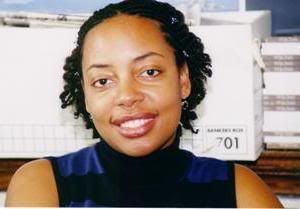
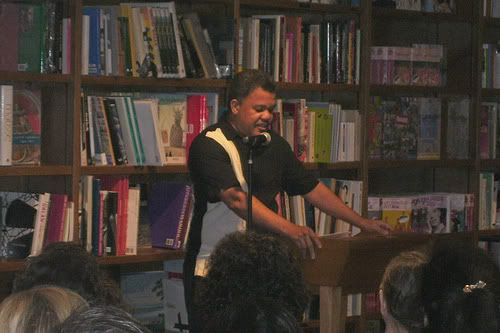
 Dr. Joanne Hyppolite is the Curator for Community Research at the Historical Museum of Southern Florida. She holds a Ph.D. in literature from the University of Miami and an M.A. in Afro-American Studies from the University of California, Los Angeles. An experienced public speaker and author, she lectures widely at schools, libraries, and conferences on African-American and Caribbean culture and children's literature. Her short stories have been published in the Caribbean Writer and The Butterfly's Way: Voice from the Haitian Dyaspora. She is also the author of two popular middle-grade novels for children Seth and Samona, which won the 1994 Marguerite DeAngeli prize for New Children’s Fiction and Ola Shakes It Up.
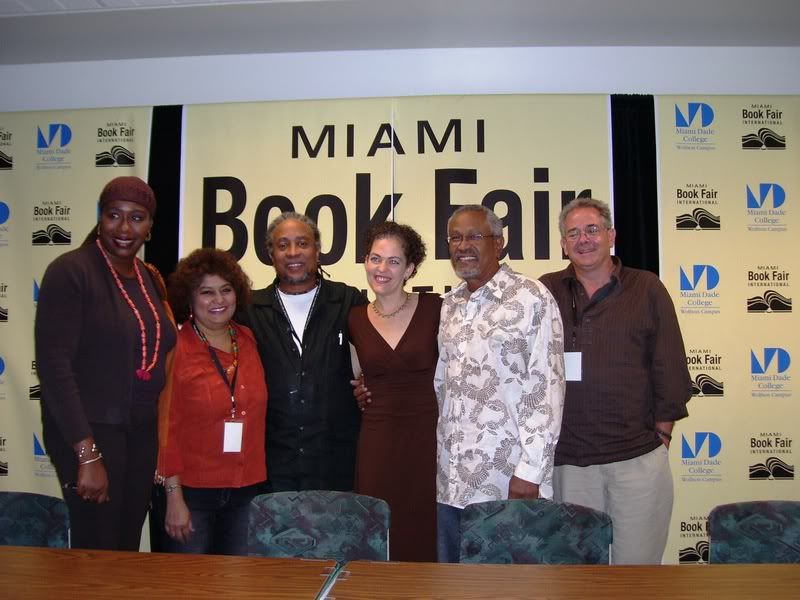
Joanne read "Dyaspora" from The Butterfly's Way: Voices from the Haitian Dyaspora, an autobiographical essay, and an excerpt from chapter 4 of Seth and Samona, the story of two children’s first encounter with death.
For photos of the event, click here: http://www.flickr.com/photos/51858402@N00/sets/72157594370170162/show/
Here’s the podcast:
http://media23a.libsyn.com/podcasts/d1b9e2d3879df31c93a2d0be58c19b8e/45632a14/geoffreyphilp/Podcast_of_Joanne_Hippolyte.mp3
*
Beginning on Friday, I am going to be running Amazon coupons and excerpts from Twelve Poems and A Story for Christmas, which I hope will generate some book sales over the holidays. (Click here for a review of last year's reading at the Diaspora Vibe Gallery). It’s always a tricky situation for independent artists to do things like this because it seems like unwarranted self-promotion which is frowned upon by our cultures, especially those belonging to the former British Empire. But big publishing houses advertise through publicists and surrogates to create the illusion that their writers are far removed from the taint of money and “filthy lucre.” I can no longer hold on to these pretensions. But it’s also tied to the reason why I write.
From the time I discovered that I had a gift for writing, I realized that it was skill that had to be honed. My stories have been developed through listening to the stories of friends, relatives, acquaintances and eavesdropping—I still haven’t figured out how to tell the story that I overheard at a bus stop in Jamaica, “And when the girl fling her waist like this, the man never had a chance!”
I also realized as I wrote the stories (some of which included personal details from the my life and the lives of my friends, relatives and acquaintances) that what separated me from many of my peers was that I was willing to tell the stories. This has sometimes led to some awkward situations where people confuse me with my characters, and they come over to my side and whisper, “You know, the same thing happened to me.”
That’s why I believe these stories have to be told. Writers tell the stories that many people don’t want to tell and they examine issues that many don’t want to confront. But it’s not until the story has been told that we can gage our individual response against the “traditional” voices of the culture. And sometimes the culture is wrong. Sometimes the culture convicts us for just being alive. Stories are about finding a way to be comfortable in our own skins, so that even if we break the “law,” we can say, “If I am guilty, I will pay.”
But it takes time to arrange the details of a story in order to achieve the intended results. And time, as they say is money. Writers use money to buy time. To be a writer is to expose oneself to enormous monetary and social demands, which is why so many writers (not just from the Caribbean) finally give up.
Pressure drop.
We are welcomed back into the fold with open arms, back into “cultures of shame.” This is even more dread in our region. Feelings of guilt and inadequacy (part of the human condition, really) are compounded in the Caribbean by institutional racism, colonialism, and churchism—where people use the Bible to kill us instead of trying to heal us. Instead of the power of love, it’s the power of ME.
This is what led to the writing of the story and the poems collected in Twelve Poems and A Story for Christmas. The poems are about the travels of Joseph and Mary-- an older man betrothed to a young girl who has been ostracized by her family and village because she is pregnant with an “illegitimate child.” I often wondered, how did Joseph feel when Mary told him she was pregnant and he knew the child wasn’t his? How did Mary feel when the weight of her culture came crashing down on her because she had broken one of its taboos? I’ve tried to humanize the saints. It’s not faith without working through the doubt; it is not redemption without changing from within.
The poems and the story in Twelve Poems and A Story for Christmas reveal the grandeur of the Christmas story from the perspective of a Caribbean man, husband, father, and son. Except for marketing purposes, Twelve Poems and A Story for Christmas is much broader than the labels book sellers have applied to the collection: Jamaican Christmas stories and poems, Caribbean Christmas stories, Jamaican Christmas story or even as Caribbean Christmas poems, but you gotta do what you gotta do. For as Keith Nurse pointed out in his lecture at the Miami Book Fair International, writers from the Caribbean do not have access to the vast philanthropic resources that writers from other cultures have and as he also argued, we have not developed the habits of first appreciating/ supporting our own talent. We’ll import before we buy locally.
I think we can stop this, and if there is to be a change as a great man said, let it begin with me. So, I’m going out on the limb, and “If I am guilty, I will pay.”
***
Haitian-American writer Caribbean Christmas poems Caribbean Christmas book Christmas book Jamaican Christmas poems Twelve Poems and A Story for Christmas podcast Books Caribbean Caribbean writers Christmas Caribbean poems Jamaican author Jamaican writers Jamaican Christmas Story Jamaican Christmas stories and poems Jamaican Christmas Christmas nativity story Jamaican Xmas
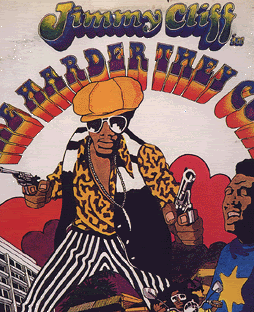 Perry Henzell, the director of The Harder They Come, made his transition today. I met him only once at a Calabash reading at Red Bones and he was still fiery, opinionated, and irascible. I loved it. I shook his hand, thanked him for the film (he must have heard this a million times), and moved on. To him, I was just another fan.
![Reblog this post [with Zemanta]](https://lh3.googleusercontent.com/blogger_img_proxy/AEn0k_v6Kme1oXl3Jyp5O6M0iiFqq4kqtzA6jEvphwyrf3vpD_wYJbkYYoWT2NServWPxqxxgtR14AOqsT7iG8sL_svVKyCe28_Qu_wBGzKEVcuppPUnsTvfYL15jmctEEQQNIpdlxhjyh80FcBYIhK_J92V=s0-d)




![Reblog this post [with Zemanta]](https://img.zemanta.com/reblog_e.png?x-id=4e5b49a6-4a0d-419e-b4cd-47e4c119702f)


![Reblog this post [with Zemanta]](https://lh3.googleusercontent.com/blogger_img_proxy/AEn0k_uWpSBZjQRZ1wFPuTzU15HsbngconMuiJ1K80L8rKNAWUOJvCAg1vU8Tr-4qzqy_GZH46_rJOtI3SflfamgxC2Z_nhMVCnUjoI-4jQAUW7yr4nA6qqC4LVUT95mkNUUXmcodjNgD3bxceNyu4dhfSHB=s0-d)
