Showing posts with label Colin Channer. Show all posts

November 17, 2019

Phonographic Memories by Njelle W. Hamilton


Phonographic Memories: Popular Music and the Contemporary Caribbean Novel
by Njelle W. Hamilton

About This Book

Phonographic Memories is the first book to perform a sustained analysis of the narrative and thematic influence of Caribbean popular music on the Caribbean novel. Tracing a region-wide attention to the deep connections between music and memory in the work of Lawrence Scott, Oscar Hijuelos, Colin Channer, Daniel Maximin, and Ramabai Espinet, Njelle Hamilton tunes in to each novel’s soundtrack while considering the broader listening cultures that sustain collective memory and situate Caribbean subjects in specific localities. These “musical fictions” depict Caribbean people turning to calypso, bolero, reggae, gwoka, and dub to record, retrieve, and replay personal and cultural memories. Offering a fresh perspective on musical nationalism and nostalgic memory in the era of globalization, Phonographic Memories affirms the continued importance of Caribbean music in providing contemporary novelists ethical narrative models for sounding marginalized memories and voices.

Njelle W. Hamilton's Spotify playlist to accompany Phonographic Memories: https://spoti.fi/2tCQRm8

Reviews

“Njelle Hamilton’s Phonographic Memories explores how a set of Caribbean novelists has foregrounded music as a locus for memory, nostalgia, and selfhood. Her study attests to the importance of music in the region in both personal and national senses of identity and suggests original ways of interpreting its representation in fiction.”

 ~Peter Manuel, author of Caribbean Currents: Caribbean Music from Rumba to Reggae.

“Njelle W. Hamilton’s Phonographic Memories is a resonant and remarkable contribution to the fields of Caribbean studies and literary sound studies. Her substantive interdisciplinary work interweaves critical insights from neuropsychology, ethnomusicology, and literary studies with meticulous close-reading and close-listening analyses of musical styles, performance genres, and recording technologies in a multiplicity of Caribbean contexts. In harmony with the practice of liyannaj that Hamilton relates in her analysis, this important and impactful work will appeal to audiophiles and bibliophiles alike."

~Julie Huntington, author of Sounding Off: Rhythm, Music, and Identity in West African and Caribbean Francophone Novels.

Here's the link for Phonographic Memories @ Rutgers University Press: https://www.rutgersuniversitypress.org/phonographic-memories/9780813596594


November 13, 2015

The Miami Book Fair International, 2015


More than 200 national and international book exhibitors and publishers, bestselling authors, artists, entertainers, and food vendors will participate in the Street Fair Weekend as part of the 32nd Miami Book Fair,  the largest and finest literary event in the U.S., presented by Miami Dade College (MDC). The Street Fair runs Friday – Sunday, Nov. 20 – 22, from 10 a.m. - 6 p.m.


The Street Fair brings together all the elements of the Fair during one jam-packed weekend! In addition to the more than 200 publishers and exhibitors, there will be book presentations and readings by some of the world’s most celebrated authors and poets, representing various genres and in multiple languages. The Swamp, a pop-up lounge and stage, and The Porch, the central gathering place for the Fair, will feature round-the-clock performances, live music, poetry readings, theater, and more. In addition, there are literacy and learning activities for children/tweens/teens during Generation Genius Days and The Kitchen will offer demos and panels for food enthusiasts in partnership with the MDC’s Miami Culinary Institute. The International Food Court at the southeast corner of 3rd St. and 1st Ave. will offer a variety of treats, including shish kabobs, frozen lemonade, crepes, ice cream, and more.   

This year, the Fair will also host several celebrities, including John Leguizamo, Rosie Perez, Paul Giammatti, Jesse Eisenberg, and Kunal Nayyar, as well as hip-hop legends Luther “Uncle Luke” Campbell, Christopher “Fresh Kid Ice" Wong Won and FAB 5 FREDDY, among others.

Admission to the Street Fair is free Friday, Nov. 20. General admission Saturday and Sunday, Nov. 21 – 22, is $8; admission for those 13-18 or over 62 is $5; those 12 and under are admitted free. The Street Fair will be located on N.E. 2nd Ave. between N. 3rd St. and N. 5th St., and along adjacent side streets. The Street Fair is presented with the generous support of OHL Arellano Construction.  

"OHL-Arellano takes pride in giving back to the community by supporting the Miami Book Fair, internships, philanthropic and educational programs,” said Alicia Cuervo, Regional Director for OHL-Arellano Construction. “We believe that philanthropic endeavors are the private sectors' opportunity to look at our past for lessons and inspiration while looking forward to successful projects and events like the Miami Book Fair that enrich our community.

For a complete list of Street Fair exhibitors and activities, please visit the Miami Book Fair site and download the printable guide at www.miamibookfair.com..

August 10, 2015

On My Bookshelf: Providential by Colin Channer

Colin Channer

Channer’s debut poetry collection achieves an intimate and lyric meditation on family, policing, loss, and violence, but the work is enlivened by humour, tenderness, and the rich possibilities that come from honest reflection. Combined with a capacity to offer physical landscapes with painterly sensitivity and care, a graceful mining of the nuances of Jamaican patwa and American English, and a judicious use of metaphor and similie, Providential is a work of “heartical” insight and vulnerability.

No one, since Claude McKay’s folksy Constab Ballads of 1912, has attempted to tackle the unlikely literary figure of the Jamaican policeman. Now, over a century later, drawing on his own family knowledge of the world of the police, on the complex dynamic of his relationship with his father, and framed within the humane principles of Rasta and reggae, Channer has both explored the colonial origins of that police culture and brought us up to date in necessary ways. Here are poems that manage to turn the complex relationships between a man and his father, a man and his mother, and man and his country and a man and his children, into something akin to grace. Providential does not read like a novelist’s one-off flirtation with poetry, but an accomplished overture to what ought to be a remarkable literary journey for a writer of immense talent and versatility.

“…Written with pitch-perfect rhythm and a keen eye for supple, limber turns.” —Lorna Goodison, author of From Harvey River

“Channer writes with a moving vulnerability and much lyric grace, revealing new facets to familiar themes—home, family, history, and the evolving journey of self. A universal, timeless meditation.”
—Chris Abani, author of The Secret History of Las Vegas

Born in Jamaica to a pharmacist and cop. Colin Channer is named by Junot Díaz calls him “one of the Caribbean Diaspora’s finest writers.”

October 4, 2013

Jamaican Authors Connect with Home


(L-R Colin Channer and Kwame Dawes)

by Claire Rocastle.

Many of the celebrated Jamaican authors who have been published in the last 50 years have made their homes abroad, in a diasporic wave, fanning out from their homeland in the Caribbean. The effects of this diaspora appeal to contemporary writers and become important themes in their work. The Jamaican literary voice has always been strong, reaching out to audiences all over the world, yet the writing has its roots in home and continues to connect authors and readers with their past.

Literary Tradition

The Calabash Literary Festival in Jamaica gives Jamaican writers a voice each year and in 2012 the event celebrated 50 years of independence, with the theme of ‘jubilation’. Among the writers asked to speak was Kerry Young, who still calls Jamaica her home despite having lived over 40 years in the UK. Her novel Pao was nominated for the Commonwealth Prize in 2012.

Many other writers make their homes abroad, such as Orlando Patterson and Olive Senior, and Kwame Dawes, an Emmy award-winning poet who teaches at the University of Nebraska. Dawes explained that, despite the diasporic nature of Jamaica, its people find each other and connect again in anthologies and at festivals and that it has always been this way. Novelist Colin Channer claims that the diasporic pattern has led to a literary boon for Jamaican writers and their culture, because they are exposed to so many different types of people and this gives them a platform within global literature, rather than striving for national identity.

Brave New Writing

Channer edited an anthology for the Calabash festival entitled Kingston Noir, exploring the darker side of Jamaican life and showcasing a variety of exciting writers. Most of them were born in Jamaica and came together to explore the different facets of Kingston life and the way its boundaries crisscross. The anthology highlights the outsider’s experience of Jamaica and it turns the images of sunshine, sea and reggae on their heads, revealing instead an underworld that threatens the peace and tranquillity of the country.

One of the stories in Kingston Noir focuses on adolescent girls and their school daydreams that are shattered when a classmate disappears. Writer Marlon James evokes the loss of innocence very well in this short story, as do others in their contributions that take from hard-boiled fiction and gangster themes.

The New York Times featured an article on Jamaican writers becoming much more emboldened by their culture, particularly the influence of Reggae, and literally exploding onto the pages of fiction with their voices. Reggae has tuned the world into Jamaican culture much more and since 1962, and the country’s independence, writers have become confident and multinational. Kwame Dawes explains that literature in the Caribbean was reacting to colonialism in the 20th Century, as writers left the country to seek their education abroad. Being taken away from this landscape, Dawes claims, meant that writers had to try to ‘recapture the Jamaican experience’.

Busting Out


Marlon James again features in Iron Balloons, an anthology with universal themes but with Jamaica at its heart. The title refers to performers in music terms who are unable to bust out and claim the success that should come their way. James claims the Calabash workshops in Jamaica encouraged him to try to publish his novel John Crow’s Devil, which had received between 70 and 80 rejections from publishers at that time. Finally it was bought by an independent publisher in Brooklyn called Akashic, specializing in Caribbean writers. James’ novel subsequently became a finalist for the Commonwealth Writers’ Prize as well as the Los Angeles Times Book Prize.

Opportunities for writers are highly competitive today. There are various reputable sites offering genuine freelance work to talented writers, such as writing for wait.co.uk, and these are good for flexing your literary muscles in between novel writing.  In addition, global writing prizes are becoming more popular and are recognizing diverse voices within different categories of the literary marketplace. 

The Windham Campbell Prizes was launched at Yale University earlier this year and it has become one of the largest prizes for fiction, nonfiction and drama in the world, with nine $150,000 prizes being awarded. Among the fifty-nine writers nominated from around the world were participants from Jamaica, India, Trinidad and Tobago and South Africa. The prize has given minor writers an important voice. Zoe Wicomb, a finalist who wrote a collection of Apartheid era stories, said the prize was a validation she hadn’t dreamt of and that it would support her through her future writing efforts.

Brave new voices are finding that there is an audience out there, and it is one that values original, thought provoking fiction with its roots in ‘home’.

October 9, 2012

Open Registration for 2012 Miami Writers Institute


The Center for Literature and Theatre at MDC Announces Schedule for Its Fall 2012 Miami Writers Institute during the 29th Edition of its Miami Book Fair International.

Space is limited so early registration is encouraged.

This fall, aspiring writers will have the opportunity to learn techniques and get publishing advice when The Center of Literature and Theatre @ Miami Dade College (MDC), formerly known as the Florida Center for the Literary Arts, presents its prestigious Miami Writers Institute from Wednesday, Nov. 14 through Friday, Nov. 16, during the Miami Book Fair International at the Wolfson Campus in downtown Miami. This year, the Writer’s Institute will offer a variety of workshops for both beginners and advanced writers, which include one- and three-day workshops with authors, as well as one-on-one manuscript consultations with an editor.

The comprehensive set of workshops will focus on topics such as dialogue, marketing for authors, turning ideas into words, as well as the business of publishing. All courses are taught by accomplished authors or publishing professionals with extensive teaching experience. The Writers Institute offers flexible packages; participants may attend just one workshop if their time is limited or take part of the full creative writing program for a deep discount.
Full workshop descriptions, as well as dates, times and other details, are available at www.thecenteratmdc.org, click on the Writers Institute link.
Workshops offered at the 2012 Fall Miami Writers Institute:

Vivir de escribir con Teresa Dovalpage (in Spanish)
Create YOU and Unleash Your JOY: A Writing Workshop with Lisa McCourt
How to Convert Your Ideas into Novels and Stories with Colin Channer
The Novelette: Science Fiction's Little Jewel with Hugh Howey
Master Class on Dialogue with Margot Livesey
How to Get Published with Kimberly Witherspoon and Ibrahim Ahmad
Cómo escribir (¡y leer!) textos narrativos con Abilio Estévez (in Spanish)
Buzz Your Book with MJ Rose
Publishing Today with Johnny Temple

Since space is limited, The Center encourages everyone who is interested to register now at www.thecenteratmdc.org.

All 2012 Miami Writers Institute workshops will be held at MDC’s Wolfson Campus, 300 NE Second Ave. Discounted rates are available for MDC staff, as well as students currently enrolled in credit courses. To register, or to obtain more information, please call the Center’s main line, 305-237-3940, or Nicole Swift at 305-237-3023, nicole.swift@mdc.edu, or visit The Center at MDC website at www.thecenteratmdc.org.

The Center for Literature and Theatre at Miami Dade College promotes reading, writing and theater at locations throughout South Florida by consistently presenting activities open to all Its Generation Genius programs for children and teens promote literacy and learning. Its creative writing program has national appeal, and courses are taught by local and visiting authors. The Center produces the annual Miami Book Fair International, regarded as the largest and finest literary gathering in the U.S. It is also home to Prometeo Theatre, the nation's leading Spanish language, conservatory-style program offering training for actors, and featuring performances throughout the year. In 2012, the Center celebrates its tenth year with a renewed commitment to the advancement of literary and theatre arts.

***

Blog Disclosure Policy


Geoffrey Philp’s Blog Spot receives a percentage of the purchase price on anything you buy through links to Amazon, Shambala Books, Hay House, or any of the Google ads or Google Custom Search.

***

Disclaimer of Endorsement


The documents posted on this Web site may contain hypertext links or pointers to information created and maintained by other public and private organizations. These links and pointers are provided for visitors' convenience. I do not control or guarantee the accuracy, relevance, timeliness, or completeness of any linked information. Further, the inclusion of links or pointers to other Web sites or agencies is not intended to assign importance to those sites and the information contained therein, nor is it intended to endorse, recommend, or favor any views expressed, or commercial products or services offered on these outside sites, or the organizations sponsoring the sites, by trade name, trademark, manufacture, or otherwise.

Reference in this Web site to any specific commercial products, processes, or services, or the use of any trade, firm or corporation name is for the information and convenience of the site's visitors, and does not constitute endorsement, recommendation, or favoring by this blog.

June 1, 2012

1 Minute Book Review: Kingston Noir


Name of the book: Kingston Noir

Author: Colin Channer, Editor

Publisher: Akashic Books

What's the book about? "Original stories by Marlon James, Kwame Dawes, Patricia Powell, Colin Channer, Marcia Douglas, Leone Ross, Kei Miller, Christopher John Farley, Ian Thomson, Thomas Glave, and Chris Abani. From Trench Town to Half Way Tree to Norbrook to Portmore and beyond, the stories of Kingston Noir shine light into the darkest corners of this fabled city."

Why am I reading the book? Kingston Noir introduces a new genre of writing into Jamaican literature, and I was interested in seeing how the writers would handle the classic noir plots with private investigators, plainclothes policemen, and victims of circumstance. I could say I was surprised, but I would be lying. Colin Channer is to be congratulated for bringing together these remarkable writers whose stories transcend the de rigueur cynicism of the genre to reveal  homicidal class conflicts, homophobia and hypocrisies in the badass capital of the world.

Quote from the book: 

"Yes, I am a fat man, but don't sorry for me. In Jamaica a woman like a big man. She can see he is prosperous, and that he can be in charge. People call you "boss" before they even know who you are. "Big man," "Boss," "Officer," "King," and my favorite, "My Lord." When a woman call you, "My Lord," that is a sweetness."

"My Lord" by Kwame Dawes

Where to buy: http://www.amazon.com/Kingston-Noir-Akashic-Colin-Channer/dp/1617750743/ref=sr_1_1?s=books&ie=UTF8&qid=1338385951&sr=1-1


***

I've modified this format from One Minute Book Reviews: http://oneminutebookreviews.wordpress.com/

***

Blog Disclosure Policy


Geoffrey Philp’s Blog Spot receives a percentage of the purchase price on anything you buy through links to Amazon, Shambala Books, Hay House, or any of the Google ads or Google Custom Search.


***

Disclaimer of Endorsement


The documents posted on this Web site may contain hypertext links or pointers to information created and maintained by other public and private organizations. These links and pointers are provided for visitors' convenience. I do not control or guarantee the accuracy, relevance, timeliness, or completeness of any linked information. Further, the inclusion of links or pointers to other Web sites or agencies is not intended to assign importance to those sites and the information contained therein, nor is it intended to endorse, recommend, or favor any views expressed, or commercial products or services offered on these outside sites, or the organizations sponsoring the sites, by trade name, trademark, manufacture, or otherwise.

Reference in this Web site to any specific commercial products, processes, or services, or the use of any trade, firm or corporation name is for the information and convenience of the site's visitors, and does not constitute endorsement, recommendation, or favoring by this blog.

April 22, 2010

10th Annual Calabash International Literary Festival


Jamaica comes to life with the sights and sounds of local and international literary works at the 10th Annual Calabash International Literary Festival. This year’s event will bring together an extraordinary mix of new and established writers from around the world for the most anticipated annual literary event in the Caribbean region.


The three-day festival, free and open to the public, will take place over Memorial Day weekend, May 28 – 30, 2010 at Jake’s, in Treasure Beach, on Jamaica’s South Coast. In honor of its 10th anniversary, Festival organizers have collaborated to produce So Much Things to Say, an anthology of the works of renowned poets who have performed at the festival over the years.


“For visitors looking to be romanced by powerful prose, the Calabash Literary Festival is the event that will appease their literary craving,” said John Lynch, Jamaica’s Director of Tourism. “Hosting some of the world’s greatest literary talent exposes the depth of Jamaica’s culture, which transcends the cuisine and music. At the core of our culture are the people who stimulate thought-provoking discussions and encourage the love of self and country, and the Calabash Literary Festival provides an avenue for expression.”


Global Participation


Truly international, Calabash has grown dramatically since its inception ten years ago, attracting writers from around the globe. Calabash has consistently delivered inspirational performances by both well-known and new writers, and by great musicians, in programs of spoken poetry, readings from novels, stimulating discussion, and music.


The selection of authors and performers for Calabash 2010 includes Nigerian Nobel Laureate Wole Soyinka, US Poet Laureate Billy Collins, Russell Banks, Sharon Olds, Geoff Dyer, Nami Mun and Colson Whitehead. The opening night will feature a rare screening of the late Jamaican director Trevor Rhone’s 1976 comedy classic Smile Orange, the story of a roguish waiter at a beachside hotel. Reggae superstar Freddie McGregor and the soulful Etana, will treat the audience to the invigorating rhythms of live reggae music at a late night concert. The festival culminates with an acoustic exploration of the lyrics of Bob Marley’s final studio album Uprising, which celebrates its 30th anniversary this year.


Commemorative Book 


The milestone of Calabash 2010 will also be marked by the release of the anthology So Much Things to Say, a collection of works by 100 poets who have appeared at the festival since its inception. The anthology was edited by Jamaican novelist Colin Channer and award-winning poet and playwright Dr. Kwame Dawes, and published by Akashic Books in New York. So Much Things to Say, which is a beautiful and affordable soft cover original with elegant French flaps, features works from Li Young Lee, Derek Walcott, Elizabeth Alexander, Martin Espada, Michael Ondaatje and a host of other distinguished poets.


***


Reblog this post [with Zemanta]

March 5, 2010

What I've Learned From...Colorful Characters


Whenever Colin Channer enters a room, he always brings with him a promise that something remarkable is about to happen. And he rarely disappoints. I’ve seen him work his magic in intimate one-on-one settings with ex-prime ministers or with 3000+ people at the Calabash International Literary Festival. For no matter the occasion, Colin’s charisma comes shining through.

I first met Colin after the publication of my first collection of short stories, Uncle Obadiah and the Alien. Colin was in Miami and he gave me a phone call. He said he wanted to meet me because he had been following my work in The Caribbean Writer and he liked the stories in Uncle Obadiah. We had lunch at a quayside restaurant in Miami and we became instant friends. We talked about writing and Colin told me about a novel, Waiting in Vain, that he was writing and I agreed to read the manuscript.

As I read the manuscript, I became convinced that the novel was a new departure in Caribbean writing. Colin’s choice of characters, point of view, and tone were much different from the work of more established Caribbean writers whose work sometimes took the stance of noblesse oblige. Waiting in Vain sought to engage the reader from the first sentence and Colin carried that energy to the end of the novel. After I read the manuscript, I thanked him for allowing me to read what I thought was going to be a new trend in Caribbean writing.

A few months later, just before the final proofs of Waiting in Vain were to be delivered to Colin’s publisher, Random House, I stayed with Colin at his home in Brooklyn. For the first half of week, Colin showed me a side of Brooklyn that I’d never seen and he invited me to listen to his band, Pipecock Jaxxon, in small restaurant in Flatbush.

On the big day for Colin to take the manuscript to his publisher, when he learned that I’d only known the Brooklyn Bridge from the poems of Hart Crane, he invited me to walk the bridge with him as a rite of passage. I jumped at the invitation and he and I walked the bridge—all the while talking, arguing about art, politics, and writing.

As soon as we set foot in Manhattan, we went to Colin’s agent, the legendary Marie Brown and then, we walked over to Random House. I’ll never forget standing on the umpteenth floor of the Random House and looking down on New York. It was an honor to bear witness to his moment of his triumph with a big time publisher. It felt great. The rest, as they say, is publishing history.

Since then, Colin and I have read in Jamaica and in the States and it is always a pleasure to see him and share war stories. And over the years, as he has grown from merely being a best-selling author to the founder of the Calabash International Literary Festival, he has remained as grounded and confident as the first time I met him. Whenever we see each other, he usually greets me with raucous laughter and the salutation, “Veteran, wha gwaan?” Or some other Channeresque term of endearment.

And this is what I’ve always admired about Colin—his ability to connect and praise in one breath. Everyone feels special in his presence and his confidence is contagious. But more than anything else, Colin has taught me to embrace life no matter what the circumstances.

The only way to describe level of skill and dedication that Colin brings to life and work is to say he is aware of his`ashe, the divine power to make things happen, which according to the Yoruba religion we all possess--an almost universal belief among the religions of the Black Atlantic. But believing and doing are two different things. By his actions, Colin, manifests`ashe and in so doing calls on us to do the same. We may not all answer in the same way as he does which is a function of his`ashe iwa (character), but still the call is made.

I am listening, my brother. I am listening: `Ashe.

***

This post is part of a group write project @ Middle Zone Musings/


Reblog this post [with Zemanta]

June 21, 2009

Colin Channer's Tribute to his Father

Colin ChannerThe following is an open letter by Colin Channer to his deceased father, Charlie.

Channer
, the founder and artistic director of the Calabash International Literary Festival, was honoured by the St Elizabeth Homecoming Committee on Sunday, the final day of this year's festival.

However, for Channer, who grew up in Kingston, to honestly accept and appreciate the award, he must revisit the relationship with his father, who is from St Elizabeth, and invoke his spirit.


Dear Charlie,

I don't know if you know, but I'm going to be getting an award next week. I'm getting the award at Calabash, a literary festival down in Treasure Beach, a district not too far from Watchwell in St Elizabeth, where you were born in 1932. You were buried there in '75. I didn't go to the funeral. Complications, you know.


To read more, please follow this link:

http://www.jamaica-gleaner.com/gleaner/20090519/ent/ent1.html

***


Reblog this post [with Zemanta]

June 3, 2009

Big Wheels Keep on Turnin' : Calabash 09 (Part 2)

Calabash 09

I was as nervous as one of the blue herons I’d seen on our Black River Safari. The moment was here and I still didn’t know which story I was going to read. I’d narrowed down the choice to two stories: “The Day Jesus Christ Came to Mount Airy” or “Cry to Me” from Who’s Your Daddy? : And Other Stories. It was going to be a difficult choice between stories which confront two important issues in Jamaican life: spirituality and fatherhood.


“Cry to Me” seemed an obvious choice because throughout the festival, the theme of fatherhood was a subtext in many of the readings. I was also moved by the sight of so many fathers and their children in the audience: sitting on the grass, cradling their children in their arms and one father watching attentively while his partner went to get a drink and the baby slept soundly in a makeshift crib. It was a beautiful sight to witness the protective side of Jamaican fathers, which is a theme in “Cry to Me”—a portrait of a Jamaican man who will do anything to safeguard his child.

On the other hand, “The Day Jesus Christ Came to Mount Airy” deals with fatherhood and spirituality, but in a more humorous way. It also incorporates something that I had learned from Rastafari, but has not been fully articulated in Jamaican fiction: the Divine moves in and through us. That despite the hardships and circumstances, faith and hope abide with us. It is part of our liberation. For if we can begin to think of ourselves and Jamaica as part of the Divine continuum, then we could see progressive changes in how we treat ourselves, others, and the environment. And considering the audience reaction to writers such as Anthony Winkler, whose story had what some considered “racy” content, I realized something essential in the Jamaican character: we love to laugh. And this, perhaps, is why the audience reacted favorably to Winkler even though he did use some “bad words” in his story.


So, I made a compromise. I used the hastily written introduction for “Cry to Me” as a preamble for my reading, and it worked. My wife, who was in the audience and watched me nervously as I stepped on the stage, told me that many of the fathers in the audience perked up when I livicated the reading to them.

I could feel it.


It made me more confident as I read about Macky’s adventure with a Jamaican Jesus in Westmoreland. The audience loved the idea and I was greeted by several roars of laughter and thunderous applause as I left the stage.

Later that night, after listening to readings by Terese Svoboda and Xu Xi and then to the sound clash of Colin Channer and Mutabaruka, my wife and I strolled down to the bonfires on the beach--the dull thud of the bass rivaling the incessant throb of the sea.


Thirty years before, I would have been alone at a dance like this and worrying if I would ever publish a book or a book of poems. Now I was with my wife, who has been with me from my first public readings in Miami and the publication of nine books, dancing under the stars that winked through the sea grapes.

Calabash had provided me opportunity and I give thanks I-tinually for this. The reading, judging by some of the shouts as we headed back to Jake’s, was a success: “Jesus Christ, good story!”


Full circle and more.

My doubts had been erased. My promise had been kept.

***

Related Post: Big Wheels Keep on Turnin': Calabash 09 (Part One)

***

Friday, June 5, 2009: Calabash 09: Reflections

***

This post has been included in Middle Zone Musings: What I Learned from a Mountaintop Experience.


Reblog this post [with Zemanta]

November 20, 2006

Caribbean Voices @ Miami Book Fair International

Caribbean writers Miami Book Fair“There’s a Caribbean conference happening under the radar,” said Adrian Castro as the 23rd Miami Book Fair International began, and the continuation of the successful Caribbean Voices series under the guidance of Mervyn Solomon kicked into high gear. This year’s program featured younger writers such as Marlon James, established veterans such as Mervyn Taylor, and displayed the breadth of talent in fiction, poetry, and non-fiction that has emerged from the Caribbean during the past thirty years. For whether it was Shara McCallum’s reminiscing about her family’s choice to leave Jamaica during the seventies, Pamela Mordecai’s elegies to a slain brother, or Deborah Jack’s celebration of motherhood, the tone of the presentations reflected the newfound confidence of the writers who’ve come a long way from the image of Brathwaite’s “homeless, harborless spade,” to adventurous journeyers like Dawad Phillip.

The program began with Visting Author, Colin Channer and Marlon James who read from Iron Balloons and I read a story from my manuscript, “Who’s Your Daddy?” and Other Stories. Christopher John Farley read excerpts from The Rise of Bob Marley and gave some interesting insights into the “universality” of Bob’s music and some of the reasons for his continued popularity.

Next came a panel discussion, “Globalisation, Diaspora, and Caribbean Popular Culture.” I usually stay away from panel discussions by academicians, but this one had me riveted. During the course of his lecture, Keith Nurse pointed out that North American markets are rewarding Caribbean artists, especially musicians, so that many of the artists can afford to live and create in the region. Nurse also pointed out that Jamaica imports five times as much media (books, CDs, etc.) as it exports. This certainly contradicts the popular notion that their isn’t a market for the arts in the Caribbean. There is. The biggest challenges seem to lie in devising ways to change local opinion about homegrown talent, and breaking the distribution bottlenecks.

This led to many impromptu gatherings after the lively Q&A, and the consensus in a group of writers (of which I became an unwitting member) was that these problems could be overcome by investment/promotion by the regional media and publishing houses in the wealth of talent that now exists in the Caribbean. These investments in literary talent could bring returns, not only in fee based archival systems such as those employed by the New York Times, but also in copyright/intellectual property contracts. The second problem of distribution is more problematic because it means overturning established patterns of media distribution, but with the advent of the Internet, media entrepreneurs could actually break into the markets (as true entrepreneurs have always done) and create new forms of distribution. Of course, this will involve long-term strategic thinking and partnerships to break the strangleholds of the media giants and distribution companies that continue to neglect the interests of arts and the people whom they claim to serve.

The rest of the evening was devoted to Donna Weir-Soley, Deborah Jack, Shara McCallum, Dawad Phillip, Ramabai Espinet, Mervyn Taylor, Lawrence Scott, and Pamela Mordecai.

The Caribbean Voices program, which has seen the birth of literary careers, highlighted the work of writers in mid-career, and memorialized the work of elder writers such as Kamau Brathwaite (who was sorely missed) has grown in the scope of its ambitions and reflects the confidence of writers who are now aware of their growing critical acclaim and worth in the market. At nearly every Caribbean literary conference that I’ve attended over the past ten years, I’ve often heard it repeated that Caribbean literature is ready to project itself as a powerhouse of diversified talent. Based on what I saw on Saturday, I beginning to think that it’s true.

***

Here are some of the photos from the two days of the Miami Book Fair International. Podcasts of will soon be available as soon as the editing is finished. Until then, enjoy the photos.


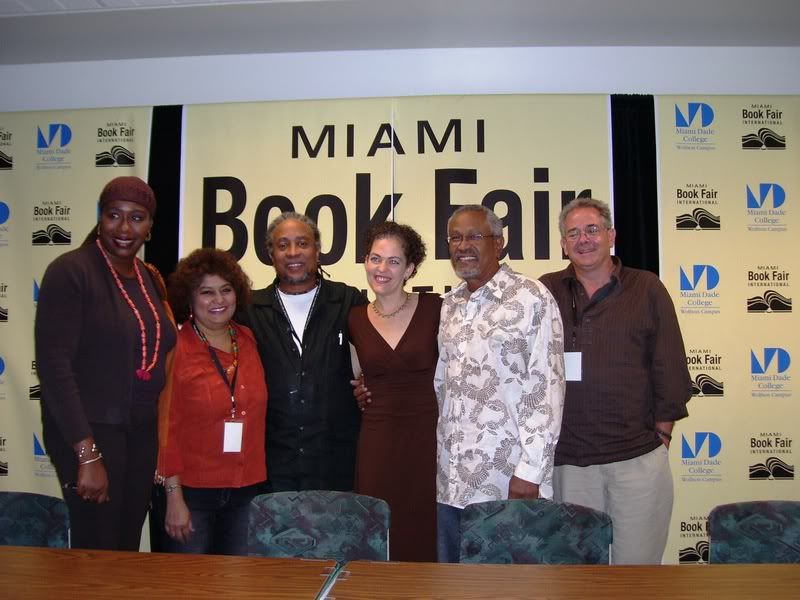
In the photo above (Left to Right): Donna Weir-Soley,
Ramabai Espinet, Dawad Phillip, Shara McCallum, Mervyn Taylor, and Lawrence Scott.

Day One:
http://www.flickr.com/photos/51858402@N00/sets/72157594381971284/show/

Day Two:
http://www.flickr.com/photos/51858402@N00/sets/72157594383382477/show/

***
The book giveaway has come to an end. I did not specify the official end of the contest, but I did say that the winners would be announced after the Book Fair. Here are the winners of an autographed copy of Iron Balloons.

Rethabile
eemanee
ikkinlala

Congratulations! Send me your snail mail address (geoffreyphilp101 at gmail.com) and I will get the books out to you ASAP. The books have been autographed by Colin Channer and Geoffrey Philp.
***

South Florida writers, Miami Dade College Miami Book Fair International , Caribbean, Caribbean writers,