 After tossing and turning a whole night in bed, I woke up early the next morning and went to Lester Goran’s office in the Ashe Building He joked with me and asked if I had given up the notion of being a critic. I told him yes and he seemed pleased. He showed me how I could graduate from UM with a Master of Arts with a concentration in creative writing. I agreed to the plan. The only problem was I would have to write a dissertation. Goran asked me if I’d ever thought about writing a novel. I told him that I’d thought about it from time to time, but I’d never given it serious thought. He told me it was time to get serious.
I walked around the campus that evening waiting for the Coral Gables traffic to die down, so that I could get home. I sat under one of the beautiful banyans that grace the campus, and began thinking through my options. I thought about some of the characters in short stories that I’d written when Goran and Isaac Bashevis Singer team-taught our creative writing classes, but none of those characters had a crisis that would match the scope of a novel. In short stories, the protagonist faces a single problem that can be resolved within three to ten thousand words. A novel, however, is more complex and the protagonist has to confront a problem that is interesting enough to be sustained over ninety thousand words.
I didn’t want to write a historical novel about slavery and I didn’t want to write in the style of some West Indian writers whose novels were, to put it mildly, boring. It was as if they weren’t interested in writing novels in the way American authors such as Russell Banks, Phillip Roth, and John Irving, structured the narrative to engage their readers in the story. My model for writing was always Shakespeare and in most of his plays he had something for the groundlings and something for the literati. This seemed to be a rational way to look at writing because at their base, novels and plays are forms of popular entertainment. Novels can be transformed the way Joyce did in Ulysses or Aldous Huxley in Eyeless in Gaza, but those represented the high end of the form. If I was now embarking on a career of becoming a writer, then I would have to write novels that had some commercial appeal, and I didn’t think a Caribbean audience would read novels like Ulysses or Eyeless in Gaza.
As I envisioned the novel, it would be a Caribbean coming-of-age novel (George Lamming's, In the Castle of my Skin) with elements from James Joyce’s Portrait of the Artist as a Young Man, Robert Penn Warren’s, All the King’s Men, Dante’s Inferno, and Shakespeare’s Hamlet. The novel needed a murder at its core because these kinds of stories change one of the essential mysteries of the universe from why to who. Then, I started to ask myself a series of what ifs? based on my life, these books and the situation in the Caribbean. I wanted the novel to connect and find resonance in the lives of the readers, for I still believe a novel should give the reader an experience of meaning.
Drawing on my readings of Joseph Campbell, the protagonist’s mentor—his guide through the circles of a Jamaican Inferno--would have to be a mystical, yet human figure—a combination of Jah Mick, Bob Marley, Leghorn, and Seeco. Especially Seeco, who after getting frustrated with my many questions about Rastafari, said to me, “Benjamin, the questioner! Just let it go.” I didn’t know what he meant until I went to a Twelve Tribes of Israel meeting and asked one of the elders who told me that Benjamin referred to the month of March. I was born in March, but I’d never told Seeco when I was born and he never asked. He just proclaimed. I would call the mentor/psychopomp, Papa Legba, to give him a connection to Haiti like the Maroon Boukman, but also to connect him to the Yoruba religion: Eleggua in Cuba and Eshu/Anancy in other parts of the African diaspora.
I also wanted the novel to have the feel of Jamaica during the eighties—like the dread sound that Bob heard and put in the opening bars of “Burnin’.” It would open with the word, “Bumbo,” one of the ugliest curse words in Jamaican that would signal, like Marley’s guttural rumble or Carly’s signature “one drop,” that the reader had entered a new, yet profane world and in the act of doubling creation, the beginning and end of the novel would contain descriptions of the sea-- from which the purgatorial experiences of Black people in the New World began.
The plot, like Hamlet, would revolve around the death of a father/king/prominent politician, and the main suspect would be David (of the Psalms, a warrior/poet) Carmichael (almost like Michael Manley). The young protagonist would be renamed Benjamin by Papa Legba—a name he would reject because of his bourgeois background at Jamaica College and his leanings toward North American materialism. I gave him the name Jason because he would be on a quest. As an homage to my grandfather and the Scottish presence in Jamaica, I gave him the surname Lumley.
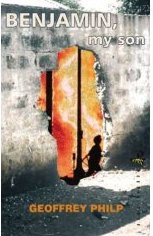
Jason, like Telemachus from the Odyssey and Iliad, would embark on a quest of self-discovery, and he and Telemachus would also be similar in one important aspect: they were brought up by their mothers. Jason, like Telemachus, would yearn to demonstrate within the world of action a “manhood gaining act.” For men in the Caribbean, this act takes many forms and in the ghetto/garrisons of Kingston, it takes a deadly turn as Laurie Gunst's, Born Fi Dead, proved to me. Writing the novel wasn’t just telling another story. The mystery of how so many of my classmates at Jamaica College—idren I used to kick ball with—who had now become hardened gunmen with their faces splashed over newspapers, haunted me for years. And the platitudes of “There, but for the grace of God, go I,” were unsatisfying. I was determined to find an answer in fiction. I would write a reggae novel, and I would call it, Benjamin, My Son.
Part One of Genesis (of Benjamin, My Son)
Benjamin, My Son: Caribbean Literature Textbook
Tags:
Caribbean
Jamaica
Writing
Books
Benjamin, My Son
Caribbean writers
Miami
Caribbean writers
Joseph Campbell
 Caribbean American novel
Reggae novels