Showing posts with label Jamaica College. Show all posts

October 28, 2013

How my DNA Set me Free

How my DNA set me free


For the past fifty years, I have been living under the shadow of a lie. I think it has to do with the shape of my eyes. From the time that I was in primary school, my friends and classmates thought that I was part Chinese. In high school at Jamaica College, one of the boys in Cowper, the upper house to Murray, called me a “Tappa shop Chinee bwai.” The name calling didn’t bother me. Growing up in Mona Heights with Jamaicans of African, English, Chinese, and East Indian ancestry, I knew that Jamaicans of Chinese descent (especially our fathers) were just as crazy as everyone else.

Yet even after I graduated from Jamaica College and I moved to Miami, the mistaken identity followed me. I just smiled whenever someone called me, “Mr. Chin,” and went on with whatever I was doing. However, when a Chinese-Jamaican cashier at our local supermarket asked me how I was going to celebrate the New Year—she meant the Chinese New Year—I decided to research to create a family tree.

This was not as easy as it seems. My father was married four times and I have brothers and sisters living in Jamaica, Canada, England, and Switzerland. My mother’s family is even more complicated with cousins and aunts living in Jamaica, Cuba, Canada, and Panama. Piecing together a family tree under these circumstances was going to be a challenge.

With the help of my brother, Ricky, who lives in Canada and who had already begun putting together the Philp family tree, I began working on the Lumleys, my mother’s side of the family.

Using Ancestry.com, I created a family tree and traced my roots to the early nineteenth century when the Philp and Lumley males came to Jamaica from Great Britain and began marrying Jamaican women. Both Philp and Lumley males were also very religious and left behind family Bibles and other artifacts. My great-grandfather, Frederick Andrew Lumley, Sr. was one of the earliest founders of the Seventh Day Adventists in Jamaica and one of my grandaunts, Marie Evelyn Jones née Lumley, “is thought to be the first Negro to enroll at Loma Linda University.”

But then my research came to a halt. Using immigration records, the males on both sides of my family could be traced back to Scotland and England, but the females on either side ended up in slavery as property. I always knew I had African ancestry, but  after being called “Mr. Chin” for so many years, I wanted to know if there was even a trace of Chinese blood flowing through my veins. After collecting the email and snail mail addresses of my relatives, I asked the question, “Do we have any Chinese ancestry?”

All the answers came back negative. This I suspected could have been due to the prejudice that many Chinese Jamaicans have faced. I continued asking what could have been perceived by my relatives as uncomfortable questions, but I wanted to know the truth. Despite making connections with living first, second, third, fourth, fifth and sixth cousins, many of whom I had never known before, I kept hitting genealogical dead ends.

I was just about to give up when Ancestry.com introduced AncestryDNA, which promised an accurate reading of my DNA. I purchased the kit and within a few days, it arrived on my door step. After following the instructions, I returned the kit and waited for the results.

A few weeks later, I received an email from AncestryDNA. My ancestry was 51% West African and 49% European (36% Great Britain, 5% Scandinavian, 3% Ireland 3%, 2% Italy/Greece, < 2% Iberian Peninsula, and < 1% Finnish/Northern Russia.  

Scandinavian? I guess that’s where I got my "Chinee eyes" or the epicanthal fold found in Europeans such as Poles and Scandinavians.

The DNA test had lain to rest all the doubts about my so-called Chinese ancestry. But now a new set of questions opened up before me. Which part of Africa did my ancestors come from?


***


As a part of the Bob Marley: Messenger exhibition at Miami History,  Cedella Marley, Gerard Hausman and Geoffrey Philp will be reading Jamaican Tales at MiamiHistory on November 9, 2013

HistoryMiami, 101 West Flagler Street, Miami, FL


August 1, 2013

Happy Birthday, Lorna Goodison


When I was in first form at Jamaica College, nearly every boy in 1 Murray drooled and doodled while Lorna Goodison tried to teach us color, value, and texture. Lorna taught us art for about two or three years, and then, she left. The next time I saw her was when she was invited by our drama teacher, Dennis Scott, to talk with our literary club. Lorna talked passionately about art, Rastafari, and music. Afterwards, she gave us a writing exercise to compose a Reggae song. We toyed with the idea for some time and she offered a few suggestions. At the end of the exercise, Dennis asked her to read a poem.

Miss Goodison was also a poet? We listened intently as she read one of her poems. I can't remember the name, but I'll never forget the awe that I felt after her reading. She was like a saint. Saint Lorna.

The feeling never left me.


When I decided that I wanted to be a poet and I was searching for models by reading everything that Derek Walcott had ever written, I tried writing a poem like Lorna's "She," which was published in Savacou 13: Caribbean Women. Of course, I failed miserably. No one can write like Lorna Goodison.

For unlike Walcott, from whose work a young poet can learn forms such as the sonnet and how to use allusions drawn from Greek and Roman mythologies to create Odysseus-like characters or from Shakespearean drama to construct Calibanesque figures, Lorna's poems, while drawing from a similar landscape as Walcott's, does not seek to transform the characters into anything other than what they are. Her speakers remain obstinately Caribbean with red dirt under their fingernails, and smelling of rum and carbolic soap. Also, her sense of line, like brush strokes, carry the signature and confidence of the artist.

There was nothing that she could teach me because the images and the associations that she had made in her art held deeply personal meanings, yet she managed to translate those sentiments to the page so that her readers could experience similar emotions. In other words, what I learned from Lorna was that if I wanted to write like her, I would have to live my own life and to use the experiences and associations from my life. And that couldn't be faked. If I wanted to be a poet like Lorna, I would have to write my own poems.

Give thanks, Lorna. Give thanks!


***

"Emancipate yourself from mental slavery/ None but ourselves can free our minds." ~ Lyrics from Bob Marley's "Redemption Song" taken from a speech by the Hon. Marcus Mosiah Garvey.

April 20, 2012

Bob Marley: Voice of the Ghetto


This is the first article I ever wrote about Bob Marley. It was written in 1974 when I was sixteen years old. It's hard to believe that I was ever sixteen.


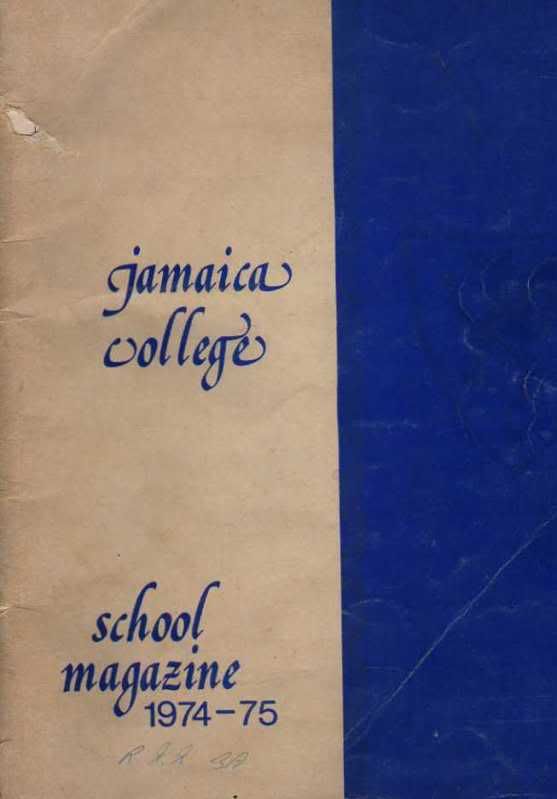
I was attending Jamaica College, Lower Sixth, and I was the literary editor of our school magazine. Back then, I was better known as Herbert Spliffington.

Been a long time coming...

1Love


***


If you enjoyed this post, check out my page on Amazon. I’d also be very grateful if you’d help it spread by emailing it to a friend, or sharing it on Twitter or Facebook.

Follow Me on Pinterest

Thank you!

October 17, 2011

Howzat! Mid-Day Thoughts of a Late Cut Artist


By Geoffrey Philp

I love to play cricket. Sometimes I like to think I was born with a bat in my hand. Or at least it seemed that way when I was growing up in Mona Heights, Jamaica. Many of my holidays were spent playing cricket with David "Griffo" Griffiths, Paul "Pat Chow" Chin, Paul "Pablove" Smith, and our friends from Geranium, Orchid, or Daisy Avenue. In fact, you could substitute some of the characters from my short story, "The Day Mrs. HoSang Got Arrested"  in Uncle Obadiah and the Alien for Griffo, Pat Chow, Pablove, and me playing cricket on Plumbago Path.

We all had individual skills at which we excelled. David was a good pace bowler; Pat Chow had a wicked leg break, and Paul had a mixture of off-break, leg break, and googly. And when we had our version of test matches against teams from Hope Pastures, we'd call on Ian Carey, who was also a good spin bowler, to be our opening batsman. The competition was always a means to hone our skills in the three essential positions of a cricket team.

When you are fielding, you have to be aware of your surroundings by paying attention to the bowler and the batsman's reactions. A bowler has to confuse the batsman either by pace or spin, spotting his weaknesses or bowling him out by indulging his strengths. As a batsman, my favorite position, you must possess a combination of skill, patience, and confidence to master each shot. You have to focus on each ball to either play defensively or to create an opportunity for your team to make runs. My favorite shot was a late cut off the back foot for four runs between backward point and third man.

You also learn every ball is different. If, as a wise philosopher once said once said that you never step in the same river twice, then every ball is an opportunity for defeat--Howzat!; victory--six runs!, or a resounding truce--"Nooooooo!"

For nearly every summer until we graduated from primary school, Griffo, Pat Chow, Pablove, and I played cricket against different teams. Griffo went to Wolmers, Pat Chow to Ardenne,  Pablove and I went to Jamaica College. I was chosen for Murray House and Paul was inducted into Hardy House, our perennial rivals. Mid-way through our first term, Paul stopped playing cricket and started playing football. I, however, continued playing cricket, and as a first former, I was assigned to the "B" team. I thought I deserved to be on the "A" team, but the events proved me wrong.

I was the opening batsman in a limited overs match against Hardy House, so every ball counted. The pace bowler, who I think went on to play for our Sunlight team, had me pinned from the first ball. I was forced to make defensive plays: "Nooooooo!" Our housemaster, Mr. McLeod, didn't like what was happening. Didn't like it one bit.

After the second over, my partner and I had only scored four runs. Mr. McLeod walked over to me and said I needed to make runs or he would declare me out. I didn't think it was fair, but I couldn't protest or do anything about it, I was only a mere first former. Pressure was mounting on and off the field. I tried hard to remember the advice that Griffo's father had once given us, "Play the ball. Not the crowd."

The next ball came at a blistering pace, and I showed the bowler the face of the bat, "Nooooooo!" I looked over at Mr. McLeod. He looked me dead in the eyes and tapped his watch. Mr. McLeod was angry with me.

More pressure. The bowler delivered a ball that swung from the offside toward mid-wicket and I countered with another, "Nooooooo!" Mr. McLeod threw his hands in the air and pointed to another first former to get ready.

I was losing my cool and the bowler sensed it. He slammed a crushing bouncer at my head, and I tried to lift the ball over his shoulders for six runs, but it didn't work. He jumped up and caught the ball. I was out for three runs.

And then, the bowler laughed. I've never forgotten the smirk on his face or his raucous cackle.

I walked off the field with my bat under my arm and my head hung low. As I passed Mr. McLeod, I said, "I hope you're happy now."

"What did you say?" he screamed at me.

"Nothing, sir," was all I could say and sat on the sidelines. I didn't want to get a caning, so I kept my mouth shut for the rest of the game.

The worst was yet to come. Our team lost. My wicket had been sacrificed for expediency, and it was all in vain. My only comfort was I hadn't made a duck.

From that day, I made a decision that no one would ever force me to give up my wicket for any reason. As long as I could hold the bat between my hands, I would never give up my wicket for anything or anyone. I would dig in and if I had to play defensive strokes, then so be it. Either bowl me out or I would parry with "Nooooooo," for the rest of my life.

I've never forgotten that day or the bowler's derisive laughter. It has been the spur in situations that I've faced as a teacher and writer where the odds have been against me.

In fact, a few years ago when I worked as an English teacher in Dade County Public Schools, I was confronted with a situation where I had to be defensive. I was a young father and I needed every penny I could get. So, in addition to teaching English, I taught journalism and I was the yearbook/newspaper advisor and soccer coach. But that, sports fans, is another story.

There had been a change in the administration and I sensed that the new principal wanted to replace me so she could give the yearbook/newspaper job to one of her cronies. She tried every trick in the book to get me out, but I wouldn't budge. With every charge she delivered, my reply was "Nooooooo!"

When the situation became obvious to my coworkers, one of them said to me, "Why are you trying so hard? Why don't you just quit?"

My response? You guessed it. "Nooooooo!"

It is that kind of determination--my wife says stubbornness--that has also helped me as a writer. Every morning I get up to practice my writing as I had done with batting in the nets because it takes a special kind of perseverance to dig in when the rejections are coming from publishers: "Nooooooo!"  Call me Bartleby with a cricket bat.

During my writing apprenticeship, I went for years without making a run or taking a wicket. But I figured as long as I could hold my pen between my fingers--I still write by longhand--I would never be discouraged by anything or anyone. And whenever I saw an opportunity to transform the issues that plague my culture intopersonal stories, it would be a late cut off the back foot for six runs.

That's the kind of persistence that I've had to possess to continue writing, and I've never settled for expediency. A good writer, like an experienced batsman, has to have faith in his skills, which according to Malcolm Gladwell can take up to 10,000 hours of hard work todevelop, so he can get through those times when it seems as if you're facing Michael Holding at the peak of his powers, and it doesn't seem as if Mikey is going to tire any time soon.

But every now and then, I look at the scoreboard, the runs that I've made and I feel confident that even though the innings may not have been as spectacular as I would have liked, I still haven't lost my wicket.

I'm still batting.

July 10, 2011

Among the Saints: Mount Carmel Missionary Baptist Church


What happens to a dream deferred?

Does it dry up
like a raisin in the sun?
Or fester like a sore--
And then run?
Does it stink like rotten meat?
Or crust and sugar over--
like a syrupy sweet?

Maybe it just sags
like a heavy load.

Or does it explode?

This poem by Langston Hughes, the theme for your commencement, has always meant a lot to me. Coming from a single parent home and raised by my mother, I saw what broken dreams did to my family and what it has done to so many people that I've loved:

Destructive addictions
Repetitive cycles of procrastination
Crippling alcoholism

And so many more broken dreams.

Seeing as I'm in church, I going to take this opportunity to preach a little. One of the most famous dreamers in the Bible was Joseph, the son of Jacob. But what did Joseph dream and why were his dreams important? We also know that his brothers betrayed Joseph and we have to ask ourselves why they did that.

Joseph's dreams kept his tribe alive and his dreams saved the nation of Egypt. But why did his brother betray him? Sell him into slavery?

I think his brothers betrayed him because they stopped believing in their own dreams, and when they did that, they wanted to stop anyone else who had a dream. Joseph, the dreamer, became their enemy.

I know many of you, especially the children who are graduating from elementary school, are seeing that every day. You see the broken dreams, and you see the broken men and women all around you.

Langston Hughes saw this every day and that's why he wrote the poem.

But you have a better chance than Joseph and his brothers. You have an abundance of love in your church family that surrounds you at Mount Carmel .You have  brothers and sisters, aunts and uncles who only want the best for you.

My question is what are you going to do about it?

I believe every one of us is here for a reason; every one of us has a dream. Are you going to live up to your dream? Are you going to use "what's in your hand" to "put your dreams to reality"?

I know I have been living my dream, but it wouldn't have been possible without some of the people on whose shoulders I now stand.

I'll just mention a few of them

My teachers at Mona Primary: Mrs. Pennycooke and Mrs. Henry
My teachers at Jamaica College: Dennis Scott and James Carnegie
My teachers at Miami Dade College: Martha McDonough, Bruce Firestone, Angela Turner
My teachers at the University of Miami: Lester Goran, Evelyn Wilde Mayerson, O. R. Dathorne, and Isaac Bashevis Singer. 
My  family, who loves me and gives me the space to create and come back to them
My friends, who support my work in seen and unseen ways


And many, many more.

I'm standing here because of people who had faith in me. One is sitting right here in your church. Your sister, Lois Smith.

The Bible says, "Now faith is the assurance of things hoped for, the conviction of things not seen." The thing "not seen" is your future, but do you have to have faith that it can and will happen?

Do you believe?

I believed the words of my teachers and mentors that I could write a book. Up to today, I have published ten books and three more are one the way. If I could do it, so can you. I'm not saying your dream has to be to write a book. The fire in you is your dream. You have to follow your dream

The question is will you live up to your dreams?

I know you see evidence every day of your brothers and sisters, classmates who have stopped believing in their dreams and they want to drag you down. Don't let them. Never let them drag you down.

You are too precious, too worthy, too beautiful to be dragged down

And you have so many people who are praying for you, night and day. Day and night for you to succeed. Will you stand on the promise? Will you stand on the promise of all those who love you?

I hope and pray that you do.

For when you do, you praise the ancestors, all of those who fought for you to be free to have an education. All of then freedom fighters here in Miami who relied on God's promise for you.

Stand on the promise young graduates. Stand on the dream and you will be greatly blessed.


***


Mount Carmel Baptist Missionary Church, July 12, 2011.


June 27, 2011

My Love Affair With Libraries


During the launch of Marcus and the Amazons at the Anancy Festival, which was simulcast between the South Regional-Broward College Library in Fort Lauderdale, Florida, and the Tom Redcam Library in Kingston, Jamaica, I couldn't help but feel a nagging sense of betrayal. The festival, now in its third year, brought together two places that are very dear to me. 


The first, the South Regional-Broward College Library, has hosted several readings by Caribbean writers and has become a second home for many of us. The Tom Redcam Library, one of the first libraries I visited when I lived in Jamaica, was one of my favorite haunts during my adolescence. My mother would leave me on the steps of the library ostensibly to read and borrow books. But when I began attending high school at Jamaica College, Tom Redcam was the place where I would try and meet girls. Interesting girls. At that age, I didn't know what I was going to do after I met them; I only knew that I wanted to meet them. So the library became not only a place to hone my intellectual skills, but also my social skills, and this has served me well in my growth as a student and writer.
 
I practically lived in the library during my first five years at Jamaica College. And during my last year at Jamaica College, I thought I was in heaven. After a series of complications in the life of our librarian, Mrs. Valentine (I swear I'm not making up her name), I became the de facto librarian of Jamaica College. It was a position of trust, which I will now admit that I abused.
 
I gave myself the privilege of increasing the amount of books I could borrow at one time. Instead of the customary three, I gave myself the permission to borrow five at a time. Oh, the guilt wracked nights! I also had access to the books that had not yet been catalogued. I still remember the new book smell when I opened one of the boxes, and sitting on top of the pile was Alvin Toffler's Future Shock. Ah, the thrill! I lived between 813-820 Dewey Decimal and every evening would emerge from those dusty corridors, my mind swirling with ideas in my attempt to read every book in that section of our small library. This experience became the foundation for my readings in Caribbean literature and the basis for my work as a writer. This, I thought, was going to prepare me for the vocation I would enjoy in Jamaica for the rest of my life.
 
Boy, was I wrong.
 
Everything changed after I left Jamaica College. My family and I were swept up in what is now called the Jamaican Diaspora. After I came to South Florida, I enrolled at Miami Dade Community College and spent most of my time in the library's media collection catching up on episodes of Roots that I hadn't seen in Jamaica and, of course, meeting girls. But now I knew what to do.
 
I spent days, weeks, and months in the libraries of Miami Dade Community College, and when I graduated, what seemed like years in the stacks of the Otto G. Richter Library of the University of Miami. I re-read In the Castle of my Skin, which helped me to understand the direction of my first novel, Benjamin, my son, a coming of age novel that takes place during the time of Jamaica's undeclared civil war, and Florida Bound, one of the first collection of poems to explore the Jamaican Diaspora in a South Florida setting. But I couldn't have done it without the help of those librarians.
 
I owe a great deal to librarians. During my undergraduate days, I met librarians who assisted me with finding books by a then obscure Caribbean poet, Derek Walcott. But librarians are like that. Wherever I've travelled, I've always found them to be kind, courteous professionals who are always willing to help anyone who shows a little initiative. And, perhaps, I've been a little naïve. For whenever I've given readings in the South, I've always stayed in the library rather than my hotel room until it was time to leave. It just felt safer.
 
So, during the reading of Marcus and the Amazon when I looked at the faces of librarians such as Nancy Ansley and Valrie Simpson, I felt I was betraying them: I had published my work in a format that some have said undermines the necessity of libraries and librarians. In these hard times, I felt as if I was trying to put these two wonderful women out of work. But then, I had to ask myself it is that dire? A few days ago while doing some research, I took comfort in a post, by Seth Godin, The Future of the Library: 
 
The next library is filled with so many web terminals there's always at least one empty. And the people who run this library don't view the combination of access to data and connections to peers as a sidelight--it's the entire point.
Wouldn't you want to live and work and pay taxes in a town that had a library like that? The vibe of the best Brooklyn coffee shop combined with a passionate raconteur of information? There are one thousand things that could be done in a place like this, all built around one mission: take the world of data, combine it with the people in this community and create value.
We need librarians more than we ever did. What we don't need are mere clerks who guard dead paper. Librarians are too important to be a dwindling voice in our culture. For the right librarian, this is the chance of a lifetime.
 
For the sake of my friends, I hope you're right, Seth. I hope you're right.


December 25, 2010

Christmas and Nostalgia


All men come to the hills
Finally…
Men from the deeps of the plains of the sea—
Where a wind-in-the sail is hope,
That long desire, and long weariness fulfills—
Come again to the hills.

“All men come to the hills” by Roger Mais

I had no intention of writing this morning. But then, old habits die hard, and when I could no longer stay in bed, I went downstairs as usual to check my e-mail. Was I surprised!

Sitting at the top of the list was an e-mail from Harold Mitchell, who had been searching the Net for the names of old friends, when he stumbled upon my blog. I hadn’t seen nor had I heard from him in years! In fact, had to dig through my copy of the Jamaica College ('75) yearbook, of which I was the literary editor, to recall his face.

A flood of memories of Jamaica at Christmas (including the poem by Roger Mais—it’s as if those old poets always knew we would be a wayfaring people) came back: football, the Mona Heights fair, and friends.

Yes, I know, memory is selective. But sometimes that is a good thing. In this case, I have used my memories of Jamaica to rebuild my life in Florida. I have taken the best that living in Jamaica has taught me to recreate a life here.

So, although I can no longer go to the fair nor do I play football, I still have a few friends with whom I can share some great memories. Here’s the post that Harold found:


***

July 6, 2009

"Bad" Words & Storytelling

Geoffrey PhilpDuring a radio interview in the eighties, Peter Tosh said that there were no "bad" words and I believed him. However, to many in his listening audience this was a radical concept and another example of Rasta-speak. But to overstand what Peter meant, one has to realize that he, like many Rastafari, realize that words in themselves are not "bad," but they are merely the vehicles of an awakened or unawakened consciousness. Or to put it another way, if one's mind is "as clear as a hillside lake," as another of my teachers said when I was telling him about "bad" and "good" energy," one would be able to see through "bad" and "good" as merely events--without attaching limited judgment to phenomena.

What both these men were trying to teach me in less mystical terms was that every individual creates a context, largely defined by language, through which s/he perceives the world. If the contextual framework is removed or expanded, then the relative terms, "good" or "bad," begin to lose their meaning because of their limited relevance to reality. My teachers' worldview can be summed up in the Taoist story of the farmer.

Yet context (character, plot, setting) is at the heart of fiction and one of the guiding principles of my storytelling is to use only the words or sentences that will either advance the plot or reveal character. And since many of my stories are about working class or middle class Jamaicans with a patina of "sophistication," how the characters speak, especially when they are faced with conflict--the essence of storytelling--is vitally important. If a writer betrays his characters because s/he fears what the audience will think, the story will lose its soul and the audience even if they are amused by changes, will realize that the writer has been unfaithful. And that is a certain death of the story and perhaps the writer's career because trust--the willingness of the writer to speak the truth of a character and situation--is the element upon which all good stories are built. That trust is sacrosanct.

It was against this backdrop that one of the most embarrassing episodes in my writing career took place.

In July 2003, Colin Channer, Kwame Dawes, and I were invited to read at Jamaica College, an all boys' school, as part of the school's efforts to rebuild the library. I was very excited about reading Benjamin, my son, my coming-of age novel, because much of the action takes place at Jamaica College, my alma mater.

In Benjamin, my son, I use the framework of Dante's Inferno to challenge the illusion of Jamaica that is promoted by our tourist brochures and to illustrate the loss of moral vision in post-Independence Jamaica. The latter has had a corrosive effect on every aspect of culture, which extends to games such as dominos or cricket--two staples in the lifestyles of Jamaican men. One could even argue that mastery of these games is a male rite of passage in Jamaica.

As an alumnus of Jamaica College, Jason Lumley, the protagonist of Benjamin, my son, approaches women from a background of fear and hostility. But as he wanders through Standpipe, a neighboring community of Jamaica College, he encounters many different women who affect a change in his attitude, and by the end of the novel, he is reintegrated into the protection of the sacred feminine.

So, for my triumphal return to the school that was the setting of my bildungsroman, I thought I had chosen the perfect section from Benjamin, my son--the domino scene.

I chose that section to exemplify many of the social attitudes that are still prevalent in Jamaica: disrespect for women, homophobia, and machoism. For although dominos is largely a game of chance, in order to win, the players must possess certain skills to "read" the game. And like cricket, about which CLR James ruminated in Beyond a Boundary, there is a social contract that involves camaraderie, community, and playing by the rules of the game. All of these rules are violated in the domino scene.

Also by using the conventions of dominos, character can be revealed, as I've done in "Beeline Against Babylon" in Who's Your Daddy?, through dialogue that will also advance the plot. In other words, the "bad" words that appear the the text reveal the characters' attachment to their definition of what is means to be a "man." And when that definition is threatened, they spew out a torrent of hellish "bad" words--this is how demons squeal when they are faced with awareness.

After I read the excerpt, I had expected to be congratulated for accomplishing something akin to what Derek Walcott had done in Another Life: using the local Caribbean landscape to illustrate global themes, such as the loss of innocence.

Was I wrong.

One woman in the audience congratulated Colin and Kwame on their writing, but then started to curse me with a string of "yous"; "Why did you have to read that? You…you… you." She complained about all of the "bad words" that I had used in the story when I knew there were children present. To be honest, I hadn't seen any children, for if I had I would have read from the "resurrection" scene near the end of the novel.

But no matter how much I pleaded or argued about freedom of speech or artistic integrity, she would have none of it. I apologized.

She went back to her seat, confident in her victory.

Later that night, a friend of mine, a JC Old Boy, consoled me over a Red Stripe and I tried to figure out what had gone wrong. Were there children present?

That reading changed me. It hasn't changed how I write (my fidelity will always be with the story and the imagined characters), but it has changed the kinds of material I read for Jamaican audiences. I understand the context and given the deeply conservative nature of Jamaican society, I now choose my sections carefully.

So, even now when I'm still accused of the gratuitous use of the word, "B*mb*" (children may be reading this) at the beginning of Benjamin, my son, I realize that if the person could be more offended by this word than the material conditions that the novel portrays--the word symbolizes the Jamaican male revulsion to the feminine--then, I realize that my work, as a fishmonger once said to a friend of mine, "Ain't for everyone."

***

This post is part of Middle Zone Musings: What I Learned From Bloopers, Mistakes, and Embarrassing Moments


***

Zen teacher and writer Cheri Huber says, “Every time we choose safety, we reinforce fear.”


Reblog this post [with Zemanta]

October 22, 2008

Old Boy Pride: Jamaica College

Jamaica CollegeDuring the nineties when I made regular trips to Jamaica, I'd usually visit my alma mater, Jamaica College, and invariably, I'd be disappointed by the physical appearance of the buildings and the rowdiness of the boys. Not that when I was in high school my friends and I weren't a bit rowdy. But this was rowdiness to the point of being rude. The line between personal and communal behaviors seemed to have been blurred, and whereas we were cautious about crossing social barriers, these boys didn't even recognize the limits and barged through with reckless abandon.


Last year, however, I visited Jamaica College and noticed a visible change. The buildings were painted and the boys seemed less uncouth. They were even courteous. This was a welcome change, and for the first in a long time, I felt proud to be a JC Old Boy.


It was quite a strange feeling because I've always had a quixotic relationship with Jamaica College, which I've written about in my novel Benjamin, my son and in some of the stories in my latest collection, Who's Your Daddy? and Other Stories. The time I spent at Jamaica College meant a lot to me, and I'm being precise when I say it was my alma mater--nourishing mother.


As a young man growing up in an all boys' school during the seventies, Jamaica College provided me with space to think about my relationships with parents, friends, and community. It was a time of enormous change, and every relationship, every assumption behind every relationship was scrutinized. This scrutiny extended into social and gender/sexual arenas.


And because Jamaica College, besides being known for its intellectual tradition, was also known as a "battyman" school, it was difficult to balance the decency and tolerance that were the cornerstones of the education that I received from JC Old Boys and teachers such as Dennis Scott and Jimmy Carnegie, while at the same time reconciling the idea of being a Jamaican gentleman, exemplified by JC Old Boy and then Prime Minister, Michael Manley, with the rise of feminism and the homophobia of Jamaican society.


I was also born during the generation that could remember the lowering of the Union Jack and the raising of the Jamaican flag, so the question presented itself: What does it mean to be a Jamaican gentleman in postcolonial Jamaica?


Growing up in colonial Jamaica, many of the previous old Boys had a clear idea of a Jamaican gentleman: white, Oxbridge accent and a sneering contempt for the masses--VS Naipaul sans melanin. However, after we gained our independence from Britain, the clarity was lost as new dimensions were added to the conception of our identity: Africa, Rastafari, feminism. Rastafari and feminism forced us to ask ourselves: How do men and women behave toward each other without invoking the legacy of paternalism, colonialism, race, and class privilege?


Reggae and Rastafari were also transforming Jamaican culture and language and therefore the lens through which we interpreted the world with words such as dawta, I-dren, and sistren.


To all these questions, I got mixed answers. So what's a boy to do?


Well, we must act and the behavior of this young man, a current Jamaica College student, seems to be just right:


He was just another Jamaica College student; she, from Ardenne Preparatory. They could have been siblings, or cousins. Yet something about them pulled my attention away from the other students nearby who were chattering noisily… It sang to me in the almost fatherly way in which he instructed her to position herself so that she could hold on to one of the bus seats for stability…


He was no longer just another high school student. He was that little girl’s protector, her rock.


And he became the hope I clenched tightly in my heart for the future of our young men.


There didn't seem to be any condescension of the young man's part, just genuine care for a younger sistren. He could be strong even in the knowledge that there are predatory men out there who would seek to exploit the sistren's vulnerability. In that moment, he was her "protector"--he was being chivalrous in the truest sense of the word, for there was nothing to be gained. He acted truly and he was on his way. And that's what being a gentleman--in any culture--is all about.


This young man acted in a way that affirmed the rich tradition of Jamaica and my alma mater. And after reading about him, I have one more reason to say proudly, "Yes, is there I come from."


***

December 3, 2007

My Jamaica: Part Two

JamaicaMona had changed. It was not the manicured lawns of my childhood nor was it the world that I'd described in some of my stories that I'd published in Uncle Obadiah and the Alien in which my friends, Paul, David, Pat, Bruce, and Norman appeared in my thinly disguised fictions about growing up in Jamaica.

In fact, I didn't see any children playing cricket or football as we had done at Top Park, Bottom Park, and the community center, or in front of our homes. It was a symptom of the exodus that began in the late seventies when I and many of my friends left for London, New York, Ontario, Atlanta, and Miami. This saddened me a bit because it was in Mona Heights that I developed my sense of community and learned how to foster many of the relationships that have played an important part in my life.

I walked through the streets like a ghost, unknown and not knowing anyone, until I reached the gates of my aunt who had lived in London, Ontario, and New York. I didn't expect her to be home because the process of moving her possessions from all the previous places where she had lived had been slow, and at her advanced age, she is often in transit between continents and the island.

I knocked on the gate and one of my cousins, Paul, peered up from behind his car. This was a sure sign that she was home because Paul has been charged by my uncle (her brother) with taking care of my aunt whenever she is in Jamaica. He opened the gates and went around the back to tell my aunt that she had a surprise: I was home.

Paul and I chatted for a while and he told me that his brother, Hew, had moved to Canada and that everyone in the family had seen the review of Grandpa Sydney's Anancy Stories in the Jamaica Observer. We continued talking until my aunt came outside to the verandah and greeted me. She was as feisty as ever and chided me (only as she could) about not calling beforehand. I accepted the mild reprimand as we sat and she asked about my family and work. We talked about my mother and she told me that she was proud of me. I accepted the blessing.

Then, she asked me where I was staying and she offered to give me a ride to the hotel. I told her that I wanted to visit my old school and she understood. I said goodbye and as I walked through the gates, I looked back at the woman who I admired for being one of the most independent of my grandfather's children. She had never got married, never had any children, never took any crap from any man, and never compromised on anything. And now she was being helped into a car by my cousin.

I crossed Daisy Avenue and then, over to Hope Road to Jamaica College where I was confronted by a security guard. (So many sentries have been appearing in my life!) I told him that I was a former student and he allowed me into the school to take a few pictures, yet he watched my every move.

As I walked by St. Dunstan's, past the names of the JC Old Boys who had died in World War I, I saw behind an open window, the eager faces of young men behind desks in what was once One Chambers. I used to be one of them. I snapped a few pictures of the school and felt vaguely nostalgic about the place that been the setting for my semi-autobiographical novel, Benjamin, my son. Of course, I had to take pictures of "Holy Ground," and the Assembly Hall, and then, went back to Mona on a hunch, a feeling that Paul Smith, one of my childhood friends was back in Jamaica.

I was right. The hunch paid off. Paul wasn't home, but his helper gave me his address and synchronicity! His business, Reggae Vacations, was right beside my hotel in the heart of New Kingston. I practically ran back to Hope Road, jumped in a mini-bus that now played music videos instead of CDs, and headed off for Half-Way-Tree.

From Half-Way-Tree, I walked over to Reggae Vacations and went up to Paul's office. I knocked on the door. No answer. I knocked gain. Still no answer. I went down stairs and talked with a receptionist who insisted that Paul had not left the building.

I want upstairs and knocked again. Nothing. Then, I heard a voice that I was certain was Paul's coming from an adjacent office. I knocked on the door. Silence. A voice said, "Come in." It wasn't Paul's. I backed away from the door. A moment of hesitation. The door opened and my Idren, Paul, was startled. He laughed. He immediately introduced me to his friend, and we were off to eat at one of his favorite East Indian restaurants in Liguanea.

It was if we'd never had a break in seeing each other. We picked up the conversation since he told me about three years ago that he was leaving for Dominica. During that time, we'd exchanged a few e-mails, but nothing big. We bragged about our kids and families. Paul said that he was surprised to see me because I hadn’t mentioned the trip on my blog. I knew he had subscribed, but I thought he was still in Dominica working with their tourist board. After a few laughs and Red Stripes, he told me about his work with the cruise industry and about another of our friends, Norman Pennycooke.

Paul, Norman, and I go way, way back. Our friendships started at Mona Primary. Norman's mother was our teacher in sixth grade and we were the three kings in our annual Christmas play. I was Gaspar ("Gold"); Norman was Melchior ("Frankincense"), and Paul was Balthazar ("Myrrh"). When we graduated from Mona Primary, we went to Jamaica College where our friendships deepened and was tempered by competition and cooperation.

Norman, as it turns out, was doing well in Dominica and that was expected. We'd attended the best high school in Jamaica (take that Kingston College and St. Georges!). In between clients for his reggae themed vacations, I teased Paul that he'd never capitalized on his music lessons, but he told me in some ways that had paid off. A few years ago, he was the leader of a reggae band, MLC (Mid Life Crisis) and they'd played a few gigs around the island.

We started calling friends around the island and I learned that Bruce was now a successful dentist in May Pen. I asked about Errol McDonald (Macky D) who given me the name, "Herbert Spliffington." He said Errol was in Ghana touring with a reggae band. For the most part, most of our friends were doing well, but then the dread catalog began: those who had been killed or became killers; those who had died from natural causes or had become invisible in America; those who were on the FBI's "Most Wanted List," and those who had suffered from an extreme case of "lead poisoning" to use one of Jimmy Carnegie's favorite euphemisms.

By the time we had caught up with everybody and everything, it was dark and we decided to go to the Top Park in Mona Heights. There we saw old friends like Larry Smith, Boothes, and Peter Moses. Peter teased me about gaining the extra weight since my Manning Cup Football days, and then, he went off to play with the "old timers." Men my age or a few years older.

As we were about to leave, Paul's sister, Gail, came by and we sat down and ate barbequed chicken (Okay, Peter, I hear you!) and talked some more until nine o'clock We reminisced about the annual Christmas fair at the community center where many of us smoked our first cigarette or kissed or first girlfriend. Or got caught doing both. Sometimes on the same day and by different parents.

We finished the chicken and our beers at about ten thirty and followed Gail back to her house. Paul drove me back to the hotel and promised me he would pick me up the next day and take me to the airport.
I slept well that night and got up the next day, ready to go back to Miami and to read at the Miami Book Fair International.

As I waited for Paul on a bench near the reception area of the hotel, I looked up at the hills how much I had missed waking up every morning as Paul, Norman, Bruce and I walked to Jamaica College. I was glad that I hadn't given into my fears and that I'd seen Kingston on foot and by taxi, bus, and mini-bus. I remembered Minto's comment about me becoming Americanized and yet in some ways how I had remained stubbornly Jamaican.

I opened Kendel Hippolyte's Night Vision with the haunting phrase, "our first generation of unmeaning," and I became conscious of how much I had changed and my connection with the generations that had grown up since I had left in 1979 was tenuous at best. My impending mortality in the face of my aunt (I turn fifty next year), and that my football friends were now called "old timers" stayed with me.

Listening to the hotel workers going back and forth as they did their duties, I realized that Jamaicans laugh at the sheer pleasure of being alive. No matter how hard the times, how dread the circumstances, we laugh. A lot.

I glanced across the front of the hotel. The two guards that I'd talked with the day before were outside smoking cigarettes and I told them about my adventures. One said that I was brave and one hinted that I had been very foolish to go out on my own like that. But that's Jamaica for you. Put two Jamaicans in a room and you'll have three different opinions. And all of them are right!

I sat back on the bench and looked at the hills once again. I closed my eyes and gave thanks for the good time, however brief, that I'd had on my return.

When I opened my eyes, my Idren, Paul, had pulled into the driveway to take me to the airport and back to Miami.
***
For photos of the trip, please follow this link: My Jamaica.
***
***
On Wednesday (12/5/2007), I will be posting"A Conversation With Peter Schmitt," and on Friday (12/7/2007), I will be featuring an interview with Mervyn Morris.

May 25, 2007

Five Questions With Xavier Murphy

Xavier MurphyXavier Murphy is the owner and webmaster of what is undoubtedly one of Jamaica's oldest and most popular online destinations - Jamaicans.Com. With a good mix of hard work, democracy, and entrepreneurship, Xavier has managed to keep Jamaicans.com on the forefront of Jamaica and the Caribbean's Internet landscape for almost a decade.


1. Why did you start Jamaicans.com?


The site went live in 1995 when the World Wide Web started to take off. In 1994 I had been working for a company that did electronic marketing and had "placements" on CompuServe, Prodigy, and AOL. These were the original "electronic" communities where everything was in one place. Back then the Internet was basically divided into 3 parts: E-mail, the graphical portion (now known as the World Wide Web) and Newsgroups. I remember searching many of the search directories (including Yahoo which started in 1995) for Jamaican web sites on the "World Wide Web" on the using the CompuServe Mosaic Browser. I found 3 sites: an Arlene Laing site with an overview of Jamaica, JaAlumni Yard Page, and the unofficial web site for my high school, Jamaica College. I was always very passionate about my homeland, and I was proud to find these sites online. I used to have my own magazine/newsletter years ago and I had some content, so I figured, why not start a website with some of the stuff I already had?


2. How has the Internet changed since you began publishing?

Wow...where do I start? It has grown tremendously. I used to use Notepad to edit the pages on my website. Now I have Dreamweaver and so many other great tools.
Open Source software applications has also leveled the playing field. It was very cost prohibitive to create complex applications, with Open Source you can find any application you need for your website.


3. What was your greatest challenge in maintaining
Jamaicans.com?


The biggest challenge is the traffic to the website. Through the years we have upgraded a few times because the site continues to grow.

4. What was your greatest disappointment?


My greatest disappointment is a bit broader than just online. I think we do not cherish our culture and the people/institutes that try to preserve it. It comes in the form of lack of sponsorship by Jamaican businesses or lack of support by the community. Even online we tend to tear down than build up.


5. What are the benefits of Internet publishing?


The ability to get information out quickly and getting instant feedback.


(Optional)

What makes you laugh?


The creativity of Jamaicans and just our style of humor. The
Jamaicans.com online forums is the outlet for a lot of funny stuff. Whenever I need a good laugh, I take a look at some of the discussions there. We have the ability to make the serious very funny or put a hilarious spin on things.

***