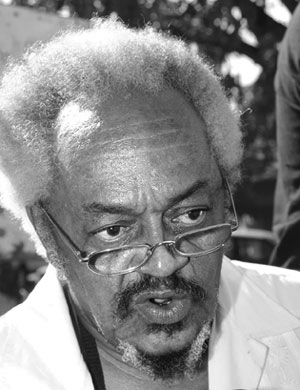
John Maxwell, one of Jamaica's most respected journalists, and an adolescent hero of mine has died. He was 76 years old.
It was just a short time ago that Mr. Maxwell had retired from the Jamaica Observer, and in this time of Wiki Leaks and other journalistic scandals, his ethics, wisdom, and courage are surely needed. For if we had more writers like Mr. Maxwell, who was devoted to the discipline of journalism, then, I think, we would be able to make more informed choices.
“We are delegates of the people…We are …the sensory organs of the body politic….the body politic's immune system… heralding, detecting malignant intrusions...In the circulatory system of the body politic, we are the white corpuscles and the T-cells.”
“Ethical journalism is a human right: that people are entitled to the truth and that journalists are not entitled to tell lies or mislead.”
This site presents a collection of columns by John Maxwell, a veteran Jamaican journalist and commentator who has covered Caribbean and international affairs for more than 40 years for the Jamaica Gleaner, the BBC, and the Jamaica Sunday Herald. He is currently a columnist for The Jamaica Observer.
In 1999 Maxwell single-handedly thwarted the Jamaican government's efforts to build houses at Hope, the nation's oldest and best known botanical gardens. His campaigning earned him the region's richest journalism prize in the 2000 Sandals Resort's annual Environmental Journalism Competition. He is also the author of How to Make Our Own News: A Primer for Environmentalists and Journalists.
PROFESSOR REX NETTLEFORD, Vice Chancellor Emeritus of the Unversity of the Wset Indies, died at 8 o'clock tonight in a Washington hospital. He was one day short of his 77th birthday
May he rest in Peace.
~John Maxwell
***
Mr. Nettleford’s death is a tremendous loss for Jamaica and the Caribbean. As a social critic, his insights have had a profound impact on the political and social development of Jamaica, and it should be remembered that Mr. Nettleford was one of the first to recognize the importance and impact of Rastafari in Jamaica and the Caribbean.
But it is in the arts that he will be missed. As a founder on the NDTC, Mr. Nettleford was instrumental in demonstrating the connection between the spiritual practices of the folk and the aspirations of Jamaicans. At the recent Caribbean American Book and Art Fair in Miami, Derek Walcottdescribed Mr. Nettleford as the “ideal reader” of his work and lauded him for his contribution to the arts, especially in the field of dance.
One of the persistent myths that should have been shattered by the discoveries of Copernicus, Galileo, and Darwin is that humans have a special place in the universe and that we were somehow separate from the rest of life on the planet. Nothing could have been further from the truth. In fact, our knowledge about the cosmic accident that created an evolutionary niche for mammals to flourish should have made us more appreciative of the fragility of life and the beauty that surrounds us--especially those of us from island nations like Jamaica.
Now it may just be a case of national pride (I grew up in post-Independence Jamaica), but I think Jamaica is one of the most beautiful places on the planet. Many Jamaicans would agree with me. And I also know some non-Jamaicans who would also agree with me.
The sad fact, however, is that sometimes we don’t act as if we live in a place of beauty, even when we receive warnings from scientists such as Anthony R. D. Porter about our environment:
the pace at which the ice sheets and glaciers are melting is downright scary to frightening…If the predictions being made are correct, then all of us in Jamaica and the Caribbean need to heed the warnings….We also need to set up a scientifically driven early warning and watchdog system to check and monitor the effects of rising sea levels, caused by increasing temperatures due to the increasing levels of carbon dioxide gas (CO2) being released into the atmosphere by the human race.
As John Maxwell has observed, geologists are not usually “alarmists”: “Geologists don’t usually do that, accustomed as they are to thinking in millions of years, aeons, epochs, and periods with Greek names like Triassic and Cenozoic.”
The implications of the release of carbon dioxide into the atmosphere are the resultant climate change are grave. According to Mr. Porter:
If a 10-ft rise should occur, then Port Royal, the Cays, Palisadoes Road, and Norman Manley Airport.
In short, planetary meltdown will result in economic, physical and social chaos, and human tragedy will be unprecedented in Jamaica's history, as every aspect of life will be affected - communications, fishing, food supplies, health, insurance, industry, power generation (if we still depend on oil), transportation, and so on.
Even now sections of the existing road surface are almost covered at high tide. Elsewhere in the island, all coastal sections less than 10 feet in height above the high tide mark will be inundated by the sea, including sections of coastal highways, beaches, hotels and other buildings, low-lying swamps, mangroves, Black River Morass, Negril Morass, and the Montego Bay International airport, to name a few: groundwater tables will rise, and weather patterns will change.
The evidence of climate change is already evident in island nations such as the Maldives. If as 350.org reports: “A warmer sea will translate into higher water levels, through thermal expansion of the ocean and storm surges. It will also damage coral, on which the islands depend for fishing and tourism,” then, the need for action is imminent. As Aminath Shauna, Deputy Undersecretary of President Mohamed Nasheed, has stated publicly: "Climate change is no joke for us: rising and warming seas pose an existential threat to the Maldives.”
Now while the problem of global climate change may seem insurmountable, I’ve always believed in the words of Margaret Mead: “Never doubt that a small group of thoughtful, committed citizens can change the world; indeed, it's the only thing that ever has.”
But we need to be vigilant. Mr. Porter continues:
We need to stay informed. And we need to ensure that any and all proposed development projects be carefully scrutinised, assessed and evaluated (especially those planned in coastal regions) by all concerned, be they architects, bankers, contractors, developers, engineers, or politicians, because global changes are occurring that we in Jamaica have little control over. It is a scary prospect, indeed!
Blog Action Dayand similar events are some of the ways that we can stay informed about this issue. Change has happened in the past when we as a species have banded together and raised our consciousness about a threat. Out of that matrix, solutions have been generated and we have reaped the benefits. Some of these solutions have already appeared in organizations such as Urban Paradise, which is making a difference in places like Haiti.
Blog Action Day is only a first step. For if we do occupy a special place in the universe, it is because of our self-consciousness—the awareness of our mortality. This alone should propel us because it is only by our collective action that InI will save ourselves.
The Center for Human Rights and Global Justice (CHRGJ), Partners In Health (PIH), the Robert F. Kennedy Memorial Center (RFK Center), and Zanmi Lasante, have issued a report on the water situation in Haiti: “Wòch nan Soley: The Denial of the Right to Water in Haiti.”
As the journalist John Maxwell stated on Sunday, June 29, 2008 in the Jamaica Observer: "Read it and weep with rage."
We need to start NOW distributing seeds and slips - peas, beans, corn, pumpkin, sweet potatoes, sweet peppers, carrots, coco, tannia, dasheen, yampi, and other easily grown backyard crops with high nutritional value. We will need to persuade large landowners, in their own survival interest, to disgorge some of the enormous acreages which they don't use and don't need. Right off the bat the government needs to ban all conversion of farmland into non-farm uses and, as the British did in the Second World War, require all landowners to devote at least 10 per cent of their land to food production. This will guarantee more food, increased employment and reduced praedial larceny.
Today is Earth Day, a time to pause and think about the environment and the impact that we are having on our ecosystem. Because of its natural beauty and hospitable climate, the thought of changing some time-tested practices are the last things that some Jamaicans would consider. But John Maxwell in The Jamaica Observer (4/20/2008) issues some dire warnings:
We need to embark on a programme of sustainable development in which the people make the decisions, or at least have the major say in the making of the decisions about what is going to happen to their country.
. We need to plan about how we are going to protect the enormous areas of land and the huge numbers of people at risk from global warming, sea-level rise and saline intrusion.
. We need to build dikes to protect Portmore and other large population centres from storm surge and later, sea level rise. If we are wise and humane, these projects will employ a large number of people instead of bulldozers and put money where it is needed, into the base of the society
John Maxwell has proven time and time again to be prescient about many of the problems we now face. Let's hope his warnings are heeded, and we will have a change in consciousness to realize that we are the eyes, ears, mouth...of our islands and the larger one in an ocean of blue.
And for good reason. In December this blog will be two years old and since I started measuring visitor stats on April 6, 2006, this blog has had over 50,000 visitors. I never thought I’d get this far from those early days when only Rethabile, Stephen, Madbull, Professor Zero, and Anonymous were my only readers.
With the passing of the 50,000 visitor mark, I’ve also been reflecting on how well I’ve lived up to the mission of the blog: to provide readers with information about my writing and the work of contemporary Caribbean and South Florida writers.
Before I go any further (and especially since we are heading into the Thanksgiving season), give thanks to the readers and subscribers who have blessed these pages with their interest. I must also thank those readers who have bought copies of my books either directly from Lulu or from my online bookstore.
Give thanks also to the writers who have shared their stories and who continue to expand our understanding of life in South Florida and the Caribbean.
And, finally, give thanks to the many bloggers who have linked to this site and for increasing the visibility of this blog.
But to the matter at hand and the mission of the blog.
I started re-reading a post, “It’s All About Love” where I created a list of the Caribbean writers that I intended to showcase. Some were famous and some were still relatively unknown. Although I’ve covered many of the writers, I am reminded of the motto of my alma mater: “Fervet opus in campis.”
Then, I began thinking about a post by Nicholas Laughlin over at Caribbean Beat, “The West Indian canon?” which was considering “a Caribbean equivalent of the French Bibliotheque de la Pleiade or the Library of America--a uniform series of definitive editions of our major literary works, edited by experts and produced to the highest physical standards.”
It could be done, Nicholas. It could be done. We need to preserve our literature. For what else is literature but memory and promise: who we thought we have been and what we imagine ourselves to be.
Here’s a starting point for a list of writers from Antigua, Bahamas, Barbados, Belize, British Virgin Islands, Commonwealth of Dominica, Haiti, Cuba, Martinique, Guyana, Jamaica, Trinidad and Tobago, and the most of the Caribbean:
One of my big regrets this week (you couldn't tell by the photo, right?) was not being able to attend more of the sessions at the We Media Conference at the University of Miami. The panels covered some very interesting topics, but a recurrent one was the emergence of blogs in the media. Although there are some who view blogs with disdain, they should be reminded that freedom of the press is a human right as John Maxwell states in his column today:
“Freedom of the press does not belong to the press, as many imagine. Freedom of the press is a human right derived from the freedom of expression guaranteed supposedly in the Universal Declaration of Human Rights (1948) and documents such as the Jamaican and Trinidad Constitution. Freedom of the press, being a human right, cannot belong to corporations.”