Showing posts with label Happy Birthday. Show all posts

May 11, 2014

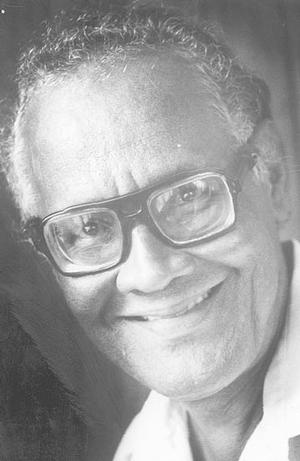
Happy Birthday, Kamau!


Dear Kamau,

Opal and I wanted to give you something for your birthday, so we decided to do something that we hope you will like. I have done a podcast of one of your earliest poems from the Caedemon (did I spell it right?) recordings--one of the poems that I liked from the first time I heard it, you know the one. Yes, "Francina." 

And Opal has livicated a poem for your birthday. We have done this tribute because in your poems and life, you have given us an example of how a life should be lived--on its own terms. You have always written how you felt the poem could only be written, and you have taken a lot of criticism over the years for doing that. But where are the critics now? You are still creating, new vibrant poems and you are still leading the way for us.

Give thanks, Kamau.
Here is Opal's poem:

reinscribing
love is not an ideal
but power to render
truth in the present
daily
despite dismay
and hopelessness
gallantry is not going
into battle shielded
by armor
rather refusing to submit
or be silenced
by corruption
or narrow religious zeal
insisting
that the flamboyant tree
will flame red in july
taking the anvil to words
hammering away like ogun
being the voice
echoing
repetitive
perpetual
you i´ve been loving
long before face and voice
brushed my ears
will be loving you
long after
the feel of your hands
have dissipated
one love
walk good
happy birthday, kamau

opal palmer adisa
***

First published 5/11/07

August 1, 2013

Happy Birthday, Lorna Goodison


When I was in first form at Jamaica College, nearly every boy in 1 Murray drooled and doodled while Lorna Goodison tried to teach us color, value, and texture. Lorna taught us art for about two or three years, and then, she left. The next time I saw her was when she was invited by our drama teacher, Dennis Scott, to talk with our literary club. Lorna talked passionately about art, Rastafari, and music. Afterwards, she gave us a writing exercise to compose a Reggae song. We toyed with the idea for some time and she offered a few suggestions. At the end of the exercise, Dennis asked her to read a poem.

Miss Goodison was also a poet? We listened intently as she read one of her poems. I can't remember the name, but I'll never forget the awe that I felt after her reading. She was like a saint. Saint Lorna.

The feeling never left me.


When I decided that I wanted to be a poet and I was searching for models by reading everything that Derek Walcott had ever written, I tried writing a poem like Lorna's "She," which was published in Savacou 13: Caribbean Women. Of course, I failed miserably. No one can write like Lorna Goodison.

For unlike Walcott, from whose work a young poet can learn forms such as the sonnet and how to use allusions drawn from Greek and Roman mythologies to create Odysseus-like characters or from Shakespearean drama to construct Calibanesque figures, Lorna's poems, while drawing from a similar landscape as Walcott's, does not seek to transform the characters into anything other than what they are. Her speakers remain obstinately Caribbean with red dirt under their fingernails, and smelling of rum and carbolic soap. Also, her sense of line, like brush strokes, carry the signature and confidence of the artist.

There was nothing that she could teach me because the images and the associations that she had made in her art held deeply personal meanings, yet she managed to translate those sentiments to the page so that her readers could experience similar emotions. In other words, what I learned from Lorna was that if I wanted to write like her, I would have to live my own life and to use the experiences and associations from my life. And that couldn't be faked. If I wanted to be a poet like Lorna, I would have to write my own poems.

Give thanks, Lorna. Give thanks!


***

"Emancipate yourself from mental slavery/ None but ourselves can free our minds." ~ Lyrics from Bob Marley's "Redemption Song" taken from a speech by the Hon. Marcus Mosiah Garvey.

September 7, 2012

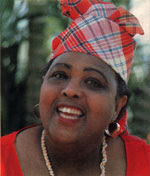
Happy Birthday, Miss Lou!

On the surface, no one would describe the matronly Louise Bennett-Coverly as a warrior. But Miss Lou, as she was known to many Jamaicans, realized from an early age that freedom and language are tied to our breath, and if we cannot speak freely, we die. Her verse was a poetry of liberation that was intimately linked to her freedom to speak in her own tongue, and in her unwavering defense of her rights, she provided an example of the negotiations that Caribbean people sometimes need to undertake in order to survive, especially in hostile environments. In an interview collected by Mervyn Morris in Is English we Speaking, Miss Lou describes her childhood: “When I was a child nearly everything about us was bad, you know; they would tell you she yuh have bad hair, that black people bad... and that the language you talk bad. And I know a lot of people I knew were not bad at all, they were nice people and they talked this language” (20).

Language is a source of power and it is for this reason that colonial powers have always frowned upon the development of dialects because local power disrupts imperial hegemony. Fluency in the language of power is also a gateway to social mobility and power as George Bernard Shaw dramatized in Pygmalion. In her own way, Miss Lou challenged the demands of the British Empire to her body and breath by writing in Jamaican while being fully articulate in English and aware of its origins:

"Like my Auntie Roachy say she vex any time she hearing the people a come style fi we Jamaica language as 'corruption of the English Language'. You ever hear anything go so? Aunt Roachy she say she no know why mek dem no call the English language corruption of the Norman French and the Greek and the Latin where they say English is derived from. Oonu hear the word: English 'derive' but Jamaica 'corrupt'. No, massa, nothing no go so. We not corrupt and them derive. We derive, too. Jamaica derive!" British Library.

It was this pride that endeared many Jamaicans to Miss Lou’s dramatic monologues which often used irony to effect a “combination of sympathy and judgment” (Morris 20). Miss Lou’s comic verse employed a kind of cognitive dissonance that seemingly upheld the status quo while undermining the foundation of its claims. For example, by exposing the double-standard in using the word “corrupt” instead of “derive” she tactfully avoids a confrontation while asserting her equality. This ingenuity is also seen in the poem “Bans O’ Killing” where she exposes the duplicity of those who would denigrate Jamaican in favor of English.

Meck me get it straight Mass Charlie
For me noh quite undastand
Yuh gwine kill all English dialect
Or jus Jamaica one?

She then argues that if eradication of dialect is the aim, then other English dialects should suffer the same fate:

Yuh wi haffi kill de Lancashire
De Yorkshire, de Cockney
De broad Scotch an the Irish brogue
Before yuh start to kill me!

Yuh wi haffi get de Oxford book
O’ English verse, an tear
Out Chaucer, Burns, Lady Grizelle
An plenty o’ Shakespeare

The suppression of dialect, in this case Jamaican, is a murder of the human spirit and Miss Lou would have none of it. Nor would she be an accomplice to those who would kill in the name of etiquette and empire. Beneath the humor, the subtlety of her intellect almost goes unnoticed; beneath the comic mask is a fierce warrior. In closing his essay on Miss Lou, in Mervyn Morris expresses the impact of her poems: “They expose people ashamed of being Jamaican or ashamed of being black. They ridicule class and colour prejudice, but are more concerned to tackle black self-contempt or to express pride in being black” (23).

Miss Lou was a compassionate warrior whose weapons were satire, wit, and the very air we breathe. And if as Pablo Neruda says, “When the earth blooms, the people breathe freedom,” then with her passing a mighty Mahoe has fallen and we are all lessened.

Give thanks, Miss Lou.

***


August 17, 2012

Happy Earthstrong, Marcus Garvey!

"We are going to emancipate ourselves from mental slavery because whilst others might free the body, none but ourselves can free the mind. " ~ Marcus Garvey.


"How long shall they kill our prophets
While we stand aside and look?"
~ Bob Marley, "Redemption Song"

Give a great Earthstrong gift for Baba Garvey:

1. Featuring the petition on your FB page: http://bit.ly/KqUrGh

2. Tweeting to friends and contacts, especially media contacts: Our goal: PUBLIC restoration of the good name of #MarcusGarvey: #PanAfrican #AfricanAmerican #Caribbean http://bit.ly/KqUrGh

3. Emailing the petition to at least 10 friends and URGING them to sign: http://bit.ly/KqUrGh

 "With confidence, you have won even before you have started." 
~ Marcus Garvey


***
We are petitioning President Barack Obama to exonerate the Right Honorable Marcus Mosiah Garvey.

http://signon.org/sign/exonerate-marcus-garvey?source=c.url&r_by=4631897
***

Blog Disclosure Policy


Geoffrey Philp’s Blog Spot receives a percentage of the purchase price on anything you buy through links to Amazon, Shambala Books, Hay House, or any of the Google ads or Google Custom Search.

*** 

Disclaimer of Endorsement


The documents posted on this Web site may contain hypertext links or pointers to information created and maintained by other public and private organizations. These links and pointers are provided for visitors' convenience. I do not control or guarantee the accuracy, relevance, timeliness, or completeness of any linked information. Further, the inclusion of links or pointers to other Web sites or agencies is not intended to assign importance to those sites and the information contained therein, nor is it intended to endorse, recommend, or favor any views expressed, or commercial products or services offered on these outside sites, or the organizations sponsoring the sites, by trade name, trademark, manufacture, or otherwise.

Reference in this Web site to any specific commercial products, processes, or services, or the use of any trade, firm or corporation name is for the information and convenience of the site's visitors, and does not constitute endorsement, recommendation, or favoring by this blog.

June 7, 2012

Happy Birthday, Martin Carter

Martin Carter is known primarily as a voice of protest against British colonialism. It is a well deserved distinction. Carter was not a poet who used his talents to merely showcase his fluency with words. His themes of freedom, defiance, and the power of the imagination are rooted in the people and the landscape of Guyana.


And yet, years after the revolution has been betrayed, his original vision bears witness against the racial animosities fueled by craven political aspirations. Martin Carter’s poems mock these ambitions by their insistence on the necessity of love which propels his work into the annals of the prophetic:


This is the dark time, my love
it is the season of oppression, dark metal
and tears;
it is the festival of guns
the carnival of misery;
everywhere the faces of men are strained
and anxious


from Poems of Resistance


Martin Carter belonged to that generation of writers whose vision of community in their respective homelands extended to the rest of the Caribbean, and represented the highest ideals of the region. If Carter’s poems could sink into our bone and marrow, we would not face the ecological disasters that are so prevalent in the Caribbean.


It is still a “dark time” for us in Guyana and the Caribbean, but Carter made us realize that there was a time when hope was brightest despite the obstacles that we faced. He was willing to be imprisoned and die for that hope. Carter’s hope was not a small flame, but a furnace. His poems endure because of his lifelong commitment to his country, his people, and his art.


Give thanks, Martin Carter.


***


For more information on Martin Carter, please visit, http://www.martincarter.blogspot.com/

July 3, 2009

Happy Birthday, America (2009)


I'll be taking a break for the long holiday weekend to be with family and friends.

Maybe I'll even watch some fireworks. Or just light some sparklers--times are tough, y'all!

Take care of yourselves & your loved ones.

I'll be back on Monday.

1Heart,

Geoffrey
***

February 6, 2009

Happy Birthday, Bob Marley (2009)

Bob Marley

For Brother Bob

Again and again, I heard your voice,
Whispering through the noise, "Don't cry. Just sing."
In the dregs of a bottle thinking I didn't have a choice,
Again and again, I heard your voice.

When I felt even my bones were cursed,
and my body trembled from the troubles Babylon can bring,
Again and again, I heard your voice,
Whispering through the noise, "Don't cry. Just sing."

***

"For Brother Bob" is an excerpt from my latest manuscript, DUB WISE.

***
Villager: Rest in Peace: Bob Marley

July 20, 2008

Happy Birthday, Frantz Fanon (2008)


"There is no white world, there is no white ethic, any more than there is a white intelligence.There are in every part of the world men who search. I am not a prisoner of history. I should not seek there for the meaning of my destiny.I should constantly remind myself that the real leap consists in introduction invention into existence. In the world through which I travel, I am endlessly creating myself."

~Black Skin, White Masks~ Frantz Fanon


***

June 5, 2008

Happy Birthday, Orlando Patterson

Orlando Patterson is a sociologist at Harvard University known for his work regarding issues of race in America. Patterson took his B.Sc in Economics from the University of London and his Ph.D. in Sociology at the London School of Economics in 1965.

Earlier in his career, Patterson was involved concerning the economic and political development of his home country, Jamaica. He served as Special Advisor to the Prime Minister of Jamaica from 1972 to 1979. (Wikipedia)

As a novelist, Patterson is best known for The Children of Sisyphus, a novel that depicts ghetto life in Jamaica and which I count as one of the major influences on my own novel, Benjamin, my son.

Here is a quotation from a my short review on Amazon:
Orlando Patterson's Children of Sisyphus set the standard for social realism in Caribbean fiction. He does not romanticize the lives of the poor, nor does he damn them with neglect; rather, he gives their lives dignity.

This is the moral tightrope that all Third World writers face: the choice between compassion and brutal honesty. Patterson succeeds in this fine portrayal of the lives of the poor that is imbued with grace, despite their mean existence.

Give thanks, Orlando Patterson!

***

JIC, you missed this in the Comments:

Hope readers of this blog will be glad to know that just at this very moment the scans of Orlando's Children of Sisyphus are open on my laptop and being retypeset in preparation for reissue early in 2009. Geoffrey is absolutely right. Sisyphus still reads immensely powerfully. The sadness is that what he writes about is not history.

Jeremy Poynting, Peepal Tree Press

***

May 1, 2008

Happy Birthday, VS Reid

VS ReidVS Reid (Order of Jamaica, Literature) an eminent Jamaican author, journalist, and historian, is usually credited, along with Trinidad and Tobago's V.S. Naipaul and St Lucian Derek Walcott, as shaping modern Caribbean writing. He died on August 25, 1987. Vic Reid was 74 years old.

Reid, a reporter and sometimes editor of the Public Opinion, a weekly newspaper, was educated at Kingston Technical High School.

New Day, his first book, was published in the 1940s, and The Leopard was influenced by the Mau Mau uprising in Kenya during the 1950s. VS Reid also wrote several books about Jamaican history:Sixty-Five is set in 1865 and is inspired by the Morant Bay Rebellion. It was a popular textbook in high schools.

Mount Ephraim is based on the Sam Sharpe rebellion of the 1830s.

Quote: "I write to make black people feel proud of themselves and their history."

From The Daily Gleaner

***


by VS Reid

March 13, 2008

Happy Birthday, Felix Morisseau-Leroy (2008)

Félix Morisseau-Leroy.Although the controversy still rages in Jamaica about English vs patwa or "nation language" as Kamau Brathwaite has dubbed our tongue, from as early as 1958, Felix Morisseau-Leroy was writing plays and poems in Kreyol.

In one of my favorite poems by "Moriso" or "Lewa," the poet shows his allegiance, and we are all better off for it.

I still remember the defiance and the fire when he used to read this poem, and especially when he said, "I don't want any priest/ To speak Latin over my head."

There was no room for genuflection to the metropolitan cities in Lewa's world, and it is sometimes sad to see the young Haitian men and women in Miami walking around with their heads bowed down because they lack the knowledge/memory that a great poet like Lewa came from among them and was the champion of their language for most of his life.

Give thanks, Lewa and Happy Birthday!

New Testament

In 1954
I wrote my will
I said I don't want any priest
To speak Latin over my head

I don't have that problem today
Because priests don't speak latin anymore

Even God
Had to learn Creole
Like any other white man
Coming here
To do business with us
***

From "Boat People" from Haitiad & Oddities by Félix Morisseau-Leroy. Copyright © 1991 by Félix Morisseau-Leroy.

Felix Morisseau-Leroy was born in Grand-Gosier, Haiti and had degrees from the University of Haiti, Columbia, New York City College, and the New School of Social Research. He was exiled in 1959 and lived in Africa, France, Jamaica, and the United States.

In Ghana, he served as national organizer of drama and literature at the Arts Council and in Senegal, as Technical Adviser of the Senegalese Federation of People’s Theater.

He wrote numerous books of poetry, novels, and plays including “Ravinodyab,” “Plenitudes,” “Recolte,” “Diacoute,” and “Antigone in Creole” which was performed at the Theater of the Nations in Paris. His works have been translated into French, English, Spanish, German, Russian, Fanti, Twi, and Wolof, and his plays have been performed around the world.


Although he was multilingual, Felix Morisseau-Leroy preferred to write in Creole, because he wished “to express the deepest feelings, emotions, and aspirations of the people for whom he claimed to be a mere “scribe.”

***

February 21, 2008

Happy Birthday, Mervyn Morris (2008)

Mervyn MorrisMervyn Morris was born in Jamaica in 1937 and studied at the University College of the West Indies and St Edmund Hall, Oxford. In 1992 he was a UK Arts Council Visiting Writer-in-Residence at the South Bank Centre. His previous collections include The Pond, Shadowboxing, Examination Centre and On Holy Week; he also edited The Faber Book of Contemporary Caribbean Short Stories and published 'Is English We Speaking' and Other Essays. He lives in Kingston, Jamaica, where he is Professor Emeritus of Creative Writing & West Indian Literature.


The Lovers (after Rene Magritte)


The lovers kissing

do not see

each other, do not feel

unmediated hair and skin.


Each hooded

in an opaque swirl,

neither seems aware

of something strange.


Do not disturb.

They are in love.

Each feels a kinship

with the other’s mask.


From Caribbean Writing Today.

***


February 6, 2008

Happy Birthday, Brother Bob!

BobWhen I first read VS Naipaul’s Mimic Men, the statement by the protagonist, Ralph Singh, “Why, recognizing the enemy did you not kill him, swiftly?” stuck with me. For just as the phrase from Froude’s The Bow of Ulysses that was echoed in Naipaul’s The Middle Passage, “History is built around achievement and creation, and nothing was created in the West Indies,” became part of Derek Walcott’s creative impetus, so this sentence from Naipaul’s fiction haunted me for over thirty years. It became the spur to many of my poems, short stories, and novels. But this hindsight works like tracing backwards from the solution to an algebraic equation, and makes everything seem intentional and occurring with perfect timing. Yet nothing could have be further from the truth.

I was sixteen and I knew I wanted to write. But write about what? I knew I was angry with Naipaul, and could have built a career on being the opposite of the Ralph Singhs who lived then and now: in a state of perpetual abhorrence of the “native. But good writing, like a good life, cannot be built solely on negation.

But the only voices that I heard coming out of the University of the West Indies and the intelligentsia of Jamaica were a thunderous cacophony of negation. No! to British colonialism. No! to American imperialism. No! to multinational corporations. No! No! No! But where was the Yes! to the joy of life?

Luckily, there were a few affirmative voices in Jamaica: Dennis Scott, Mervyn Morris, and Anthony McNeill. However, at the age of sixteen, the most insistent exhortations came from Bob Marley, the most visible icon of the Rastafari community.

It was through Marley’s work that I learned about the central tenet of the mystic revelation of Rastafari, InI, that proclaimed the one-ness of the individual, community, and the divine. This elegant concept of InI, which can be compared to Indra's net, developed by Mahayana Buddhist school in the 3rd century that emphasizes the interconnectedness of the universe and has been further developed by Thich Nhat Hanh as "Interbeing," was a natural solution to the many problems that Jamaica faced during the seventies: how to deny the sense of unworthiness that plagued the sufferahs and how build a community that had been torn asunder by history. In other words, how to love InI.

And just as InI stresses personal responsibility for one’s actions and with the community in manifesting creation, Bob Marley took the lead in shaping many of the ideas within Rastafari that had been espoused by Marcus Garvey into a coherent vision that affirmed moral values.

But how does one translate ideas into a piece of writing that is not merely a polemic, but which uses the two most persuasive tools in a poet’s arsenal: rhythm and metaphor? Bob showed me how.

In the song, “Is This Love?” Bob demonstrated what Kwame Dawes has dubbed the reggae aesthetica combination of the erotic, social, and divine into a remarkable triplet:
We'll be together with a roof right over our heads;
We'll share the shelter of my single bed;
We'll share the same room, yeah! - for Jah provide the bread.

For many young writers growing up in the seventies, this was groundbreaking for it opened up a new way of seeing our work. our community and our lives. Bob’s work became a model for poetic possibilities and method for evaluating our work.

Bob’s boldness—his claim that anything was possible, if only like the Buddhists claimed we would “Wake up and Live!” and his insistence that we “Put our dreams to reality” became a personal mantra. By embodying Rastafari, Bob proclaimed that InI through renaming an experience had the power to create (I-rate) anything that InI desired (I-sired). It was a powerful idea then. It’s a powerful idea now. And in a land plagued by ideas of lack, limitation, and scarcity, it was truly revolutionary.

Also, Bob’s fearlessness, his willingness to confront Babylon head on as a mature Nyahbinghi warrior, and to change the world without bloodshed, but if necessary, “Brothers you're right, you're right/ You're right, you're right, you're so right/ We'll have to fight, we gonna fight/ We'll have to fight, fighting for our rights (Zimbabwe) became an inspiration for me and many other writers who came of age during the seventies. And if Bob was a “natural mystic,” maybe we could be “cautious mystics”: observing the trappings of Babylon while still seeking union with the divine.

But more than anything else, Bob’s ability to transform through word-power the consciousness of a generation and to show how life-affirming values could be transmitted in poetry through rhythm and metaphor opened up a path that many of us could follow.

And so for this on his Earthday, InI can only say, “Give thanks, Brother Bob. Give thanks!”

***


The curator of a groundbreaking exhibit at the Smithsonian National Museum of Natural History discusses Rastafarian culture on exhibit until November 2008.

***
Related Posts:

***


September 7, 2007

Happy Birthday, Miss Lou--2007

Miss LouHere is the link post that I did last year about Miss Lou.

Of course, we'll be hosting a Miss Lou celebration later today and if tonight's show is like last year's, there will probably be a few stories about the performer's connection to Miss Lou. I never met Miss Lou, but my connection with her goes back to Jamaica's Festival Competition. I recited one of her poems and I won a gold medal in speech. Reciting Miss Lou's poems gave me the confidence to speak in public and I've never forgotten that.

I tell this story as a cautionary tale when school officials talk about cutting funds for the arts--as if the arts are unnecessary and do not feed people. Artists and writers provide food for many people who have made a living reciting Miss Lou's poems or singing Bob Marley's songs. Think about how many singers, good and bad, that Marley is feeding right now. Think about how many young poets and writers that Miss Lou inspired to write in the language that when everything falls away, they cry in.

What language do you cry in? What language gives you comfort when you cry?

In Jamaica, we always have Marley singing, "No, Woman, Nuh Cry." But more importantly, there is always Miss Lou's voice, brimming with sunlight, singing "Evening Time" and her comforting laugh and adieu, "Walk good, yuh hear!"

***

February 21, 2007

Happy Birthday, Mervyn Morris!

For MM ætat LXX anno MMVII

I still remember listening to music in your campus home,
the drive up to Munro, your flowing supply of tales,
your patient ignoring at my young poet's vain wails
at plain critique. Across the years my thoughts roam,
days wholly gone, vanished like the last sea-foam,
into pale nothingness. You write of the sharp nails
in Christ's hard hands, you work out the details
in tightest lines. An epigram says much more than a tome.
Your words reverberate with brightly living scenes,
with kindest regards, and yet each honestly chosen
in a brilliant flash, not one embroidered; simple, straight.
We see beneath, we know what each poem means,
we know that the moment has been held and frozen,
each word, each letter, bears its fullest weight.

Fragano Ledgister, author of Class Alliances and the Liberal-Authoritarian State: The Roots of Post-Colonial Democracy in Jamaica, Trinidad and Tobago, and Surinam, teaches political science at Clark Atlanta University. He has also published poems in Focus 1983 and the Penguin Book of Caribbean Verse in English. The father of two sons, both in college, he lives in Atlanta, Georgia.
***
Mervyn Morris, who is also the Featured Caribbean Writer, has recently published a wonderful poem, "The Lovers (After Rene Magritte)" in Caribbean Writing Today.
***


February 6, 2007

Happy Birthday, Brother Bob!

Bob Marley

Sestina for Bob

It started with a silly quarrel when my lover
changed the music from Sean Paul--she wanted to listen to Bob.
I wish all our choices were that simple--not the struggle
everyday between the open sea and the comfortable yard--

the blind hunger that disguises itself as freedom
and becomes what we most dread.

It's like when I'm listening to Natty Dread,
"Bend Down Low" when Marley's talking to a coy lover.
You know he wants her, but he still wants his freedom.
And you can imagine her outside Island House as her head bobs

up and down--she knows she'll become one of the women in the yard,
but she wants the man behind the music, so why struggle?

Yet for Marley that was all that mattered--the struggle
to change our hearts, so when InI, the Twelve Tribes in that dread

day, disgusted with the shistem, will leave yard,
and Africa will welcome us with open arms like a neglected lover.
We'll find the dreamland we’ve always wanted, the place that Bob
glimpsed in the streets of Trench Town, searching for freedom.

But is Africa the only place that we'll find our freedom?
In England, in America, in France, is it only the struggle
that will give us peace, that will help us find the place that Bob
told us about in "So Jah Seh"? Urging the faint-hearted dreads
in the heart of Babylon, who hated him like a spurned lover,
to never give up their hope and promised a better yard.

For he never forgot that Babylon tried to murder him in his own yard,
jumping over so many fences in Trench Town to find the freedom

he never found in the sweet kisses of his contented lovers,
as he trod through I-ration, and couldn't sleep because of the struggle
while the ancestors tormented him, tugged at his dreads
flowing over the stones. He could never rest as they whispered, “Bob

we are here in the dark, hungry, and waiting. Bob, Bob
the politicians, the traitors are betraying the youth a yard,
and there's no more turning back, there's no more retreat, dread.
This time, the fatherless children must fight for their freedom,
their lives will never be their own unless you continue the struggle,
only then will their eyes soften towards each other like old lovers."

It hurt too much, so I left the room when Bob began Songs of Freedom,
his voice with the smell of yard spilling over the lyrics--his struggle
to convince us he would always be here, like a constant lover.

***

If you haven't taken the survey on blogging and community, tomorrow is the last day.
Here's the link:


February 4, 2007

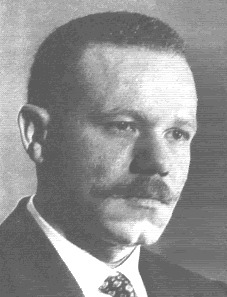
Happy Birthday, John Hearne

John Hearne By Fragano Ledgister.

The first Jamaican novel I ever read was John Hearne’s Land of the Living, which I found in my high school library when I was thirteen. I had no idea then, of course, that a few years later I’d be John’s student in a creative writing class at UWI. Nor that he would be my mentor and friend.

John wasn’t the first of the writers I admired that I would meet (that was Mervyn Morris, who, completely by accident, became responsible for my habit of ordering “café solo” as the first thing I consume whenever I land in Madrid), but he has probably had the greatest impact on me, both as someone who encouraged my writing poetry and who encouraged my entry into journalism.


Reading John’s “Cayuna” novels provides us insight into the story of Jamaica as it moved from colonialism into independence. The device of creating a fictional version of Jamaica (as Mervyn Morris says, “Cayuna is Jamaica right down to Green Stripe beer”), permitted him to explore change both in Jamaican society (the bauxite industry, the Rastafari movement), and in relation to neighbouring countries (events in Haiti, the Cuban Revolution) in a mode that allied both distance and closeness. The accents of Cayuna and the places are as Jamaican as it is possible to be, and yet separated from the real Jamaica by an infinite distance.

John enjoyed creating fictional countries. Cayuna is one of two that he shaped out of West Indian reality with his pen (he also created the Caribbean countries of Saint Pierre and Navidad, modeled on Haiti and Cuba respectively, but little action takes place in them). The other is “Abari”, based on his experiences in Guyana in the late 1950s, which appears in two novels (The Checkerboard Caper, one of the “Robin Blackmore” thrillers that he wrote together with Morris Cargill, and The Sure Salvation). Yet he could, and did, deal directly with the real Jamaica and Guyana (the latter in his short story “At the Stelling” which is included in the Independence Anthology of Jamaican Literature).

He had to tread carefully, I suspect, as a white Jamaican who did not sound Jamaican, in a society that was changing rapidly and in which the privileges, which a generation before a person in his situation would have taken for granted, were disappearing. It’s noteworthy that the only novel set in Jamaica on which his name appears as an author is his first, Voices Under the Window. The three Robin Blackmore thrillers (in which the hero is a white Jamaican planter) were written under the pseudonym “John Morris” although the authorship was well-known. When he switched political allegiance from the PNP to the JLP in the late 1970s persons unknown painted “John Hearne is a British CIA” on the walls of the Creative Arts Centre at UWI (which John ran). A rather catty mutual friend commented at the time, that the capital letters looked just like John’s.

John’s politics were never quite in step with Jamaica’s actual politics. John was a Whig gentleman whose conception of the good political order drew from the best impulses of the British liberal tradition. He had joined the PNP in the post-war period along with other liberal gentlemen who saw Norman Manley’s project as vitally necessary to the creation of a free and just society. His break with the PNP (which meant the ending of his friendship with Michael Manley), followed not, as some might think, the PNP’s close relationship with Cuba but the Orange Street fire, which he saw as a descent into thuggishness that was simply unacceptable. John was to be quickly disappointed with the JLP, which lacked the Whig tradition of the PNP.

But, deep down, John was not really a political person. He was a writer who urged his students to observe the world and write what they saw. He also represented, for those students, a bridge to the origins of modern West Indian literature as he had been a protégé of Roger Mais in the early 1950s, and Mais had encouraged his early writing. In teaching us he was, fairly consciously, acting to promote a literary tradition.

John’s work deserves to be brought back before the public eye, in particular, the four Cayuna novels which capture a time now gone forever when Jamaica seemed on the verge of wonderful things.

Fragano Ledgister, author of Class Alliances and the Liberal-Authoritarian State: The Roots of Post-Colonial Democracy in Jamaica, Trinidad and Tobago, and Surinam, teaches political science at Clark Atlanta University. He has also published poems in Focus 1983 and the Penguin Book of Caribbean Verse in English. The father of two sons, both in college, he lives in Atlanta, Georgia.
***
If you haven't taken the survey on blogging and community, Wednesday is the last day. Here's the link:

***

Tags: ,

January 15, 2007

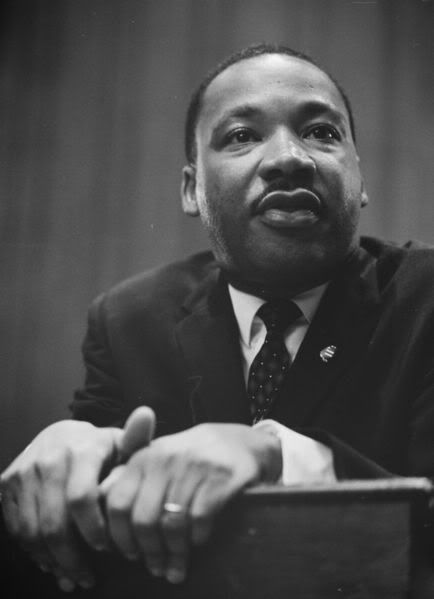
Happy Birthday, Dr. Martin Luther King, Jr.

Martin Luther King JrA few years ago when I taught freshman composition, I began a discussion with my students about Dr. King, and as we talked, I realized that many of them thought that all the freedoms that they were now enjoying were inevitable.


So I asked them to imagine what would have happened if Dr. King had decided after the first baton hit his skull, a water cannon blasted his body, or a dog snarled in his face that although the civil rights movement was a just cause, it simply wasn’t worth it?
How many of us facing lesser obstacles have walked away?

Happy Birthday, Dr. Martin Luther King, Jr.
***