Showing posts with label Merty Philp. Show all posts

May 13, 2012

My Mother's Hands


My mother’s hands always fascinated me. She rarely wore a lot of make-up or nail polish, but like every boy growing up in a single parent home, I thought she was the most beautiful woman I’d ever known. In many ways, she resembled the mother in Lorna Goodison’s “For My Mother (May I Inherit Half Her Strength)”: “She could work miracles, she would make a garment from a square of cloth/ in a span that defied time. Or feed twenty people on a stew made from/fallen-from-the-head cabbage leaves and a carrot and a cho-cho and a palmful/ of meat.” But it was always her hands, plain and unadorned—a country girl’s hands--that told her life of struggle and triumph, and from which I’ve learned so much.

My publisher lists Struie, in Westmoreland, Jamaica, as the place of my birth, but it isn’t true. Struie is the birthplace of my mother, Merty Philp née Lumley. This biographical inaccuracy really doesn’t matter to me, for I would happily claim Struie—home of the Lumleys of Westmoreland--as my birthplace.

The Lumleys of Struie are a hardy lot. My grandfather, Andrew “Big Papa” Lumley, had homes in Jamaica and Cuba. In fact, one aunt, Hortensia Lumley-Hechevaria, lived in Cuba until she passed away a few years ago. Big Papa, a cook, baker, tailor, farmer, and shopkeeper, almost resembled the description of Stephen Dedalus's father in A Portrait of the Artist as a Young Man: “an oarsman, a tenor, an amateur actor, a shouting politician, a small landlord, a small investor, a drinker, a good fellow, a story-teller…a tax-gatherer.” Big Papa, also known as "Tailor," instilled in his nine children essential survival skills, many of which my mother passed on to me and they have had a profound impact on my life.

The first time my mother taught me to sew, it was by accident. She had been trying to thread a needle and she called me into her sewing room. I threaded the needle with ease and probably made some smug remark about her eyesight to which she answered, "Geoffrey, you ever hear this saying: ‘Hog ask him mumma, 'Mumma, wha mek you mouth so long?' And him mumma answer: 'Wait pickney, yu time a come.'”

After giving me this vital lesson by using a Jamaican proverb (she was also a primary school teacher who graduated from Mico), she showed me how to sew a button on a shirt. That evening she taught me a valuable skill that has served me well—like a few years ago when I was getting ready for an important interview, and wouldn’t you know it, the button popped off my shirt. I sewed on the button, got the job, but I was never able to thank that girl from Struie.

As with many country girls, if my mother’s hands weren’t cooking, they were planting. Something. She always had a garden wherever she lived. It’s part of the African folk tradition that has weathered slavery (and gentrification) and that many people from Jamaica and the Caribbean practice without thinking about the origins. Whether it was in Mona Heights, Carol City, or Sanford my mother always had a garden. 

And although she was not as obsessive about her garden as the main character in “The Day Mrs. Ho Lung Got Arrested” in Uncle Obadiah and the Alien, there were many times as a teenager (much to my embarrassment) that she sent me to gather cow dung from the open government lands in Mona Heights or Hope Pastures so that she would have fertilizer for her garden. Over time her garden grew and yielded an abundance of tomatoes, gungo peas, sorrel, mangoes (Julie, Number 11, Long Mango) sour sop, ackee, breadfruit, okra, and pumpkins in our backyard. And it wasn't because she had a "green thumb." Rather it was the tenderness she showed in everything that she did. Her generosity was evident at our Sunday dinners when we feasted on the bounty from her garden.

My mother loved cooking. It was her chance to share with us something that came from her hands—visible proof of her love for us. Now, I wouldn’t say she was a superb cook, but she taught me the basics of cooking meals such as curried goat, beef stew, and chicken soup. One of her specialties was a mean potato salad, which when I prepared it for my then girlfriend impressed her so much, she decided to give me a second chance. We’re now married.

And because I did not want to be a wutless son, I learned the lessons well. In turn, I have passed these skills on to my children. Learning how to cook, taught me how to be patient, and also to be resourceful—you’ve run out of milk, now what are you going to do? I’ve learned to provide for my family and sometimes, I’ve made a meal out of bare necessities. 

Learning to sew showed me that I needed to be tenacious and  no matter what kind of clothing emergency I faced—you never get a second chance to make a first impression—I could handle it. Finally, gardening always made me aware of my relationship with the earth under my feet—with the land itself, no matter where I've lived.

Today as my family and I celebrate Mother’s Day, I know the meal that I’ll prepare for my family would not have been possible had it not been for Merty Philp née Lumley from whose generous hands taught me how to live and love.

Happy Mother's Day!

***
First published: 2010-05-09 01:01
Eastern Daylight Time
Enhanced by Zemanta

November 2, 2011

Jamaica: What's Halloween Got To Do With It?


Last week as I was finishing the edits on "Bawon Samedi's Halloween," a friend of mine tweeted, "What does Halloween have to do with Ja. culture?"

It was an interesting question. When I was growing up in Jamaica, Halloween would never have been celebrated in my home. My Jehovah's Witness mother did not celebrate Easter, so you can bet that Halloween wouldn't have had a chance. And the nearest that my father came to a costume was the Masonic regalia that he donned when he went to meetings with his lodge brothers.

So what was my motivation for writing a Halloween story, other than the obvious self-imposed task of writing a story with fewer than five hundred words?

The first is to change our attitudes about embracing Halloween or the period known as Dia de los Muertos, All Saints' Day, All Souls' Day or Samhain. In nearly every culture, there is some form of remembrance of the ancestors that is practiced in the liminal period between October 31 and November 2.

The question we have to ask ourselves is why didn't these celebrations, even though they are practiced in Britain, become part of the Jamaican calendar?

The first clue has to do with Jamaica's Protestant past where any kind of popish foppery, including the veneration of the saints, is strictly verboten. Protestants do not take kindly to the veneration of saints, so it was very difficult to continue any kind of subterfuge, as other New World Africans had done in Catholic Cuba, Haiti and Brazil, by sneaking African gods under the vestments of the saints and which gave rise to the many syncretic religions of the Americas.

But a far more important variable—and this is pure conjecture in my part-- has to do with the history of colonialism in Jamaica. I don't think the Home Office would have appreciated any kind of religious ceremony for the remembrance of ancestors. African religions and any associated practices, which included drumming, were banned in Jamaica.

And if any naïve expat would have tried to initiate a Day of the Dead ceremony in Jamaica, I'm sure the Home Office would have sent some underpaid undersecretary to have a talk with him, over tea, on the verandah: "Not a good idea, old chap. We don't want the darkies to start thinking about their ancestors, would we? Put us in a bit of a pickle, don't you think?"

And the British had every reason to fear Africans who remembered their ancestors. It was a Jamaican, Dutty Boukman, who along with other houngans on Bois Caiman, ignited a revolution that would lead to freedom in the Americas.

But is that the only reason why we should embrace a celebration in remembrance of our ancestors?

As much as I love "Do Not Go Gentle Into that Good Night" by Dylan Thomas, I also realize that death is a part of life. Steve Jobs in his commencement speech at Stanford said, "Death is very likely the single best invention of Life. It is Life's change agent. It clears out the old to make way for the new."

In other words, death is not to be feared. We are all going to die. This fact alone should awaken our compassion and should cause us to be kinder to each other.

It should also be a time to think about the sacrifices that our ancestors made for us to be here. This is has nothing to do with morbidity, but rather it is a celebration of the preciousness of life. For it is when we forget about our ancestors and the fragility of life that we sometimes commit inhumane acts and take for granted the preciousness of the breath streaming out of our nostrils right now.

So what does "Bawon Samedi's Halloween" have to do with Jamaican culdture?

By using a psychopomp from a Yoruba based religion, I hope I have sensitized readers to the archetypal function of the lwas in order to reverse some of the effects of colonialism, which have robbed us of our common human heritage.

And this goes to the heart of larger questions that we should ask ourselves as we approach the fiftieth anniversary of Jamaica's independence: What are the traits/qualities that define us as Jamaicans and how are they expressed in our public and private behaviors? What are the affirmations and denials that have shaped us? Have these affirmations and denials helped or hurt us? Should these affirmations or denials be amplified or eliminated? How will we amplify or eliminate these affirmations and denials?

One way to bring about change in through storytelling: The stories we tell ourselves and others. But what are these stories? Do they set us free or limit our conception of ourselves?

I hope "Bawon Samedi's Halloween" will be the start of a conversation about our African and British heritages.


One Love,

Geoffrey


May 25, 2006

Chicken Soup and my Family

A week ago, everyone in my family had come down with a nasty cold/flu that has been going through Miami like those wildfires in the Everglades. We were walking around like sniffling, bleary-eyed zombies addicted to Kleenex and Theraflu. Pitiful. On Saturday after struggling all week with the over-the-counter medications, my wife turned to me and said, “You know what you have to do, don’t you?” I knew.

It wasn’t that I was dreading making the chicken soup, but my new responsibilities at the college were taking their toll, and I thought about the mountain of work that I had brought home. I was determined that not even a cold was going to stop me from finishing the job. I reluctantly told my wife yes with the secret hope that everyone would have forgotten by the next day. 


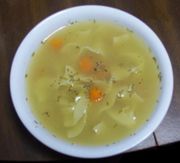
But by the next morning, my son, Andrew, was downstairs with a list for the supermarket and his stern admonition, “Don’t forget to make the dumplings.” Sometimes I have to remind Andrew and his sister that it’s called “chicken soup,” not “dumpling soup.” So, on Sunday evening after going to the supermarket, I pulled out my stock pot and made my famous chicken soup that my mother taught me how to make.


My mother, Merty Synidia Philp, nee Lumley, was a country girl from a small town named Struie in Westmoreland, Jamaica. According to my aunt, Norma Lumley, my great-grandfather, Andrew Lumley, came over from Scotland to build churches in Bethel Town which is two miles from Struie. My grandfather, Frederick Andrew Lumley, was a baker/shopkeeper/bartender/ farmer/ village reader of letters in Struie. He also worked as a cook on a ship that traveled between Jamaica and Cuba, and he taught my mother how to cook chicken soup the way my great-grandfather taught him. 

My great-grandfather and my grandfather are a part of a Scottish lineage in Jamaica. As youngsters at Jamaica College, we used to joke that when the teachers were taking roll, you could go outside, smoke a cigarette in the bathroom, come back, and they would only be getting to the McKenzies after going through the Mac Adams, McDaniels, McDonalds, and MacDougalls. The meeting of Scotland and West Africa (I will only vouch for those two--who knows what else happened in my grandfather’s bar on a Friday night?) down in Westmoreland tempered by the rigors of farm life and the daily chores of feeding the chickens, tying out the goats, and feeding the hogs produced a set of habits such as dependability, tenacity, and a certain fearlessness toward work and sacrifice that kept my mother’s family together.


For my mother’s family to survive in Struie, they had to be ready for any opportunity that presented itself. My aunts and uncles had careers in fields where opportunities were open: nursing, law enforcement, and teaching. They did well in these professions because they had learned firsthand about dependability and sacrifice in Struie. Everyone on the farm was expected to contribute something. There weren’t any exclusive boys’ jobs (except with the bulls and hogs) or girls’ jobs. You had to help in any way that you could. This tenacity and attitude towards work helped my mother throughout her life. She began as a teacher, and then she became a legal secretary to one of the top lawyers in Jamaica. When she left Jamaica, she started all over again and eventually became a nurse—the career she had always wanted. But she always stressed, if a job had to be done, someone had to step up to the job. If you couldn’t do the job, you could help. This is why she taught me how to cook and to iron my clothes because the last thing she wanted was a wutless man in her house. Everyone had to do something.


So, on Sunday evening it was my turn to do something that no one else could do as well. Whatever I brought home from the college had to be put aside for my family’s sake. I made the chicken soup from Jamaican-Miami recipe with a whole chicken (skinned and quartered by yours truly), thyme (of course), onions, butternut squash (they only had some fenke-fenke pumpkins and the kids prefer squash), dumplings (the kids used to help me make them when they were younger, but they’re teenagers now and way too cool for that. But they did help to carry the bags in from the supermarket), carrots, celery, parsnips (added since we’ve come to Florida—for a little sweetness), chayote (don’t make the mistake of going into the Latin supermarkets and asking for cho-cho, you will get hurt), turnips (I now have immense respect for the turnip since I saw the movie Last Holiday: “It’s not how you start, it’s how you finish”), and scallions added just before serving.


The soup may not have cured our colds, but it gave us a chance to sit down together and have a hearty meal with equally wholesome company. Well, not so wholesome. There was a revival of “The Dumpling War,” a family habit, which I hope our children will never share with their children.

***