February 8, 2008

In My Own Words: Ricardo Pau-Llosa

Ricardo Pau-LlosaRicardo Pau-Llosa was born in Havana in 1954 and fled with his family as exiles from the communist takeover of his native Cuba in 1960. He has lived in the United States ever since. Deeply influenced by Husserlian Phenomenology, Pau-Llosa draws on his wide experience in the visual arts—he is a widely published critic and curator—to craft poems whose sensorial impact is commensurate with philosophical ideas. His website is www.pau-llosa.com.

Parable Hunter carries the themes of my previous three books to their logical conclusion. The man without a sense of belonging to a time or a place—at home in exile—is impelled to question all other kinds of belonging: family, religion, even loyalty to one’s own work. Traditionally, we think of parables as allegorical answers to complex questions about life, meaning, transcendence, and the like. But parables are also questions, or more accurately, they are dramatic episodes in which questions, answers and the symbols that negotiate between them act out their own conflicts and interactions. The persona in many of these poems weaves and then dismantles the parables, or the images which immediate experience offers up as potentially pregnant with resonances, pointers, hints, and theories. The process of weaving and dismantling, or rejecting the parable, is in itself a kind of parable—a process which seeks to elucidate another process (thinking, creating) through symbols that stand between the two processes.


The four sections of the book delve into the themes of need, instinct,
fulfillment, and transcendence. The themes, of course, intertwine. Some poems focus on works of art—from Bruegel, Titian, Zurbarán et al—while others take off from contemporary experiences, such as looking out of plane windows onto diverse landscapes or views of cities or the sea. Parable-making, ultimately, is about point of view, and that is the primary disclosure in the reception of symbols, be it in isolation or embedded in a narrative.


The book is dedicated to Cubans like my father who died in exile, and while the theme of lost homeland is less evident in this collection than in previous books of mine—such as Cuba (1993) and Vereda Tropical (1999), also from Carnegie Mellon—the theme provides a historical and personal backdrop to my interest in parables. Poetry reaches its first fruition as epic, a genre rooted in the idea that the power of symbols is transferable to narrative. And epic—Gilgamesh, the epics of Homer and Virgil—is utterly linked to the theme of exile. Journey is always an expulsion, from a home that must change in one’s absence, from a goal that must perish before one attains it. What reconciles courage and the fundamental absurdity of life is the making of parables, if not always the parables themselves which have come down to us through religion and popular lore.


Ricardo Pau-Llosa, Parable Hunter, Carnegie Mellon University Press, 2008, ISBN: 978-0-88748-483-4. $14.95 paperback.


***

Ricardo will be reading from his latest collection of poems, Parable Hunter, at Books and Books on February 10, 2008. The program begins at 6:00 p.m.


Here is a sample from Parable Hunter and one of my favorite poems by Ricardo: "Flight to L.A."


***


February 6, 2008

Happy Birthday, Brother Bob!

BobWhen I first read VS Naipaul’s Mimic Men, the statement by the protagonist, Ralph Singh, “Why, recognizing the enemy did you not kill him, swiftly?” stuck with me. For just as the phrase from Froude’s The Bow of Ulysses that was echoed in Naipaul’s The Middle Passage, “History is built around achievement and creation, and nothing was created in the West Indies,” became part of Derek Walcott’s creative impetus, so this sentence from Naipaul’s fiction haunted me for over thirty years. It became the spur to many of my poems, short stories, and novels. But this hindsight works like tracing backwards from the solution to an algebraic equation, and makes everything seem intentional and occurring with perfect timing. Yet nothing could have be further from the truth.

I was sixteen and I knew I wanted to write. But write about what? I knew I was angry with Naipaul, and could have built a career on being the opposite of the Ralph Singhs who lived then and now: in a state of perpetual abhorrence of the “native.” But good writing, like a good life, cannot be built solely on negation.

But the only voices that I heard coming out of the University of the West Indies and the intelligentsia of Jamaica were a thunderous cacophony of negation. No! to British colonialism. No! to American imperialism. No! to multinational corporations. No! No! No! But where was the Yes! to the joy of life?

Luckily, there were a few affirmative voices in Jamaica: Dennis Scott, Mervyn Morris, and Anthony McNeill. However, at the age of sixteen, the most insistent exhortations came from Bob Marley, the most visible icon of the Rastafari community.

It was through Marley’s work that I learned about the central tenet of the mystic revelation of Rastafari, InI, that proclaimed the one-ness of the individual, community, and the divine. This elegant concept of InI, which can be compared to Indra's net, developed by Mahayana Buddhist school in the 3rd century that emphasizes the interconnectedness of the universe and has been further developed by Thich Nhat Hanh as "Interbeing," was a natural solution to the many problems that Jamaica faced during the seventies: how to deny the sense of unworthiness that plagued the sufferahs and how build a community that had been torn asunder by history. In other words, how to love InI.

And just as InI stresses personal responsibility for one’s actions and with the community in manifesting creation, Bob Marley took the lead in shaping many of the ideas within Rastafari that had been espoused by Marcus Garvey into a coherent vision that affirmed moral values.

But how does one translate ideas into a piece of writing that is not merely a polemic, but which uses the two most persuasive tools in a poet’s arsenal: rhythm and metaphor? Bob showed me how.

In the song, “Is This Love?” Bob demonstrated what Kwame Dawes has dubbed the “reggae aesthetic”—a combination of the erotic, social, and divine into a remarkable triplet:
We'll be together with a roof right over our heads;
We'll share the shelter of my single bed;
We'll share the same room, yeah! - for Jah provide the bread.

For many young writers growing up in the seventies, this was groundbreaking for it opened up a new way of seeing our work. our community and our lives. Bob’s work became a model for poetic possibilities and method for evaluating our work.

Bob’s boldness—his claim that anything was possible, if only like the Buddhists claimed we would “Wake up and Live!” and his insistence that we “Put our dreams to reality” became a personal mantra. By embodying Rastafari, Bob proclaimed that InI through renaming an experience had the power to create (I-rate) anything that InI desired (I-sired). It was a powerful idea then. It’s a powerful idea now. And in a land plagued by ideas of lack, limitation, and scarcity, it was truly revolutionary.

Also, Bob’s fearlessness, his willingness to confront Babylon head on as a mature Nyahbinghi warrior, and to change the world without bloodshed, but if necessary, “Brothers you're right, you're right/ You're right, you're right, you're so right/ We'll have to fight, we gonna fight/ We'll have to fight, fighting for our rights” (Zimbabwe) became an inspiration for me and many other writers who came of age during the seventies. And if Bob was a “natural mystic,” maybe we could be “cautious mystics”: observing the trappings of Babylon while still seeking union with the divine.

But more than anything else, Bob’s ability to transform through word-power the consciousness of a generation and to show how life-affirming values could be transmitted in poetry through rhythm and metaphor opened up a path that many of us could follow.

And so for this on his Earthday, InI can only say, “Give thanks, Brother Bob. Give thanks!”

***


The curator of a groundbreaking exhibit at the Smithsonian National Museum of Natural History discusses Rastafarian culture on exhibit until November 2008.

***
Related Posts:

***


February 3, 2008

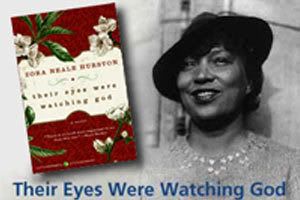
It's Zora, Zora, Zora Day at Miami Dade College!

Zora Neale Hurston

Save the Date!

Monday, February 4, 2008.


Live Feed of Dramatic Readings from Zora Neale Hurston’s Their Eyes Were Watching God


Celebrating the Spunk of Zora Neale Hurston with dramatic readings from Their Eyes Were Watching God


Miami Dade College
will be hosting a live feed of dramatic readings of Zora Neale Hurston’s Their Eyes Were Watching God on Monday, February 4, 2008.


Monday, February 4, 2008


10 a.m. (EST)– MDC North Campus,

William & Joan Lehman Theatre, 11380 NW 27th Ave., Miami


Watch LIVE from MDC'S North Campus:


www.mdc.edu/north/live


10 a.m. (EST)– MDC Wolfson Campus, Rm. 2106, 300 N.E. 2nd Ave., Miami
11 a.m. (EST)– MDC Hialeah Campus, Rm. 1119, 1780 W. 49th St., Hialeah
11 a.m.(EST) – MDC West Campus, 3800 N.W. 115th Ave., Doral


***


February 2, 2008

Celebrating the Spunk of Zora Neale Hurston

Zora Neale HurstonThe National Endowment for the Arts (NEA) has once again chosen the Florida Center for the Literary Arts at Miami Dade College to receive a $20,000 grant to host the Big Read program to promote literary reading by encouraging the community to read one of 16 classic novels from January-June 2008. During the first half of 2008, the Center will lead a campaign to urge South Florida residents to read Zora Neale Hurston’s Their Eyes Were Watching God.


“We’re very honored to be involved with the Big Read for the third year in a row,” said MDC’s Florida Center Director Alina Interián. “Our hope is that this particular selection will give readers of all ages the opportunity to appreciate Hurston’s contribution to American Literature of the 20th century.”


Participating cities and towns also receive reader’s guides and teacher’s guides for each novel, audio guides that also can be used for radio programming, promotional materials, an online organizer’s guide for running a successful Big Read program, and access to a comprehensive Big Read Web site. Each local program will include events, such as book discussions, film screenings, and library and museum exhibits, aimed at avid and lapsed or reluctant readers alike.


“In just two years, the Big Read has grown from ten communities to include nearly 200 towns and cities nationwide,” said NEA Chairman Dana Gioia. ”Although each of these communities celebrates its Big Read program in its own way, one theme we consistently hear back is that the Big Read is not just bringing citizens back to the joy of reading, but also reinvigorating the very idea of community. I am delighted to announce the newest round of Big Read communities in this program, which is about so much more than reading.”


The Florida Center for the Literary Arts at MDC is one of 127 libraries, municipalities, and arts, culture, higher education, and science organizations to receive a grant to promote and carry out community-based Big Read programs.


The latest Big Read grantees represent 38 states, the District of Columbia, and the U.S. Virgin Islands. By 2009, approximately 400 communities in the U.S. will have hosted a Big Read since the program’s launch.


"The Big Read is reaching across state and international borders," said Dr. Anne-Imelda Radice, director of the Institute of Museum and Library Services (IMLS), the NEA's lead federal partner for the Big Read. "As director of the IMLS, the federal agency that funds libraries and museums, I am pleased to support this initiative that is creating a new generation of readers. The sky is truly the limit with this partnership."

The NEA launched the Big Read in partnership with the Institute of Museum and Library Services and in cooperation with Arts Midwest. The initiative is designed to restore literary reading to the center of American culture. The Big Read brings together partners across the country to encourage reading for pleasure and enlightenment.


The Florida Center for the Literary Arts at Miami Dade College promotes reading and writing throughout the year by consistently presenting high-quality literary activities open to all in South Florida. The Center works with established and emerging writers from Florida and beyond. Through Center programs, they help students and diverse members of the community deepen their understanding of literature and sharpen their creative writing abilities. The Center’s literacy-focused initiatives, One Book, One Community; One Picture Book, One Community; and El Club de Lectores, encourage an appreciation for books with the goal of fostering dialogue in the community and enhancing the reading skills of children and adults. For more information, please visit www.flcenterlitarts.com.


The National Endowment for the Arts is a public agency dedicated to supporting excellence in the arts—both new and established—bringing the arts to all Americans, and providing leadership in arts education. Established by Congress in 1965 as an independent agency of the federal government, the Arts Endowment is the nation’s largest annual funder of the arts, bringing great art to all 50 states, including rural areas, inner cities, and military bases. For more information, please visit www.arts.gov.


The Institute of Museum and Library Services is the primary source of federal support for the nation’s 122,000 libraries and 17,500 museums. The Institute’s mission is to create strong libraries and museums that connect people to information and ideas. The Institute works at the national level and in coordination with state and local organizations to sustain heritage, culture, and knowledge; enhance learning and innovation; and support professional development. For more information, please visit www.imls.gov.


Arts Midwest connects people throughout the Midwest and the world to meaningful arts opportunities, sharing creativity, knowledge, and understanding across boundaries. Arts Midwest connects the arts to audiences throughout the nine-state region of Illinois, Indiana, Iowa, Michigan, Minnesota, North Dakota, Ohio, South Dakota, and Wisconsin. One of six non-profit regional arts organizations in the United States, Arts Midwest’s history spans more than 25 years. For more information, please visit www.artsmidwest.org.


For more information on FCLA’s Big Read program, contact Roselyne Pirson (305) 237-7261.

Media-only contacts:
Juan Mendieta, 305-237-7611, jmendiet@mdc.edu, MDC communications director Beverly C. Williams, 305-237-3949, brodrigu@mdc.edu, MDC media relations director.

***


February 1, 2008

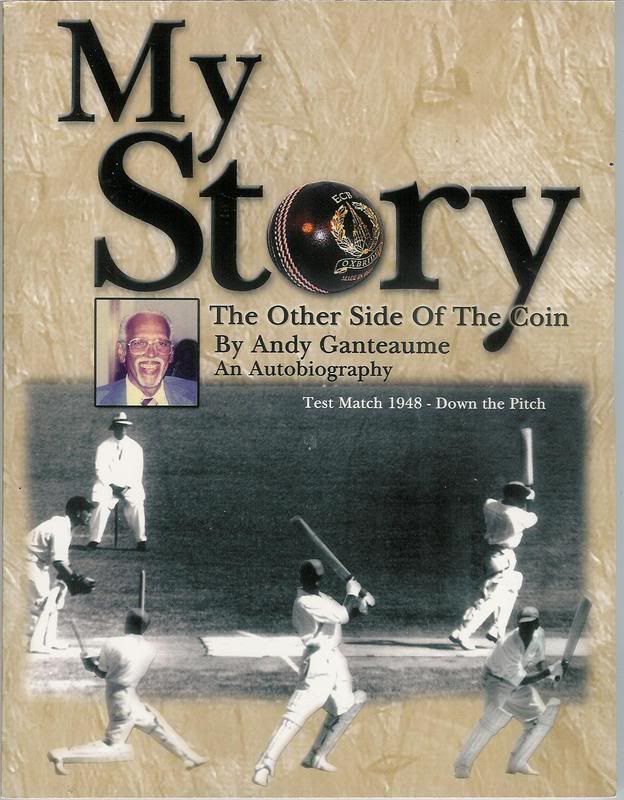
The Other Side of the Coin by Andy Ganteaume

Andy GanteaumeAndy Ganteaume’s name is not usually mentioned among his peers, the greats of West Indies cricket, that peculiar English pastime, that for a while at least, West Indians have been considered masters of the game. He played and scored a century plus – 112 runs - in only one test match against England in 1948 and was never again selected to play in another Test match. Almost sixty years later, opening batsman Andy Ganteaume has published My Story: The Other Side of the Coin - in which he reveals why, after being among the select few international cricketers who scored centuries in their maiden Test appearances, he was discarded by what he refers to as “the establishment.”

Andy’s My Story: The Other Side of the Coin was recently launched at a famous West Indies test cricket venue, the newly renovated Queen’s Park Oval members’ pavilion in Port of Spain, to an audience of cricketers, cricket enthusiasts, friends, and the local press.


Over the years Andy has in jest claimed that he has “a better test average than the Don” (Sir Donald Bradman), pausing just long enough for the unthinkable idea to register before adding much to the relief of the surprised listeners, “ but it is also my aggregate score.” That sense of humour is reflected throughout his book.


In a prepublication review, Dr. Ian Mc Donald, poet and Fellow of the Royal Society of Literature, who has written extensively on West Indies Cricket noted that, “Along with much else, he refutes conclusively the misconception, not to say smear, that in that expert and assured debut Test innings he batted “too slowly”. This is absolutely required reading. But his account of this extraordinary cricketing episode is only a part of Andy Ganteaume’s wonderfully interesting, revealing, and forthright autobiography, My Story. Especially vivid are his portraits of persons he has known well, many of them treasured friends, some of them famous personalities and others with whom sharp daggers were drawn.”


In the foreword, Sir Everton Weekes, the lone surviving member of the famous 3 Ws (Everton Weekes, Frank Worrell and Clyde Walcott) said, “The atrocities that existed and prevailed way back when the West Indies was given Test match status must be properly recorded. The injustices experienced by some players mainly because of social and economic advantages must not be allowed to go unnoticed. Thank heavens the playing field now seems to be more level.”


But Andy did not dwell on the negatives. In his Introduction he wrote, “Nothing I have said is meant to malign anyone but facts are stubborn things. As a matter of fact, to avoid seeming to “paint the lily,” I have not mentioned all I could have. Obviously, it must be left to the reader to accept or reject. I however have no fear of successful contradiction.”


In his long career as player, selector, administrator and coach, Andy’s life touched many persons some famous, some not known, many of whom became firm friends. In My Story, he paints interesting vignettes of many of them. The long list includes Sir Frank Worrell, Sir Everton Weekes, Sir Clyde Walcott, Clifford Roach, George Headley, Lord Learie Constantine, J.K. Holt, and CLR James.


In his classic book on cricket, Beyond a Boundary, CLR James traced the fruition of national West Indian consciousness through the development of cricket, where what happened inside the boundary affected life beyond it. Now, Professor Baldwin Mootoo of the University of the West Indies told the audience at the launch of My Story that Andy, “has told a unique story in this publication which we should all read if we are interested in West Indian cricket development and thus the evolution of Caribbean society.” And Everard Gordon writing in the Arena, the Trinidad Guardian sports supplement has cautioned, “It is a piece that every young man should read and not only young men, a piece that should be compulsory reading for every cricketer.”


About Andy Ganteaume:

Andy Ganteaume, now in his 87th year is a former West Indies cricketer, selector, administrator and coach. His claim to fame is that he played one test for the West Indies in 1948, scored 112, and was never selected again. His autobiography examines his relationship with the ‘colonial cricket establishment’ of the period and debunks the myth that he was dropped because he batted “too slowly.”


My Story: The Other Side of the Coin is published in Trinidad and Tobago by Medianet Ltd. It is available to Caribbean Diaspora readers on the world wide web at Amazon.com.


***

January 30, 2008

Writer Questions

Writing QuestionsAbout a week ago, a young writer and I began a very interesting conversation, which with her permission, became this post.


How many short stories have you written?


Between Uncle Obadiah and the Alien, stories that I’ve published in magazines such as The Caribbean Writer , and a new collection I’m working on, Sister Faye and the Dreadlocked Vampire, I’ve written about thirty stories.


Do you ever write stories with a certain length in mind? Or do you just write and worry about editing it down to a certain size afterwards?


I write the story first and then I worry about editing.


How do you tell so much information in such a short amount of time without it becoming didactic? Like, he did this, she did this, and then there was an explosion! And then we did this.


One trick is to let the characters give the information and to begin in the middle of the action (in medias res). For example, instead of beginning the story about a man and his cheating lover the day before, begin the story the moment after he has found out and ask the character, "So, what are you going to do now?"


How do you keep the action going in your stories? And do you listen to music while writing? What's your perfect writing environment?


Before I write, I do a brief character inventory. It's the method that I used to write my latest multi-character hypertext novel, Virtual Yardies.

Answer the following questions as the character:


Who are you?

Where am I?

To whom am I speaking?

What's my relationship with him/her?

Why must I speak with this person?

What do I want?

Why?

What are my obstacles?

What is my plan to overcome these obstacles?

What do I hope to attain from getting what I want?

Example:


My name is Marta. I am a filmmaker. I am at home speaking to my parents. Both, my father and mother are my mentors. They are very driven, responsible, and dedicated people and they have worked hard all their lives to get to where they are in their careers- they are both in the medical field. I have to speak to them because I need their help. I want to move back home with them because I have accrued debt when I moved away to California. The problem is that they have been planning to retire for sometime, and if I move in with them, they will have to continue work to support me. Also, they do not of my career choice- they do not believe that filmmaking in a real career. So, if they let me move back in with them, it might be on the condition that I get, what they call, a real job. So I am going to try to appeal on their sense of hope, and inspire them as best I can. If I can get them to agree that filmmaking is an important and honorable way of to earn a living, I might just be able to continue with my work, and move on with my life as a young filmmaker.


And do you listen to music while writing? What's your perfect writing environment?


Doris Lessing gives a better answer than I could:


"Writers are often asked: "How do you write? With a word processor? an electric typewriter? a quill? longhand?" But the essential question is: "Have you found a space, that empty space, which should surround you when you write? Into that space, which is like a form of listening, of attention, will come the words, the words your characters will speak, ideas - inspiration." If a writer cannot find this space, then poems and stories may be stillborn. When writers talk to each other, what they discuss is always to do with this imaginative space, this other time. "Have you found it? Are you holding it fast?"


http://books.guardian.co.uk/review/story/0,,2223780,00.html


Let me know if the questions begin to sound like a FAQ-- speaking of which, do you have one?)


Yes. Here it is: http://geoffreyphilp.com/faq.html


Thanks for your help.


You’re welcome!


***


Next week Friday (2/8/08), “In My Own Words: Ricardo Pau-Llosa.” Ricardo will also be reading from his latest collection of poems, Parable Hunter, at Books and Books on February 10, 2008. The program begins at 6:00 p.m.

***


January 29, 2008

"Colonization in Reverse”: The Louise Bennett-Coverley Reading Festival

Miss LouThe Friends of the South Regional /BCC Library, Broward Community College and the Jamaican Folk Revue, invite the South Florida community to the launch of a two-day reading festival, "Colonization in Reverse,” to honor and study the life and works of the Hon. Louise Bennett-Coverley – author, comedienne, social commentator and cultural ambassador.


The two – day event, under the patronage of the Jamaican Consulate General in Miami, will take place at 7300 Pines Boulevard, Broward Community College, South Campus.


Thursday, January 31st, 6:30 – 8:00 p.m.

Panel Discussion -“Perspectives on the Life and Work of the Hon. Louise Bennett-Coverley”

Multi-media Auditorium of the Library,

Location -7300 Pines Blvd.

Admission is free.


Panelists will include Mervyn Morris (UWI, Mona,) who contributed editorials and introductions to Miss Lou’s books; Joan Andrea Hutchinson (actress, author, and comedienne, who produced Miss Lou’s last CD, Lawd de Riddim Sweet; Dr. Susan Davis; Marlon Hill, J.D.; Dr. Marva McClean, and George Lewis, JD.

The following areas will be discussed:

The Politics of the Language, Empowerment, and Identity

Education and the Impact of the Culture on the Caribbean Diaspora

Creolization –Linguistics and Etymology

The Political Humor of Miss Lou

Louise Bennett-Coverley – The Next National Heroine of Jamaica.

The moderator will be Dr. Marcia Magnus (FIU) a well-known educator and Diaspora Board member, and the audience will be able to participate in a question and answer period following the discussion.


Friday, Feb 1st, 7:00 to 9:00 p.m.

Concert honoring Miss Lou and celebrating the first Birthday of the South Regional/BCC Library in the new LEED certified “Green” building.

Location – BCC South Campus, Performing and Cultural Arts Center, 7300 Pines Blvd.

Admission - A $10.00 donation to the “Hon. Louise Bennett-Coverley Scholarship for the Performing Arts”

The February 1st concert, headlined by Joan Andrea Hutchinson, will be hosted by well-known tenor and music impresario, Steve Higgins and also marks the beginning of the Library’s Black History Month celebrations.


A supporting cast of local South Florida talent: Malachi Smith, Jeanne Powell, Tallawah Mento Band, Hyacinth Penso, Jamaica Folk Revue, Sophia Nicholson and the Sierra Norwood Calvary Baptist Church, Early Childhood Center and Fashions from “Kulture Klothes by Isis,” insures an evening of unparalleled “bellyful kulcha.”


The major Sponsors of this exciting, multidisciplinary event are the
Publish Post Jamaica Tourist Board, Caribbean Today, American Airlines, Broward Community College, and Friends of the South Regional Library. Current contributors are Joan Seaga- Gonzalez and the Jamaica Folk Revue.


For more information please contact Marjorie Hall –Friends of the South Regional Library- (954) 201-8828/ E-mail –marjoriehp@aol.com or Jamaica Folk Revue (305) 235-8410.

Copies of Miss Lou’s Books, DVD’s, and CD’s will be on sale at both functions.

***

Related Post:

"Miss Lou" Celebrations for South Florida


January 28, 2008

Virtual Yardies: A Hypertext Novel

Virtual YardiesImagine a novel that takes place in cyberspace.

Now imagine a group of mainly Jamaican bloggers who have never met each other and they plan a meet-up in Negril and one of them is murdered. Then, they find out that the murderer, a Jamaican Cotton Mather, has plans to kill all of them to rid the island of "fornication, corruption, and battymanism."

This is the premise of my hypertext novel, Virtual Yardies, of which ten chapters are now available online.

Give thanks to Tobias, Nicholas, and Georgia for spreading the word about this first of its kind novel.

Click here for Virtual Yardies!

***

Related Posts:

A New Novel: Virtual Yardies

Does it Already Exist? An Internovel? A Nog?

The Novel 2.0

***

Reblog this post [with Zemanta]

January 27, 2008

Ishmael Reed on the Obama/ Clinton Conflict

Although I have lived in the US for almost twenty-nine years, there are still some subtleties of American life and politics that elude me. Oftentimes, I have to rely on the insights of writers such as Ishmael Reed to decipher the meaning of certain events:

When Mrs. Clinton, during a debate, commented that voters found Obama more "likeable" than Mrs. Clinton, Obama said that Mrs. Clinton was "likeable enough." Obama's reply prompted an Ante Bellum white man, Karl Rove, to refer to Obama as "a smarmy, prissy little guy taking a slap at her." He said that this exchange threw the primary victory to Mrs. Clinton. Notwithstanding the irony of Karl Rove referring to someone as "smarmy," if a reply as mild and innocuous as Obama's leads to his being flogged by Clinton and reprimanded by one of the Establishment's Black tokens, Obama is going to be restricted in his ability to take on the political brawlers and hit persons aligned with Clinton like Don Imus's buddy, James Carville, a man who sneers at people who live in trailer parks, and who practices a no-holds-barred political strategy

To read the entire text, please follow this link: Going Old South On Obama: Ma and Pa Clinton Flog an Uppity Black

***

Related post:

One Vote for Barack Obama

Toni Morrison Endorsement of Obama

January 25, 2008

Anancy at Model City Library

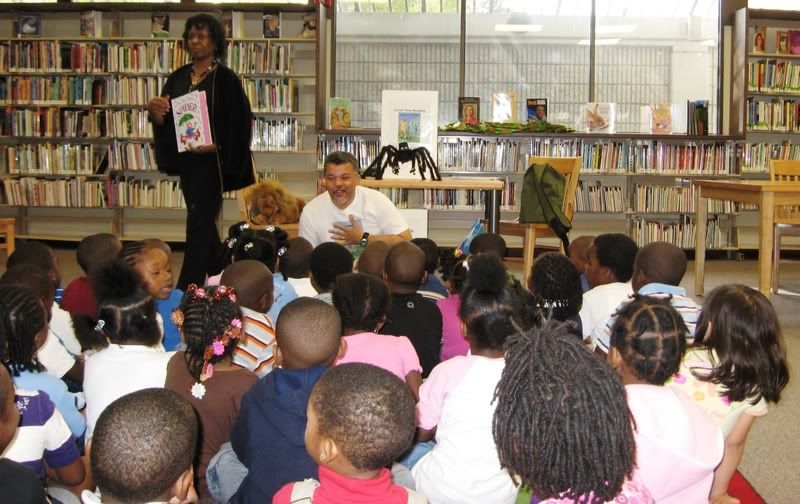
Black History MonthWho'd have thought that when I wrote Grandpa Sydney's Anancy Stories that I'd be reading to approximately fifty or sixty children at the Model City Library? Yet, there I was at a kickoff event for Black History Month hosted by the Miami Dade Public Library System.

Now, I'm not even going to pretend that it was easy to keep their attention. Many of the children, I suspected, were not used to being read to, or maybe it was the subject matter--they'd never heard about Anancy. Which makes me think I need to get to work on that Anancy picture book that I've been thinking about.


Whatever the case, I had lots of fun and I think the children did too. I also hoped that the children learned something about themselves. You see, I wrote Grandpa Sydney's Anancy Stories because I worry about our children's self-esteem. I meet the broken ones every day.


When I wrote Grandpa Sydney's Anancy Stories, I hoped that the children would see a child who looks like them in the book. I wanted them to see an author who looks like them on the cover of the book. I wanted children to see that books were not distant things locked away in libraries or expensive bookstores where strange people drink mocha lattes or order a grande cup of just nonfat milk foam and eat it with a spoon.


I also hoped that they would identify with the main character and, like Jimmy, use their intelligence, and not their fists, to solve problems.For it's no use lecturing to them about the heroes of my imagination (Bob Marley, Derek Walcott, Kamau Brathwaite, Dennis Scott, and Tony McNeill ) when they get to college. By that time it may be too late. By that time we may have already lost too many"immature warriors."


I want these children to imagine possibilities that I have not dreamed about.


***


Related Posts:
Anancy


***

For more photos of the event, please follow this link: Anancy @ Model City Library


***

Technorati Tags: