Showing posts with label R.I.P.. Show all posts

February 3, 2011

Edouard Glissant (1928-2011) R.I.P.


"Eloquent defender of diversity and métissage, the great Caribbean writer Edouard Glissant died on February 3 in Paris, at the age of 82. Poet, novelist, essayist, playwright, thinker, [and exponent of the concept of] creolization, he was born in Sainte-Marie (Martinique) on September 21, 1928 and conducted studies in Philosophy and Ethnology in Paris."

Via Repeating Islands: http://repeatingislands.com/2011/02/03/edouard-glissant-passed-away-today/
Photo: Edouard Glissant in 1958 (Le Monde)

***


Enhanced by Zemanta

December 11, 2010

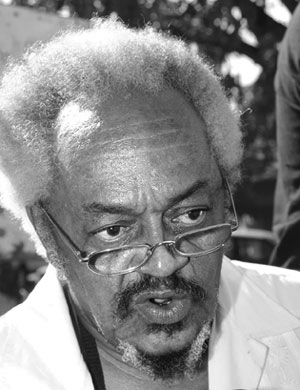
John Maxwell, R.I.P.


John Maxwell, one of Jamaica's most respected journalists, and an adolescent hero of mine has died. He was 76 years old. 


It was  just a short time ago that Mr. Maxwell had retired from the Jamaica Observer, and in this time of Wiki Leaks and other journalistic scandals, his ethics, wisdom, and courage are surely needed. For if we had more writers like Mr. Maxwell, who was devoted to the discipline of journalism, then, I think, we would be able to make more informed choices.


I have written about John Maxwell several times on this blog, but I think this section from my post The Top Ten Things Every Writer Should Know says it best about Mr. Maxwell's commitment to writing:


“We are delegates of the people…We are …the sensory organs of the body politic….the body politic's immune system… heralding, detecting malignant intrusions...In the circulatory system of the body politic, we are the white corpuscles and the T-cells.”


“Ethical journalism is a human right: that people are entitled to the truth and that journalists are not entitled to tell lies or mislead.”


Walk good, John!


Photo Source: http://www.blackagendareport.com/?q=blog/129


http://www.jamaicaobserver.com/latestnews/John-Maxwell-is-dead
http://www.jamaica-gleaner.com/gleaner/20101204/lead/lead5.html

***
For more of John's insights, please visit Maxwell's House: http://johnmaxwellshouse.blogspot.com/


This site presents a collection of columns by John Maxwell, a veteran Jamaican journalist and commentator who has covered Caribbean and international affairs for more than 40 years for the Jamaica Gleaner, the BBC, and the Jamaica Sunday Herald. He is currently a columnist for The Jamaica Observer.

In 1999 Maxwell single-handedly thwarted the Jamaican government's efforts to build houses at Hope, the nation's oldest and best known botanical gardens. His campaigning earned him the region's richest journalism prize in the 2000 Sandals Resort's annual Environmental Journalism Competition. He is also the author of How to Make Our Own News: A Primer for Environmentalists and Journalists.

All columns are copyright © John Maxwell.


November 7, 2010

Alston Barrington "Barry" Chevannes, R.I.P.


Prime Minister, the Hon Bruce Golding, says the death of University of the West Indies' (UWI) Professor Emeritus, Alston Barrington "Barry" Chevannes, has dealt a tremendous blow to the academic, religious and cultural communities.

"Professor Chevannes has left a void as an outstanding mentor in our society," Mr. Golding said, in a statement issued by Jamaica House shortly after the Professor' passing at the University Hospital of the West Indies (UHWI) on Friday afternoon (November 5). He was admitted to the hospital in September in serious condition.

Professor Emeritus Barry Chevannes

The Prime Minister said that, in addition to his outstanding contribution to the University, Professor Chevannes will be remembered as a leading activist for peace in Jamaica, as the head of the Violence Prevention Alliance.

"To his wife, Pauletta, his children (daughters - Abena and Amba), members of his family, and friends, I extend my deepest condolence," Mr. Golding said.

The UWI also paid tribute to Professor Chevannes in a release, stating that his passing was a tremendous loss for the university, "to which he devoted almost a lifetime of service."

"Professor Chevannes joined the UWI in 1973, and was continuously engaged with issues dear to the hearts of the Jamaican and Caribbean people throughout his career", the university said.

As a Masters student, he was involved in the study of Afro-Caribbean culture and religion, as well as one of the earliest scientific studies of the social impact of Ganja in Jamaica.He went on to do a Ph.D on Rastafari at Columbia University. From work in these areas, he published two books Rastafari: Roots and Ideology and Rastafari and Other African Caribbean Worldviews.

He was also well known for his more recent work on socialization, the family, fatherhood, masculinity and sexuality; out of which came his book Learning to Be a Man: Culture, Socialization, and Gender Identity in Five Caribbean Communities. In 2006, he published Betwixt and Between: Explorations in an African-Caribbean Mindscape which provided his insights into the essence of Caribbean culture.

Professor Chevannes' association with the UWI spans the Institute of Social and Economic Research, now The Sir Arthur Lewis Institute for Social and Economic Studies and the Department of Sociology, Psychology and Social Work, where he served as Head.

He was subsequently appointed Dean of the Faculty of Social Sciences, a position which he held until 2004 when he was appointed Director of the newly created Centre for Public Safety and Justice. He played a leadership role in the University Township Project, which built on work that he had done for many years in the surrounding communities of August Town.

He was the recipient of several national, international and university awards: Commander of the Order of Distinction, the Institute of Jamaica Centenary Medal for work in the field of culture (1979); the Norman Manley Award for Excellence in the field of social development (1997); the UWI Guild of Graduates Pelican Award for contribution in the field of anthropology (1998); and the Vice-Chancellor's Award for Excellence in research, teaching, University service, and service to the wider society. He was also an Honorary Fellow of the Royal Anthropological Institute.

He we was Chair of the Council of the Institute of Jamaica, founder of Fathers Incorporated, and of Partners for Peace, and is recognized for his original contribution to Jamaican folk and religious music.

He chaired the National Commission on Ganja in 2000-2001, was a member of the Peace Management Initiative (PMI) of the Ministry of National Security, Chairman of the Jamaican Justice System Reform Task Force and Co-chaired the CARICOM Commission on Youth Development.

***

September 14, 2010

Mervyn Morris Reminisces About Wayne Brown @ CRB


"When Dennis Scott, Tony McNeill, Wayne, and I, in unplanned meetings in the warden’s house, discussed each other’s draft poems, Wayne would be more emphatic than the rest of us. He could be very challenging, not just about details in a poem, but sometimes its aesthetic assumptions. Even when I didn’t agree with what he was saying, the force of his attention was an energising compliment. I didn’t know it at the time, but he may have been remembering what he saw and liked in Derek Walcott’s approach: “a certain high seriousness that doesn’t have time for tact and caring about the person’s feelings, but deals with what’s on the page; that’s unstintingly generous if you think they deserve it, and unstintingly critical if you think they don’t.”

For more on Wayne Brown, please follow this link to The Caribbean Review of Books:
http://caribbeanreviewofbooks.com/crb-archive/23-september-2010/holding-the-strain/

***

June 8, 2010

Laurelle “Yaya” Richards (1955-2010)

Yaya


Laurelle “Yaya” Richards was Herself a “Community Center”

by Lasana M. Sekou

The St. Martin folklorist Laurelle Richards, affectionately known island-wide as “Yaya,” passed away on May 26, 2010 and was laid to rest in Marigot on June 4. She was 55 years old. 

Laurelle Richards was born on April 28, 1955 in Freetown, the first of nine children to Alvira Bryan and Albert Richards. At age 14, while she was attending elementary school, Laurelle obtained her sewing diploma from Clara Mingo. At age 16, she left the Girls School of Marigot to help her parents raise her brothers and sisters—which included making the family’s clothes. At the time her father was a construction sub-contractor, and her mother worked in housekeeping at La Samanna resort.

In 1972, Laurelle began what she called her “first job training,” making pizza and serving as a waitress at the Portofino restaurant/guesthouse at Mt. O’reilly. When her mother passed away in 1974, Laurelle found employment in housekeeping at La Samanna.

In 1988, after the death of her husband and now a mother herself, Laurelle obtained her taxi license. (She was still an independent taxi driver and worked at La Samanna at the time of her death.) In keeping with a deathbed promise to her mother to “always” keep her “brothers and sisters united,” her family would gather “once a week” for dinner at each other’s homes in Freetown, a hamlet of St. Louis.

In 1990, Laurelle founded the Cultural Women Association of Rambaud-Saint Louis to promote domestic knowledge of traditional cooking, folk and carnival costuming; and how herbs, ground provisions, and fruits were used in both villages and generally on the island. Around 2006, Laurelle became a founding member of the Rambaud St-Louis Fête Association, a cultural promotion group of which she was the president. On May 17, nearly 10 days before her passing both associations joined forces to hold the annual cook-out of traditional foods that Yaya was famous for organizing under or around an ancient tamarind tree in St. Louis. She called that “tamon” tree the “community center.”

Schools and cultural organizations from both parts of St. Martin regularly invited Laurelle Richards to exhibit and talk about the nation’s folklife. In 2002, with the recital of “The Frock,” Laurelle’s poems began to evolve out of what may be called her “Spoken Word” presentations. The story-filled dress that she wore also became more characteristic of her public performance persona. In 2009, she was a special guest poet at the Poetry in the Garden series, organized in Marigot by the arts and culture department of the Collectivité Territoriale.

In April 2010, Yaya appeared at Miss Ruby’s cultural retreat in Friar’s Bay and stunned audiences with her “modeling” of the “pantylette,” stitching humor and sensual elements into an original vignette. Audience members who had seen her in Clara Reyes’ record-attendance Vagina Monologues in 2007 and 2008, were already prepared for her style of dramatizing the “private” and “ordinary” parts of traditional St. Martin with extraordinary personal affect. Essentially, as a folklorist she projected the folklore aspect of the nation onto modernity, with pride and confidence.

Carnival, UNESCO Mother Language presentation, Fish Day, Boardwalk Mas on Great Bay Beach, Christmas fête at the Waterfront, like a village chief welcoming folks to the annual St. Louis food fair, our Yaya was there  … with us, for us. When we saw her coming, her eyes finding us in the crowd, looking upon us with a warm livingroom smile, we smiled back … to memory, not in mockery nor mimicry but in that modest way of oldtime S’maatin people.

In her presence we did not have to find our way home, home came looking for us, found us, and never judged what we had become. And by the time she passed on in the procession or picnic, we knew, if only for a moment, that we came from far more grounded places than we’ve been made to believe, that we could be better than who we wanted to be when that solitary “want” was less than our best solidary selves.

Before her passing Laurelle Richards had collected her poems into a manuscript for publication by House of Nehesi Publishers (HNP) as her first book, which will be called The Frock & Other Poems. The team coordinated by HNP that has been working on various aspects of the Richards book include Minerva Dormoy, Rhoda Arrindell, Lenny Mussington, Roland Richardson, Sundiata Lake, Shujah Reiph, and Laura Richardson. A number of family members and friends that assisted Yaya typing the draft manuscript are acknowledged by her in the book.

When leading Caribbean Impressionist Roland Richardson painted Yaya’s image on a larger-than-life canvas a few months ago, the village griot told the painter how she came to fashion her frock out of strips of colored cloth. The pieces of cloth reminded the artist of dolls as he painted Yaya’s story about her own family and village life. The painting will grace the cover of the posthumous title.

In Yaya’s upcoming book Richardson concludes his impression of the “culture woman” like this: “I saw that Laurelle had been transformed, had become a living embodiment of these generations of tiny dolls. Enrobed in this living fabric, nourished by the stream of multiple lives, she has become a living doll, mother to them all.”  

Many of us are so saddened by the sudden passing of Yaya, one of the nation’s beloved cultural mothers. O “Death be not proud” with his one.

Rest In Glorious Peace, Laurelle “Yaya” Richards. 

***

Reblog this post [with Zemanta]

April 10, 2010

Marvin E. Williams, R.I. P.


UVI Director of Academic Administration Maria Fleming has informed the University community of the passing of Marvin Williams, Associate Professor of UVI's College of Liberal Arts and Social Sciences. Williams died quietly on Wednesday, April 7, at his home. Williams joined the University of the Virgin Islands, St. Croix campus August 1992 as a visiting faculty member for the academic year. He later rejoined the faculty in 1995 in another visiting capacity and became permanent in 2001. He became the Editor of The Caribbean Writer in 2002. He ended his tenure with the University in September 2008, when he became ill. Further information will be forthcoming.


***

I met Marvin a few years ago when I was invited to read at the University of the Virgin Islands. He was a gracious and generous host , and without his expert knowledge of the islands' history,  I would have only seen the tourist version of the Virgin Islands. 

Marvin's tenure with The Caribbean Writer, especially during the early years was important and he and Erika Waters nee Smilowitz have built an important cultural institution that is now under the capable leadership of Opal Palmer Adisa.

Marvin, I know, will be missed by many of us within The Caribbean Writer family and beyond. You are in my thoughts and prayers.

1Love,
Geoffrey

***
Reblog this post [with Zemanta]

February 12, 2010

Sir Ronald Sanders: An Appreciation of the life of Rex Nettleford.


“The texture of character and the sophistication of sense and sensibility engaging the Planet’s systemic contradictions were ironically colonialism’s benefits for a couple of generations in the West Indies.


In dealing with the dilemma of difference manifested in the ability to assert without rancor, to draw on a sense of rightness without hubris, to remain human (e) in the face of persistent obscenities that plague the human condition, all such attributes in turn served to endow the Caribbean man with the conviction that Planet Earth is, in the end, one world to share”.


[More...  Sir Ronald Sanders: An Appreciation of the life of Rex Nettleford.]


Reblog this post [with Zemanta]

February 10, 2010

"Kumina King" by Malachi Smith

Kumina King
For Prof. Rex Nettleford, O.M.


Kumina King
On a blue moon stage
Garvey, Nanny, Miss Lou in front row
Marley, Trevor and the ancestors
Enjoy your majesty’s grand entrance

Silence, silence
Tear drop dead silence
A kete drum speaks an African dialect
You answer in Jamaican steps
Movement to the right
Movement to the left
But always center stage

Your brilliant blackness, white hair
Illuminating Caribbean space
For all to see
The Kumina King dancing

And a one and a two and a three
And a four and turn
And a one and a two and a three
And a four and spin spin
Turn, turn
Feet firm in tradition leaping
Through and above theatre sky
To sky god’s heaven
For he too is watching

As a whole nation joins in
Discovering the beauty of culture
Beaten and woven from African traditions
Europeans, Spanish, Tainos, Siboneys
Jews, Lebanese, Chinese, Indians
Out of many one

Dancing, dancing, dancing
Movement from dance to intellect
Speaking in tongues
Lecturing the world


Dancing across space
Into I-story
Telling my story
Telling our stories
Of slavery
Of beat down, batter down
Of rape, of starvation
Morant Bay, Sam Sharpe rebellion

Of free peoples and indentured servants
Of betrayal and forgiveness
Of hell fire and finding the cross
Of dying and surviving
Of damnation and salvation
Of peoples breaking apart and uniting
Singing songs of redemption

Kumina King
Making us proud
From dance to tongue
Lifting us higher
With every movement
Defying time and space
Dancing in our face
Dancing in our space

Silence, silence
Tear drop dead silence
The kete drum speaks
Your name

Kumina king

Malachi Smith, 02/03/2010


***

An alumnus of Florida International University, Miami-Dade College and Jamaica School of Drama, Malachi was one of the founding members of Poets In Unity, a critically acclaimed ensemble that brought dub-poetry to the forefront of reggae music in the late 70s and carried it forward for a decade.  Malachi has also performed as an actor and poet, and is an accomplished writer, publishing and performing his own plays and poetry. He has also become known for his performances in other theatrical productions and on radio, television, and live theatre.

Malachi has won many medals and awards for his writing. In 2005, he appeared in New York and several venues in Florida. He headlined the International Dub-Poetry Festival in Toronto and he performed at the Love-In Festival in Miami with Richie Heavens and other greats. He also made three appearances in New York. 

In 2003, Malachi was a featured performer in Baltimore at that city’s Black History Month tribute to Bob Marley, and at the Manhattan Center in New York. For 2003, Malachi has also performed at the prestigious Broward Center of the Performing Arts in Fort Lauderdale, Florida. He is scheduled for the African-Can-Do Festival in Miami on July 26, and he is booked to appear in the city of Tampa on August 1.  Malachi toured St. Kitts and Nevis in the summer of 2000 to rave reviews.


Reblog this post [with Zemanta]

February 3, 2010

Rex Nettleford, 1933-2010

PROFESSOR REX NETTLEFORD, Vice Chancellor Emeritus of the Unversity of the Wset Indies, died at 8 o'clock tonight in a Washington hospital. He was one day short of his 77th birthday

May he rest in Peace.

~John Maxwell
***

Mr. Nettleford’s death is a tremendous loss for Jamaica and the Caribbean. As a social critic, his insights have had a profound impact on the political and social development of Jamaica, and it should be remembered that Mr. Nettleford was one of the first to recognize the importance and impact of Rastafari in Jamaica and the Caribbean.

But it is in the arts that he will be missed.  As a founder on the NDTC, Mr. Nettleford was instrumental in demonstrating the connection between the spiritual practices of the folk and the aspirations of Jamaicans. At the recent Caribbean American Book and Art Fair in Miami, Derek Walcott described Mr. Nettleford as the “ideal reader” of his work and lauded him for his contribution to the arts, especially in the field of dance.

***


Reblog this post [with Zemanta]

February 1, 2010

Albert Huie 1920 –2010


Albert Huie was the last survivor of the so-called  Drumblair Group of artists and intellectuals that formed round Edna and Norman Manley in the late 1930s at the beginning of the national movement for Jamaican Independence and provided much of the intellectual horsepower of the movement.

Huie, who was probably the best known of the artists, achieved early renown when he represented Jamaica at the 1938 New York World's Fair winning several prizes. Albert was best known as a landscape artist and inspired dozens of imitators.

Albert was born in Falmouth, Trelawny on December 30,1920

~John Maxwell

Photo: http://www.jamaicaobserver.com/news/Albert-Huie-dead_7378195

***


Reblog this post [with Zemanta]

September 16, 2009

"The Witness": Wayne Brown (1944-2009)

I still have the copy of On the Coast that Wayne Brown autographed for me when he visited South Florida as a guest author at Miami Book Fair International in 2003. In that slim volume, Brown demonstrated his ability to extend Derek Walcott's influence while maintaining his own voice. This is evident in the poem, "The Witness," where his mastery of lyricism, enjambment, and imagery are on full display. Wayne Brown, poet, journalist, and creative writing teacher, died yesterday.


T.S. Eliot once said, "As things are, and as fundamentally they must always be, poetry is not a career, but a mug's game. No honest poet can ever feel quite sure of the permanent value of what he has written: He may have wasted his time and messed up his life for nothing." As a poet and teacher, Brown extended his legacy through the many creative writing workshops that he organized in Jamaica, and was responsible for creating opportunities for writers such as Kei Miller, Millicent Graham, Sharon Leach, and Frances Coke.


Perhaps Brown's greatest contribution to Caribbean letters was the publication of Derek Walcott: Selected Poetry, where he introduced generations of students and poetry lovers to an understanding of the many levels of Walcott's verse. His exegesis of poems such as "To a Painter in England," "The Castaway," and "Mass Man," established Brown's considerable skills as a critic.


Wayne Brown's persistence in broadening the public's appreciation of Caribbean literature will be cherished by his readers and students, who I am sure were grateful for having known this remarkable man.


***


The Witness


Always when the warring tides

ebb at sunset, someone comes.

At first you can hardly see

him: a black nut in the surf


Of the advancing skyline,

or as if the dusk congealed

to fleck that darkening iris:

your eyes widen in terror,


You hate him, mock him as he moves

among the schrapnel of chipped stones,

the palm trees' tattered flags, the stiff

trunks flung face down in the sand…


Later, on the well-lit train

to a colonial future

narrow as rails, you ask 'Who

was that stranger by the sea?'


Man, he is your memory

that each sunset moves among

the jetsam of the tribe, the years

widowed past grief, yet lingering.


Even as the murmuring

sea unwraps and wraps its arms

in turn around each dead, loved thing:

and the gesture may be fruitless, but is made.


Reblog this post [with Zemanta]

October 29, 2008

"For Alton Ellis, O.D." by Malachi

Alton EllisThe death of Alton Ellis on October 10, 2008 sent shock waves through the Jamaican community and many of us have still not fully recovered from the passing of this great artist who gave us so many great songs that were part of the soundtrack of our adolescence.

Birth, death, and all the other parts of life surround us. But it is the writer, the poet, acting in a public role, who creates context for us to understand the emotional meaning/significance of events within the community.

The dub poet, Malachi, has written a tribute poem and a brief narrative, and I give thanks to him and Alton Ellis for enriching our lives.


For Alton Ellis, O.D.


I couldn’t take it

Seeing you standing in line

In this time

With a meal ticket


Your black felt crown shading, just barely

Your majesty’s face

From the blazing Miami sun

Coming down without mercy

As you waited patiently, off stage

For a meal

You had already paid for in Trench Town


Father, take my hand and sit

I will serve you.

For how could I, how could they

How could we not know better

When you had given us so much

With your song dance sermons ?


How could we not know

You stopped this very dance from crashing

Long ago…

Giving us love melodies

That kept us dancing

Holding us together as one

When hungry belly suffering threatened

To make us all victims?


How could we not know you are a pillar

Of the movement that gave us our culture

That you soared before Paragons and Heptones

Feathering from Brown to Beres

To Sanchez crooning

And all the rest of us who hide

Behind blinking facades,

Trying to deny your legacy?


But let them try


For no longer will they see

Feel a weeping willow rocking steady, center stage

No longer will they feel

See black man tears bursting flowing

The gully banks of a black man’s face

No longer will they hear the cock crowing

Sunday coming…

Prepare the sweet seasoning

For the one day of the week when

Sufferers had good dining


No longer will they know

That love is all that matters between souls

And forever “I’m still in love

With you girl” will linger


The deejays will still spin you

Yesteryear souls will rock steady, get closer

At Merrytone gathering

Choking up reliving, celebrating

A time when love meant something

When the music was as sweet as honey

Pressed from live wax


Losing you is hot


Like seeing yard without Blue Mountain peaks

Unfathomable, undeniable

Father Alton…


***

Growing up in Jamaica, I was always fond of Alton Ellis’s music, so you can imagine how I felt when I introduced him on stage at the Miami Reggae Festival at Bayfront Park in 2005. His sister Hortense had just died and was still to be interred. Alton came and did the show any way and what a performance it was. Tears streamed from his voice eyes as he sang “Weeping Willow”--a tribute to her.

But the time that really made an impact on me was a few years earlier when I emceed a show at Bayfront Park and Alton was on the show. I was standing at the side of the stage. When I looked down, I saw him standing in line with a meal ticket in his hand. He was very humble and dignified. I was enraged when senior female member of the production team jumped to the head of the line and took a large snapper dinner to a so-called super star, who was hobnobbing backstage, and he wasn't even performing on the show.

I went down to Alton and said, "Father, this isn't right. This is disrespect of the highest order. Sit. Give me the ticket, and I'll bring you your meal." He said something like “Thank you, sir,” or “son.” I got him his meal. The experience still lingers in my psyche. It seems my people often times take the greatest of us for granted too many times and it hurts.

**

Born "the son of a preacher-man" in the Parish of Westmoreland, Jamaica, Malachi has become an icon in the world of reggae/performance/dub-poetry. Performing from an early age, his first three poems were written while still attending White Marl Primary School for the White Marl Beacon magazine.

An alumnus of Florida International University, Miami-Dade Community College and The Jamaica School of Drama, Malachi was one of the founding members of Poets In Unity, a critically acclaimed ensemble that brought dub-poetry to the forefront of reggae music in the late 70s and carried it forward for a decade. Malachi has also performed as an actor and poet, and is an accomplished writer, publishing and performing his own plays and poetry. He has also become known for his performances in other theatrical productions and on radio, television, and live theatre.

*

Related Post: Heaven Just Got I-rier

October 12, 2008

Heaven Just Got I-rier


Alton Ellis, one of the original rocksteady grandfathers, made his transition on Friday evening. Ellis, who was known mainly for tunes such as "Dancecrasher," "Girl I've Got a Date," and "I'm Just a Guy," provided the tracks that launched the careers of many singers who covered the I-tinually buoyant "I'm Sill in Love." He also provided some good rub-a-dub for many parties in uptown and downtown Kingston and all around Jamdown.

We've lost a great pioneer whose music goes back to the days when the word "shotta" did not exist--not that there weren't rude bwais. But the sheer innocence and optimism of the Ellis's music reminds me of a time when the island was not ruled by fear of the gunman, and you could walk down the street singing, "I'm Just a Guy," or even try singing it to a dawta. For here was a song written in your own idiom and without any apologies for the emotion or delivery.

Enjoy some more of his clips here, and give thanks to the I-dren who whether for love or money preserved these clips.

But most of all, give thanks, Alton!

***

April 18, 2008

Aime Cesaire: An Online Memorial

Aimé CésaireI am a slow, deliberate writer, so sometimes it takes me a while to process a monumental event. The death of Aime Cesaire was one of these events.

I also realized as the day went on that I was remiss in not providing a personal context for the life of the Cesaire, especially for the younger readers of this blog who are sometimes deceived by the illusion of time and linearity into believing that certain actions are inevitable—thereby dismissing personal agency and courage. And Cesaire was certainly courageous, and the impact of his work was felt beyond the Caribbean.

It is also one of the aims of this blog to provide the historical context between writers of Caribbean writers from the past and the present. For if this link is broken, then the writer finds himself or herself reinventing the wheel. (In some cases, this is not entirely bad—you need a dust up every now and then). But in terms of a nascent regional literature—a corpus of literary works that describes the lives, dreams, hopes tragedies of a people—such continuity is desirable.

This is especially true when a nation or region has been subject to outside forms of oppression such as British, French, Spanish, or Dutch colonialism, which was the thread that led me to Cesaire’s work and goes back to my undergraduate days at the University of Miami.

During that time, I was still trying to figure out the basis of my poetics (not that I have arrived at any final conclusions) and I began to study the work of Langston Hughes and the Harlem Renaissance and Leopold Senghor and Aime Cesaire and Negritude.

I was struck immediately by Hughes’s manifesto, “The Negro Artist and the Racial Mountain” and even more affected by the principles of Negritude that Senghor and Cesaire applied to poetry: “An image or group of images that were analogical, melodic, and rhythmical.” This definition helped me to sort out my own poetic tastes. For whereas the work of TS Eliot, Wallace Stevens, and Ezra Pound had rich imagery, they lacked melody and rhythm. And while the work of the dub poets of my generation were “melodic and rhythmical,” they lacked the kind of imagery that I’d seen in the work of Walcott, Scott, McNeill, and Brathwaite—whose work was directly influenced by Cesaire.

But another reason for my enormous respect for Cesaire was his fierce stance against French (and by extension) British, Spanish and Dutch colonialism. Now I realize it is unfashionable to speak about slavery and colonialism, and I certainly do not subscribe to any kind of victimology, but a great evil was perpetrated against people of African descent. Cesaire was one of the first to speak out against this evil.

And while it may be argued that the French, British, Spanish and French were all at one time subjugated peoples, African colonialism was not only different in scale and with the myriad of players involved, it came with a type of thorough brainwashing and denigration of a people that led to all kinds of loss of identity (read Fanon) and self hatred—some even loving the master’s whip to the caress of a brother or sister. Effects that we still witness the legacy in many of the inner cities of North America and the Caribbean. Colonialism threatened the soul of people of African decent. And if the soul exists, it is connected to the integrity of the individual. Cesaire gave us back our integrity.

Aime Cesaire and Negritude began one of the movements that Professor Rex Nettleford has called the “decolonization of the mind.” For poets such as Cesaire, freedom is not an abstract idea. His legacy is for us to pursue freedom (self-actualization) in the body and the mind—the abilty to realize the full expression of an individual talent unbound by race, class, creed, religion, gender or sexual preference.

For if the goal of any life is freedom, then Aime Cesaire was a light.

***
Photo credit: Le Figaro