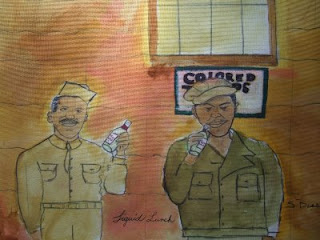
Stephen Bess is now a published author. Stop by his blog and BUY a copy of Liquid Lunch.
 clipped from www.civileyes.blogspot.com clipped from www.civileyes.blogspot.com
|
clipped from www.civileyes.blogspot.com
|
 My first prose novel is called Blonde Roots (Riverhead USA 2009) and in it I turn the transatlantic slave trade on its head and create a world where Africans enslave Europeans. My protagonist, Doris, is kidnapped as a child from the Cabbage Coast of England and enslaved in the West Japanese Islands. As an adult she is moved to the United Kingdom of Great Ambossa where she becomes the personal assistant of her formidable master, Bwana, a.k.a. Chief Kaga Konata Katamba I. The novel is about her desire and attempt to escape slavery and return to the Motherland – England.
As a writer I always want to do things differently, to stay true to a creative impulse that wants to re-create and re-imagine the world from unexpected viewpoints. I want to push the boundaries, to venture into new and sometimes precarious territory. I have previously written verse novels, one of which, The Emperor’s Babe is about a black girl growing up in Roman London. I was astonished to discover in my twenties that African soldiers had been stationed in the north of Britain during the Roman occupation 1800 years ago. I just had to write about it.
When I sat down to write about the slave trade in 2005, I wracked my brains about how I could do this in a way that enabled people to see it afresh. I really didn’t want to write the kind of novel about slavery where the reader knows where they are going emotionally and morally. I didn’t want to be predictable because there’s a safeness to that, a familiarity, that reaffirms what we know rather than leading us into new terrain. I had long been aware that the slave trade is a subject that elicits strong responses including anger, defensiveness, resentment, self-righteousness, guilt, sadness. So I decided to ask the question What if? What if the history as we know it is turned on its head and Africans enslave Europeans over a four hundred year period? What if Africans assume the moral and intellectual high ground and notions of savagery and civilisation are inverted? What if Africans see Europeans as depraved, lesser creatures and themselves as superior, more evolved beings? This idea is not without comic potential, so while the novel is a serious re-examination of the transatlantic slave trade, it also lends itself to satire. And while it is in one sense historical, I’ve written it in such a way that it sometimes appears contemporary. The world I’ve created is a parallel universe.
Blonde Roots re-investigates what we accept as the truth of this particular slave history and at the same time references and challenges still-prevailing attitudes towards race in our societies today.***
Bernardine Evaristo was born and raised in London where she still lives. Blonde Roots is her first prose novel. She has previously fused fiction with poetry in the novels, Soul Tourists (Penguin 05) and The Emperor’s Babe (Penguin 01). Bloodaxe Books will publish a new expanded edition of her verse novel Lara in 2009--the story of her family history with roots in England, Nigeria, Ireland, Brazil, and Germany. In 2007 she co-edited the Granta new writing anthology NW15. She has received several awards, her books have been a Book of the Year nine times for national newspapers and publications, and she is a fellow of the Royal Society of Literature and the Royal Society of Arts. For more information, please visit her website: www.bevaristo.net or her blog: www.bevaristo.wordpress.com. NALO HOPKINSON is a writer who has so far published a collection of short stories, four novels and an anthology or two.
  clipped from www.nebulaawards.com clipped from www.nebulaawards.com
|
 clipped from www.onlineuniversities.com clipped from www.onlineuniversities.com
|
 A writer learns her craft by toil, failure, and providence. But mostly from failure. For writing is a solitary discipline--learning to create a poem, short story or poem from a fleeting phrase, an ephemeral image or an indelible experience. And she must do this by using language that is true to her life and her community while she is also learning from other writers, living or dead, how to balance tone and rhythm, metaphor and rhyme, plot and pacing while maintaining her unique vision. This, as Pam Mordecai recently stated, takes persistence and courage.
For it is so easy to give in and fade into the crowd. Better to be a prodigal and to be welcomed back into the bleating herd of writers.
But if she is lucky, she may find a way to speak with confidence in the timbre of her own voice. If she is very lucky, she may find a living mentor who may offer her guidance at a crucial stage of her career. A living mentor, as John O' Donohue has suggested in Divine Beauty, has a valuable place in any society: "To know they are there, day in day out, at the frontiers of their own limitation and vision, probing further into new possibility, enduring at lonely thresholds in the hope of discovery, to know they are willing to risk everything is both disturbing and comforting" (257).I count myself among the lucky because throughout by development as a writer, I've had several mentors who have guided me for the past thirty years.
My first mentor was Dennis Scott and it was through his work that I discovered Anthony McNeill, Mervyn Morris, Derek Walcott, and Kamau Brathwaite. Dennis helped me to see many of my strengths as a writer, but when I came to America and after his subsequent death, I was pretty much on my own.
Of course, I continued to take classes to learn as much as I could from writers such as Isaac Bashevis Singer, O. R. Dathorne, Lester Goran, and Evelyn Wilde Mayerson, who offered me encouragement, but I was essentially rudderless.
I didn't want to become an exiled writer like many of the luminaries of Caribbean literature who over the years grew further and further away from the communities that gave birth to their talent. I had grown up with the music of the "Reggae Generation" and Bob Marley, in particular: "Children, get your culture/ And don't stay there an jester" ("Natty Dread').
Yet it wasn't until I attended the Caribbean Writers' Summer Institute and met Kamau Brathwaite that things began to change. Sure it was a large class, but when Kamau spoke to us about creating beauty from the trees, flowers, plants, and animals that surrounded us, I began to see a way out. It was also a thrill to be in the same room, in the very presence--breathing the same air--of a poet whose work I had long admired.
In our poetry seminar, Kamau suggested a new way of looking at Florida as a part of the Caribbean both in terms of the geography and sensibility-- a unity that was "submarine." Through his words, I was able to find a connection between Jamaica and Florida--my two homes.
Over the days that the seminar continued, we recoiled in horror when Kamau told of about the destruction of his library in Jamaica. To date, I don't know if any of these treasures have been recovered, but they no doubt are part of literary landscape of the Caribbean that has been lost.
So much in the Caribbean comes and goes, it is hard to preserve anything under these circumstances. And the mercantilist mindset that we have toward "soft" things such as literature doesn't help either.
From this insight came hurricane center and xango music. Both locales faced the yearly threat of physical and psychic hurricanes that threaten to destroy anything that we try to build. And there was always the music even in the face of destruction of lives and dreams.
And because we lack sustainable artistic communities, the importance of living mentors within the Caribbean cannot be overstated. For as O' Donohue states in Divine Beauty: "The presence of the contemplative and the artist in a culture is ultimately an invitation to awaken and engage one's neglected gifts, to enter more fully into the dream of the eternal that has brought us here to earth" (257).
Kamau taught us that despite all this, we must build--we must preserve. His example served as the impetus for the creation of this blog. From the start, Kamau was one of the first to urge me to continue and as I have followed his example with x-periments, in my prose and poetry, this blog has also been an attempt to preserve and showcase the literary talents from my two homes.
In the Sufi tradition there is a concept known as the "blessed glance" between a master and an adept. I don't know if I received this from any of my mentors, but I do know that through their words they have given me the confidence to pursue my path.
Give thanks, Kamau, for all that you have done and continue to do for InI.
1Love,
Geoffrey
***
In the course of writing this post, I received a disturbing e-mail from Kamau for me to spread the news about strange occurrences in his office and at his home. I hope that these incidents have stopped.
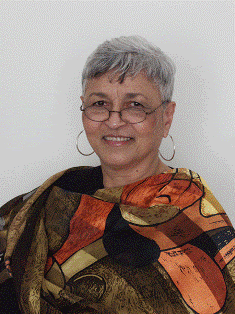 Pamela Mordecai has published four collections of poetry, Journey Poem; De Man, a performance poem; Certifiable; and The True Blue of Islands and, with her husband Martin, a reference work, Culture and Customs of Jamaica.
Dear Young Writer:
I’m using ‘young’ not to signify age, but to refer to how long you’ve been writing, which, I’m assuming, isn’t that long, even if you’re going to be a hundred on your next birthday. If you are looking at your first century, that’s cool, because you have so much more to write about when you put pen to paper. Old bones aren’t great for doing the hundred meter hurdles but they are exactly what writers need to sift around in as they look for a great story! If, however, you are a young-in-age as well as young-in-history writer, give thanks for time — time to do the things all writers must do and keep on doing: dream, research, draft, redraft, and most of all, and above all, read and read and read…All of which has been said before and all of which you have heard before. So this is not so much my advice to you as it is what I would wish for you.
I would wish the following things.
1. A Good Nose. This is necessary so you will not salivate at the enticing smell of every word you put down on a page, and also so that you will not be taken in by the spicy blandishments of words other writers have put down that are by no means a healthy literary meal because someone has decided to publish them. You want to save that mouth-water for the really good repast! A lot of poor entrées find themselves on to the book menu, while some of the healthiest literary consumables remain tucked away on dusty shelves or in bottom drawers, perhaps yours among them. A good writer sniffs out first, things that deserve to be put into the literary pot, and then, snout in the dirt like a pig hunting truffles, the best ways of saying them.
2. Persistence. There was an actor once. He was in his first role. It was a workshop production, in the round, of a play produced by the late Hugh Morrison. The actor had the part of a (Mexican, I think) peasant, and all he had to do was run in, throw himself to his knees, and say, “The rain! The rain!” (This was a not unimportant line, since the time was one of terrible drought.) Again and again he hurled himself upon the floor, and, try as he might, he could not get it right. But he kept going. I won’t tell you who it is, but he is one of the finest actors in the Caribbean, a veteran of stage, TV and the movies! Had he taken his earliest reviews to heart, our loss would have been enormous!
3. Thick Skin. I wish you the covering of the cascadura, since you must endure many disappointments and discouragements. Rejection slips are never welcome, and, unless you are very lucky, you will get many of these. Harder, though, may be the tossing-aside of people who dismiss your work, or folks, some of whom you may count as supporters or friends, who pigeonhole you. “A genre writer! Good at fantasy!” “Not bad at children’s stories.” “Good at travel writing — not much else.” This is where numbers one and two come in handy; married to five, they will take you where you need to go.
4. Pig-in-Mud Experience. Back with the pig again! This is the thing I most wish for you: that you are happy, consumed (ha! you’re the dinner now!) and content when you are engaged in the writing task. And I don’t mean that you are necessarily writing cheerful or funny stuff, or that it’s coming easily — far from it. Funny stuff is often the most heartbreaking, and the greatest exhilaration is to be had from the struggle to get it right. But there is a special high that comes from doing something that you want to do, and working hard at it, and a very special high when that something is writing, for it unites your senses and intellect, memory and imagination, art and craft in a unique way, a way that teaches you about the world, your fellow human beings, and yourself. Not all writers are happy when they are at work: some are anguished putting pen to paper or fingers to the keyboard. I have always been happy when I write, and I wish this for you.
5. Courage. Writing is not for the faint-hearted. Hang around with people who wish you well in the task. Go to places (workshops, readings, courses) that help build a stout heart and join others (writing groups, online or off) who can cheer you on and whose spirits you can help to buoy up.
6. A Solid Bottom Line. You will certainly enjoy this if Oprah buys the movie rights to one of your stories, but it is possible otherwise. You can earn your living from writing. Fame and fortune apart, it is satisfying to know that your writing is a bankable item, so much so that you need rely on nothing else for earning your living.
Blessings, then, on your aspirations, as an early writer named Luke, said, “pressed down, shaken together and running over…” May you ride on into a glorious sunset of many well-wrought books…
***

“I’d like anyone who has a lot of self-esteem to stand up.”
None of the children moved. I stood in the center of the room and searched their faces for some response, but I was greeted by blank stares.
Finally, one little girl put up her hand.
“What’s self esteem?” she asked.
“Self esteem is loving yourself, being confident, knowing that you are valuable and worthy.”
“If there’s one thing that I want you to remember,” I said, “when you tell your friends about the Jamaican writer who visited you, is that he told you to respect yourself.”
“You’re Jamaican?”
“Yes.”
“Say something Jamaican.”
“Never let anyone make you feel ashamed of how you speak or how you sound. But realize that if you are going to survive in South Florida, you may have to change how you speak. For example, when I’m speaking with the president of my college, I speak like this: (fake British accent)."I then read from the second chapter from Grandpa Sydney’s Anancy Stories where Jimmy encounters the bully, Kevin. We discussed how Anancy, as the smallest animal in the jungle, overcame his enemies by using his wits. We also made the connection between what Jimmy was going through with Kevin and Anancy’s conflict with Snake.
Laughter.
"And when I'm playing dominoes with my Jamaican friends, I speak like this, “Man, shuffle de kyard dem right.”
More laughter.
“So no matter what you encounter in life,” I added, “you never have to resort to violence. You never have to use your fists to solve a problem. And no one can ever make you feel small or disrespect you because you have self esteem and you don’t depend on other people to make you make you feel worthy."About eighteen out of the twenty children stood up. The other two were being pressured by their peers to stand up.
The children clapped
"Okay, so how many of you have self-esteem? I want you to stand up.”
“They don’t have to stand up,” I explained. “Self worth begins with being honest with yourself and sometimes it means not doing what everyone else is doing. And if they don’t feel it right now, then I hope they’ll feel it in the future.”
The children clapped and they all sat down.

 clipped from www.cba.org.uk clipped from www.cba.org.uk
• Entries must be made by email to e.dcosta@commonwealth.int, either as an attachment in a mainstream software format or in the body of the email. All entries must use the subject line 'Commonwealth Short Story Competition'. Enter the 2009-2010 Commonwealth Short Story Competition First prize £2,000
|
On Wednesday, March 4 at 7:00 p.m. at Pages Bookstore, 1135 Kensington Road NW, Pamela Mordecai reads at an event sponsored by the Canada Council and the Creative Writing Research Group at the University of Calgary. The reading is free and open to the public. A few years ago, I used to teach a research course in which I used Awakening the Heroes Within by Carol S. Pearson as a means for my students not only to identify role models in their particular discipline, but also for them to learn from their heroes a way out of the labyrinth of choices that they would have to make and to avoid the siren calls that would lead them off the paths they had chosen.
And then there were some students who were clueless. And no matter how much I talked about “following your bliss” as Joseph Campbell advised, they still didn’t know what they wanted. It wasn’t until I had one-on-one meetings with him or her in my office and asked, “If you won a million dollars right now, what would you be doing?” And then, I would get an immediate answer such as, “Oh, that’s easy. I’d be doing X or Y.” To which I’d respond, “Then, why aren’t you doing it?”
For some students, the light went on immediately. And that’s the moment that we as teachers all love—that moment when you’ve met a student who has found her way and you as a teacher have helped her to discover her path.Sure, we’d all love to have Jordan’s fame and dollars, but that’s not the reason why we should get into a line of work. For over the long haul, we are bound to be disappointed once we look back and see where we’ve invested all our energy. We will have seen that what we have done has not given us the sense of life—the joy of life that comes from Flow—those hours when time and space disappear and we are caught up in the rapture of doing what we really love—something that expands our horizons—those moments when we step beyond the boundaries of race and class--whatever else that binds us to the small, limited versions of ourselves-- to discover what it means to be truly human--for we have discovered the passion in which we can invest our whole being. This is life. This is fire. This is passion. And as Henry Miller once reminded us, “The aim of life is to live, and to live means to be aware, joyously, drunkenly, serenely, divinely aware.”
***
Text from a lecture @ the African- American Male Summit,Miami Dade College, North Campus, February 27, 2009
***
Update: Don't miss a guest post by Pam Mordecai on Friday, March 6, 2009:
Letter to a Young Writer.
![Reblog this post [with Zemanta]](https://lh3.googleusercontent.com/blogger_img_proxy/AEn0k_tNuM99IwekxAg0UkIBrWRTZkLSNdyFvFMutAs3JR4QthxKtYDrZJfFQ-bf0D0JmF3ezXPDydd5ltHGwVSo9DmPybX3Mg0HTwrnKThd15XEZUQcnEZFpSkw2SkoScPrd3gE6ZZl5JglMnPCH2tHKMY-=s0-d)
 Nationally syndicated columnist Marisella Veiga has released a spoken word CD, “Square Watermelons: Ten Essays on Living with Two Cultures.”
The CD highlights the meshing and clashing natural to the assimilation process. English-only listeners have embraced it, as have bilingual listeners. Veiga plans a version in her native Spanish as well.
“Square Watermelons is ‘un encanto,’ (an enchantment) from start to finish, a perfect blend of heart and mind, insider and outsider, English and Spanish, written and spoken, heartache and comedy, music and text. This rich mixture creates a fresh perspective on the value of living in several worlds simultaneously,” writes Holly Iglesias, author of “Souvenirs of a Shrunken World” and University of North Carolina—Asheville professor.“She wrote with an eloquence that I felt should be put to music, and now she’s done that,” says Charlie Ericksen, who syndicated most of the essays as editor and founder of Hispanic Link News Service in Washington, D.C.
A classical guitarist accompanies Veiga’s reading. Mario Escandel, a graduate of the Havana Municipal Conservatory, has taken Cuban popular musical selections by Cuban composers and arranged them for the classical guitar.
“It’s the music of my home—both of Cuba and Miami; my father plays,” Veiga says. She hopes to increase appreciation of her native culture by sharing its musical talent as well.The CD is available online at www.eclipserecording.com or by calling Eclipse Recording Studios at 904-794-1872.
For more information, contact Marisella Veiga at 904-501-4647 or mveiga@bellsouth.net or Charlie Ericksen at 202-234-0280 or Charlie@hispaniclink.org
Marisella Veiga was born in Havana, Cuba, and went into exile with her family in 1960. She was raised both in St. Paul, Minnesota, and Miami, Florida. She received a B.A. in English from Macalester College and a Master’s in Fine Arts in Poetry from Bowling Green State University. Her writing has appeared in numerous magazines, newspapers, and literary anthologies. Veiga has won The Pushcart Prize XX, Best of the Small Presses, Special Mention in Fiction, the Canute A. Brodhurst Prize for Best Short Story in The Caribbean Writer. She was also given the Evelyn LaPierre Award for Journalism in Alexandria, Virginia. Recently, Veiga released a spoken word recording that collects 10 of her nationally syndicated columns. Square Watermelons: Ten Essays on Living with Two Cultures. She lives with her husband in St. Augustine, Florida.
***


