April 14, 2007

Broward County Library: Pan African Bookfest and Cultural Conference

Pan African BookfestBroward County Library proudly presents the fifth annual Pan African Bookfest and Cultural Conference from April 11 through April 21, 2007. This event offers a host of programs by new and established authors, and includes Artist-in-Residence and Storyteller-in-Residence programs, a community history presentation, and panel and book discussions by local and national authors.

Most of the programs will be held at the African-American Research Library and Cultural Center located at 2650 NW Sistrunk Blvd., Fort Lauderdale.

The bookfest was established to draw attention to the proliferation of new work being written by local authors of African descent. In addition, the bookfest addresses the cultural, historical and day-to-day issues that impact this community.

Featured exhibits include:

  • The Colors and Textures of Our Legacy: South Africa Rises, a contemporary exhibit with a focus on utilitarian and symbolic forms including totems, bead work, ornate baskets and rites of passage ornamentation.

  • Haitian Community Arts, Images by Iris PhotoCollectives is a 38-panel exhibition in collaboration with the Historical Museum of Southern Florida. It represents the practice of Haitian traditional arts in South Florida. This exhibit is featured at the Collier City Library in Pompano Beach.

  • The Salvador of Pierre Verger is an 18-panel display of photographs showing the relationship between African and Brazilian cultures. It is sponsored by the Broward Center for the Performing Arts and South Florida Point of Light in association with the Ministry of Culture of Brazil.

Following are some highlighted activities of the event. A complete listing is available in the Library’s newsletter, Bookings, or at the Broward County Library web site: www.broward.org/library.

April 15, Sunday

2 to 5 p.m. – Yoruba-Ifa Cosmology

The Yoruba-Ifa Cosmology Panel with Yeyefini Efunbolade will explore the traditional Ifa religion and the evolution of the practice throughout the world. The Yoruba-Ifa religion is the faith practiced for thousands of years in what is known today as South Western Nigeria. In the New World, Yoruba-Ifa tradition was transfigured in order to adapt to the oppressive institution of slavery.

April 17, Tuesday

6 to 9 p.m. – “An Evening with Amiri Baraka”

This American writer is best known for his works for theatre and poetry. Baraka has explored a variety of themes, including race relations, Beat aesthetics, Black Nationalism, Marxism, and contemporary events. Baraka has founded or co-founded a number of organizations, including YUGEN Magazine, Totem Press, the Black Arts Repertory Theatre, and the Congress of African People. He has served as director of the Congress of African People, secretary-general of the National Black Political Assembly and has served as New Jersey’s Poet Laureate.

April 18th, Wednesday,

6 to 9 p.m. – First Florida Freedom Film Festival, Rewind!

(A National Library Week Celebration)

So good it had to be done twice. This event will employ a unique format of documentary films and movie films to tell the epic yet tragic story of the Black/American experience from the Middle Passage to the present. Featuring the 1987 documentary “Time and Judgment,” by British-based producer, Menelik Shabazz, and excerpts from “Goodbye Uncle Tom,” “The Birth of a Nation,” and “Marcus Garvey: Look for Me in the Whirlwind,” presented by Priest Douggie Smith and I. Jabulani Tafari, author of Marcus Mosiah Garvey. Sponsored by the Broward Public Library Foundation.

April 19, Thursday

6 - 9 p.m. – Joan Cartwright, “In Search of a Melody”

The Artist-In Residence Program with Joan Cartwright, jazz vocalist and educator recently back from an Asian tour. Cartwright will launch her new book, In Search of a Melody” that explores her 30 year career in Jazz.

April 20, Friday

10 a.m. – Moses: When Harriet Tubman Led Her People to Freedom

A reader’s theatre presentation of a book by Carole Boston Weatherford, will be presented by students from the Performing and Fine Arts Department at North Carolina’s Fayetteville State University. This multimedia production will feature readers, dancers, singers, and projected images. RSVP required. To register your group, call 954-357-7455.

April 21, Saturday – PAN AFRICAN BOOKFEST DAY

12 noon to 5 p.m.

Bookfest Day features local, national and international authors. The day includes a young adult book writer’s workshop and reception, author book signings, and cultural events.

Special features include:

12 noon to 1:30 p.m. – Zora Neale Hurston: A One-Woman Show

Phyllis McEwen will portray the life and times of Ms. Hurston, an American folklorist and author, who lived during the time of the Harlem Renaissance and is best known for her novel, Their Eyes Were Watching God.

1 to 2 p.m. – Young Adult Authors

Meet Brian W. Smith, author of Mama’s Lies – Daddy’s Pain and Blair Poole, author of Breathe. These Young Adult Authors will discuss their new fiction books and their relevancy to today’s youth and issues.

2 to 5 p.m. – Promises from the Palmetto Bush: the Genesis of Carver Ranches, Florida. This is a book signing and discussion by Cynthia Strachan Saunders. Join new author Saunders, writer and native of Carver Ranches, as she brings to life the people, places, events and the story of the growth of the 300-acre community founded in 1940. Living pioneers and their families will tell the stories of their families and this culturally rich community.

2 to 3 p.m. – Tatiana Henrique, Storyteller-In-Residence

A native of Brazil, Tatiana Henrique will present “Storytelling from the African Diaspora” with stories from her native country of Brazil. Sponsored by the Broward Center for the Performing Arts.

3 to 4:30 p.m. – Learning to Dream with Your Eyes Open.

This is a Young Adult Workshop by author, motivator Melanie D. Geddes, who will deliver her book’s message directing youth, parents and educators to focus on setting and achieving goals, pursuing dreams and focusing on the individual’s potential, not their problems.

4:30 to 5:30 p.m. – Rites of Passage for Breast Cancer Victors.

Author Jeanette Stephens-El, “Raining Deer,” author of BCV – Rites of Passage for Breast Cancer Victors, will hold a tea party to promote breast cancer awareness and discuss her new book that shares her personal experience with this diagnosis.

This years’ sponsors for the Pan African Bookfest and Cultural Conference include Broward Community College, The National Endowment for the Arts, Broward Public Library Foundation, Broward County Transit, Pyramid Books, The School Board of Broward County, The Herald, Comcast, Unique Graphics and the Florida Center for the Book, the Florida Humanities Council, Broward Center for the Performing Arts, and South Florida District of Culture.

For additional program information, call Broward County Library Outreach Services at 954-357-7348.


Contact: Tanya Simons Oparah, 954-357-7514, tsimons@browardlibrary.org

Contact: Karen Williams, 954-357-7395, kwilliam@browardlibrary.org


Founded in 1974, the award-winning Broward County Libraries Division, www.broward.org/ library, provides essential quality of life community service as well as outstanding customer service throughout Broward County. The library consists of 37 branches, more than three million items for public use, 970 permanent staff, 114 part-time staff and $4.6 million in grants with 41 grant-supported positions. Broward County Library is the ninth largest library system in the United States serving 10 million customers annually.

April 13, 2007

Reading @ La Carreta, Hialeah

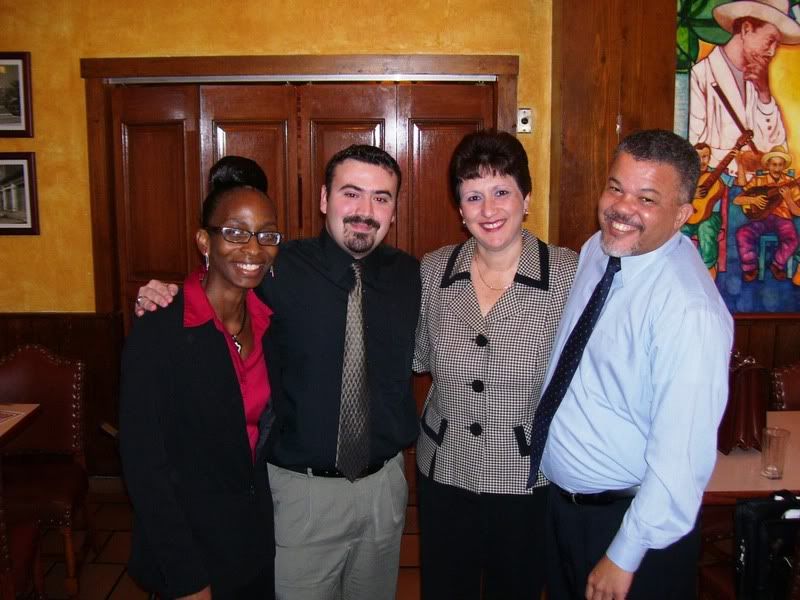
Geoffrey Philp Reading at La Carreta"In two years I will have known you for thirty years," I said to Cary, and as the words slipped off my tongue I realized how much of a rich and wonderful journey it has been since I came to Miami in April 1979.


And here I was at La Carreta in Hialeah, a piedra's throw away from the Hialeah Campus, which was merely an outreach center when I began working in the Writing Lab at Miami Dade College.


For the first group of students, I read a short story, "The Third Time" from my manuscript, "Who's Your Daddy?" and Other Stories, and for the second group, I read poems such as "miami mambo" "A Poem for the Innocents," and "oshun." For the third group, I went back to "The Third Time." Throughout the reading, we had some lively discussions about realism in fiction, the Yoruba religion; Lukumi (Santeria); the Jamaican diaspora, Xango / St. Barbara; Eshu/Anancy/Papa Legba/ Hermes/Loki; Tricksters as psychopomps; Jung's "archetypes of the unconscious"; Benjamin, My Son; Uncle Obadiah and the Alien, and the practice of writing fiction.


Give thanks to Professor Judy Welch, the students and faculty of the Hialeah Campus, and to my good friend of so many years, Caridad Castro.


Blessings, sister.


For more photos of the reading, click here: Reading @ La Carreta.


April 12, 2007

In My Own Words: Frances-Anne Solomon

Frances-Anne SolomonA cluster of thoughts are crisscrossing my mind tonight.

My new film, A Winter Tale, will be in front of an audience for the first time on Wednesday, and with that a long creative journey from concept to print finds closure.

I was asked by Geoffrey Philp to write "In My Own Words" for his blog.

"I'd be particularly interested in how you have managed to keep Leda Serene going..." he said.

I'll try to reflect on that (if indirectly) over the next days.

Reflection 1: Last night I was reading Harriet (the Poetry Foundation's blog), where the poet Derek Walcott is quoted as saying he still feels terror at the empty page, and "any writer who says he doesn't is lying".

To which a younger poet replied that Walcott should be ashamed of himself.


Tonight I lie sleepless wondering from whence the macho indignation at Walcott's admission?


I get up and write a comment to that effect: that as artists we face terror daily when we choose to express whatever it is we call our truth.


Creation is a form of Terror, particularly when you come from a colonial context and background in which Empire (read: a sense of inferiority) was imposed through education, language, culture, as much if not more than through the barrel of a gun.

Most chose silence.
(My mother and my father both.)
For those who don't, how can we not be terrified?

Walcott paved our way, dared to be Creole, hybrid, native, himself, in all his inherited complexity.

He did it first. He must have been/still be shit-scared, all the time.

Fear - real, tangible, sweaty, sick-to-the-stomach, terror - comes with the territory. Defines it. There's no shame in it.

I try to live with it, but it's not easy.


Post script: Re Walcott


From Nicholas Laughlin's Blog, January 11 2003:


The Nobel Prize-winning poet Derek Walcott stood alone on the stage ... in a bright pool of light in front of a wine-red curtain, and read sections of a new, as yet unpublished poem... Between reading sections of the poem, he spoke not only of a colonisation of the planet by powerful European nations, but also the colonisation of the mind and the soul by European culture. In the face of such dangers, poetry provides people with a navigational tool, a way out.

Derek Walcott


Liberation is possible when one honestly examines and expresses one's conflicts, thoughts, and emotions. As Walcott wrote in a poem in his book, Sea Grapes, "Now, I require nothing from poetry but true feeling."


From Walcott: "The Schooner 'Flight'":


I know these islands from Monos to Nassau,

a rusty head sailor with sea-green eyes

that they nickname Shabine, the patois for

any red nigger, and I, Shabine, saw

when these slums of empire was paradise.

I'm just a red nigger who love the sea,

I had a sound colonial education,

I have Dutch, nigger, and English in me,

and either I'm nobody, or I'm a nation.


Photos: (1) Myself, warts and all. (2) Walcott or any red nigger with sea-green eyes and a sound colonial education.


Frances-Anne Solomon is an award-winning filmmaker, writer and producer whose credits include Lord Have Mercy!, Peggy Su!, What My Mother Told Me and Bideshi. She is the president and artistic director of the two companies she founded, Leda Serene Films and CaribbeanTales, and has also worked as a radio film and television drama producer for the BBC. Her new film, A Winter Tale, will open the Reel World Film Festival in Toronto on April 11th.


***


April 11, 2007

Real Fantasy: Barbra Nightingale @ BCC

Florida writer Barbra NightingaleBarbra Nightingale writes real fantasy and last week Wednesday at Broward Community College, South Campus, she demonstrated this talent when she read from her prize winning collection, Singing in the Key of L and her manuscript, "The Ex-Husband Files."


Many of the poems in the manuscript display an almost macabre sense of humor because they describe the traumatic events of the poet's life that resulted from her ex-husband's suicide and her discovery of his body nine days later. The poems, eighteen sonnets of rage, despair, loneliness and humor with rich imagery of the body as a landscape of passion and betrayal, are a tour-de-force. In every poem, Barbra shifts the perspective on everyday objects that surround our lives, cats, books, can openers, and hammers, and transforms them into metaphors of our deepest despair or hopes.


And there is always her playful humor. For even when she's vamping on the D(ead) W(hite) M(en) of the canon, "A thing of beauty is a boy forever," her sense of the fantastic hovers over every line so that the real becomes woven into dream, into fairy tale, myth, and re-enters the body as poetry that is grounded in the body, "an ear lobe, toe, small tender ankle" ("Making Love to a Cannibal").


During the reading, which she described as "cathartic," Barbra read one of her best known and favorite poems of the audience:


The Cape Was Never White

Little Red Riding Hood


First of all, I was not skipping.

I never skip, but yes, I was eating

strawberries: red, ripe, delicious.

I had heard rumors

that girls who ate them

would never want for men.

I was after the woodcutter

not the wolf, but the wolf

was quicker, sly, and intense.

I hadn't meant to enjoy it--

but being swallowed whole

was a definite kick

no man could ever give.


For more photos of the reading, click here: Barbra Nightingale @ BCC, April 4, 2007.


Barbra Nightingale has had over 200 poems published in various national and online journals such as Tigertail, The Best of Tigertail, MiPo, Ocho, The Appalachee Review, Kansas Quarterly, Barrow Street, The Chatahoochee Review, Mississippi Review, MacGuffin, Many Mountains Moving, Kalliope, Calyx, and others. She has five published books, including the Prize-winning Singing in the Key of L.

***

On Thursday, April 12, 2007, "In My Own Words: Frances Anne-Solomon."


Frances-Anne Solomon is an award-winning filmmaker, writer and producer whose credits include Lord Have Mercy!, Peggy Su!, What My Mother Told Me and Bideshi. She is the president and artistic director of the two companies she founded, Leda Serene Films and CaribbeanTales, and has also worked as a radio film and television drama producer for the BBC. Her new film, A Winter Tale, will open the Reel World Film Festival in Toronto on April 11th.

***


April 9, 2007

"Little Boy Crying" by Mervyn Morris: An Appreciation


Throughout Mervyn Morris' first collection of poems, The Pond, the family is used as a setting for the most intimate and fearsome dramas. "Little Boy Crying" is no exception. In this poem, Morris investigates the complicated emotions between a father and his three year old son who has received a spanking because he has been playing in the rain. The themes of time, paternal love, and punishment are demonstrated in the complex pattern of word choice and shifts in point of view.


The poem begins by using word play to show change (bold) and water imagery (italics) to reveal the fluidity of time and introduces the theme of crime and punishment (underline):


Your mouth contorting in brief spite and hurt,
your laughter metamorphosed into howls,
your frame so recently relaxed now tight
with three year old frustration, your bright eyes
swimming tears, splashing your bare feet,
you stand there angling for a moment's hint
of guilt or sorrow for the quick slap struck.


Morris' wry sense of humor is especially present in the second stanza where he alludes to the language of (Grimms'?) fairy tales (superscript) to describe the only way that a three year old boy could see or understand his father's actions:


The ogre towers above you, that grim giant,
empty of feeling, a colossal cruel,
soon victim of the tale's conclusion, dead
at last. You hate him, you imagine
chopping clean the tree he's scrambling down
or plotting deeper pits to trap him in.


In the third stanza, the complexity of time/change (bold), crime, judgment and punishment (underline) are revealed in the emotions of the father, who will "piggy-back, bull-fight, anything" with his son who only understands play. Yet the father wants to teach his son a valuable lesson he "should learn." Both are suffering through the ordeal of punishment: the father who has a "fierce" love for his son and the son who is suffering because of the slap:


You cannot understand, not yet
the hurt your easy tears can scald him with
nor guess the wavering hidden behind that mask.
This fierce man longs to lift you, curb your sadness
with piggy-back or bull fight, anything,
but dare not ruin the lessons you should learn.


You must not make a plaything of the rain.


Of course, this appreciation does not do justice to the concept of the mask and the use of irony, integral parts of understanding Morris' poetics, which are hallmarks of his literary creations. For beneath his urbane intelligence there is a radical distrust of the tools such as language and metaphor that are used to explore our existential and epistemological dilemmas.

***


April 4, 2007

Desire, The Secret, and Literary Fictions

BodhidharmaBuddha gathered his disciples at a lake on Gridhakuta for instruction. His adherents sat in a circle about him eagerly awaiting his teachings. Wordlessly Buddha reached into the muck and pulled up a single lotus flower. He then held it high for all to see.

Practically everyone was bewildered. But then the disciple Mahakashyapa began to laugh.

Finally, Buddha handed the lotus flower to Mahakashyapa and said, “What can be said I have said to you, and what cannot be said, I have given to Mahakashyapa.” (Via Copyblogger)

What makes an action significant? Is an action inherently significant or does it depend on the actors or the perception of the observers? The interchange between the Buddha and Mahakashyapa could have been perceived as one person giving another person a flower, but when the contextual clues of teacher and student are added, we understand why this simple action led to Mahakashyapa's realization of Zen. Does the difference between significance and insignificance rest on the intentionality of the actors and the ability to perceive the meaning of the action within the framework of the contextual clues?

In the story above, the disciples of the Buddha were expecting a lecture on being and the Buddha pulled up a lotus-- a flower that had profound cultural significance. Yet only Mahakashyapa realized the profundity of the action. The significance resulted from the Buddha's intentionality (a sign on a focused consciousness) and the meaning was expanded by metaphor. The significance of the action was created by the Buddha's focused consciousness and not from the perception of the observers. In an alternative story I would have written, the Buddha in another incarnation had tried the same lesson, but it didn't work, so he was left with a dead flower in his hand. And even though he knew he was enlightened, he was still sad as he walked down the hill because he knew that he would have to go through another lifetime before one disciple got it, but he was still focused.

In literature, as in life, it is this focused concentration on the significant actions within a community's memory that distinguishes literary from non-literary fictions. The result of this concentration is manifested in sentences, characters, plot, and narrative, and the entire work is marked by an awareness of the complexity of choice within the cultural/historical tradition of a community. In a work of fiction, the desire of the protagonist propels the drama and necessarily invites the presence of an antagonist. This antagonist can be external, internal or external representations of the protagonist's internal conflicts. Is it me, them, or there is no "them," Spoon Boy? Either way, if there is no desire, there is no drama.

Writers and prophets tread the same hallowed ground of desire and often ask the same questions: what is the nature of desire? What is the relationship between ethics and desire? At what cost should the desired object be achieved? Are some actions inherently "wrong" or "right" or should those questions be considered only within the context of the gaining the desired object and the ability/willingness of the protagonist to live with the consequences of his/her actions? The difference between a writer and a prophet is that the prophet usually wants to change the listeners' views about desire and the writer is fascinated by the effects.

Quite often, the writer begins from the proposition, I wonder what would happen if the hero of my novel, I'll call him Bobby, who wants______ were to_____. But then, _____ happens. The drama begins with desire, and as the Buddha teaches desire, even if fulfilled, is the cause of suffering. The writer may know this, but it's Bobby we're worried about. Bobby really wants X. This begs the question, why does Bobby want X?

This leads us to questions of identity:
Who am I?
Where have I been?
Where am I going?

Methods of gaining the desired object:
How will I get X?
How did people in the past get X?
Did it work?
Is R, the way of my people, the only may of getting X?
How about using Y?

The context of the community's identity and memory;
This is who we are.
This is where we have been.
This is where we are going

The community's methods of gaining X:
R is how we have gained X in the past and R is how we will gain X in the future.
Only ___________ should gain or have X

Non-literary fiction or popular fiction doesn't concern itself with these questions. Commercial fiction is only prepared to ask two questions, will Bobby get X? What happens next? And we read along just to find out if Bobby will get X because Bobby is a fine fellow who has ___ hair, ___ eyes, brushes his teeth, combs his hair, lives in ______, doesn't smoke, works out regularly, and has a sense of humor, so he's named his dog, Woof!

Bobby never asks complex questions--he's too busy worrying about his hair. And if Bobby does think about these questions, his partner usually says, "Why are you worrying about that? I just want to dance. C'mon, dance with me Bobby! Dance with me! You're still not thinking about Y, are you?"

For the minute Bobby thinks about Y, then the creator has a choice: either to continue with the same old script (which may not be working) or use what s/he knows to write a new script. If the creator decides to follow Bobby on his quest of discovering how using Y will get X, then we have the possibility of a literary novel. For if Bobby tries a new way, he must now confront his past, the community's memory of the past, and the upholders of Y-NOT! Allusion is one method that writers often use to demonstrate the protagonist's plight within the literary tradition. The strength of literary fictions often depends upon the writer's ability to make the connection between the past and contemporary events and to create complex metacognitive patterns that are reflected in the choice of words, sensory details, and figurative language. And it's not complexity for complexity's sake, but a thorough examination of metaphor--a signature beauty that is often not present in commercial fiction.


For example, a popular novel could be about a man who went to fight in Iraq because he thought that this would make his parents and the girl whom he loves proud of him. Bobby goes to the war and sees many bad things. On his journey home, he meets some interesting people and then comes home. His parents are proud of him and he marries the girl at the dance.

A literary novel on the other hand could show the connection between Bobby's journey and the mother of all war veteran's journey, the Odyssey, and if the characters are emotionally appealing, the plot is believable, and the sentences are rich with sensory and emotional details that engage the reader, then the writer may have written a book that a school teacher will force on her students. This is why we have Cliffs Notes.

But what if the creator is obsessed about desire, the nature of desire, and its relationship to ethics? In other words, what is the price that Bobby must pay to achieve X? What must Bobby do to achieve X? What if the community of which Bobby is a part deems that his methods of achieving X are "unethical"? What if his community has said that people like Bobby shouldn't get X and will defend their right to deny Bobby X? What if Bobby hasn't been trained or mentored to achieve X and isn't prepared for the consequences of using R? What if after Bobby has achieved X, the cost and unintended consequences of achieving X are more than Bobby can bear? As a sidenote, this is the part that the creators of The Secret (which verges on a kind of solipsism) have left out, but these questions have been a part of our literary tradition in the plays of Shakespeare and in Orson Well's classic, Citizen Kane.

In Hamlet, the protagonist, who has been studying in another country, wants to discover who killed his father, but he has not been trained by his society in the methods of achieving this goal. The only surviving mentor available is an old fool who prattles traditional platitudes. Hamlet's knowledge of the murderer's culpability was not arrived at by his community's usual methods of judging guilt or innocence. Yet he trusts that intuitive knowledge which leads him to the truth, but his method gives the murderer enough time to plot against him. In the midst of this, although he is committed to bringing his father's killer to justice (not merely vengeance), he questions his community's ethics and values. Hamlet is focused on his goal, but he gives his antagonist enough time to react, which leads to his demise. Hamlet is in new territory, but when he doubts his methods and actions, he shows that he doesn't have a sense of entitlement that a young prince should have. Was he doomed from the start to deal with situations like this? Shouldn't he have been trained from childhood to become the king and to deal with similar situations? Shakespeare gives us an answer in Prince Harry who knows exactly what he wants, but when he leaves Falstaff, his beloved mentor, we realize the terrible price he has paid in order to become the king. Similarly, Orson Well's, Citizen Kane (the hero's final word is "Rosebud"--a reference to his childhood), also demonstrates the unintended consequences of achieving a goal for which the protagonist is emotionally unprepared. The weight of history crushes the hero.

The burden of history takes many forms. In Caribbean literary fictions, as the books from the Top Ten Caribbean Novels demonstrate, the protagonist's struggle against history in the forms of slavery, colonialism, and patriarchy, and the ethical dimensions seems to haunt the narratives. The ethical questions of the actions are usually judged within the context of the Judaeo Christian morality. (In the oral tradition, many of Bob Marley's lyrics derive their appeal from his allusions to Judaeo-Christian morality and its connection to the events in his life.) But many of the novels the Top Ten Caribbean Novels are over thirty years old and some of the questions that they raised are now historical curiosities.

If a writer's task is to demonstrate the emotional consequences of action within a cultural and historical context, where are the literary fictions in the Caribbean that highlight our current preoccupations (desires) within the literary tradition of Naipaul, Kincaid, Danticat, Mais, Lamming, Hopkinson, CLR James, Schwarz-Bart, Patterson, Lovelace and Rhys? If they are not present, do we really want this? Why? Why not?

The question of desire is as old as Gautama and all the Buddhas before him, and a healthy literary tradition asks questions about the means of achieving goals. The tentative answers provided within literary fictions are always conditioned by time and place because if it was "right" for Hamlet to kill the king to achieve his goal, then why is it "wrong" for Macbeth to kill the king to achieve his goal? Are authenticity and intentionality the only means of judging actions? Should we be judging at all? Do ethics matter at all? Are all ethical questions conditioned by time and place? What is ethical in a postcolonial setting? Is a focused, driven life the only way to achieve success or is there such a thing as serendipity? What if someone either by natural or cultural disposition, like the Caribbean Hamlet, Ralph Singh in Naipaul's Mimic Men, is hesitant, will this always lead to failure? Are there cultures that are predisposed to failure in the twenty-first century? What if someone who was born into one of these cultures tried to change the cultural dispositions, would she achieve success? Who should achieve success? These are some of the questions we could be asking or finding ways to ask new questions. Are we listening or do we just want to dance?
***
I'll be taking a break for Easter. See you on Monday.

***

April 2, 2007

Results of the Voting for the Top Ten Caribbean Books

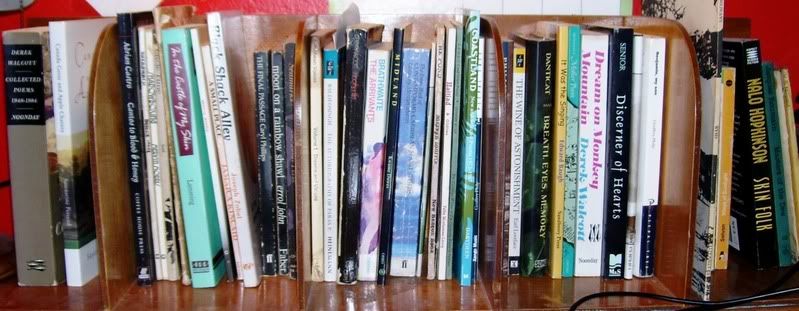
Caribbean writersFirst, give thanks to all who participated in the voting for the "Top Ten Caribbean Books" which closed on Friday evening. The results have been very interesting and I've posted the raw data here: Results.


I have not ranked the books because as Frances-Anne pointed out, each book has its own audience and appeal. Overall, however, the books are fairly representative of the majority of readers of this blog: North American/Caribbean and between the ages of 25 and 55.


Here are the books:


A House for Mister Biswas by V.S. Naipaul.

Annie John by Jamaica Kincaid

Breath, Eyes, Memory by Edwidge Danticat

Brother Man by Roger Mais.

In the Castle of My Skin by George Lamming

Miguel Street by VS Naipaul

Minty Alley by CLR James

The Children of Sisyphus by Orlando Patterson

The Dragon Can't Dance By Earl Lovelace

Wide Sargasso Sea by Jean Rhys


Sir Vidia had two books in the running, A House for Mr. Biswas and Miguel Street, and three of the books were written by women. I couldn't help but notice the thread of social realism that connects some of these works. If you notice any other similarities or you'd like to comment on the process or the books, please leave a comment.


I've also made a comparison between this list and my choices, and five out of the ten are on my Top Ten List. I could have had six, but Danticat's, The Dew Breaker, is a much richer book in terms of exploring Haitian culture and my relationship with the characters was far more complex. I was more willing to empathize with the characters in The Dew Breaker than with Sophie in Breath, Eyes, Memory for whom I could feel only sympathy.


And this is a crucial difference and perhaps Edwidge's breakthrough in what the booksellers call "minority" or "World Literature" which usually posits race, gender and class as the cause of suffering, and begins from a premise of victimhood rather than having a central character as John Gardner states in The Art of Fiction, " [Who] is struggling for his or her own goals" (65).


In The Dew Breaker, the cause of the character's suffering is not because she is female and Haitian, but is caused by a discovery about her father which is complicated by the fact that she is female (a daughter) and Haitian. These complications work against her discovering the truth because she is a doting daughter and Haitian society is closed to inquiry about subjects such as the Ton-Ton Macoutes. This is what makes a fiction like The Dew Breaker "universal" because Danticat book explores the relationship between a father and daughter, and ranks as "world class" literary fiction.

For more on this, look out my upcoming post this Wednesday(4/4/07): "Desire, The Secret, and Literary Fiction."


***

I've just published four poems, including "poltergeist or the duende's gift," over at the Concelebratory Shoehorn Review.


Enjoy!


***


March 30, 2007

Color, Identity, and Candomblé in Brazil

Joel Gondim"Brazil is not just Pele, coffee, and Samba," said Joel Gondim as he began his presentation, "Color, Identity, and Candomblé in Brazil," in which he explored the African connection in Brazil, specifically Bahia where he lives, and the manifestations in food, music, and religion. "And the true wealth of Brazil," he continued, "comes from the fusion of the Africans, indigenous peoples, and the Portuguese."


It was this fusion, especially in the religious arena that led to the creation of syncretized religions such Candomblé and one of the more interesting aspects of Joel's lecture was his description of his preparation, the psychic cleansing by a babalorixá that he underwent before he came to America. He also explained the relationship between the orisha pantheon ( Shango, Olokun, Ifá, Yemoja, Osun, Obatala, Oshun, Ogun, Ochosi, Oko, Soponna, Oya and Esu|Legba), nature, and everyday life. In fact, today is Oxalá's day.


Axé

***

For more photos of "Color, Identity, and Candomblé in Brazil" which is part of the Conference on African Spirituality in the Americas (February/March 2008), click here: Candomblé.


***


March 28, 2007

Howzat! Books, creative writing workshops, and a Caribbean Canon.

Caribbean novelsI don’t know if it’s a form of linkbaiting, but book lists are popping up all over the Internet. One of the more interesting ones (via John Dufresne’s blog) from Newsweek features the following A-list critics and writers who discuss their Five Most Important Books:


In a roundabout way, voting for the Top Ten Caribbean Novels is trying to achieve a similar goal. However, as the Comments on my post and at Nicolette’s demonstrate, choosing the "best" books from the Caribbean is difficult because the books are as varied as writers. But as Nicolette said, we have to start somewhere, and a lack of consensus shouldn’t deter the effort. There isn’t much agreement among the Newsweek bunch either. And if we choose to avoid the issue because of difficulty or lack of agreement, then that may only lead to more problems.


For one, creative writing workshops are also now as ubiquitous as these surveys. And if we follow what my history teacher, Jimmy Carnegie, used to call “enlightened self-interest,” a discussion about the books that best represent the essence of Caribbean literature and life seems only logical. Now this shouldn’t be interpreted as narrow regionalism. Chaucer's pride in his "nation language" led to the creation of the Canterbury Tales, and had it not been for the rise of the British Empire, that bumpkin from Stratford-upon-Avon, would have probably remained a “local writer.” We have great writers from the Caribbean. And how could I call myself a Jamaican/Caribbean literary blogger if I ignored the talents of Naipaul, Lovelace, Rhys, and Lamming?


And then there’s the issue of time. Much as we would love to, we can’t read all the books that are being published, so we need a standard for aesthetic judgment. That’s why I began the list with fiction writers. From my experience of teaching creative writing workshops, fiction is not only easier to teach than poetry, it is also easier to evaluate. (Or are my standards are higher for poetry?)


For example, here’s a typical workshop question:


Write a poem or short story about playing cricket.


When I read a poem, I am expecting a cerebral/sensory/ emotional experience. Poetry asks complex questions within the details: the bok! when the ball meets my bat, the sweet stench of naseberries floating across the oval from a nearby field, dried saliva on my lips, blinking at the punishing sun, the wind billowing through my shirt, and lifting kites above my head.


The poem encapsulates that moment of infinity, the game, and the universe. It’s everything that led up to the moment, the moment itself, and what may happen after the moment has passed. And in the midst of everything, there is word choice for rhythm, connotation, denotation, wordplay, simile, and metaphor.


The poem delivers infinity. And then some.


A short story, on the other hand, asks very simple questions: What is the name of the bowler? The batsman? Where are they playing? What time is it? What’s happening? The writer supplies the information. The bowler’s name is George and the batsman’s name is Will. Protagonist or antagonist, take your pick. If George is the protagonist, I should care if he will be bowled out, so supply some background information about George and Will. They’ve hated each other since childhood or they’ve always been friends, but they must now be opponents because of the game. You decide.


They’re playing in Kingston, Jamaica and it’s late in the evening. You could also mention the sky, but that’s not really important. What’s really important is that it’s the last ball of the last over of the fifty over match and both teams are tied at 115 for five. The bowler cleans the ball on his thigh and prepares to make his run…


The main thing that a short story must deliver is what happens next: “He’s out!” or “Four!” Short stories are the autistic savants of fiction.


Of course, Naipaul, Lovelace, Rhys, and Lamming are asking more complex questions in their fictions, and few, if any, outside the region know about their work. Other Caribbean authors such as Olive Senior and Tony Winkler, who have been publishing outstanding literary fiction for years, have also gone unnoticed. It will be interesting to see the final count, and to see which books finally emerge from this very limited survey of books by Caribbean writers.


Voting ends this Friday: Vote for Your Top Ten Caribbean Novels


***

Give thanks to the readers who decided to Subscribe via E-mail or to Subscribe via Browser (Google, etc.). Got a spike in Feedburner yesterday.

***


March 26, 2007

Review of Kingdom of Empty Bellies

Jamaican writer Kei MillerFrom the moment I opened Kei Miller’s, Kingdom of Empty Bellies, I knew I was going to like it because of the juxtaposition of John 7:38, “For out of your bellies shall flow rivers of living water,” and Bob Marley's, “Them belly full, but we hungry.” For if anyone wants to understand Jamaica, they need to read the King James Version and listen to Bob Marley. Preferably both at the same time.


Still, I was a bit wary. Reading a book of poems is like entering a relationship. Some people can talk a great talk, but can they walk the talk? By this I mean, after reading the book will I have a deeper understanding of the subjects about which the poet has chosen to write? Has the poet crafted the poem (sound and sense), so that I can dive headlong into the poem and perhaps encounter beauty?


“Mother” and “Hats” from the first section of the book, “Church Women,” allayed those fears. The poem describes a Jamaican matriarch whose sole mission is to save “sinners, whom she crushes/ to her chest shouting, Jesus! / Jesus! until the evil breaks.” In “Hats,” which is told from the perspective of a child, the speaker confesses:


The boy will not see the majesty

In these women;

He will not understand their purple claim:


We are not God’s children!

We are his wives.


The rest of the poems in the section introduce us to the world of these women whom I have often glanced on a Sunday morning through my car window as they urge a gaggle of children up a hill to a small chapel where they “will strip Britain/ off their tongues, allowing them to dance free.” And in a country as hard as Jamaica, I've often asked myself, what makes them continue?


“In Dream Country” the second section of the book, “Granna’s Eyes” answers that question with the haunting refrain:


Is de ocean

de blue blue ocean

in mi eye, in mi eye

Is de ocean

de endless ocean

in mi eye, in mi eye


It is beauty and terror. Terror and beauty. In this section, Miller exposes the dreams/fears of his immediate family and the color red assumes a different meaning from the associations in the first section: the "red flowers laid at the altar" ("Communion") and the "red banner" of Sister Sybil ("War Dance"). In the poem, “On Arson and Parachutes," red is not only the color of unrequited love, but also of Aunt Valda's murderous passion.


At family dinners, she was the one who danced

always in a new red dress

and hugging her, the sharp smell

of kerosene would rise as a ghost

from behind her ears.


When passion is turned inward it becomes destructive, and the men in the third section, “Rum Bar Stories,” are as intent on damnation as the women are insistent on salvation. The poems “Sunset Glow,” “Liza’s Love” and “Jamaica Dream” are the names of popular cocktails, which as Edward Baugh points out in the Caribbean Review of Books, “Kingdom Come,” "represent the contrast between the upscale life they [the drinks] represent and the unglamorous reality of the lives of the men in the poems.” And the aptly titled “Drink and Die," reveals not only the incongruity of the speaker's life and his surroundings, but also his realization of impending mortality:


And Paul, these days I feel

my bones being pulled

into the earth

and my skin lifting

to show the duppy-self

underneath. So I know

I coming, Paul, real soon.


The poems in Kingdom of Hungry Bellies do not have the usual props and tricks that much of contemporary poetry uses to dazzle and befuddle the uninitiated. Miller doesn't need to. Instead the assured tone of the poems convinces the reader that Miller not only understands the joy and terror of intimate relationships, but more importantly, beauty made real by poetry.

***


Voting ends this week for the Top Ten Caribbean Novels;


***


March 23, 2007

Birthday Meme

I’m passing along this Birthday meme from Rethabile.

Go to Wikipedia and type in your birthday, month and day only

List 3 events that occurred on that day

List 2 important birthdays

List one notable transition

List a holiday or observance (if any)

Tag five of your friends.


1. March 14


2. Three events


3. Two Birthdays


4. One notable transition


5. Holiday(s)


6. Tag Five Friends


*


PS. While you’re at it, Vote for Your Top Ten Caribbean Novels.


Ha! Thought you were going to get away for the weekend? Have a great one!

***


March 22, 2007

A Poem for the Innocents


A Poem for the Innocents


A killing moon peeks through leaves

of the trumpet trees in full bloom

for Lent, their barks still scarred

by the wild strokes of a machete

when my son tried to help me weed

our garden, overrun with dandelions,

carpeted with petals, a bounty of seed

and thorns, side by side, under clusters

of suns bursting through the branches.


Shadows flicker across the wall

over Buzz Lightyear’s grin, Mr. Potato

Head’s sigh, a collection of cards

and Harry Potter books under a map

dotted with the cities that fill his dreams.


What promises will I make

when I climb the stairs before

he falls asleep to the noise

of the television with cluster

bombs blooming in the sky

over Baghdad? What comfort

can I give him as I draw the sheets

over his shoulders, kiss his forehead,

when he worries that if he closes his eyes,

his aunt, Batsheva, half a world away,

will not rise from her bed in Gan Yavne,

thirty-seven miles west of Ramah

where Rachel wept for her children

because they were dead

and refused to be comforted--

who could stop her tears?


The map over his bed frightens him,

and I cannot convince my son

despite the miles and miles of oceans

and deserts that the machete he has hidden

under his bed will not make him safer,

any more than the sacrifice of innocents

will save us, for he knows,

he knows, somewhere

between the Tigris and Euphrates,

a wave of steel races toward Babylon.


March 22, 2003

***