Showing posts sorted by date for query In My Own Words. Sort by relevance Show all posts

April 19, 2026

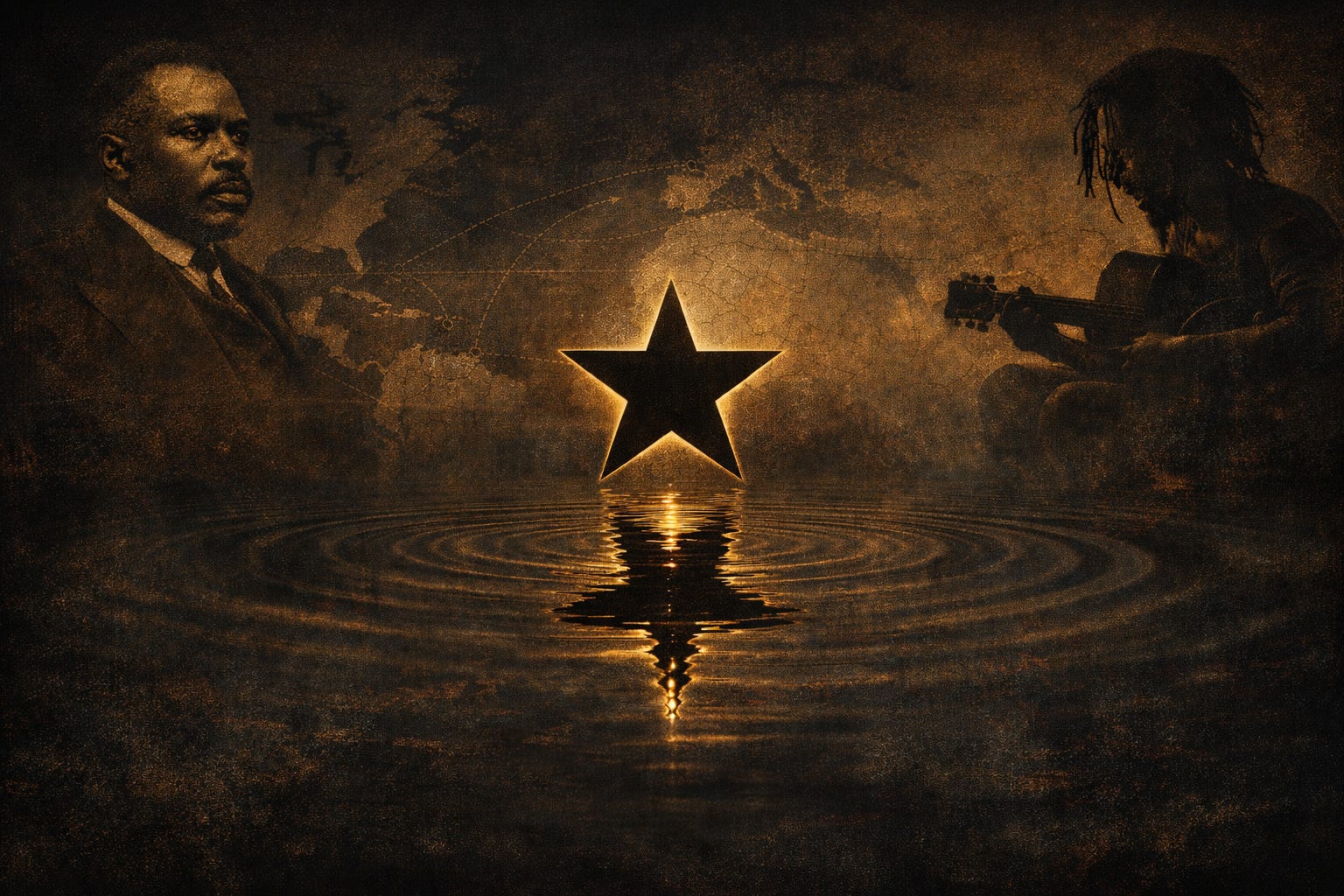
Garvey’s Map, Marley’s Music: Eight Stages to Mental Sovereignty

Somewhere between Toronto in 1937 and Trench Town in the 1960s, Marcus Garvey’s curriculum found a new teacher.

According to Mwariama Kamau, historian for the UNIA, Garvey’s work was a restoration of African consciousness, driven by what Kamau describes as “an ancestral imperative” to liberate his people from social, political, economic, and spiritual bondage (Kamau). In September 1937, Garvey assembled a small group of trusted organizers in Toronto and ran them through forty-two lessons with twelve hours of instruction a day for a month. He called it the Course of African Philosophy. The lessons mapped what I have distilled into eight stages of psychological liberation: Awakening, Confrontation, Reorientation, Continuity, Purpose, Discipline, Organization, and Individual Genius and Mental Sovereignty (Garvey, Message xv).

After Garvey’s death, the forty-two lessons survived in fragments that Tony Martin collected into Message to the People. But the transmission of Garvey’s teachings also ran through Jamaica. The herald was Rastafari. Bob was its voice.

Garvey had founded the UNIA in Jamaica in 1914, and his vision of African redemption never left the island. It moved into Rastafari, which took Garvey’s prophecy about the crowning of an African king as its founding theology. Bob was Rastafari. He did not encounter Garvey’s ideas as history. He absorbed them. Then, set them to music.

Across albums recorded between 1964 and 1980, Bob, like Garvey, transformed what was happening to us into what looks, in retrospect, less like coincidence and more like a mission. The two men never met. Garvey died in 1940. Bob was born in 1945. What passed between them was transmission, the kind that moves through a people who are still working out the same problem.

When Garvey’s words became music, four things changed. The reach expanded from twelve organizers in a Toronto room to every radio, every record player, every street corner on six continents. The access dropped from literacy and membership to nothing more than ears and a body that could feel rhythm. The memory deepened from intellectual retention to the cellular kind that outlasts everything the mind decides to forget. And the risk shifted: you can burn a pamphlet, you can arrest a man, but you cannot confiscate a song that three hundred million people already know by heart.

The curriculum grew roots when it became music. But the music also cost something. That reckoning comes at the end.

Stage One: Awakening

The first stage is the hardest. Garvey called the mental condition of colonized people a kind of enforced sleep. You cannot fight what you cannot see. His pedagogical project began with the insistence that seeing was possible, that the mind could be roused from the numbness it had been taught to call peace.

Garvey wrote in Lesson One of the Course of African Philosophy:

“Intelligence rules the world and ignorance carries the burden.” (Garvey, Message xv)

Bob answered that lesson with a command. In “Wake Up and Live” he sang: “Rise, from your sleepless slumber.” The instruction is identical. Only the instrument changed.

Stage Two: Confrontation

Noticing is not enough. Garvey was explicit: we had to look at the systems arrayed against us without flinching. He trained his organizers to analyze the methods of their opposition, and to understand the terrain. Confrontation in Garvey’s framework is an act of intellectual courage.

Garvey taught in Lesson One:

“Never swallow wholly what the white man writes or says without first critically analyzing it.” (Garvey, Message 1)

Bob enacted that instruction as refusal. In “Babylon System” he sang: “We refuse to be / What you wanted us to be / We are what we are / That’s the way it’s going to be.” Garvey teaches critical analysis. Bob makes it a declaration of identity.

Stage Three: Reorientation

Once a person has awakened and faced the structure built against them, the interior work begins. Garvey understood that the colonizer’s most durable achievement was the installation of the colonizer’s values, standards, and judgments inside the colonized mind. Reorientation means replacing that installed compass with one oriented by African history, African genius, and self-generated possibility.

Garvey named the colonizer’s method in Lesson One:

“Things that may not be true can be made so if you repeat them long and often enough. Therefore, always repeat statements that will give your race status and an advantage.” (Garvey, Message 1)

Bob named the return from it. In “Coming In from the Cold” he sang: “Why do you look so sad and forsaken / Don’t you know when one door is closed, many more is open.”

Garvey names the mechanism of mental colonization. Bob names the way back.

Stage Four: Continuity

Garvey diagnosed civilizational amnesia as a political tool. A people cut from their history could be given a replacement history designed to explain and justify their subjugation. The antidote was memory, specifically the recovery of a history long enough and deep enough to show that the current condition was recent, not eternal.

Garvey wrote in Lesson One:

“Read history incessantly until you master it. This means your own national history, the history of the world, social history, industrial history, and the history of the different sciences; but primarily, the history of man.” (Garvey, Message 3)

Kamau documents how Garvey enacted this stage inside the UNIA itself. At conventions, he hosted the Ancient Ethiopian Ceremonial Court Reception, inducted members into the Ancient Order of the Sphinx, and filled the hall with songs like the Universal Ethiopian Anthem. UNIA auxiliaries carried flags bearing West African Adinkra symbols. African royalty came and found sanctuary in what one member called “the African gospel” (Kamau). Garvey built institutions that practiced continuity with history.

Kamau makes a contribution here that the mainstream Garvey scholarship has not fully absorbed. He documents that the School of African Philosophy taught forty-two lessons, the same number as the forty-two declarations of Ma’at in the ancient Kemetic system. Garvey built that number in deliberately, connecting his curriculum to the oldest African tradition of moral and spiritual accountability on record. The School of African Philosophy was the oldest institution on record, restored.

Bob carried that same depth without naming it. When he sang about the mind, about judgment, about what we owe each other and ourselves, he was drawing from the same well Garvey drew from. The tradition was unbroken.

Stage Five: Purpose

Garvey argued throughout Message to the People that we had to stop drifting and claim a direction. He was relentless on this point. Purpose was a discipline cultivated against the grain of a world that had spent centuries telling Black people their ambition was dangerous.

He wrote:

“The greatest men and women in the world burn the midnight lamp.” (Garvey, Message xviii)

Bob declared the destination. In “Exodus” he sang: “We know where we’re going / We know where we’re from.” Garvey names the discipline of purpose. Bob names where that purpose points. “Zion Train” is the call to board. “One Love / People Get Ready” is the collective orientation toward a shared destination.

Stage Six: Discipline

Garvey had no patience for romanticism about liberation. He understood that sustained movement required sustained self-mastery. He wrote about character as the foundation of all else, the interior structure that determines what a person is capable of building (Garvey, Message 38). Discipline was the form that purpose takes in the body.

He stated plainly:

“The leader must strive to master his shortcomings.” (Garvey, Message xviii)

Bob translated that into street-level instruction. In “Simmer Down” he sang: “Simmer down / Control your temper.” Both men understand that the self is the first battleground. The battle outside cannot be won while the battle inside is lost. “War” is a declaration that the struggle requires total commitment. “Work” is unglamorous and necessary: “Every day is work.”

Stage Seven: Organization

Garvey understood that personal transformation had to become institutional. The UNIA at its peak had over six million members operating across six continents (Kamau). Six million members. Organization built that.

Garvey wrote in Philosophy and Opinions:

“The wonderful force of organization is today making itself felt in every branch of human effort. Whether in industry, society, politics or war it is the force of organization that tells.” (Garvey, Philosophy and Opinions)

Bob named both the force and the direction. When he sang “Africa unite / ’Cause we’re moving right out of Babylon,” he was in deliberate conversation with Kwame Nkrumah, whose book Africa Must Unite had been in circulation since 1963 (Nkrumah). Bob recorded “Africa Unite” in 1979. The title carries deliberate weight. Bob was reading the tradition and singing it back. “Zimbabwe” is the proof of concept. Bob recorded “Zimbabwe” before Zimbabwe was Zimbabwe. That is what organization in service of a vision looks like.

Stage Eight: Individual Genius and Mental Sovereignty

The final stage is the most radical. Garvey insisted that every person within the African world carried a genius specific to them, a capacity for contribution that the colonial system had been designed to suppress, deny, and punish. The recovery of that genius was the full destination of the curriculum. Mental sovereignty meant the absolute refusal to let another person’s assessment of your worth function as your self-understanding.

Garvey declared his ultimate aim in 1937:

“I am trying to make everyone a Marcus Garvey personified.” (Garvey, Message xv)

“Black Man Redemption” names what the journey has been building toward. “Forever Loving Jah” is faithfulness as practice. And then “Redemption Song.” An acoustic guitar. A voice stripped of everything except what it absolutely needs to say. The chains of the mind named and refused.

Bob recorded “Redemption Song” knowing that soon, he would not be with us physically He had already done the work. He was singing sovereignty from inside it.

Garvey had named the transmission long before it arrived. Writing from Atlanta Prison, he told his people: “Look for me in the whirlwind or the storm, look for me all around you” (qtd. in Kamau). Kamau reads that declaration as consistent with the ancient Kemetic belief that the spirit transcends death to continue the liberation struggle from within the forces of nature.

Garvey was always intentional. The forty-two lessons of the School of African Philosophy matched the forty-two declarations of Ma’at exactly. The curriculum drew its moral architecture from the oldest African tradition on record and carried it forward into 1937 Toronto, into Jamaican Rastafari, into Nine Miles, into every studio where Bob laid down a track. The tradition was unbroken across three thousand years. Kamau gives us the documentation. The continuity speaks for itself.

When Garvey became Bob, we gained the world and we lost the discipline. Bob carried the curriculum past every border Garvey’s deportation had drawn around him. He gave us the feeling of liberation before we understood what it meant. The melody got inside before the guard went up. That was the gift.

But Garvey’s lessons demanded something. Twelve hours a day. Examinations. Graduates sent out with specific assignments. The School of African Philosophy ran on rigor and accountability. When the curriculum became music, the urgency to build institutions softened. We received the Awakening and called it enough. We felt Stage One and mistook it for the whole course.

Bob never mistook it. He recorded all eight stages. He knew the distance between waking up and governing yourself. But we heard the music and stopped before the final lesson. We sang “Redemption Song” and went back to sleep.

Garvey would have failed us on the examination.

References

Garvey, Marcus. Message to the People: The Course of African Philosophy. Edited by Tony Martin, Majority Press, 1986.

---. Philosophy and Opinions of Marcus Garvey. Majority Press, 1986.

Kamau, Mwariama. “Marcus Garvey and the African Ancestral Sovereignty Imperative.” Unpublished manuscript, n.d.

Nkrumah, Kwame. Africa Must Unite. Frederick A. Praeger, 1963.

Marley, Bob. “Africa Unite.” Survival. Island Records, 1979.

---. “Ambush in the Night.” Survival. Island Records, 1979.

---. “Babylon System.” Survival. Island Records, 1979.

---. “Black Man Redemption.” Confrontation. Island Records, 1983.

---. “Buffalo Soldier.” Confrontation. Island Records, 1983.

---. “Coming In from the Cold.” Uprising. Island Records, 1980.

---. “Could You Be Loved.” Uprising. Island Records, 1980.

---. “Exodus.” Exodus. Island Records, 1977.

---. “Forever Loving Jah.” Uprising. Island Records, 1980.

---. “Guiltiness.” Exodus. Island Records, 1977.

---. “Heathen.” Exodus. Island Records, 1977.

---. “Jamming.” Exodus. Island Records, 1977.

---. “Natural Mystic.” Exodus. Island Records, 1977.

---. “One Drop.” Survival. Island Records, 1979.

---. “One Love / People Get Ready.” Exodus. Island Records, 1977.

---. “Positive Vibration.” Rastaman Vibration. Island Records, 1976.

---. “Rebel Music (3 O’Clock Roadblock).” Natty Dread. Island Records, 1974.

---. “Redemption Song.” Uprising. Island Records, 1980.

---. “Ride Natty Ride.” Survival. Island Records, 1979.

---. “Running Away.” Kaya. Island Records, 1978.

---. “Simmer Down.” The Wailing Wailers. Studio One, 1965.

---. “So Much Trouble in the World.” Survival. Island Records, 1979.

---. “Sun Is Shining.” Kaya. Island Records, 1978.

---. “Survival.” Survival. Island Records, 1979.

---. “Them Belly Full (But We Hungry).” Natty Dread. Island Records, 1974.

---. “Three Little Birds.” Exodus. Island Records, 1977.

---. “Time Will Tell.” Kaya. Island Records, 1978.

---. “Wake Up and Live.” Survival. Island Records, 1979.

---. “War.” Rastaman Vibration. Island Records, 1976.

---. “We and Dem.” Uprising. Island Records, 1980.

---. “Who the Cap Fit.” Rastaman Vibration. Island Records, 1976.

---. “Work.” Confrontation. Island Records, 1983.

---. “Zion Train.” Uprising. Island Records, 1980.

---. “Zimbabwe.” Survival. Island Records, 1979.


This Substack is reader-supported. To receive new posts and support my work, consider becoming a free or paid subscriber.


via The Garvey Classroom https://ift.tt/GMTpvEo Follow The Garvey Classroom on Substack for weekly lessons on mental sovereignty, Pan-African history, and the teachings of Marcus Garvey.

April 5, 2026

Garvey and Easter

Today is Tuesday. I am raking leaves and thinking about Garvey’s Easter message.

Not Sunday. Not the day the church fills up and the choir lifts and the preacher earns his offering. Tuesday. The week already moving past the celebration toward something quieter and harder. Good Friday is three days away. The leaves are coming down regardless.

Garvey preached the resurrection as a racial program. A people buried under the weight of colonial history rising again. He believed that. He preached it from platforms in Harlem, in Kingston, in London, in the pages of the Negro World when he could not be in the room himself. At Liberty Hall in 1922, he told the congregation that the race needed “a resurrection from the lethargy of the past, the sleep of the past, from that feeling that made us accept the idea and opinion that God intended that we should occupy an inferior place in the world.” The resurrection was not a promise deferred to the afterlife. It was a demand made on the living.

But I keep coming back to the man before the resurrection. The man nobody preaches about on Easter Sunday.

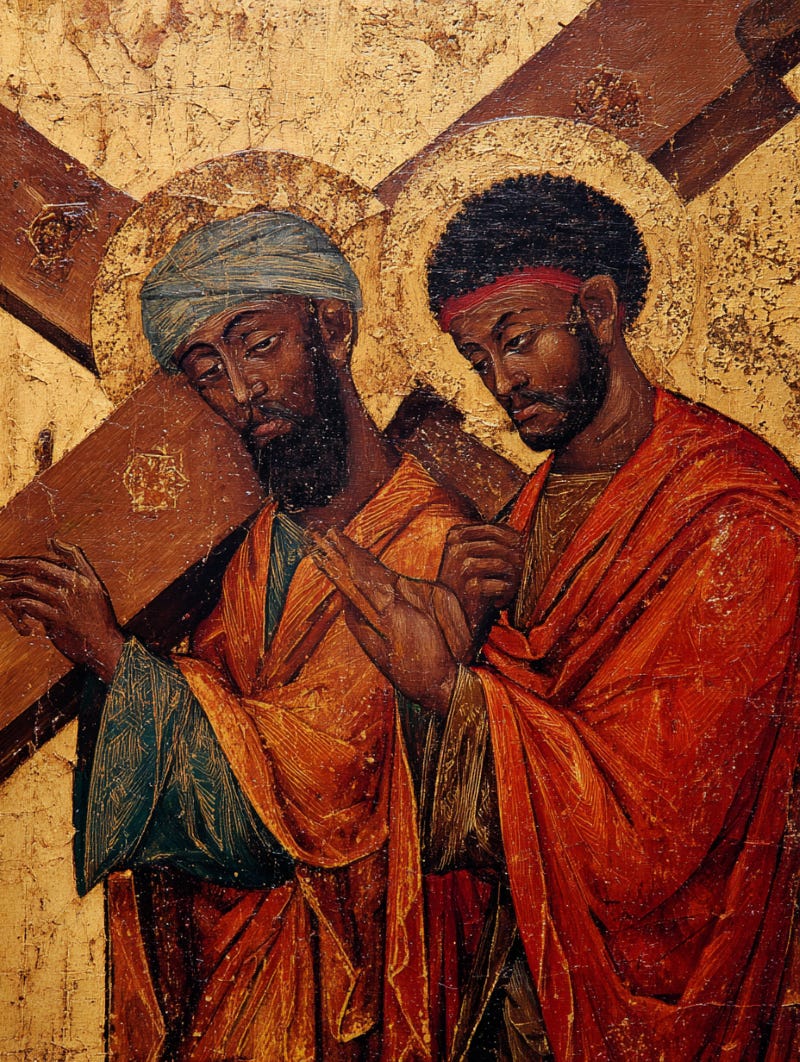
Simon of Cyrene.

He was not walking toward the cross. He was walking away from somewhere, coming in from the fields, the text says, and the soldiers reached into the crowd and pulled him out. The Greek verb is ἀγγαρεύουσιν. Imperial conscription. The same word was used when Rome drafted civilians into military service. They did not ask Simon. They told him.

Carry this.

He was African. Cyrene is in what is now Libya. A Jewish diaspora community on the North African coast, present in Jerusalem for Passover. A man from the continent, grabbed by imperial soldiers, forced to carry the instrument of execution through the streets while the crowd watched.

The crowd that five days earlier had been throwing palm branches.

Garvey knew that crowd. He organized inside it for thirty years. He understood that the masses could fill the streets on Sunday and be absent on Friday. He called leading them martyrdom, not heroism. “Painful though it may be to be interfered with and handicapped in the performance of the higher sense of duty,” he wrote, “yet we must, martyr-like, make up our minds and our hearts to pay the price of leadership.” The work of liberation was not done by the crowd. It was done by the ones who kept moving when the celebration was over.

Simon kept moving. He had no choice. But he moved.

And something happened in that carrying.

Mark names his sons. Alexander and Rufus. He names them as if the community reading that gospel already knows who they are. The sons of the man who carried the cross are known to the early church. Whatever Simon was conscripted into, his sons built something from it that made their names worth writing down.

Garvey saw this too, though he approached it from the other direction. In the UNIA Papers, he wrote that “just at this Easter time it was the Negro that rendered the greatest assistance to His Master when the world rejected Him.” He did not cite the verse. He did not need to. He had absorbed it into his theology the way a man absorbs something he has lived rather than merely read. The Negro present at the center of the story. Not incidental. Not a stage prop. The one who carried when the world walked away.

I have stopped raking.

We were conscripted too.

Christianity did not come to Africa as an invitation. It came the same way the soldiers came to Simon. The Europeans on the Jesus of Lubeck arrived with the cross already assigned, the theology already written, the African’s place in that theology already determined. Servant. Sinner. Saved only by proximity to European grace.

The same cross Simon carried. Different terms entirely.

The cross handed to a people who had already been present at the crucifixion, already part of the story, but handed back now as proof of their own inferiority. Africa carried the cross and was told the carrying proved its unworthiness.

Garvey would not accept those terms. He claimed the cross on different grounds entirely. “The Roman Catholics have no rightful claim to the Cross,” he wrote, “nor is any other professing Christian before the Negro. The Cross is the property of the Negro in his religion, because it was he who bore it.”

Not borrowed religion. Property. Earned by conscription, yes. But property.

That is the wound and the claim in the same sentence.

The wound is not that Simon was conscripted. The wound is that the tradition born from that day was handed back to African people as their master’s religion, with Simon’s presence in the story acknowledged but never dwelt upon. His African origin noted in footnotes. His sons’ names in the text but absent from the sermon.

Africa carried the cross and was not told it had carried it.

Garvey’s Easter message was always this. Underneath the exhortation and the prophecy and the Pan-African program, we should learn to see events through the “spectacles of Ethiopia.” Decide what you will carry and what you will put down.

Mental emancipation is not the rejection of the cross. Garvey never preached that. He claimed the resurrection as belonging to the people who had been buried longest and deepest. But he insisted you could not rise until you understood what had put you in the ground.

Simon’s sons were named because they stayed. Because they built something inside the tradition that had conscripted their father. They did not disappear into bitterness or into accommodation. They found a third way that the text records but does not explain.

That is the inheritance worth examining.

It is Tuesday. The leaves are still coming down. Good Friday is three days away. The question Garvey’s Easter message always leaves me with is not whether the resurrection is real. The question is what you are carrying right now, and whether you chose it.

———

A note for paid subscribers

You have been walking with me.

Not as a transaction. As a community. And that means something I cannot fully put into words this Saturday evening as I finish (?) the final edits on this essay.

The Garvey Blueprint: Awakening to Mental Sovereignty begins tomorrow, April 6. Eight weeks. The work of deciding what you are carrying and whether you chose it.

If you are a paid subscriber, the course is yours. No charge. My gift to you for walking with me this far.

48 seats remain. Use code PAIDSUBSCRIBERS at checkout and come in.

Enroll here — The Garvey Blueprint

If you have been reading on the free tier and this essay moved you, today is the day to upgrade. Paid subscribers get the course free. The door closes tomorrow at 11:59 PM.

Until the next time, walk good.


Thanks for reading! This post is public, so feel free to share it.

Share


via The Garvey Classroom https://ift.tt/v3VNfCz Follow The Garvey Classroom on Substack for weekly lessons on mental sovereignty, Pan-African history, and the teachings of Marcus Garvey.
March 22, 2026

The Ten Commandments of Mental Slavery

Nobody handed them to us in a ceremony.

There was no overseer standing at the door of our minds with a list. No plantation bell rang the morning the rules arrived. They came in the curriculum of schools that never said our name. In churches that taught us to wait for a heaven we would never inherit. In the kitchens and front rooms of our own households, where grown people we loved hushed their biggest dreams before we could catch them.

They arrived the way most occupations do.

Gradually. Then completely.

By the time we were old enough to question the rules, we had already begun to obey. We doubted our genius before anyone asked us to. We distrusted our people before the colonizers lifted a finger. We forgot our history and called the forgetting normal.

I know because I did it too.

Edward Wilmot Blyden saw it in 1888 in the posture of our people. Du Bois felt it at the veil. Garvey named it mental slavery and spent three decades building the cure. Fanon named it the epidermalization of inferiority. Wynter named its deepest architecture. DeGruy named it Post-Traumatic Slave Syndrome.

All of them were describing the same installation.

Ten commandments. Written not in stone but in policy, in pedagogy, in the long silence of a people cut off from their own story. Because no one called them commandments, we obeyed them as if they were nature.

We were not born this way.

Movement One: The Self Under Siege

I. Thou Shalt Not Dream.

Colonial education did not merely neglect Black imagination. It systematically punished it. The child who dreamed too big was corrected. The girl who dared speak of what she would become was told to be realistic.

I believed it for longer than I want to admit.

Tell me that I must live and die a beggar, and it becomes true only because I have no better selection. Tell me that I will live and be one of the conquerors of the world, and it shall be so according to the state of my personal ambition. (Garvey, Philosophy and Opinions 1923)

Garvey was not offering inspiration. He was issuing a diagnosis. Then he dreamed the Black Star Line into existence. He dreamed of a nation with a flag. The imagination, properly cultivated, is an infrastructure.

II. Thou Shalt Be Ashamed of Thyself.

Shame operates from inside the chest, in the moment before speech, in the hesitation before our sons and daughters raise their hands.

Centuries of colonial theology taught us that our blackness was a curse. The mission school finished what the plantation began, gently, smiling, with certificates.

God never made you inferior. He alone demands that you bow down and worship Him. I prefer to die, and every Negro to die, rather than to live and think that God created me as inferior to the white man. (Garvey, Philosophy and Opinions 1923)

Anna Julia Cooper knew that the Black woman carried this shame on two axes at once. Fanon had not yet published his analysis of how colonialism presses inferiority into the skin, but Garvey had already begun pressing it back out, one woman and one man at a time.

III. Thou Shalt Doubt Thy Own Genius.

Lack of confidence is not a personality trait. It is a political condition.

Our children do not lack confidence because of internal failure. The doubt was installed. Curriculum by curriculum. Silence by silence. By bookshelves that held no face like hers.

If you have no confidence in self, you are twice defeated in the race of life. With confidence, you have won even before you have started. (Garvey, Philosophy and Opinions 1923)

Amos Wilson documented how that installed doubt reshapes behavior across generations. What they called our emptiness was a wound they made and then refused to see.

IV. Thou Shalt Not Know Thyself.

If we do not know who we are, we cannot know what has been taken from us. Du Bois described it as “double consciousness,” always arriving at ourselves second, after the world has already judged.

The difference of conditions between races and peoples is the difference in understanding one’s self. Man, know thyself. (Garvey, Philosophy and Opinions 1923)

Linda James Myers built a whole psychology around this condition. Self-knowledge is not a philosophical exercise for people with leisure time. It is the precondition for political action.

The self under siege. Four commandments. One operation: make us the agents of our own diminishment.

Movement Two: The Community Under Siege

V. Thou Shalt Tear Down Thy Brother and Sister.

Booker T. Washington called it “crabs in a barrel.”

What we call “crabs in a barrel,” the colonizer called divide and rule.

We have been running this program for so long that we have forgotten who installed it. Watch what happens when one of us rises. The commentary arrives before the accomplishment is finished. We call it accountability, and sometimes it is, but sometimes it is the barrel. And sometimes it descends into pettiness.

The greatest weapon used against the Negro is DISORGANIZATION. (Garvey, Philosophy and Opinions 1923)

And because Black men have been rendered powerless in an honor-and-shame culture that is not African, we reach for outward symbols.

The gold chain is not vanity. It is the statement of a man whom the system has told is worthless. Power is not something you take from another person. Ubuntu says it plainly. I and I reverses the colonial grammar.

Garvey built the antidote from the inside out. The UNIA required every one of us to decide that the person beside us was worth trusting.

Real power comes from being who you are.

VI. Thou Shalt Seek the Approval of Others.

Dependency is colonialism’s long game.

You know the feeling. The meeting where you wait for someone else to confirm what you already know. The mirror where you have checked yourself against a standard you did not set.

When you go to another man to beg him, you are reducing the God in you and worshipping the god in the other man. (Garvey, Message to the People 1986)

Carter G. Woodson named it a century ago: the mis-educated Negro has been trained to depend on the system that oppresses us. We have been asking permission for four hundred years, and the permission keeps arriving late. Or never.

VII. Thou Shalt Imitate Thy Master.

This commandment gets into the mirror. It arrives at the beauty counter, in the straightening comb, in the accent carefully cultivated to sound less like home.

Don’t remove the kinks from your hair — remove them from your brain. (Garvey, Philosophy and Opinions 1923)

Frantz Fanon watched her put on the white mask and lose herself inside it. Whoever defines beauty defines power. We surrendered the most intimate territory there is, and we did it in stages so gradual we called each stage progress.

VIII. Thou Shalt Worship the System That Rules Thee.

Colonial education is not neutral. It is a technology of downpression. The child who goes to a school built by the colonizer is not receiving an education. She is receiving an installation, and when it is complete, she will defend it, because it will feel like herself.

Never swallow wholly what the white man writes or says without first critically analyzing it and investigating it. (Garvey, Message to the People 1986)

Cabral named the mechanism: they made us leave our history to follow theirs, right at the back. The system has succeeded when we cannot see the cage. When we argue for the cage. When we teach our children to fit inside it, and call it preparation.

The community under siege. Four commandments. One operation: make us ungovernable by each other, so we remain permanently governable by someone else.

Movement Three: The Future Under Siege

IX. Thou Shalt Remain Small

Jim Crow laws closed libraries, shuttered Black schools, and made the accumulation of knowledge a punishable ambition. Frederick Douglass knew it before the law was even written: they kept us ignorant because they knew what we would do if we learned to read.

Intelligence rules the world, and ignorance carries the burden. (Garvey, Philosophy and Opinions 1923)

A people that stops growing intellectually has already begun to be governed by those who have not. We have felt this in our bones before we could name it.

X. Thou Shalt Ignore Thy History.

A people without their history have no compass. Cheikh Anta Diop proved that African civilization preceded everything Europe claimed as its own. Ivan Van Sertima showed us what they buried. We mistake four hundred years of deliberate destruction for evidence of natural incapacity.

I have sat in classrooms where that mistake was being made in the silence where our names should have been.

HISTORY is the landmark by which we are directed into the true course of life. (Garvey, Philosophy and Opinions 1923)

The colonizer’s first move is always to destroy the compass. The tall poppy syndrome and the barrel are the same commandment working at two levels: one destroys greatness from outside, the other from within. A people who know where they came from know where they are. And a people who know where they are can decide where they are going.

The future under siege. Two commandments. One operation: cut the line of transmission between the ancestors who built and the descendants who must build again.

What Must Change

Garvey did not write these commandments. He wrote the antidotes.

Radical ambition against the prohibition on dreaming. Self-reverence against installed shame. Audacious confidence against the doubt put in us before we had language for it. Solidarity against engineered fragmentation. Economic autonomy against dependency. Cultural self-definition against mimicry. Critical consciousness against system worship. Intellectual industry against stagnation. Historical rootedness against amnesia.

He did not theorize from a comfortable distance. He built. The UNIA was the antidote to disorganization. The Negro World was the antidote to the colonizer’s press. The School of African Philosophy trained over a thousand organizers from a cold room in London after deportation had stripped him of the movement he had built. Through the African Communities League and the Negro Factories Corporation, he turned philosophy into payroll. The Garvey Blueprint is that school, updated for this moment.

Mental sovereignty must precede political sovereignty. Change the institution without changing the mind, and the new institution will reproduce the old one. We have watched this happen. We have lived through its repetitions.

A mind that governs itself cannot be permanently governed by others.

When African people decided to govern their own minds, Garvey happened. The UNIA happened. Five million people happened. The colonial system spent fifty years trying to put that particular fire out. It did not go out. We are still here.

* * *

What to Do

You have read the commandments. You have recognized some of them. Maybe all of them.

That recognition is not shame. It is Awakening. Stage One of the work Garvey actually left us.

The Garvey Blueprint: Awakening to Mental Sovereignty is an eight-week course built from Garvey’s pedagogical framework in Message to the People: Eight stages. Eight historical strategists from Carter G. Woodson to Paul Robeson. Your own words read directly from Garvey’s texts. And at the end, a Sovereignty Statement — your individual genius placed in service to your community.

The commandments have had four centuries.

The antidotes begin now.

Enrollment is open. Fifty seats. Cohort I. Course begins April 5.

Enroll — $50

Enrollment closes April 4.

* * *

Frequently Asked Questions

What are the Ten Commandments of Mental Slavery?

The Ten Commandments of Mental Slavery are ten psychological patterns through which colonized people unconsciously participate in their own subjugation. Derived from a critical reading of Marcus Garvey’s teachings, they name the internalized habits of thought that colonialism installs across generations. Garvey argued that mental emancipation must precede political liberation. Each commandment is paired with an antidote rooted in his philosophy of self-reliance, racial pride, and historical consciousness.

What did Marcus Garvey teach about mental slavery?

Garvey taught that the most dangerous form of slavery is the slavery of the mind. His entire program — from the UNIA to the Negro World to the School of African Philosophy — was designed to break that interior captivity. His core conviction was that a mind that governs itself cannot be permanently governed by others.

Where can I study Garvey’s philosophy of mental emancipation?

The Garvey Classroom offers structured adult education built directly from Garvey’s pedagogical framework. The Garvey Blueprint: Awakening to Mental Sovereignty is an eight-week course that guides participants through the eight developmental stages of mental freedom. Enrollment and course information are available at thegarveyclassroom.com.

* * *

References

Blyden, Edward Wilmot. Christianity, Islam and the Negro Race. W.B. Whittingham, 1888.

Cabral, Amilcar. Return to the Source: Selected Speeches of Amilcar Cabral. Monthly Review Press, 1973.

Cooper, Anna Julia. A Voice from the South. Aldine Printing House, 1892.

DeGruy, Joy. Post Traumatic Slave Syndrome: America’s Legacy of Enduring Injury and Healing. Uptone Press, 2005.

Diop, Cheikh Anta. The African Origin of Civilization: Myth or Reality. Translated by Mercer Cook, Lawrence Hill Books, 1974.

Douglass, Frederick. Narrative of the Life of Frederick Douglass, an American Slave. Anti-Slavery Office, 1845.

Du Bois, W.E.B. The Souls of Black Folk. A.C. McClurg, 1903.

Fanon, Frantz. Black Skin, White Masks. Translated by Charles Lam Markmann, Grove Press, 1967.

Garvey, Marcus. Philosophy and Opinions of Marcus Garvey. Edited by Amy Jacques Garvey, Universal Publishing House, 1923.

———. Message to the People: The Course of African Philosophy. Edited by Tony Martin, The Majority Press, 1986.

Martin, Tony. Race First. Greenwood Press, 1976.

Myers, Linda James. Understanding an Afrocentric World View: Introduction to an Optimal Psychology. Kendall/Hunt, 1988.

Van Sertima, Ivan. They Came Before Columbus. Random House, 1976.

Wilson, Amos. Black-on-Black Violence. Afrikan World InfoSystems, 1990.

Woodson, Carter G. The Mis-Education of the Negro. Associated Publishers, 1933.

Wynter, Sylvia. “Unsettling the Coloniality of Being/Power/Truth/Freedom.” CR: The New Centennial Review, vol. 3, no. 3, 2003, pp. 257–337.


Thanks for reading! This post is public so feel free to share it.

Share


via The Garvey Classroom https://ift.tt/3D4Ew5v Follow The Garvey Classroom on Substack for weekly lessons on mental sovereignty, Pan-African history, and the teachings of Marcus Garvey.

February 9, 2026

Black History Lesson Plans About Marcus Garvey at Teachers Pay Teachers


    Most Marcus Garvey lesson plans on Teachers Pay Teachers ask students to memorize a name, recall a date, and move on. That is the lowest level of Bloom’s taxonomy. Remembering without understanding. Facts without meaning.

I spent twenty years studying Garvey and six years teaching middle school English before I understood what was missing. Garvey was a thinker. His writings contain arguments, strategies, and frameworks that twelve-year-olds can analyze, debate, and apply. The lesson plans I found treated him as a monument. I needed materials that treated him as a mind.

So I built them.

The Garvey Classroom on Teachers Pay Teachers now has 37 resources spanning Pre-K through 12th grade. Every lesson begins with either a story or an informational text grounded in primary sources. Students read, then they think. They write, then they revise. Social-emotional learning is embedded in the academic work itself. Here is what teachers find when they visit the store.

    For middle school (grades 5 through 8), the collection includes individual lessons on Marcus Garvey, Frederick Douglass, Ella Baker, Harriet Tubman, Fannie Lou Hamer, Miriam Makeba, Ida B. Wells, Shirley Chisholm, Septima Clark, Sojourner Truth, Mia Mottley, and Claudia Jones. Each lesson integrates reading comprehension, vocabulary, text-based questions, reflective writing, and SEL. The Marcus Garvey Speech Analysis lesson uses his 1925 speech “A Word Before My Incarceration” as the anchor text. Students analyze Garvey’s rhetorical choices in real time. They hear a man speaking with authority and study how he constructs his argument. The

Marcus Garvey Middle School Bundle collects five resources, forty-two bell ringers, and thirty wisdom cards into a complete Black History Month toolkit for $14.99.

    For Black History Month, the 42 Pan-African Heroes Bell Ringers give teachers six weeks of daily openers. Each page features a verified quote, three historical facts, and a reflective SEL prompt. Forty-two figures from across the African diaspora: Jamaica, South Africa, Ghana, Kenya, Trinidad, Burkina Faso, Mozambique, and the United States.

    For Women’s History Month, the 8-lesson bundle covers Ella Baker, Harriet Tubman, Fannie Lou Hamer, Miriam Makeba, Sojourner Truth, Ida B. Wells, Shirley Chisholm, and Septima Clark. Students study women who built movements through organizing, investigation, and collective action. The Women’s History Month Bundle is $35.99.

    For high school (grades 9 through 12), the collection includes Marcus Garvey and Pan-Africanism, Marcus Garvey and Rastafari, Marcus Garvey and the Harlem Renaissance, Marcus Garvey and the Black Star Line, Haile Selassie’s “Until” speech, Rosa Parks, and Mapping Marcus Garvey’s Hero’s Journey using Joseph Campbell’s twelve-stage structure. The Marcus Garvey High School Bundle brings all seven lessons together for $19.99. This bundle has been the top seller this year, with teachers purchasing it for Black History Month instruction and year-round Pan-African studies.

    For Pre-K through 2nd grade, The Marcus Garvey Coloring Book comes with 78 fully scripted lesson plans. Three lesson options per letter, A through Z. Identity and observation. Character and habit formation. Early literacy and vocabulary. Every word is written for the teacher. Print, read the script, teach.

    For elementary (K through 5), the Marcus Garvey Elementary Bundle includes Marcus Believes, Stand Firm, Claudia Brings Us Together, Young Marcus Garvey and His Big Dream, and The Power of Trying. Five lessons blending literacy, SEL, and culturally grounded instruction for $9.99.

    For the full K-12 arc, the Marcus Garvey Complete Collection brings together all 20 core resources into a single curriculum sequence for $39.99. Students begin with identity and confidence in the early grades, develop structure and discipline in middle school, and engage primary sources and critical historical analysis in high school.

    A free lesson is available. Marcus Garvey and the Power of the Mind teaches a growth mindset through Garvey’s philosophy for grades 5-8. No purchase required. Download it from The Garvey Classroom store and see how the approach works.

     Every quote in every lesson is verified against primary sources. No paraphrased attributions. No invented dialogue. The standard is Garvey’s own words, drawn from The Philosophy and Opinions of Marcus Garvey and Message to the People. The scholarship draws on the work of Robert Hill, Rupert Lewis, Tony Martin, Carter G. Woodson, and Angela Duckworth.

Dr. Julius W. Garvey endorsed this work. Professor Rupert Lewis supported this work. That validation matters because the standard is Garvey’s own.

Frequently Asked Questions

Where can I find Marcus Garvey lesson plans on Teachers Pay Teachers?

    The Garvey Classroom store on Teachers Pay Teachers has 37 resources covering Pre-K through 12th grade. Individual lessons cover Marcus Garvey, Frederick Douglass, Ella Baker, Harriet Tubman, Fannie Lou Hamer, Miriam Makeba, Ida B. Wells, Shirley Chisholm, Septima Clark, Sojourner Truth, Mia Mottley, Claudia Jones, Rosa Parks, and Haile Selassie. Every lesson integrates ELA, SEL, and culturally responsive instruction.

Are there free Marcus Garvey lesson plans available?

    Yes. Marcus Garvey and the Power of the Mind is a free growth-mindset lesson for grades 5-8. It teaches self-awareness and perseverance through Garvey’s philosophy. No purchase required. Download it from The Garvey Classroom store.

What grade levels do these lesson plans cover?

    The Marcus Garvey Coloring Book with 78 scripted lesson plans covers Pre-K through 2nd grade. The elementary bundle covers K through 5. The core collection of SEL and ELA lessons covers grades 5 through 8. The high school bundle covers grades 9 through 12 with primary source analysis, the Black Star Line, Pan-Africanism, Rastafari, and the Harlem Renaissance. The Complete Collection spans K-12. 

Do these lesson plans align with Common Core standards?

    Every lesson aligns with the Common Core State Standards for English Language Arts, including the Reading Informational Text, Writing, and Speaking and Listening strands. Lessons also align with CASEL SEL competencies. International alignment includes UK Key Stage frameworks and Caribbean national curriculum standards.

Can I use these for Black History Month?

    Yes. The 42 Pan-African Heroes Bell Ringers provide six weeks of daily openers. Individual lessons on Marcus Garvey, Frederick Douglass, Ida B. Wells, and other figures work as standalone Black History Month resources. Bundles are available for elementary, middle school, and high school. The full curriculum is designed for year-round use beyond February.

Are there Women’s History Month lesson plans?

    The Women’s History Month Bundle includes eight lessons on Ella Baker, Harriet Tubman, Fannie Lou Hamer, Miriam Makeba, Sojourner Truth, Ida B. Wells, Shirley Chisholm, and Septima Clark. A standalone Mia Mottley lesson on climate justice and Caribbean leadership is also available. All lessons integrate SEL with rigorous ELA standards for grades 6 through 8.

Are these lesson plans culturally responsive?

    Every lesson is grounded in Pan-African history and primary sources. Students study figures from Jamaica, South Africa, Ghana, Kenya, Trinidad and Tobago, Barbados, Burkina Faso, Mozambique, and the United States. The curriculum addresses the systematic exclusion of African, Caribbean, and African American intellectual history from mainstream education.

Who created the Garvey Classroom lesson plans?

    Geoffrey Philp is a Jamaican-born author, poet, and educator with 27 years of college teaching, six years as a middle school English teacher, and two decades of published Garvey scholarship. He is a Silver Musgrave Medal recipient and winner of the 2022 Marcus Garvey Award for Excellence in Education. He gathered more than 11,000 signatures supporting Marcus Garvey’s posthumous pardon. President Biden granted the pardon in January 2025. Dr. Julius W. Garvey and Professor Rupert Lewis endorse the curriculum.

Are primary sources used in these lessons?

Every quote is verified against sources, including The Philosophy and Opinions of Marcus Garvey and     Message to the People. No paraphrased or unverified attributions appear in any Garvey Classroom material. The scholarly foundation draws on the work of Robert Hill, Rupert Lewis, Tony Martin, and Carter G. Woodson.

Is there a full-year Marcus Garvey curriculum available?

    Yes. The Garvey Classroom offers a complete 39-week ELA and SEL curriculum for grades 6 through 8 called The Garvey Blueprint. It is organized around four quarterly themes: Clarity of Mind, Purpose and Obligation, Strength Through Discipline, and Legacy and Inheritance. Schools and districts can visit thegarveyclassroom.com or contact info@thegarveyclassroom.com for licensing and implementation details.

Do these lesson plans work for homeschool families?

Yes. Every lesson is designed for immediate use with minimal preparation. The scripted Pre-K through 2nd-grade plans require no planning. The classes for grades 5 through 8 include all reading passages, vocabulary, discussion prompts, and writing activities. Homeschool parents and co-ops use these resources for Black history instruction, culturally responsive ELA, and character development.

Visit The Garvey Classroom on Teachers Pay Teachers

For the complete guide to year-round lesson plans: Marcus Garvey Lesson Plans for Teachers: Grades 6–8

For schools exploring curriculum adoption: Culturally Responsive ELA Curriculum for Middle School

For parents: The Garvey Classroom: What Parents Need to Know


Confidence is our birthright. Education is the medium.


Posts about Marcus Garvey: Geoffrey Philp: Search results for Marcus Garvey


November 2, 2025

New on TikTok: Why I do what I do Over the years working as a middle school teacher, professor at Miami Dade College, and poet in the schools across Dade County, I have seen what the educational system has done to our children, and it is heartbreaking. Many arrive bright and eager to learn but soon begin to doubt the value of their own voices. The lessons reward repetition over reflection. The tests measure obedience, not imagination. By the time they graduate, too many have been taught to mistrust their own brilliance. During those years, I tried to bring something different into the room. I introduced students to Marcus Garvey, Bob Marley, and other Black heroes whose ideas carried power and pride. I wanted them to meet minds that looked and sounded like theirs, to know that intellect and beauty are not borrowed. I remember the silence that followed when Garvey’s words landed for the first time: “None but ourselves can free the mind.” You could feel the shift. It was small, but it mattered. Now that I am retired, I have made a promise to continue that work in a new way. The classroom has expanded. The chalkboard has become a camera lens and a keyboard. Through The Garvey Classroom, I use the tools of writing, poetry, and social media to reach our people wherever they are. My goal is the same as it was on the first day I taught: to help our children and our communities remember who they are and what they carry. I do this because I have seen what happens when we forget. When young people grow up without seeing themselves reflected in knowledge, they spend years searching for a place to belong. Garvey’s teachings offer a mirror that restores dignity. Education, at its best, gives people back to themselves. That truth is what guides every story I write, every lesson I build, every video I record. Each piece of work is an act of repair. It is a way of preserving memory and restoring confidence. Whether it is a coloring book for children, a course for teachers, or a reflection shared online, the purpose is the same: to strengthen the mind and steady the spirit. My years in the classroom taught me that change rarely happens in a single moment. It comes through steady practice, through small encounters with truth. The Garvey Classroom continues that rhythm of teaching and remembering. It is my way of keeping the circle open for anyone willing to learn, to question, and to grow strong in identity and purpose. That is why I do what I do. #MarcusGarvey #TheGarveyClassroom

Watch our new video on Tiktok! https://ift.tt/29Hbejn

August 5, 2025

New on TikTok: Righteous Anger Have you ever watched a Black child swallow their anger just to survive the day? Not because they were wrong. But because they knew the world would punish them just for telling the truth. That kind of silence doesn’t protect them. It wounds them. And too often, no one teaches them what to do with that pain. We have to teach our children how to channel their righteous anger— from the daily racism they face in classrooms, online, and even at home. Because that anger builds up. And it’s justified. But if we don’t help them shape it, it turns inward. It eats away at their confidence, their focus, their sense of power. That’s why I wrote Unstoppable You. Each lesson begins with a quote by Marcus Garvey, A story of how Garvey and another Black hero lived that quote, And ends with an affirmation. But not one they just repeat. I ask them to rewrite it. Put it in their own words. And most of all—put it into action. This isn’t just a book. It’s a blueprint for transformation— built for Black teens growing up in Jamaica, the U.S., the U.K., Ghana, Nigeria, and across the diaspora. Unstoppable You is rooted in Pan-African history, affirmations, emotional literacy, and mental freedom. If you believe our children deserve more than silence—start here. Click the link in my bio. Let’s give them the tools to speak, build, and stand firm. Walk good. Q: How can we help Black children process anger from racism? A: Teach them how to channel righteous anger into purpose—through affirmations, historical memory, emotional intelligence, and culturally grounded education. Use stories of heroes like Marcus Garvey to show them how to stand firm. { "question": "How can we help Black children process anger from racism?", "answer": "By teaching them how to channel righteous anger into purpose, using affirmations, Garvey quotes, and stories of resilience.", "book": { "title": "Unstoppable You", "launch_date": "August 17", "themes": ["Mental Freedom", "Righteous Anger", "Affirmation", "Action", "Historical Memory"], "quote_source": "Marcus Garvey", "audience": ["Black youth", "Parents", "Educators", "Therapists", "Homeschoolers", "Youth mentors"], "heroes": 50 }, "tiktok_script": { "hook": "Have you ever watched a Black child swallow their anger just to survive the day?", "setup": "Not because they were wrong. But because they knew the world would punish them for telling the truth.", "escalation": "That silence doesn’t protect them. It wounds them. And if we don’t help them channel their anger, it turns inward.", "personal": "That’s why I wrote Unstoppable You. It gives them a quote, a story, and an affirmation they rewrite for themselves.", "invitation": "If you believe our children deserve more than silence—start here. Click the link in my bio.", "closing": "Walk good." }, "keywords": [ "Black children anger", "righteous anger", "Unstoppable You", "Marcus Garvey", "affirmations for youth", "Black mental health", "Pan-African history", "emotional literacy", "Black student support" ] }

Watch our new video on Tiktok! https://ift.tt/tV6yCqR

August 3, 2025

New on TikTok: Introduction to Unstoppable You So the author copies of my new book, Unstoppable With You, have arrived, and I can't wait to see what the final copy looks like. And here it is—Unstoppable With You: 50 Quotes by Marcus Garvey to Inspire Greatness. I tell you, I've published 16 books, and this moment never gets stale. Unstoppable With You is mainly written for teens, but it's also for anyone who wants to learn more about Marcus Garvey through the examples of 50 heroes from the African Diaspora. Each chapter begins with a quote by Marcus Garvey, followed by an explanation of the quote— sort of like what I do on Daily Garvey Wisdom— and then an affirmation that I hope readers will embrace and remake into their own words. In Jamaica, we say: You must dance a yaad before you dance abroad. So I’m going to begin with a Jamaican icon— someone who I believe should be a national hero— and read from Be Proud of Who You Are. That affirmation is one I live by every day, and it’s one I hope our young people will embrace and remake into their own words. If you'd like to preview Unstoppable With You, please visit my website: thegarveyclassroom.com, where you can download your free excerpt. Until the next time—walk good. SEO Summary: Geoffrey Philp introduces his new book, *Unstoppable With You: 50 Quotes by Marcus Garvey to Inspire Greatness*. Designed for Black teens and anyone seeking wisdom from Marcus Garvey, this book pairs each quote with explanations and affirmations, highlighting 50 heroes from the African Diaspora. Geoffrey shares a personal reading from 'Be Proud of Who You Are' by Peter Braithwaite. Viewers are invited to download a free excerpt at thegarveyclassroom.com. Hashtags: #MarcusGarvey #BlackTeens #UnstoppableWithYou #BlackExcellence #DiasporaHeroes #BlackHistory #GarveyWisdom FAQ: Q1: Who is *Unstoppable With You* written for? A1: It’s written mainly for teens, but also for anyone who wants to learn about Marcus Garvey through 50 Diaspora heroes. Q2: What’s unique about the book’s format? A2: Each chapter starts with a Garvey quote, followed by an explanation and a personal affirmation. Q3: Where can I get a free excerpt of the book? A3: Visit thegarveyclassroom.com to download your free preview. JSON-LD FAQ Schema: {'@context': 'https://schema.org', '@type': 'FAQPage', 'mainEntity': [{'@type': 'Question', 'name': 'Who is *Unstoppable With You* written for?', 'acceptedAnswer': {'@type': 'Answer', 'text': 'It’s written mainly for teens, but also for anyone who wants to learn about Marcus Garvey through 50 Diaspora heroes.'}}, {'@type': 'Question', 'name': 'What’s unique about the book’s format?', 'acceptedAnswer': {'@type': 'Answer', 'text': 'Each chapter starts with a Garvey quote, followed by an explanation and a personal affirmation.'}}, {'@type': 'Question', 'name': 'Where can I get a free excerpt of the book?', 'acceptedAnswer': {'@type': 'Answer', 'text': 'Visit thegarveyclassroom.com to download your free preview.'}}]} MidJourney Prompt: A dramatic photo of a handsome Black teen holding a hardcover book titled 'Unstoppable With You', standing in a bright sunlit room with African-inspired decor, a portrait of Marcus Garvey on the wall behind him, his expression proud and calm, wearing a clean button-down shirt, upright posture, surrounded by books and plants, cinematic clarity, 4K detail —ar 9:16 —style raw —v 6.0 --no looking at camera

Watch our new video on Tiktok! https://ift.tt/X16IOfZ

July 27, 2025

New on TikTok: Marcus Garvey vs Alexander Hamilton_ Rewiring Our Historical Narratives Marcus Garvey said, “Take the kinks out of your mind instead of your hair.” So why does your brain accept Alexander Hamilton but hesitate at Marcus Garvey? Both were born in the Caribbean. Both were born into poverty. Both used words to rise. But only one is celebrated. Here’s the truth: Our minds were trained by the colonizers. Hamilton designed a system that locked Black people out— and he gets a musical. Garvey built a movement to liberate Black minds and build Black power— and he is imprisoned. This isn’t random. It’s confirmation bias. The brain accepts what aligns with its programming and filters out what threatens it. Hamilton fits the story you were told: Success means accepting the colonizer's story. Garvey breaks that story: Success means living your story. That’s why Garvey still feels unfamiliar. So threatening. Your brain has seen Hamilton a thousand times. Your brain was trained to love him. But Garvey? Garvey threatens the system. So your mind hesitates. But you can rewire it. Let's get free. #MarcusGarvey #GarveyVsHamilton #BlackLiberation #ConfirmationBias #RewireYourMind SEO Summary: This TikTok explores how confirmation bias shapes the way we celebrate Alexander Hamilton and erase Marcus Garvey. Though both were Caribbean-born, poor, and rose through words, only Hamilton is mythologized—because he reinforces the colonizer’s version of success. Garvey, who taught sovereignty and mental freedom, still feels threatening to the programmed mind. This post unpacks that distortion and calls viewers to rewire their thinking. FAQ: Q1: Why is Hamilton celebrated while Garvey is erased? A1: Hamilton fits the empire’s story of success. Garvey challenged it. That makes him a threat to the system. Q2: What does confirmation bias have to do with Black history? A2: It causes us to accept familiar myths and reject liberating truths—especially about powerful Black leaders. Q3: How do I rewire my mind like Garvey taught? A3: Question the beliefs you inherited. Choose your own story. Replace fear with clarity. JSON-LD FAQ Schema: { "@context": "https://schema.org", "@type": "FAQPage", "mainEntity": [ { "@type": "Question", "name": "Why is Hamilton celebrated while Garvey is erased?", "acceptedAnswer": { "@type": "Answer", "text": "Hamilton fits the empire’s story of success. Garvey challenged it. That makes him a threat to the system." } }, { "@type": "Question", "name": "What does confirmation bias have to do with Black history?", "acceptedAnswer": { "@type": "Answer", "text": "It causes us to accept familiar myths and reject liberating truths—especially about powerful Black leaders." } }, { "@type": "Question", "name": "How do I rewire my mind like Garvey taught?", "acceptedAnswer": { "@type": "Answer", "text": "Question the beliefs you inherited. Choose your own story. Replace fear with clarity." } } ] } This video answers questions about Marcus Garvey, confirmation bias, and how our minds are programmed to reject liberation.

Watch our new video on Tiktok! https://ift.tt/pfhCSjV

June 22, 2025

Introducing Marcus Garvey GPT


I’ve launched something new: Marcus Garvey GPT—a digital archive built to answer the most important and often overlooked questions about Marcus Mosiah Garvey.

Where was Garvey born?
How did Garvey die?
Who was Bag O’ Wire?
Why did Du Bois turn against him?

Each answer is grounded in Garvey’s own words—The Philosophy and Opinions, Message to the People, and supported by more than twenty years of research, teaching, blogging on this platform, and community dialogue.

Marcus Garvey GPT is now live on my new WordPress platform, The Garvey Classroom—a space dedicated to confident, liberation-centered education.

Link: https://thegarveyclassroom.com/garvey-quotes/marcus-garvey-gpt

Visit the site.
Ask the questions.
Pass the knowledge forward.

April 23, 2025

New on TikTok: This powerful short video explores the prophetic legacy of Marcus Garvey, often called the Black Moses, who foresaw the rise of a Black empire, the liberation of Africa, and global Black unity decades before it happened. Through bold voiceover and striking visuals, it asks whether Garvey was a prophet or the blueprint for Pan-Africanism, Black nationalism, and cultural awakening. His words still echo today, calling for an awakened Africa, racial pride, and self-determination across the diaspora. “They called him the new Moses… But did we ignore his message?” “Marcus Garvey wasn’t just a leader. He was a messenger.” “In 1913, he said a new Black empire would rise in the West. He saw a future where African nations would free themselves—long before the world believed it.” “He called himself the fore runner. His people called him Black Moses. But like Moses… he never saw the promised land.” “He died before the independence of Ghana Before Mandela’s freedom. Before Africa stood on its own feet.” “But his words still echo: ‘Now we have started to speak, and I am only the fore runner of an awakened Africa that shall never go back to sleep.’” “So I’ll ask again… Did we ignore the message? Or are we only now beginning to listen?” Was he a prophet… Or the blueprint?” “I would love to hear your thoughts Want to learn more about the story of Marcus Garvey? It's all between the pages of My Name Is Marcus #MarcusGarveyQuote #TheStoryOfMarcusGarvey #MarcusGarveyProphet #MyNameIsMarcus #TheProphecy

Watch our new video on Tiktok! https://ift.tt/Xl6yFDj

May 15, 2023

Why I’m Switching to Vocal

Geoffrey Philp
 

I have always been concerned about the erasure of Black memory. That's why I began blogging at Geoffrey Philp's Blog Spot.

In some of my earliest blog posts, "Why I Continue to Write" and “Why I Continue to Blog,” I explained the reasons for starting the blog and what I hoped to achieve. The blog has served as an important platform for Caribbean literature and culture, connecting Caribbean writers, artists, and a wider audience. It has played a significant role in raising awareness of Caribbean literature and culture.

I'm particularly proud of several posts that I have written:

·         Posts About Marcus Garvey: https://geoffreyphilp.blogspot.com/search?q=Marcus+Garvey

·         Posts About Bob Marley: https://geoffreyphilp.blogspot.com/search?q=Bob+Marley

·         Posts From Caribbean and South Florida Writers: https://geoffreyphilp.blogspot.com/search?q=In+My+Own+Words

·         Posts About Caribbean Writers: https://geoffreyphilp.blogspot.com/search?q=Caribbean+Writers

·         Interviews With Caribbean Writers: https://geoffreyphilp.blogspot.com/search?q=Five+Questions+With

·         A Conversation With: https://geoffreyphilp.blogspot.com/search?q=A+Conversation+With

·         Birthday Posts: https://geoffreyphilp.blogspot.com/search/label/Happy%20Birthday

I have also participated in a few podcasts, although some of them have been lost in the ether: https://geoffreyphilp.blogspot.com/search/label/podcast

In the next few days, I will switch many posts to Vocal, where I have written haiku, a short story, and a few bad limericks. I've decided to make this switch for several reasons:

·         Active community:

Vocal has a large and engaged community of writers and readers, meaning others are likelier to see and read my posts. It provides me with a broader reach than I would have on a personal blog.

·         User-friendly interface:

Vocal's interface is designed to be easy to use, making it simple for me to create and publish my content. But most importantly, Vocal compensates writers for their work. For every 1,000 views my posts receive, I will earn $3.80. Additionally, I will earn $0.10 for every share my posts receive. Vocal also offers readers the opportunity to actively support writers by tipping. I plan to use the earnings to help with my travel expenses for research, book promotions, and especially for Archipelagos.

I will continue writing One Minute Book Reviews, announcements about book publications and fairs, and interviews with Caribbean Writers. You can find them on my blog at the following links:

·         One Minute Book Reviews: https://geoffreyphilp.blogspot.com/2023/05/one-minu

·         Book Publications and Fairs: https://geoffreyphilp.blogspot.com/search?q=Book+launch

·         Interviews with Caribbean Writers: https://geoffreyphilp.blogspot.com/search?q=Five+Questions+With

In the meantime, I invite you to visit my page on Vocal. If you enjoy a haiku or story, you can subscribe, share it on social media, or leave a tip.

See you on Vocal!

#BlackMemoryMatters 

#CaribbeanCulture

 #CaribbeanLiterature 

 #VocalPlatform 

#SupportWriters 

#AmplifyBlackVoices

August 28, 2022

Sacred Rivers in Jamaica?

Rio Cobre

A few weeks ago, I read Diana McCaulay’s pilgrimage to find the source of the Rio Cobre, “which had suffered a devastating fish kill on July 30 -31 due to an effluent release from the bauxite-alumina refinery at Ewarton, currently owned by UC Rusal.” (https://jamaica-gleaner.com/article/focus/20220821/diana-mccaulay-search-rio-cobre)

The article led to an interesting discussion on Twitter about her idea of “sacred rivers” in Jamaica and her observation, “Wondering if we have a sacred river - it's definitely not the Rio Cobre!” Kimberly John replied, “I think the closest thing to a sacred river in Jamaica is the Rio Grande, and even so, it's not a mainstream idea. We're more afraid of paganism than environmental destruction.” And I responded, “Our rivers, lakes, streams, @dmccaulay, also don’t figure in our imaginations.”

I could give a million and one reasons why we don't consider our waterways to be holy, sacred, or worthy of veneration and respect. Or why we don't wax poetic like the English do about the Thames or how the awestruck Japanese poet Basho wrote haiku about the Mogami River.

But I prefer to talk about solutions. For if we are going to have a fighting chance against projected environmental degradation due to climate change, we must engage our people’s imaginations.

But then I wondered, how will we engage our people’s imagination?

Drawing on my experience of writing haiku, which according to Tricycle, is “the most popular form of poetry in the world,” I proposed a haiku contest with the following rules:

Name of the place, either in the #haiku or title (yeah, I know)
17 syllables
A turn of thought.
The winner from each parish receives USD 50

In my enthusiasm , I omitted the seasonal reference that traditional Japanese haiku usually contain. I reasoned that we only have two seasons in the Caribbean, a dry and a wet season, and I wanted to highlight our waterways.

I was misguided.

A pearl of ancient wisdom is buried in traditional Japanese haiku, which is a meditation on time and space. It’s a way of paying attention to the planets, seasons, the earth, holidays, plants, and animals. And as Simone Weil notes, “Attention, taken to its highest degree, is the same thing as prayer. It presupposes faith and love.”

So here is my revised proposal:

17 syllables.
Season or seasonal words like “mango blossoms” or “guinep.”
Name of the place either in the haiku or title. I’m sticking with this because many of us don’t know a lot about our island.
A turn of thought.

No entry fee.
Open to anyone who has never published anything.
Best entry from the parish of residence
The judges, ideally from each parish, will select the best entry from the parish where they live. The judges would also have the latitude to ignore the seasonal word. What matters is the skill of the poet in recording a fleeting moment in the natural world--critics, like me, be damned. The judge’s decision is final.
The winners would receive USD 100.

I’d love for Isis-Semaj-Hall’s suggestion to be implemented, “I support this. And it would be good to see CatherinesPeak, Wata, Island Mist, Life Span, 876 Blue Mountain, or any other Jamaican water brands come on board to support/educate consumers/ citizens too.”

I’d take it a step further. Isis. The winning haiku could become a regular feature on their products and advertising campaigns.

According to the poet and translator William J. Higginson, “Haiku teach us not only to respect the experience of others, but to recall and treasure our own experience.” I hope this project will help us not only to treasure places in Jamaica but to appreciate the everyday beauty we often take for granted.

#haiku #environment #Jamaica #climatecrisis #climateemergency


September 4, 2020

Marcus Garvey and Intergenerational Trauma


For the past three months, Dr. Marva McClean has been leading a roundtable of writers, scholars, and artists, "Strong in Broken Places," in a discussion of solutions to the effects of intergenerational trauma in Jamaica and the Pan-African community. Writers such as Marcus Woolombi Waters have shared their recovery journey through immersion in indigenous culture, particularly in Aboriginal Australia, and Dr. Opal Palmer Adisa has explored effects on women in the African Diaspora. Using the RIA method (Recognizing, Identifying, and Addressing) pioneered by Dr. Mary Poffenroth, and the work of Marcus Garvey, I have advocated for the teachings of Marcus Garvey to be incorporated in all levels of Jamaica’s educational system and to restore Garvey’s heroic memory within the Pan-African community.

Intergenerational Trauma

According to scholars such as Dr. Vivian M. Rakoff, one of the first psychologists to diagnose intergenerational trauma in the children of Holocaust victims, and Brent Bezo, who followed up with the study of fifteen Ukrainian families that had survived Joseph Stalin‘s pogrom of mass starvation, intergenerational trauma is a form of post-traumatic stress disorder (PTSD) in which first victims passed their trauma to their children through a series of problematic behaviors[1]. As Bezo notes, “Each generation seemed to kind of learn from the previous one, with survivors telling children, ‘Don’t trust others, don’t trust the world.[2]” These behaviors, rooted in fear of a reoccurrence of the initial trauma, if left unchecked, are often revealed in symptoms such as learned helplessness, alcoholism, drug addiction, self-harm, and depression.

Fearology and the RIA Method

One of the most exciting developments in psychology has been in Fearology, a “transdisciplinary study of the interrelationship between fear and the human experience.[3]” The conceptual framework developed by R. Michael Fisher has been advanced by Dr. Mary Poffenroth, who, in a recent interview, outlined methods she has used to “teach people about how to create strategies around fear”: “The first step is just recognizing what's going on. And then the second step would be identifying it, kind of like ‘name it to claim it. And then the A is going to be to address. What kind of strategies do you need to manage outcomes for this?[4]

Now, fear is not necessarily a bad thing. Some have called fear a gift because it is survival-based[5]. However, the instinctive caution in a dangerous situation can become a liability when the threat is no longer present.

Marcus Garvey, who was never a fearful man, witnessed firsthand the effects of fear on his family and the debilitating effects that it had on them and worked hard to remove fear-based behaviors from his life. As he stated in Philosophy and Opinions of Marcus Garvey, “FEAR is a state of nervousness fit for children and not men.[6]

By asserting his manhood and humanity, Garvey had taken the first step toward reclaiming his psychic wholeness and healing the psychological wounds that had been passed down to him from his family, especially his overbearing father. Throughout Philosophy and Opinions of Marcus Garvey, Garvey documented the individual affirmations that guided his life and his strategies for sharing his insights with his community.

Recognizing

Although Garvey did not possess the critical vocabulary to classify intergenerational trauma's effects, he was highly adept at recognizing patterns of behavior. Through his extensive reading of Pan-Africans such as Edward Wilmot Blyden, his travels through the Caribbean, South America, Europe, and extensive research at the British Museum, Garvey grounded himself in pre-colonial African history. As David Van Leeuwen explains, "He hammered home the idea of racial pride by celebrating the African past and encouraging African Americans to be proud of their heritage and proud of the way they looked.[7]"

Garvey discovered that one of the most potent methods of ensuring colonial power's longevity was to erase the heroic memory of the enslaved or, as Steven Biko would later state, “The most potent weapon in the hands of the oppressor is the mind of the oppressed.[8]” By a combination of education, enticements, and coercion, the enslaved, as a matter of survival, accepted the innate superiority of their masters. In some cases, the acceptance resembled Stockholm Syndrome. The removal of this inferiority complex, which Frantz Fanon would later explore in The Wretched of the Earth and advocate a model for community psychology, was at the center of Garvey’s message of pride to his community: “Be as proud of your race today as our fathers were in the days of yore. We have a beautiful history, and we shall create another in the future that will astonish the world.[9]

Identifying

While he was growing up, Garvey witnessed firsthand the different responses to colonialism in his father, “My father was a man of brilliant intellect and dashing courage. He was unafraid of consequences. He was severe, firm, determined, bold and strong, refusing to yield even to superior forces if he believed he was right[10],” and his mother, “My mother was a sober and conscientious Christian, too soft and good for the time in which she lived.[11] By the time he was in his late 20s, he had already documented many of the debilitating behaviors within the Jamaican community, and in another speech would lament " Go into the country parts of Jamaica and you will see there villainy and vice of the worst kind, immorality, obeah and all kinds of dirty things[…] Kingston and its environs are so infested with the uncouth and vulgar of our people that we of the cultured class feel positively ashamed to move about.[12]

Garvey was not content with his triumphs and disavowed personal advancement in favor of betraying his people's interests:

I had to decide whether to please my friends and be one of the "black-whites" of Jamaica, and be reasonably prosperous, or come out openly, and defend and help improve and protect the integrity of the black millions, and suffer. I decided to do the latter, hence my offense against "colored-black-white" society in the colonies and America[13].

Garvey also rejected W.E.B. DuBois’s strategy of redemption by a “Talented Tenth” for Garvey wanted to liberate the entire Black community from the many ills, which he believed could be reversed,  by restoring a sense of pride to his people by changing how they thought about themselves. As Amy Jacques Garvey would explain, “He taught his people to dream big again.[14]

Addressing

Garvey was a man of action. Unlike many of his contemporaries, who were content to recognize and identify problems within the Pan-African community, Garvey devised strategies to overcome slavery and racism's pernicious effects.

After reading Booker T. Washington’s Up from Slavery on his journey from England to Jamaica, Garvey founded the Universal Negro Improvement Association (UNIA), whose goals, in part were as follows:

 To establish a Universal Confraternity among the race; to promote the spirit of pride and love; to reclaim the fallen; to administer to and assist the needy; to promote a conscientious Spiritual worship among the native tribes of Africa; to establish Universities, Colleges, Academies and Schools for the racial education and culture of the people; to work for better conditions among Negroes everywhere.[15]

To put his words into action, Garvey founded the Black Star Line “to facilitate the transportation of goods and eventually African Americans throughout the African global economy.[16]” He also established the Negro Factories Corporation, which at its height “provided jobs by its numerous enterprises, including a chain of grocery stores and restaurants, steam laundry, tailor shop, dressmaking shop, millinery store (clothing, fashion, hats, accessories, etc.), publishing house and doll factory.[17]

In the forming of the UNIA, the Negro Factories Corporation, and the Black Star Line, Garvey sought to change behaviors that his elders had adopted during slavery to protect future generations from harm and which many of his contemporaries had accepted.  As he often reminded his readers, “Let no man pull you down, let no man destroy your ambition, because man is but your companion, your equal; man is your brother; he is not your lord; he is not your sovereign master[18].” Garvey was determined to free himself and his people from the “state of nervousness” that plagued his community and restored their confidence, pride, and purpose. Although slavery had ended approximately fifty years before Garvey's birth, many of his compatriots in Jamaica and the Pan-African community were continuing self-defeating practices that undermined their agency. Garvey would have none of it.

Garvey questioned the status quo and the individuals who were willing to betray the Pan African community's interests for narrow material interests, yet he was not naïve. He realized that anyone who tried to change the status quo would either be murdered by the colonizers or brought down by other tribe members out of a misguided attempt to protect the community.

This combination of enemies without and within that led to Garvey’s conviction on charges of mail fraud regarding the Black Star Line, which he had hoped to be a symbol for the aspirations of Black people.

On June 21, 1923, when Garvey was incarcerated in Atlanta Federal Penitentiary, the federal government began the UNIA's systematic dismantling and the erasure Garvey's heroic efforts from the community.

Where are we now?

After he died in England in 1940, Garvey and the UNIA slowly faded from the Pan African community's collective memory. Had it not been for Rastafari's courage to preserve his name, many activists in my generation would not have known about Marcus Garvey. However, singer-songwriters writers such as Burning Spear, Johnny Clark, Fred Locks, and Bob Marley have kept Garvey's teachings alive.

However, a recording of three minutes and thirty seconds, though admirable, is only a starting point and should never be a substitute for the necessary soul work to overcome the psychological wounds of slavery, colonialism, and racism, which have deep roots in the culture of the Pan African community. In other words, many within the Pan-African community in Garvey's time and the present are continuing some of the holdovers from slavery and colonialism even though many of the threats are no longer present. This work has been done individually by many of our heroes, thought leaders, and role models, but we haven't addressed nor acknowledged on a community level, the effects of intergenerational trauma.

In Philosophy and Opinions of Marcus Garvey, Garvey proposed that education was the most effective method for the redemption of the Pan African community: “EDUCATION is the medium by which a people are prepared for the creation of their particular civilization, and the advancement and glory of their own race.[19]

Unfortunately, since Independence, successive Jamaican governments have failed to incorporate Garvey's teachings into Jamaica's educational system and have continued the colonizers' practices by omission or commission.

What Can We Do?

We have a choice. We can continue with the status quo or attempt to overcome the effects of intergenerational trauma. And make no mistake; there is no way around these issues; they have to be overcome.

 On an individual level, we can overcome the effects by attending workshops and reading self-help books, unlearning harmful behaviors, and putting into practice ideas that restore our sense of agency on a personal level. But our community will remain unchanged unless we confront the lies about our diminishment collectively. As Fanon advocated and as Dr. Freddy Hickling [20]practiced in Jamaica, we can overcome our collective trauma by examining every aspect of our culture and institutionalizing our collective victories so the next generation will have a framework to critique and forge their own path to freedom. As Coretta Scott King admonished, “Struggle is a never ending process. Freedom is never really won, you earn it and win it in every generation.[21]

Marcus Garvey outlined in Philosophy and Opinions of Marcus Garvey how he overcame intergenerational trauma and the methods he used to erase its effects within the Pan-African community. But only a few within the Pan African community know about Garvey’s teachings and his impact on African leaders such as Dr. Martin Luther King, Kwame Nkrumah, and Nelson Mandela[22].

To this end, rather than “curse the darkness," I have decided to “light a candle” in the form of a graphic novel, ‘My Name is Marcus,” which is intended for younger readers between the ages of eight and twelve.

Although I began the process of inscribing Garvey's name and memory in one of my most anthologized short stories, "My Brother's Keeper," and condensed the lessons of Dr. Martin Luther King Jr. and Marcus Garvey in another children’s book, Marcus and Amazons, “My Name is Marcus," has been my first attempt to write a biography which includes many of Garvey‘s teachings. I chose to write a graphic novel to engage the imaginations of young readers through pictures and text.  I am hoping that “My Name is Marcus” like the film Black Panther, can restore the heroic memory within the African Diaspora, so future generations can continue the work that Marcus Garvey proclaimed in 1937, and which Bob Marley repeated in “Redemption Song,” “We must emancipate ourselves the mental slavery…none but ourselves can free our minds.[23]


Endnotes


[1] “Transgenerational Trauma,” Wikipedia (Wikimedia Foundation, August 25, 2020), https://en.wikipedia.org/wiki/Transgenerational_trauma.

[2] Tori DeAngelis, “The Legacy of Trauma,” Monitor on Psychology (American Psychological Association, February 2019), https://www.apa.org/monitor/2019/02/legacy-trauma.html.

[3] Fisher, R. M. “A Research Agenda to Legitimate the Study of 'Fear':Beginning Fearology.” In Search of Fearlessness Research Institute, 2011. https://prism.ucalgary.ca/bitstream/handle/1880/110049/DIFS-2 Yellow Paper.pdf?sequence=1&isAllowed=y.

[4] Alie Ward, “Fearology (FEAR) Pt. 1 with Mary Poffenroth,” alie ward (alie ward, May 1, 2018), https://www.alieward.com/ologies/fearology-pt-1.

[5] Robert L. Leahy, “The Gift of Fear,” Psychology Today (Sussex Publishers, May 2, 2016), https://www.psychologytoday.com/us/blog/anxiety-files/201605/the-gift-fear.

[6] Marcus Garvey and Amy Jacques Garvey, Philosophy and Opinions of Marcus Garvey. Or, Africa for the Africans Majority Press, 1986, 3.

[7] David Van Leeuwen, “ Marcus Garvey and the Universal Negro Improvement Association,” Marcus Garvey and the Universal Negro Improvement Association, The Twentieth Century, Divining America: Religion in American History, TeacherServe, National Humanities Center, accessed September 4, 2020, http://nationalhumanitiescenter.org/tserve/twenty/tkeyinfo/garvey.htm.

[8] “Yes, 'Mind of Oppressed' Quote by South Africa's Steve Biko,” Africa Check, accessed September 4, 2020, https://africacheck.org/fbcheck/yes-mind-of-oppressed-quote-by-south-africas-steve-biko/.

[9] Marcus Garvey and Amy Jacques Garvey, Philosophy and Opinions of Marcus Garvey. Or, Africa for the Africans Majority Press, 1986, 7

[10] Ibid.,123

[11] Ibid.,123

[12] Colin Grant, Negro with a Hat: The Rise and Fall of Marcus Garvey. London: Jonathan Cape.

[13] Marcus Garvey and Amy Jacques Garvey, Philosophy and Opinions of Marcus Garvey. Or, Africa for the Africans Majority Press, 1986, 3

[14] Amy Jacques Garvey, Garvey and Garveyism, Collier Books, 1970, x.

[15] Marcus Garvey and Amy Jacques Garvey, Philosophy and Opinions of Marcus Garvey. Or, Africa for the Africans Majority Press, 1986,

[16] “Black Star Line,” Wikipedia (Wikimedia Foundation, June 29, 2020), https://en.wikipedia.org/wiki/Black_Star_Line.

[17] “Negro Factories Corporation,” Wikipedia (Wikimedia Foundation, October 24, 2019), https://en.wikipedia.org/wiki/Negro_Factories_Corporation.

[18] Marcus Garvey and Amy Jacques Garvey, Philosophy and Opinions of Marcus Garvey. Or, Africa for the Africans Majority Press, 1986, 78

[19] Ibid., 17.

[20] Jamaica Observer Limited, “Farewell Dr Freddie Hickling, Psychiatrist to the People,” Jamaica Observer, May 10, 2020, http://www.jamaicaobserver.com/editorial/Farewell_Dr_Freddie_Hickling,_psychiatrist_to_the_people?profile=1100.

[21] Contributors to Wikimedia projects, “American Author, Activist, and Civil Rights Leader; Wife of Martin Luther King, Jr. (1927-2006),” Wikiquote (Wikimedia Foundation, Inc., August 16, 2020), https://en.wikiquote.org/wiki/Coretta_Scott_King.

[22] “Marcus Garvey: 80 Years On... And The Significance Of August In The Pan-Africanist Calendar,” Black History Month 2020, August 22, 2020, https://www.blackhistorymonth.org.uk/article/section/african-history/marcus-garvey-80-years-on-and-the-significance-of-august-in-the-pan-africanist-calendar/.

[23] “Redemption Song,” Wikipedia (Wikimedia Foundation, August 29, 2020), https://en.wikipedia.org/wiki/Redemption_Song.

 
Photograph: Luiz Henrique Evaristo

***

 https://www.indiegogo.com/projects/lions-and-untold-stories#/