Showing posts sorted by date for query A Conversation With. Sort by relevance Show all posts

April 19, 2026

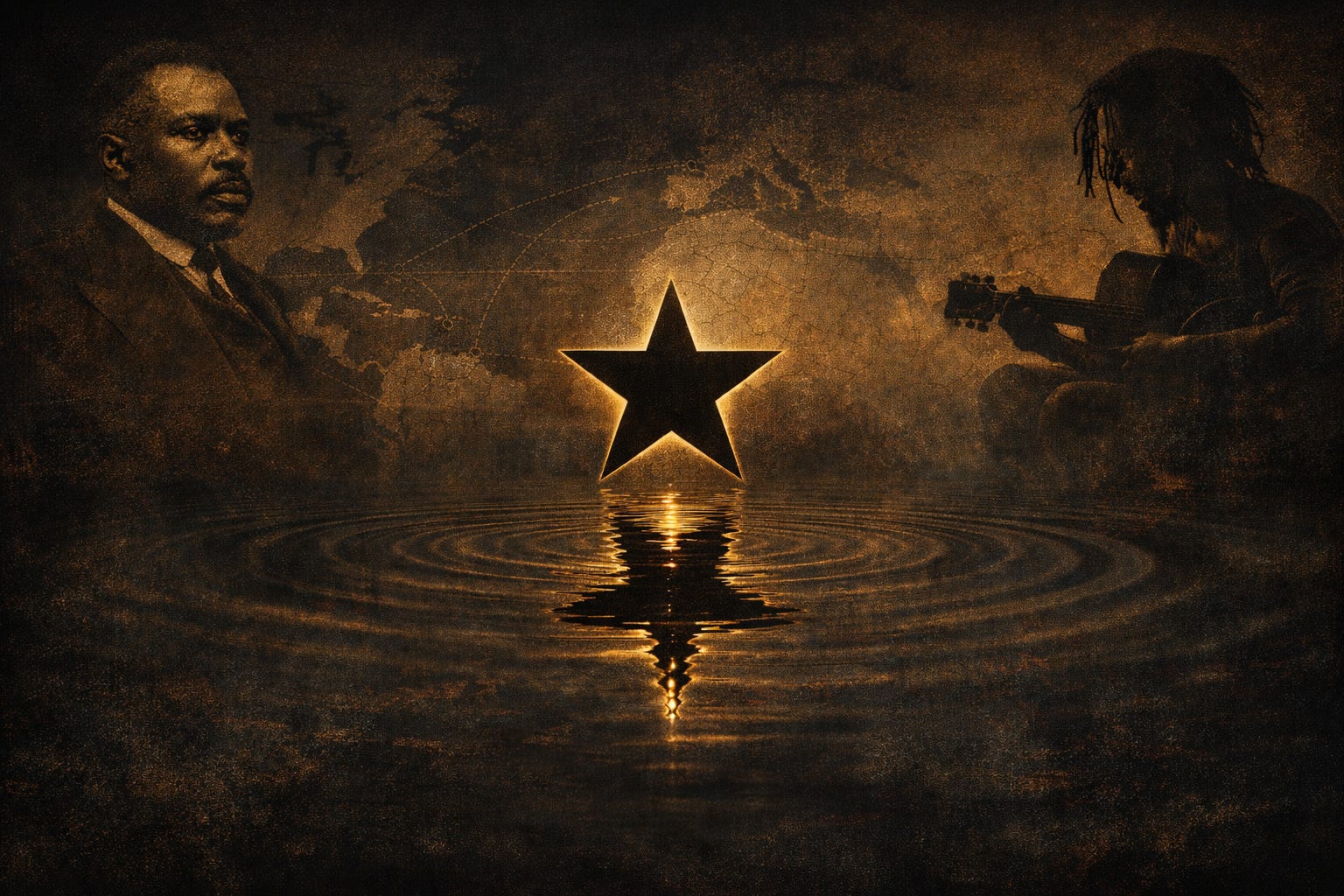
Garvey’s Map, Marley’s Music: Eight Stages to Mental Sovereignty

Somewhere between Toronto in 1937 and Trench Town in the 1960s, Marcus Garvey’s curriculum found a new teacher.

According to Mwariama Kamau, historian for the UNIA, Garvey’s work was a restoration of African consciousness, driven by what Kamau describes as “an ancestral imperative” to liberate his people from social, political, economic, and spiritual bondage (Kamau). In September 1937, Garvey assembled a small group of trusted organizers in Toronto and ran them through forty-two lessons with twelve hours of instruction a day for a month. He called it the Course of African Philosophy. The lessons mapped what I have distilled into eight stages of psychological liberation: Awakening, Confrontation, Reorientation, Continuity, Purpose, Discipline, Organization, and Individual Genius and Mental Sovereignty (Garvey, Message xv).

After Garvey’s death, the forty-two lessons survived in fragments that Tony Martin collected into Message to the People. But the transmission of Garvey’s teachings also ran through Jamaica. The herald was Rastafari. Bob was its voice.

Garvey had founded the UNIA in Jamaica in 1914, and his vision of African redemption never left the island. It moved into Rastafari, which took Garvey’s prophecy about the crowning of an African king as its founding theology. Bob was Rastafari. He did not encounter Garvey’s ideas as history. He absorbed them. Then, set them to music.

Across albums recorded between 1964 and 1980, Bob, like Garvey, transformed what was happening to us into what looks, in retrospect, less like coincidence and more like a mission. The two men never met. Garvey died in 1940. Bob was born in 1945. What passed between them was transmission, the kind that moves through a people who are still working out the same problem.

When Garvey’s words became music, four things changed. The reach expanded from twelve organizers in a Toronto room to every radio, every record player, every street corner on six continents. The access dropped from literacy and membership to nothing more than ears and a body that could feel rhythm. The memory deepened from intellectual retention to the cellular kind that outlasts everything the mind decides to forget. And the risk shifted: you can burn a pamphlet, you can arrest a man, but you cannot confiscate a song that three hundred million people already know by heart.

The curriculum grew roots when it became music. But the music also cost something. That reckoning comes at the end.

Stage One: Awakening

The first stage is the hardest. Garvey called the mental condition of colonized people a kind of enforced sleep. You cannot fight what you cannot see. His pedagogical project began with the insistence that seeing was possible, that the mind could be roused from the numbness it had been taught to call peace.

Garvey wrote in Lesson One of the Course of African Philosophy:

“Intelligence rules the world and ignorance carries the burden.” (Garvey, Message xv)

Bob answered that lesson with a command. In “Wake Up and Live” he sang: “Rise, from your sleepless slumber.” The instruction is identical. Only the instrument changed.

Stage Two: Confrontation

Noticing is not enough. Garvey was explicit: we had to look at the systems arrayed against us without flinching. He trained his organizers to analyze the methods of their opposition, and to understand the terrain. Confrontation in Garvey’s framework is an act of intellectual courage.

Garvey taught in Lesson One:

“Never swallow wholly what the white man writes or says without first critically analyzing it.” (Garvey, Message 1)

Bob enacted that instruction as refusal. In “Babylon System” he sang: “We refuse to be / What you wanted us to be / We are what we are / That’s the way it’s going to be.” Garvey teaches critical analysis. Bob makes it a declaration of identity.

Stage Three: Reorientation

Once a person has awakened and faced the structure built against them, the interior work begins. Garvey understood that the colonizer’s most durable achievement was the installation of the colonizer’s values, standards, and judgments inside the colonized mind. Reorientation means replacing that installed compass with one oriented by African history, African genius, and self-generated possibility.

Garvey named the colonizer’s method in Lesson One:

“Things that may not be true can be made so if you repeat them long and often enough. Therefore, always repeat statements that will give your race status and an advantage.” (Garvey, Message 1)

Bob named the return from it. In “Coming In from the Cold” he sang: “Why do you look so sad and forsaken / Don’t you know when one door is closed, many more is open.”

Garvey names the mechanism of mental colonization. Bob names the way back.

Stage Four: Continuity

Garvey diagnosed civilizational amnesia as a political tool. A people cut from their history could be given a replacement history designed to explain and justify their subjugation. The antidote was memory, specifically the recovery of a history long enough and deep enough to show that the current condition was recent, not eternal.

Garvey wrote in Lesson One:

“Read history incessantly until you master it. This means your own national history, the history of the world, social history, industrial history, and the history of the different sciences; but primarily, the history of man.” (Garvey, Message 3)

Kamau documents how Garvey enacted this stage inside the UNIA itself. At conventions, he hosted the Ancient Ethiopian Ceremonial Court Reception, inducted members into the Ancient Order of the Sphinx, and filled the hall with songs like the Universal Ethiopian Anthem. UNIA auxiliaries carried flags bearing West African Adinkra symbols. African royalty came and found sanctuary in what one member called “the African gospel” (Kamau). Garvey built institutions that practiced continuity with history.

Kamau makes a contribution here that the mainstream Garvey scholarship has not fully absorbed. He documents that the School of African Philosophy taught forty-two lessons, the same number as the forty-two declarations of Ma’at in the ancient Kemetic system. Garvey built that number in deliberately, connecting his curriculum to the oldest African tradition of moral and spiritual accountability on record. The School of African Philosophy was the oldest institution on record, restored.

Bob carried that same depth without naming it. When he sang about the mind, about judgment, about what we owe each other and ourselves, he was drawing from the same well Garvey drew from. The tradition was unbroken.

Stage Five: Purpose

Garvey argued throughout Message to the People that we had to stop drifting and claim a direction. He was relentless on this point. Purpose was a discipline cultivated against the grain of a world that had spent centuries telling Black people their ambition was dangerous.

He wrote:

“The greatest men and women in the world burn the midnight lamp.” (Garvey, Message xviii)

Bob declared the destination. In “Exodus” he sang: “We know where we’re going / We know where we’re from.” Garvey names the discipline of purpose. Bob names where that purpose points. “Zion Train” is the call to board. “One Love / People Get Ready” is the collective orientation toward a shared destination.

Stage Six: Discipline

Garvey had no patience for romanticism about liberation. He understood that sustained movement required sustained self-mastery. He wrote about character as the foundation of all else, the interior structure that determines what a person is capable of building (Garvey, Message 38). Discipline was the form that purpose takes in the body.

He stated plainly:

“The leader must strive to master his shortcomings.” (Garvey, Message xviii)

Bob translated that into street-level instruction. In “Simmer Down” he sang: “Simmer down / Control your temper.” Both men understand that the self is the first battleground. The battle outside cannot be won while the battle inside is lost. “War” is a declaration that the struggle requires total commitment. “Work” is unglamorous and necessary: “Every day is work.”

Stage Seven: Organization

Garvey understood that personal transformation had to become institutional. The UNIA at its peak had over six million members operating across six continents (Kamau). Six million members. Organization built that.

Garvey wrote in Philosophy and Opinions:

“The wonderful force of organization is today making itself felt in every branch of human effort. Whether in industry, society, politics or war it is the force of organization that tells.” (Garvey, Philosophy and Opinions)

Bob named both the force and the direction. When he sang “Africa unite / ’Cause we’re moving right out of Babylon,” he was in deliberate conversation with Kwame Nkrumah, whose book Africa Must Unite had been in circulation since 1963 (Nkrumah). Bob recorded “Africa Unite” in 1979. The title carries deliberate weight. Bob was reading the tradition and singing it back. “Zimbabwe” is the proof of concept. Bob recorded “Zimbabwe” before Zimbabwe was Zimbabwe. That is what organization in service of a vision looks like.

Stage Eight: Individual Genius and Mental Sovereignty

The final stage is the most radical. Garvey insisted that every person within the African world carried a genius specific to them, a capacity for contribution that the colonial system had been designed to suppress, deny, and punish. The recovery of that genius was the full destination of the curriculum. Mental sovereignty meant the absolute refusal to let another person’s assessment of your worth function as your self-understanding.

Garvey declared his ultimate aim in 1937:

“I am trying to make everyone a Marcus Garvey personified.” (Garvey, Message xv)

“Black Man Redemption” names what the journey has been building toward. “Forever Loving Jah” is faithfulness as practice. And then “Redemption Song.” An acoustic guitar. A voice stripped of everything except what it absolutely needs to say. The chains of the mind named and refused.

Bob recorded “Redemption Song” knowing that soon, he would not be with us physically He had already done the work. He was singing sovereignty from inside it.

Garvey had named the transmission long before it arrived. Writing from Atlanta Prison, he told his people: “Look for me in the whirlwind or the storm, look for me all around you” (qtd. in Kamau). Kamau reads that declaration as consistent with the ancient Kemetic belief that the spirit transcends death to continue the liberation struggle from within the forces of nature.

Garvey was always intentional. The forty-two lessons of the School of African Philosophy matched the forty-two declarations of Ma’at exactly. The curriculum drew its moral architecture from the oldest African tradition on record and carried it forward into 1937 Toronto, into Jamaican Rastafari, into Nine Miles, into every studio where Bob laid down a track. The tradition was unbroken across three thousand years. Kamau gives us the documentation. The continuity speaks for itself.

When Garvey became Bob, we gained the world and we lost the discipline. Bob carried the curriculum past every border Garvey’s deportation had drawn around him. He gave us the feeling of liberation before we understood what it meant. The melody got inside before the guard went up. That was the gift.

But Garvey’s lessons demanded something. Twelve hours a day. Examinations. Graduates sent out with specific assignments. The School of African Philosophy ran on rigor and accountability. When the curriculum became music, the urgency to build institutions softened. We received the Awakening and called it enough. We felt Stage One and mistook it for the whole course.

Bob never mistook it. He recorded all eight stages. He knew the distance between waking up and governing yourself. But we heard the music and stopped before the final lesson. We sang “Redemption Song” and went back to sleep.

Garvey would have failed us on the examination.

References

Garvey, Marcus. Message to the People: The Course of African Philosophy. Edited by Tony Martin, Majority Press, 1986.

---. Philosophy and Opinions of Marcus Garvey. Majority Press, 1986.

Kamau, Mwariama. “Marcus Garvey and the African Ancestral Sovereignty Imperative.” Unpublished manuscript, n.d.

Nkrumah, Kwame. Africa Must Unite. Frederick A. Praeger, 1963.

Marley, Bob. “Africa Unite.” Survival. Island Records, 1979.

---. “Ambush in the Night.” Survival. Island Records, 1979.

---. “Babylon System.” Survival. Island Records, 1979.

---. “Black Man Redemption.” Confrontation. Island Records, 1983.

---. “Buffalo Soldier.” Confrontation. Island Records, 1983.

---. “Coming In from the Cold.” Uprising. Island Records, 1980.

---. “Could You Be Loved.” Uprising. Island Records, 1980.

---. “Exodus.” Exodus. Island Records, 1977.

---. “Forever Loving Jah.” Uprising. Island Records, 1980.

---. “Guiltiness.” Exodus. Island Records, 1977.

---. “Heathen.” Exodus. Island Records, 1977.

---. “Jamming.” Exodus. Island Records, 1977.

---. “Natural Mystic.” Exodus. Island Records, 1977.

---. “One Drop.” Survival. Island Records, 1979.

---. “One Love / People Get Ready.” Exodus. Island Records, 1977.

---. “Positive Vibration.” Rastaman Vibration. Island Records, 1976.

---. “Rebel Music (3 O’Clock Roadblock).” Natty Dread. Island Records, 1974.

---. “Redemption Song.” Uprising. Island Records, 1980.

---. “Ride Natty Ride.” Survival. Island Records, 1979.

---. “Running Away.” Kaya. Island Records, 1978.

---. “Simmer Down.” The Wailing Wailers. Studio One, 1965.

---. “So Much Trouble in the World.” Survival. Island Records, 1979.

---. “Sun Is Shining.” Kaya. Island Records, 1978.

---. “Survival.” Survival. Island Records, 1979.

---. “Them Belly Full (But We Hungry).” Natty Dread. Island Records, 1974.

---. “Three Little Birds.” Exodus. Island Records, 1977.

---. “Time Will Tell.” Kaya. Island Records, 1978.

---. “Wake Up and Live.” Survival. Island Records, 1979.

---. “War.” Rastaman Vibration. Island Records, 1976.

---. “We and Dem.” Uprising. Island Records, 1980.

---. “Who the Cap Fit.” Rastaman Vibration. Island Records, 1976.

---. “Work.” Confrontation. Island Records, 1983.

---. “Zion Train.” Uprising. Island Records, 1980.

---. “Zimbabwe.” Survival. Island Records, 1979.


This Substack is reader-supported. To receive new posts and support my work, consider becoming a free or paid subscriber.


via The Garvey Classroom https://ift.tt/GMTpvEo Follow The Garvey Classroom on Substack for weekly lessons on mental sovereignty, Pan-African history, and the teachings of Marcus Garvey.

February 16, 2026

The Garvey Blueprint: A Conversation with the Marcus Garvey Education Academy

The Garvey Blueprint: A Conversation with the Marcus Garvey Education Academy

February 19, 2026 | 7:00 PM EST

Register: bit.ly/garveyblueprint

Direct Zoom Link: https://us06web.zoom.us/j/4045329958


I grew up in Kingston, Jamaica. Marcus Garvey was everywhere and nowhere. His name was on buildings. His face was on currency. But his ideas were absent from the classroom.

That absence shaped everything I have done since.

For thirty years, I studied Garvey’s writings. I spent six years teaching middle school English and 27 years teaching college.  And during that time, one question kept returning: Why do our children learn about Garvey as a portrait on a wall, rather than as a thinker whose methods they can use?

The Garvey Blueprint is my answer.

On Thursday, February 19, at 7:00 PM EST, I will be presenting The Garvey Blueprint at the Marcus Garvey Education Academy. The presentation is open to educators, parents, school leaders, and anyone who believes that Black children deserve a curriculum built from inside their own intellectual tradition.

What Is The Garvey Blueprint?

The Garvey Blueprint is a three-year Pan-African literacy curriculum for grades 6 through 8. It uses English Language Arts as the medium through which students encounter the intellectual, political, and cultural history of Africa and its diaspora.

Across 39 instructional weeks per year, students study 31 historical figures per grade. Over three years, they encounter 75 unique historical figures and one fictional character. Nine staple figures return every year, studied through a different analytical lens each time. A sixth grader meets Frederick Douglass through the question of clarity. An eighth grader meets Douglass through the systems that criminalized Black literacy. The figure stays the same. The thinking transforms.

Three pillars govern the curriculum: the Power of the Mind, the Importance of Purpose, and the Strength of Perseverance. These pillars come directly from Garvey’s educational philosophy. They are structural principles embedded in every quarter, every framing question, and every assessment.

Why This Curriculum Exists

Colonial education divided what belonged together. African intellectual history. Caribbean political thought. African American literary tradition. These are chapters of the same story, separated by design. The Garvey Blueprint reconnects them.

Every instructional week begins with an original historical fiction anchor text. Students enter through the story. They meet Harriet Tubman, Arturo Schomburg, Frantz Fanon, Antonio Maceo, Ella Baker, and dozens more as characters in a narrative before analyzing them as strategists and system-builders. The stance toward every figure is operational: What did this person build? What did it cost? Can the method be applied?

This is what we call Builders and Their Blueprints. Historical figures studied as architects of liberation whose methods transfer to the student’s own condition.

What I Will Cover on February 19

The presentation will walk through the curriculum's architecture. How the three pillars organize instruction across quarters. How the eight developmental stages, drawn from Garvey’s own declarations, create a spine that holds three years of learning together. How the weekly rhythm moves students through four cognitive levels every single week. How the Grit Guardrail Framework ensures that when we study perseverance, we study it alongside the systems that made perseverance necessary.

I will also address the question that every parent and educator asks first: How does this prepare students for standardized assessments? The answer is direct. The Garvey Blueprint aligns with state ELA standards. Reading, writing, speaking, and listening are embedded in every week. Students write claims with evidence. They build analytical essays. They engage in Socratic discussion. By eighth grade, they defend a capstone portfolio that traces their intellectual development over three years.

The curriculum does not choose between cultural grounding and academic rigor. It treats them as the same project.

Who Should Attend

If you are an educator looking for a curriculum that teaches Black history as a year-round intellectual framework, this presentation is for you.

If you are a parent searching for something that meets your child where they are and takes them somewhere they have never been, this is for you.

If you are a school leader considering what a Pan-African ELA curriculum looks like when it is standards-aligned, assessment-ready, and built to last three years, this conversation is where you start.

Join the Conversation

Date: Thursday, February 19, 2026

Time: 7:00 PM EST

Host: Marcus Garvey Education Academy (MGEA)

Register: bit.ly/garveyblueprint

Direct Zoom Link: https://us06web.zoom.us/j/4045329958


Share this with anyone you think may be interested. The door is open.


Geoffrey Philp is the founder of The Garvey Classroom LLC and creator of The Garvey Blueprint. He is the author of several books of fiction and poetry, a Silver Musgrave Medal recipient, and a Marcus Garvey Award for Excellence in Education honoree. He has spent twenty-seven years teaching at the college level and six years teaching middle school English.


Frequently Asked Questions

What is the Garvey Blueprint curriculum?

The Garvey Blueprint is a three-year Pan-African literacy curriculum for grades 6 through 8. It uses original historical fiction anchor texts to teach 75 unique historical figures across three years, organized around three pillars drawn from Marcus Garvey’s educational philosophy: the Power of the Mind, the Importance of Purpose, and the Strength of Perseverance.

Who created The Garvey Blueprint?

Geoffrey Philp, a Jamaican-born author and educator with twenty-seven years of college teaching experience, six years as a middle school English teacher, and two decades of Marcus Garvey scholarship, created The Garvey Blueprint through The Garvey Classroom LLC.

Is the Garvey Blueprint aligned with state standards?

Yes. The Garvey Blueprint aligns with state ELA standards, including the New York State Next Generation English Language Arts Learning Standards. Reading, writing, speaking, and listening are embedded in every instructional week.

What grades does The Garvey Blueprint serve?

The curriculum serves grades 6 through 8 across a three-year developmental sequence. Each grade has its own central question and analytical lens, with nine staple figures returning each year at increasing levels of cognitive demand.

How is The Garvey Blueprint different from other culturally responsive curricula?

The Garvey Blueprint is story-driven, meaning every instructional week is built around an original historical fiction anchor text. It studies historical figures as strategists and system-builders whose methods are transferable. Social-emotional learning is embedded in the academic work, with no standalone SEL lessons.

What is the Marcus Garvey Education Academy (MGEA) presentation?

On February 19, 2026, at 7:00 PM EST, Geoffrey Philp will present The Garvey Blueprint at the Marcus Garvey Education Academy. The virtual presentation is open to educators, parents, and school leaders. Register at bit.ly/garveyblueprint.

April 8, 2024

Caribbean Book Blogs: Shining a Light on the Region's Literary Gems


Caribbean literature is a mosaic of stories, histories, and voices that often struggle to gain global recognition. In this challenging landscape, Caribbean book blogs play a crucial role, serving a vital function in bridging the gap between talented authors and potential readers. These blogs go beyond simple book reviews; they create connections, encourage discoveries, and support the growth of both readers and writers, making them essential to the Caribbean's literary ecosystem.

Connecting Readers and Writers

Book blogs in the digital space serve as bridges, connecting Caribbean authors with global audiences. Blogs like Jhohadli (https://jhohadli.wordpress.com/) provide a platform for underrepresented Caribbean writers. One notable example of Jhohadli's commitment to showcasing underrepresented Caribbean voices is its feature of emerging Antiguan and Barbudan poets. Through dedicated poetry showcases, Jhohadli has introduced readers to talents like Brenda Lee Browne, whose poems explore themes of identity, history, and resilience in the Caribbean context. By spotlighting poets like Brenda Lee Browne, Jhohadli provides exposure to individual writers and contributes to the broader representation of Caribbean literary traditions. By fostering a supportive online community around their work, Jhohadli encourages dialogue and engagement, amplifying these voices' impact beyond traditional publishing channels' confines. In doing so, Jhohadli and similar blogs are vital hubs for celebrating and promoting underrepresented Caribbean literature, ensuring its continued vitality and relevance in the global literary conversation.

Discovering New Literary Treasures

For readers exploring Caribbean literature, blogs act as guides, leading them through the diverse range of narratives and styles that characterize the region. The Peepal Tree Press Blog (https://www.peepaltreepress.com/blog) is a notable example of curating an eclectic selection of works across various genres and themes within Caribbean literature. One specific example of the blog's commitment to introducing readers to new authors is its spotlight on emerging Caribbean playwrights. For instance, recent posts have featured playwrights like Natalia Ramanaden, whose provocative dramas challenge conventional narratives and explore pressing social issues in the Caribbean context. By showcasing Ramanaden's work alongside that of established playwrights, the blog provides a platform for emerging talents to gain visibility and recognition.

Supporting Literary Growth

Preelit stands out for its commitment to providing critical analyses, commentaries, and discussions that challenge established perspectives in Caribbean literature. One specific example of this is its series of in-depth book reviews, where contributors offer nuanced insights into works by both established and emerging Caribbean authors. For instance, recent reviews have explored novels like Kei Miller's "Augustown" and Marlon James's "A Brief History of Seven Killings," exploring themes such as colonial legacies, identity, and resistance. Through these reviews, Preelit evaluates individual works and situates them within broader literary, historical, and socio-political contexts, encouraging readers to engage critically with Caribbean literature. Preelit fosters a culture of intellectual inquiry and dialogue within the Caribbean literary community by offering critical analyses, commentaries, and discussions. Also, by creating a platform for dialogue and exchange, Preelit fosters a sense of community among writers, readers, scholars, and critics, facilitating the sharing of ideas and promoting collaboration.

Uniting the Caribbean Literary Community

The combined efforts of these blogs create a network of literary exploration, with each blog representing an island connected by the shared heritage of Caribbean storytelling. Feedspot's curation of top Caribbean book blogs (https://blog.feedspot.com/caribbean_book_blogs/)  is significant in bringing these diverse platforms together, providing readers and writers with a central hub to access the wealth of Caribbean literary content online. This amplifies the reach of Caribbean literature and strengthens the sense of community among those who create and appreciate these stories.

Looking to the Future

Caribbean book blogs are essential in narrating the ongoing story of the region's literary identity. By showcasing the diverse voices of the Caribbean, these blogs ensure that the region's literature thrives in the digital age. As we move forward, the importance of these platforms and the support from aggregators like Feedspot will continue to grow, guaranteeing that the Caribbean's literary heritage will enrich the cultural landscape. Through their collective efforts, we are reminded of the power of stories to connect us, broaden our horizons, and nurture personal and communal growth.

May 15, 2023

Why I’m Switching to Vocal

Geoffrey Philp
 

I have always been concerned about the erasure of Black memory. That's why I began blogging at Geoffrey Philp's Blog Spot.

In some of my earliest blog posts, "Why I Continue to Write" and “Why I Continue to Blog,” I explained the reasons for starting the blog and what I hoped to achieve. The blog has served as an important platform for Caribbean literature and culture, connecting Caribbean writers, artists, and a wider audience. It has played a significant role in raising awareness of Caribbean literature and culture.

I'm particularly proud of several posts that I have written:

·         Posts About Marcus Garvey: https://geoffreyphilp.blogspot.com/search?q=Marcus+Garvey

·         Posts About Bob Marley: https://geoffreyphilp.blogspot.com/search?q=Bob+Marley

·         Posts From Caribbean and South Florida Writers: https://geoffreyphilp.blogspot.com/search?q=In+My+Own+Words

·         Posts About Caribbean Writers: https://geoffreyphilp.blogspot.com/search?q=Caribbean+Writers

·         Interviews With Caribbean Writers: https://geoffreyphilp.blogspot.com/search?q=Five+Questions+With

·         A Conversation With: https://geoffreyphilp.blogspot.com/search?q=A+Conversation+With

·         Birthday Posts: https://geoffreyphilp.blogspot.com/search/label/Happy%20Birthday

I have also participated in a few podcasts, although some of them have been lost in the ether: https://geoffreyphilp.blogspot.com/search/label/podcast

In the next few days, I will switch many posts to Vocal, where I have written haiku, a short story, and a few bad limericks. I've decided to make this switch for several reasons:

·         Active community:

Vocal has a large and engaged community of writers and readers, meaning others are likelier to see and read my posts. It provides me with a broader reach than I would have on a personal blog.

·         User-friendly interface:

Vocal's interface is designed to be easy to use, making it simple for me to create and publish my content. But most importantly, Vocal compensates writers for their work. For every 1,000 views my posts receive, I will earn $3.80. Additionally, I will earn $0.10 for every share my posts receive. Vocal also offers readers the opportunity to actively support writers by tipping. I plan to use the earnings to help with my travel expenses for research, book promotions, and especially for Archipelagos.

I will continue writing One Minute Book Reviews, announcements about book publications and fairs, and interviews with Caribbean Writers. You can find them on my blog at the following links:

·         One Minute Book Reviews: https://geoffreyphilp.blogspot.com/2023/05/one-minu

·         Book Publications and Fairs: https://geoffreyphilp.blogspot.com/search?q=Book+launch

·         Interviews with Caribbean Writers: https://geoffreyphilp.blogspot.com/search?q=Five+Questions+With

In the meantime, I invite you to visit my page on Vocal. If you enjoy a haiku or story, you can subscribe, share it on social media, or leave a tip.

See you on Vocal!

#BlackMemoryMatters 

#CaribbeanCulture

 #CaribbeanLiterature 

 #VocalPlatform 

#SupportWriters 

#AmplifyBlackVoices

November 10, 2021

"Rastafari in the 21st Century" @ the Miami Book Fair

I Jabulani Tafari

 “Rastafari in the 21st Century – What Life has Taught I&I”

Comes to the 2021 Miami Book Fair


Join Priest Douglas Smith and Ras I. Jabulani Tafari at the 38th annual Miami Book Fair as they host the South Florida launching of their new book "Rastafari in the 21st Century: What Life has Taught I&I.” The Book Fair takes place at the Wolfson Campus of the Miami Dade College in Downtown Miami from November 14 to November 21, 2021.

The Book Fair presentation by Priest Douggie and I-Jabulani and the launch of “Rastafari in the 21st Century” is scheduled for Saturday, November 20 at 5.00 p.m. in Room 8106 (the Magic Screening Room) on the first floor of Building 8.
Rastafari 21st Century Vol 1 Front Cover-smallest.jpg
   
Volume One of the new book by Priest Douggie and I-Jabulani contains the previously unwritten history of the First Generation of Rastafari Elders. Today, many of that First Generation of Rastafari Elders are transitioning on to become Ancestors, and as they do so, their colorful and important life stories are already starting to fade from the collective memory of the people of Jamaica and the world.

This well-illustrated and thought-provoking volume was written as a literary tribute lest the world forget to highlight and honor those Rastafari Elders who sacrificed everything and endured so much with so little in order to establish a new Cultural Tradition and Way of Life.

The presentation by the Rastafari authors at the Miami Book Fair on Saturday November 20th will include music, videos and book signings before and after the event. Click the following link for more detailed information about “Rastafari in the 21st Century” at the Miami Book Fair.  

https://www.miamibookfair.com/event/in-conversation-on-rastafari-in-the-21st-century-what-life-has-taught-ii-volume-i/

Looking forward to seeing you all at the 2021 Miami Book Fair!
2021 save the date.


https://www.miamibookfair.com/event/in-conversation-on-rastafari-in-the-21st-century-what-life-has-taught-ii-volume-i/

#MiamiBookFair #MBF21

Facebook https://facebook.com/MiamiBookFair/

Instagram  https://instagram.com/miamibookfair/

Twitter https://twitter.com/miamibookfair


November 11, 2020

Five (More) Questions With Malachi


GP: Malachi, it's been 14 years since I last interviewed you  How has your work changed since that interview?

Malachi: A lot has changed in my life and career since 2006. I would like to think that I am now a more mature writer and student of life. I'm no longer shackled by the constructs of a 9 to 5 in a system that always forced me to stand firm and uphold my principles. I am my own man. I don't need to beg, bow, or borrow. I am totally liberated.

I have also grown in my writing. My pen is deliberate and concise. Traveling the world and experiencing different cultures has also contributed enormously to my world view and growth. I am also writing more prolifically. I have written some short stories, finished one work on the turbulent era in Jamaica, Blood Fi Blood, Fire Fi Fire: I Was There Too, almost completed another piece on my journey in the Jamaica Constabulary Force, and I’m working on other projects.

The launch of my annual Jamaican Poets Schools Nomadic Tour has been great. Taking poetry into schools and communities and see students, young poets, and academics come alive in real-time.

Finally, I’m hosting a radio show, Strictly Roots dub poetry, and more on WZOP 92.7 and WZPP 96.1 FM. It has always been a dream of mine to take poetry to the people via the airways. It is working magic. Other radio personalities are now playing poetry as part of the shows.


GP: On the title track, "Ticked Off," you've expanded the meaning of "I Can't Breathe." Why do you think George Floyd's death has sparked such a worldwide outrage?

Malachi: What the world witnessed was brutal, horrific, and downright disgusting. It is like the officer was saying, "I got this; stand back, this neck is mine." 

It was my neck. It was my people's neck. For 400 hundred years, we have been saying that this is happening, but the truth was always covered up while we suffered and bled and died. In a world with so many intuitions of justice and Christianity, it's perfectly normal to lynch a black man because we are always wrong.

GP: In a collection with so many hard-hitting poems about social justice, I was surprised by the inclusion of "Blacker de Berry." Why did you include this poem in this collection?

Malachi: I'm proud of how my beautiful black mothers and sisters, queens, and empresses, have come into their own. So, this ties into the contemporary narrative. I love to uplift and elevate them, hence the inclusion. I took into consideration too that the original recording could have technically been better. Hopeton Lindo told me recently that it was his favorite poem, and then Taurus Alphonso said I should redo it and change the arrangements.

GP: I've also noticed that you have branched out to tackle the theme of mental health on the track, "In my Head." Why did you think it was necessary to deal with this issue?

Malachi: The song, “Say My Name” by Novel-t kept calling me. I met a young man, Haile Clacken, some years ago at the Talking Tree Poetry Festival in Treasure Beach, Jamaica. I started a conversation with a librarian, and this young man walked over. She introduced him to me, and we had a nice conversation. He told me he liked my poems. Less than a year later, the librarian sent me a message on What's App with the photo of Haile and asked me if I remembered him. I replied, yes, of course. She responded he was shot and killed.

Well, actually, he was murdered. Haile, a trained teacher, attended college overseas, suffered from mental illness. On the day he was murdered, he set out on foot to visit his only child and suffered a mental lapse along the way.

Haile climbed on top of an armored car, and they drove off with him on top. The driver tried to dislodge him by driving aggressively. To avoid falling off Haile clung to the vehicle's wiper. When the vehicle stopped, Haile climbed down. There was no struggle with the guard. He just blasted him. Many people witnessed the crime. The guard was charged for murder, and in typical Jamaican justice fashion, four years later, the case still hasn’t been tried.

My good friend, Jean Binta Breeze, also suffers from mental illness and has written about it in her poetry. It is a real issue that needs our collective attention. There is also a new branch of study/philosophy that deals with the Trans-Atlantic Slave Trade post-traumatic syndrome. The way we kill each other too on our streets is a manifestation of this mental illness.

GP: Bob Dylan seems to be an unlikely candidate for your homage in "Beat Down Zion's Door." Why did you choose that song by Bob Dylan?


Malachi: I have always been fascinated by this song, but instead of just “knocking,” I am convinced that we need to beat down some constructs that are tied to and justified by religion(s). Many have become prisoners to holy books, and in the process, truths, rights, and justice are trampled.

 Dylan is polite. I am tired, frustrated, angry, uncompromising. I am demanding answers. I want them now. I have no use for propaganda. The way the UN and other organizations that are here to protect the earth's sufferers have manipulated facts, leaves a lot to be desired. So, I want to have a chat with the Father and seek out his reasoning, so I barged in.


About Malachi


Malachi Smith is an accomplished Jamaican writer of poetry and plays, and an actor, performing in his own plays and other productions in live theatre and on radio and television. He is a fellow of the University of Miami’s Michener Caribbean Writer’s Institute where he studied poetry under Lorna Goodison and play writing under Fred D’Aguilar.

He was one of the readers at the first Talking Trees in May 2011, and appeared again at the second Talking Trees in 2012, and returns to the Talking Trees stage on May 27, 2017. Malachi's earlier appearances include being the headliner in 2004 at the International Dub-Poetry Festival in Toronto and in 2008 at the Love-In Festival in Miami with Richie Heavens and other greats. He also made three appearances in New York, and toured St. Kitts and Nevis in the summer of 2000 to rave reviews. More recent appearances include: 2012 - International Poetry Festival of Colombia, Medellin, Colombia; 2014 – International Poetry Festival of Nicaragua; 2015 – International Poetry Festival of Taiwan; 2016 – Poetry Africa, Durban, South Africa; 2017 – Polokwane Literary Fair, Limpopo, South Africa - Hon. Louise Bennett-Coverley Reading Festival, Broward Community College; and 501 Café, New York. 2018 – Honduras International Poetry Festival, University of the West Indies, Bookophilia and other locations in Jamaica; 2019 – Festival Contemporanea San Cristobal, Mexico, La Guagua Poetry Festival, Lowell, Massachusetts; 2020 – Toured Jamaica with Judith Falloon-Reid’s, An Awe Inspiring Journey – Down in Antarctica (featured on the team song with Falloon-Reid).


His awards include the 2016 Akamedia Award in the Reggae Category for his poem How Yuh Mek Har and the Jamaica Cultural Development Commission’s (JCDC) 4th Place Choice Writer (gold and bronze medals) 2018; Best Adult Poet in 2017 and 2014, following earlier JCDC awards: 2009 most outstanding writer in the poetry and 2006 four Literary Awards for poetry and playwriting. Also, in 2006 he won the Joe Higgs Music Award for dub poet of the year, and was nominated for the dub poet of the year in the Reggaesoca Awards, and for the poet of the year in the Martin’s International Music Awards. He has been a nominee in the IRAWMA Award for Best Poet (2012 -2016). Malachi was one of the 50 Jamaicans living in the USA, who were special honored for their contribution to Jamaica on Jamaica’s 50 year of independence.

Launched Jamaican Poets School Nomadic Poetry Tour in 2017. Coordinates the annual, Louise Bennett-Coverley Writer’s Clinic. Featured on the 2020 Yasus Afari produced album, Dub Poetry Ina Yu Face.

The documentary film, Dub Poetry: the life and work of Malachi Smith premiered in 2007. 

Malachi’s CDs include Hail to Jamaica, released in 2011; Scream, released in 2014; and his latest 2017 release, Wiseman. He is awaiting publication of two new poetry collections, The Gathering and Stony Gut, and is currently writing a series of short stories.

An alumnus of Florida International University (M.S.C.J. & B.Sc.), Miami-Dade College (AA) and Jamaica School of Drama, Malachi was one of the founding members of Poets in Unity, a critically acclaimed ensemble that brought dub-poetry to the forefront of reggae music in the late 1970s, and carried it forward for a decade.

In addition to being a poet, Malachi served in the police force in Jamaica and in Florida, retiring from the latter in 2016. He was a freelance writer for the Jamaica Daily Gleaner (Overseas Edition), a board member of the Jamaica Ex-police Association of South Florida, as well as the Caribbean Education Foundation; and the Honorable Louise Bennett-Coverley Heritage Council. Malachi is married to his childhood sweetheart Marcia and has two sons Maurice and Marlon.