November 5, 2018

Read Caribbean @ Miami Book Fair 2018

Miami Book Fair


ReadCaribbean programming features extensive Caribbean-specific events, including readings and panel discussions, storytelling for children, music and more, plus publishers at Street Fair. When appropriate, author events will take place in Creole or French with simultaneous translation into English.

A very special thank you to Jan Mapou, Myrtha Wroy, Jerry Delince, Cergine Cator, and Sherley Louis members, of Sosyete Koukouy who collaborate with Miami Book Fair on ReadCaribbean programs, including the Little Haiti Book Festival, that takes place annually in May. Established in 1985, Sosyete Koukouy is dedicated to preserving Haitian culture in the United States . Their mission is the preservation, perpetuation and presentation of Haitian cultural performances and exhibitions, to Creole and non-Creole-speaking audiences.

After Irma, After Maria: Caribbean Women Writing the Storms
Saturday, November 17 @ 11:30 am
Room 8301 [Building 8, 3rd Floor)

Modern Caribbean literature captures not just the endemic mismanagement of natural resources and public projects, but also the enduring chasm between promises of progress through major infrastructures and the outcomes of natural disasters for average citizens. 

In this panel, four Caribbean writers reflect on the devastation from Hurricanes Irma and Maria to many Caribbean islands whose economies rely on tourism; they pay considerable attention to the Caribbean bodies caught in the crosscurrents of a catastrophic natural history. With Edwidge Danticat (Haiti), Loretta Collins Klobah (Puerto Rico), Tiphanie Yanique (Virgin Islands), and Jessica Pabón-Colón (Puerto Rico).

Unknown Histories of the Caribbean
Saturday, November 17 @ 1:30 pm
Room 8301 [Building 8, 3rd Floor)

This panel will discuss how writers from the Caribbean have attempted to construct alternative images of the present and future from the histories of slavery and colonialism that haunt the Caribbean and its diasporas. In parallel with these invented stories, archival registers give unexpected details of the unknown histories of the Caribbean and allow for scrupulously researched literary works to emerge alongside tales of imagination. 

With Natalie Hopkinson (Guyana), author of A Mouth is Always Muzzled; Patrick Bellegarde-Smith (Haiti), author of In the Shadow of Powers; Dantes Bellegarde in Haitian Social Thought; Michael Barnett (Jamaica), author of The Rastafari Movement: A North American and Caribbean Perspective, and Judy Raymond (Trinidad), author of The Colour of Shadows. Moderated by Donna Aza Weir-Soley, author of Eroticism, Spirituality, and Resistance in Black Women’s Writings.


Murder and Mayhem in the Caribbean
Saturday, November 17 @ 3:30 pm
Room 8301 [Building 8, 3rd Floor)

Writers with roots in Dominican Republic, Cuba, and Trinidad and Tobago present masterful and unvarnished literary crime fiction and wildly transgressive noir from the Caribbean. With Kevin Jared Hosein, The Repenters and The Beast of Kukuyo; Hector Duarte Jr., Desperate Times Call, and Nicholas Laughlin, editor of the anthology, So Many Islands. Moderated by Manny Duran.


ReadCaribbean Presents Adventures for Kids
Saturday, November 17 @ 4:00 pm
Wembly's Author Tent
Upper plaza of Children’s Alley

Two friends search for a long-lost quilt patch in Marjuan Canady’s Callaloo: The Trickster and the Magic Quilt; an Arctic seal tries to get back home in Joanne C. Hillhouse’s Lost!, and discoveries abound during a simple walk through the neighborhood in Paula-Anne Porter Jones’ Sandy, Tosh and the Moo Cow, and a family’s history comes alive in Francie Latour’s Auntie Luce’s Talking Paintings.


Reading Jamaica
Saturday, November 17 @ 5:30 pm
Room 8301 [Building 8, 3rd Floor]

Reading stories that explore such themes as racial identity, gender and sexuality, family and alienation, exile and history, this panel brings to life the richness and diversity of writing from and/or about Jamaica. With Marcia Douglas, author of The Marvellous Equations of the Dread: A Novel in Bass Riddim, Alecia McKenzie, author of Sweetheart, and Alexia Arthurs, author of How to Love a Jamaican. Moderated by Geoffrey Philp, author of Garvey’s Ghost.


Haitian Identities and Caribbean Aesthetics/ Idantite Ayisyen Ak Estetik Karibeyen
Sunday, November 18 @ 11:30 am
Room 8301 [Building 8, 3rd Floor)

In English with simultaneous interpretation into Haitian Creole

This panel of four Haitian women writers will address the impact of their Haitian and Haitian-American identity(ies) on their writing and the ways they navigate (hyper)visibility and erasure to honor Caribbean aesthetics. Join Marilène Phipps, author of Unseen Worlds; Katia D. Ulysse, author of Mouths Don’t Speak, and Fabienne Josaphat, author of Dancing in the Baron’s Shadow, as they discuss the ways in which their writings respond to cultural presumptions about Haitian identity. Moderated by Edwidge Danticat.


Compelling Stories from the French Caribbean/Des Histoires Captivantes de la CaraÏbe Française
Sunday, November 18 @ 1:30 pm
Room 8301 [Building 8, 3rd Floor)

In French with simultaneous interpretation into English

Writers from the French Caribbean create and chisel narratives that are vibrant and compelling as their Caribbean identity shapes and informs the stories they choose to tell. 

This panel will focus on choices writers make in telling and reporting stories that embody the depth and breadth of French-Caribbean life and imagination. With Gerty Dambury (Guadeloupe), author of The Restless;  Mehdi Chalmers (Haiti), author of À Partir du mensonge; Monique Clesca (Haiti), author of La Confession; and Serge Bilé (Martinique), author of Yasuké (a true story about the first recorded Japanese black samurai). Moderated by Vanessa Selk, Cultural and Education Attaché (Florida and Puerto Rico) of the Cultural Services of the French Embassy in the United States.

ReadCaribbean Presents Three Groundbreaking Poets
Sunday, November 18 @ 1:30 pm
Room 6100 [Building 6, 1st Floor]

Ruth Behar explores the sacrifices of her exiled Cuban ancestors alongside her own vulnerabilities in Everything I Kept/Todo Lo Que Guardé. Loretta Collins Klobah reveals the secret heart of Puerto Rico in Ricantations, where shiny modernity gives way to spirit presences before and after Hurricane Maria. I Even Regret Night: Holi Songs of Demerara is Rajiv Mohabir’s translation of the only known literary work written in 1916 by an indentured servant in British Guyana.


The Realities of Haitian Migrations
Sunday, November 18 @ 3:30 pm
Room 8301 [Building 8, 3rd Floor]

In Haitian Creole with simultaneous interpretation into English

Individuals who migrate often experience the loss of cultural norms, religious customs, and social support systems. The adjustment to a new culture brings forth changes in identity and concept of self. In the case of Haiti, how do these changes affect the motherland – and the Haitian communities of the Diaspora?
In this panel, academics and experts in the literary field will speak to the issue of Haitian migration, racial, gender, and national identity, and ultimately, of life in the balance. With Pauris Jean-Baptiste (writer), Pierre Buteau (historian), Inéma Jeudi (journalist), and Claude Charles (ethnologist). Moderated by Marleine Bastien, Executive Director of FANM


#MeToo Movement in the Afro-Caribbean Communities
Sunday, November 18 @ 5:30 pm
Room 8301 (Building 8, 3rd Floor)

In many African-Caribbean communities, reactions to the #MeToo movement often reflect a lack of adequate thought about abuse; in fact, these reactions can even indicate increasing levels of gender-based violence as a norm. Women brave enough to come out with their ordeals are often silenced or made to face backlash for their choice to demand justice. Academics and writing professionals will discuss the blurry lines between abuse and what is considered “normal” gender relations and “natural”’ male behavior in Haiti and other African-Caribbean countries, and present ideas on ways that literature can support the women in impoverished/conflict countries. With Judite Blanc (research psychologist), Monique Clesca (UN Specialist), Marlene Chouloute-Hyppolite (writer), and Georges Bossous (human rights activist). Moderated by Anaïse Chavenet (literary publicist). [In Haitian Creole with simultaneous interpretation into English]

For more information, please follow this link: https://www.miamibookfair.com/programs/


October 12, 2018

Maryse Conde's Reading @ the Historical Museum of SF-Update

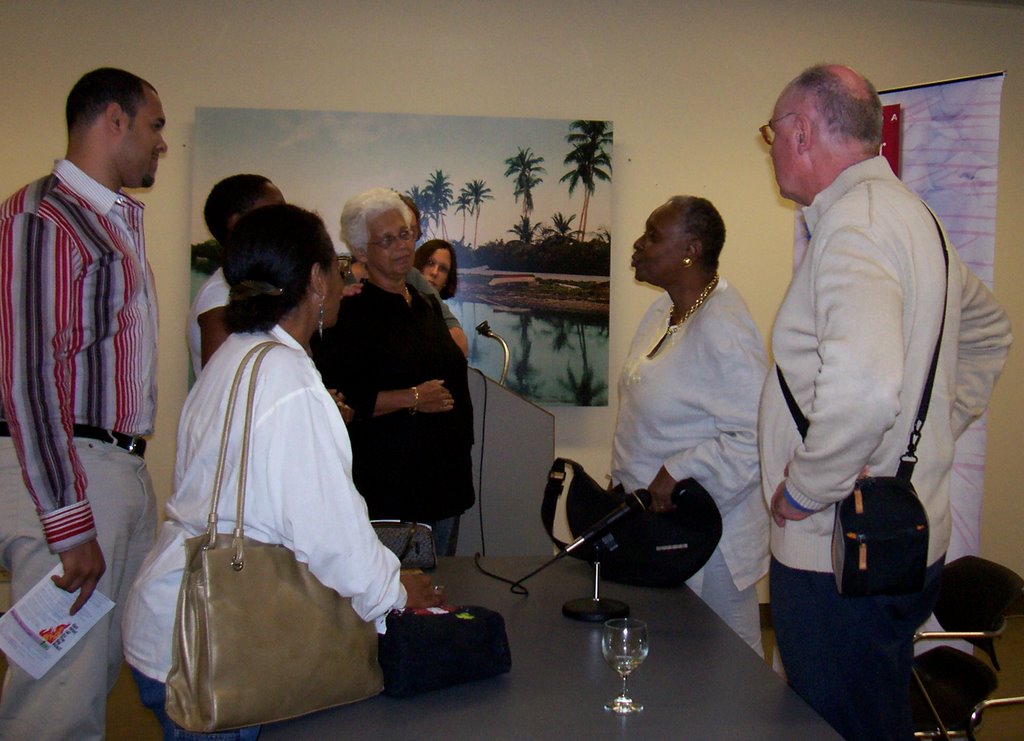
“You are not born a Caribbean writer—you become a Caribbean writer.” With that opening statement, Maryse Conde, author of twelve novels—including I, Tituba, Black Witch of Salem; Windward Heights; Crossing the Mangrove, and Desirada, began her reading on Thursday, April 6, 2006 at the Historical Museum of Southern Florida.


A spellbinding storyteller with an expansive knowledge of philosophy and aesthetics, Conde described her journey from Guadeloupe, “We are the last of the colonialists,” to Paris, France where she discovered her vocation. As she explained, “I always thought that to be a writer, you had to white and dead.” While in Paris, she began to ask one of the questions that occupies her creative life: What does it mean to be a Caribbean writer?


Her answer took her from France to Guinea. For as she learned about the complexities of the subject, she also re-discovered her African ancestry: “Slavery did not exist in my family. It was something of which we were to be ashamed.” Her readings of Frantz Fanon’s, Black Skins, White Masks, led her to Guinea where after twelve years she concluded, “I had no place in Africa.” It was primarily the differences in food, music, language, and religion, “Religion gives you a means of relating to yourself and other people,” that she realized how much she had idealized Guinea/Africa, so she decided to return to Guadeloupe.


This is not to say that her transition to Guadeloupe with the other Negropolitans was easy, for she was always asked the question: Are you on the Kreyol side or the French side? The frequency of the inquiry led her to speculate about language and identity from which she deduced that while language, Kreyol, is an important marker, it is not the only marker that distinguishes one as Caribbean. With that understanding, she began to experiment with the images, sounds, and characters that were uniquely Caribbean while disconnecting herself from the more insular demands from her colleagues, “Writing is the only sign of freedom—you have no master.” Again, the idea of freedom came back to haunt her as she realized that many the Caribbean intellectuals did not share her ideas about developing a narrative strategy that was different from the European ideal. Nor did they share her ideas about race, gender, and economics and their link to economic and psychological dependence.


It wasn’t until she came to the US, however, that she fully confronted the issue: What does it mean to be black woman born in the Caribbean? The question literally fell into her hands when a short biography of Tituba landed in her palms as she was walking through a library. She saw many similarities between Tituba’s and her own experiences that involved issues of race and gender, yet as she explained, “It was important for me to know myself.” That quest to know herself has taken her on a grand adventure and has yielded many important insights: “When a writer can say, ‘Here is my voice,” it is an accomplishment.”


First published on April 10, 2006

October 7, 2018

Round-up: 37th Annual West Indian Literature Conference

West Indian Literature Conference


"Miami Extensions: 305 Creativity, Alive and Thriving"
(L-R )Jason Fitzroy Jeffrers, Filmmaker, Co Founder of Third Horizon Caribbean Film Festival; Maria Ketsia Theodore-Pharel, Author of Rope; Caridad Moro-Gronlier, Author  of Visionware; Dr. Patricia J. Saunders, University of Miami.

There are conferences, and then, there are Conferences. The 37th Annual West Indian Literature Conference was one of the best Conferences that I’ve ever attended. The program offerings were diverse, fascinating, and riveting with a remarkable blend  of lectures for critics and creative writers.

West Indian Literature Conference
"Publishing Workshop for Creative Writers"
Johnny Temple, Publisher, Akashic Books, Brooklyn, New York
I got to meet many of the writers and critics whose work I’ve always admired, but with whom I’ve never broken bread. 


West Indian Literature Conference 
  (L-R) Oonya Kempadoo, Author of Tide Running, Ifeona Fulani, Author Seasons of Dust, Nelly Rosario, Author of Song of the Water Saints.


West Indian Literature Conference
 “Caribbean Women’s Textile/Textual Practices as Archives of Memory and Mourning”
Rachel L. Mordecai, University of Massachusetts, Amherst


West Indian Literature Conference
"Frame Work: Imaging and the Afterlife of Things"
Kevin  Adonis Browne, University of the West Indies, St. Augustine, Author of High Mas,
The Caribbean Memory Project


West Indian Literature Conference
 “An Aesthetics of Federation and a Federation of Aesthetics: West Indian Literature and the Project of Regional Unity”
Alison Donnell, University of East Anglia, United Kingdom

West Indian Literature Conference
“Manscapes: Grooming New Jamaican Iconography”
Isis Semaj-Hall, University of the West Indies, Mona

West Indian Literature Conference
“After the Collaboration: The Kamau Brathwaite Bibliography"
Kelly Baker Josephs, The City University of New York


And then, on Friday night, there was the public performance of Zong! by M. NourbeSe Phillips for the Africans lost in the Maafa. Imagine a host of Caribbean writers, all dressed in white, descending on Historic Virginia Key Beach—the Black Beach-- to offer benedictions for the ancestors and you will have some idea of the moment.
West Indian Literature Conference


M. NourbeSe Phillips, Author of Zong!

One of the highlights of the Conference was the lecture by Lizabeth Paravisini-Gebert (Vassar College), “The Debris of Caribbean History: Literature. Art, and Archipelagic Plastic,” in which she masterfully wove the ecologic degradation of the Caribbean to the legacy of imperialism and showed how plastic is being used by artists and writers, including Derek Walcott and Kamau Brathwaite as metaphors of colonial trauma.

Geoffrey Philp


 “The Debris of Caribbean History: Literature. Art, and Archipelagic Plastic,”
Lizabeth Paravisini-Gebert (Vassar College)
Repeating Islands 

Give thanks to Pat Saunders & her team for hosting the 37th Annual West Indian Literature Conference, which brought together academics and writers to discuss issues that are essential to our understanding of Caribbean literature and a framework for moving ahead into the brave new digital world of text production, critiques, and archival.


Patricia J. Saunders, Associate Professor, Department of English

On a personal note, I would like to thank Pat for inviting me to launch Garvey's Ghost at the conference and giving me the space to introduce my work to professional critics, professors, and graduate students. It is a memory I will always cherish. 

Bless up, Pat. You have done a mighty, mighty work

October 4, 2018

37th Annual Meeting of the West Indian Literature Conference

Geoffrey Philp

October 4-6, 2018

Hosted by:
Hemispheric Caribbean Studies (HCS)
 University of Miami
Newman Alumni Center
6200 San Amaro Drive, Coral Gables, Florida, USA
 

This year’s conference recognizes the vast routes/roots that link the Caribbean to the hemisphere and the globe. As many writers and literary scholars have noted, the immense bodies of water that appear to isolate belie the currents that intimately connect, and at times, destroy shelter, lands, and peoples. Deploying Arjun Appadurai’s concept of “scapes” that work to enable the exchange of ideas and information, we hope to engage a breadth of issues relevant to Caribbeanists in the region and its diasporas. Throughout the conference our aim will be to explore the intersections between disciplinary approaches to problems that are borne out of the shifting tides of globalization and cultural expression. Undoubtedly researchers in literary studies, anthropology, history, philosophy, medicine, sociology and environmental studies, are all concerned with issues of global migration, environmental sustainability, human rights, state power, education and other global issues that have particularly devastating impacts in the circum-Caribbean region. Our conference will examine some of the innovative approaches to addressing these issues across national, cultural and disciplinary boundaries, and particularly encourage inter, multi, and transdisciplinary conversations and panels.


For more information, please follow this link: West Indian Literature Conference

September 3, 2018

One Minute Book Review: Marcus Garvey by Rupert Lewis

Rupert Lewis

Name of the book: Marcus Garvey
Author:  Rupert Lewis
Publisher:  University of the West Indies Press

What's the book about?

This biography of Marcus Garvey documents the forging of his remarkable vision of pan-Africanism and highlights his organizational skills in framing a response to the radical global popular upsurge following the First World War (1914–1918).

Central to Garvey’s response was the development of organizations under the umbrella of the Universal Negro Improvement Association and African Communities League, which garnered the transnational support of several million members and sympathizers and challenged white supremacist practices and ideas.

Garvey established the ideological pillars of twentieth-century pan-Africanism in promoting self-determination and self-reliance for Africa’s independence. Although Garvey travelled widely and lived abroad in New York and London, he spent his early years in Jamaica. Rupert Lewis traces how Garvey’s Jamaican formation shaped his life and thought and how he combated the British colonial authorities as well as fought deep-rooted self-doubt and self-rejection among Jamaican black people. Garvey’s much neglected political and cultural work at the local level is discussed as part of his project to stimulate self-determination in Africa and its diaspora.

Why am I reading the book?

Professor Rupert Lewis is one of the leading scholars on Marcus Garvey's life and work. For fifty years he has been a public educator on Marcus Garvey and the Garvey movement. He is the author of Marcus Garvey: Anti-Colonial Champion and Walter Rodney’s Intellectual and Political Thought, and co-editor (with Patrick Bryan) of Garvey: His Work and Impact and (with Maureen Warner-Lewis) of Garvey: Africa, Europe, the Americas. He is also the co-editor (with Maureen Warner-Lewis) of Garvey: Africa, Europe, the Americas (Trenton: Africa World Press, 1994). Professor Lewis has served as member of the Council of the Institute of Jamaica and as Chairman of the African-Caribbean Institute of Jamaica and Jamaica Memory Bank. He is also Chairman of the “Friends of Liberty Hall – The Legacy of Marcus Garvey,” comprising a multimedia museum, library, an outreach project in downtown Kingston and a journal 76 King St. He is a member of the Jamaica Reparations Commission appointed by the Government of Jamaica which began work in May 2009. Follow him on Twitter @gbgandad.

Quote from the book:


"Throughout Garvey’s life controversy about his ideals and his leadership meant that the functioned in perpetual ideological, cultural, political, and economic minefields as he sought to challenge the racial subordination and economic exploitation being experienced by Africans. He was not always right on tactical issues, but the need for realignment of power in the interest of Africa and its peoples called for the fundamental restructuring of global power" (10).

Where to buy: http://www.uwipress.com/books/marcus-garvey

***

For my review on Amazon,  please follow this link: Marcus Garvey

I've modified this format from One Minute Book Reviews: http://oneminutebookreviews.wordpress.com/