25th Miami Annual Sunrise Ancestral Remembrance of the Middle Passage Ceremony, honoring the memory of all who endured the Middle Passage, known as the Transatlantic "slave trade" (the millions who perished and those who survived to give life to future and present generations).
Traditional Native American and African as well as multicultural contemporary prayers and meditations, performances, open "Village Talk" and the welcoming of offerings of fruits, flowers, grains, and other appropriate items to be carried out to sea.
Spiritual leaders, drummers, musicians, performers, creative artists specially invited. WHEN: Sunday, June 10, 2018, 5:30 - 8:00 a.m. The second weekend in June has been selected by a growing number of cities around the country and in the African Motherland as the date for Annual Remembrance ceremonies.
In Miami, the sunrise hour has been traditionally chosen because the land is clean and refreshed, and also in remembrance of all those who had to work form "Can't see in the morning until can't see at night."
WHERE: Historic Virginia Key Beach Park 4020 Virginia Beach Drive (off Rickenbacker Causeway) Miami, FL 33149
Directions: I-95 or US 1 to Rickenbacker Causeway/Key Biscayne Rickenbacker Causeway (Sunpass toll) to Virginia Key and left turn at second traffic signal, just before the bridge to Key Biscayne. Park entrance is 1/4 mile ahead.
WHO: All are welcome. The Annual Remembrance is free and open to the public.
The ceremony is not limited to any particular belief or ideology.
For further info: 305-904-7620 or 786-260-1246.
"The wholeness of the living is diminished when the Ancestors are not honored." Graphic: https://www.pinterest.com/pin/374009944039844394/
A recently established but highly significant Key West tradition will continue in Sunday, August, 25, at 6:00 p.m. with the Annual Observance of the International Day for the Remembrance of the Slave Trade and Its Abolition (officially August 23), at the 1860 Key West African Cemetery monument on Atlantic Boulevard, just west of the White Street Pier and adjacent to the West Martello Tower fort. The International Day was declared by the United Nations in 1999, as part of the UNESCO International Slave Route Project (ISRP), an initiative launched in 1994 as a global call to all nations which were touched by the slave trade to retrieve, restore, and conserve all historic locations, artifacts, records, memories, and other evidence, so that this world-changing chapter of human history will be more widely known and not ever be lost or forgotten. The August 23 date was selected to commemorate the beginning of the successful Haitian Revolution in 1791, as a reminder that Africans themselves were the primary actors in bringing about the Abolition of the barbaric trade in human beings. (This year’s observance marks the 222nd anniversary). The Key West African Cemetery is symbolic of Key West’s numerous, often heroic connections to the history of the slave trade. It is the site where 295 Africans, mostly young people, were buried in 1860. They were part of a total of 1,432 captives who were rescued from three American-owned slave ships captured by the U.S. Navy and brought into Key West, where the survivors benefited from the much-needed generosity of the local community and U.S. Marshal Fernando Moreno. While most of the Africans lived to be returned to Africa (although not to their original homes), those buried near Higgs Beach, fully 20% of the total, could not recover from the illnesses and horrific conditions they had endured aboard the slave ships prior to being rescued. Key West also has close other close ties to Middle (slave trade) history, by way of the remarkable saga of the Africans rescued from the 1827 wreck of the Spanish slave ship Guerrero, and the discovery of the 1700 wreck of the English slaver Henrietta Marie, discovered by legendary treasure hunter Mel Fisher, among other cases. The Maritime Museum named in Fisher’s memory has become a repository of much of this history. The Remembrance observance on August 25 will include traditional Native American and African ritual ceremonies along with prayers, discussions of this local history, and open dialogue among participants, aimed at making these memories more enduring. For further information, 306-904-7620. Image source: http://vintagevango.blogspot.com/2011/02/key-west-african-slave-cemetery.html
On
Sunday morning, June 23, 2013, beginning at 5:45 a.m., Miami’s Annual Sunrise Ancestral Remembrance of the
Middle Passage Ceremony will be held at Historic Virginia Key Beach Park,
4020 Virginia Beach Drive (off Rickenbacker Causeway), on Virginia Key
island. (The entrance to the Historic
Beach Park is a left turn at the second traffic signal on the island, just
before the Bear Cut Bridge to Key Biscayne.
Gates will open at 5:30 a.m.)
Remembering and Giving Thanks
The
Ceremony, now in its 24th year, pays tribute to all Ancestors who
endured the Middle Passage (or so-called Atlantic “slave trade”): the millions of
men, women, and children who senselessly perished, and those who survived to
give life to present and future generations.
It
also honors and gives thanks to the Ancestors of these lands (including the
three who were killed at this very site on the island during the Second
Seminole War), through an “Opening of the Way” Native American ritual performed
by Carib Tribal Indian Queen Mrs. Catherine Hummingbird Ramirez, a longtime
advocate who was highly instrumental in saving the Miami Circle.
Historical Connections
The
Annual Ceremony, which is held on the Sunday closest to the summer solstice,
has come to be linked over the years with the growing nationwide observance of
Juneteenth, the June 19 commemoration of the date in 1865 on which the last of
the enslaved population in the US, in East Texas, received word of the
Emancipation Proclamation, and therefore marks the true end of slavery.
It
should be also noted that Historic Virginia Key Beach Park is a fondly
remembered, recently restored environmental and historic treasure, which was
once Miami’s only legal “Colored Beach” during the segregation era, which
brought together all neighborhoods and social classes at a site of rare scenic
beauty.
All Are Welcome
Aside
from the Native American blessing and the traditional African pouring of a
libation, the Ceremony is a very informal gathering at which all are welcome to
share thoughts, prayers, art and artifacts, performances, and offerings of
fruits, grains, flowers, and other appropriate items which are carried out to
the ocean to culminate the event. Drums,
music, and refreshments to be shared among participants are also welcome.
Admission
is free and open to the public. (There
is a $1.75 toll per vehicle on Rickenbacker Causeway.) For further information: 305-904-7620 or
786-260-1246.
***
The Coalition for the Exoneration of Marcus Garvey is petitioning Senator Bill Nelson, Representative Frederica Wilson, and the Congress of the United States of America for the exoneration of Marcus Garvey:
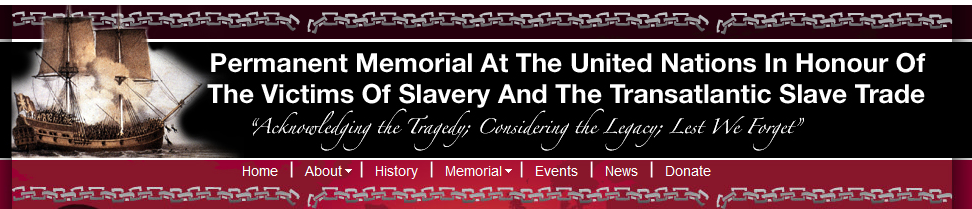
UNESCO and the Permanent Memorial Committee are delighted to invite creators and visual arts professionals to submit original ‘site specific’ artwork projects in the framework of an international competition for the creation of a Permanent Memorial to honor the Victims of Slavery and Transatlantic Slave Trade.
This call for participation offers a unique experience to insert this tragedy in the collective memory of Humanity and to raise awareness on the contributions of the victims of slavery and of the slave trade to the construction of the modern world. Their input to the redefinition of the notions of Freedom, Dignity and Human rights, help to build a new humanism and a culture of peace. It draws shared lessons from this chapter of our common History.
The granted artwork will be erected in a prestigious public space at the United Nations Headquarters, New York along the East River bank. The project will be released at the end of the competition in spring 2012 and awarded a 50,000 U.S. Dollars endowment. The deadline for submitting proposals is 19 December 2011.
One of the tragedies of the Middle Passage is that much of the wisdom of African cultures was lost on the Atlantic bed. Complicating this loss was the privileging of a Western worldview over the African genius. As a result, much of the “playful wisdom that is characteristically African” has not been passed on to generations of New World Africans. In Lifelines: The Black Book of Proverbs, Askhari Johnson Hodari (USA) and Yvonne McCalla Sobers (Jamaica) have set themselves the task of recovering some of that wisdom.
Unlike the usual arrangement of proverbs by themes, Lifelines follows the pattern of human generational challenges:
Birth (Pregnancy and Childbirth): “A fire and a pregnancy cannot be kept secret.” –Rwanda.
Childhood (Parents and Parenting): “A mother never bites her child to the bone.”—Haiti.
Adolescence, Initiation, and Rites of Passage (Identity and Individuality): “Cutting the ears of a mule will not make him a horse.”—United States (Louisiana Creole).
Love, Marriage, and Intimacy (Friendship): “Good friend better than pocket money.”—Belize, Jamaica.
Challenge (Hypocrisy): “Beware of the herbalist whose wife sells coffins.”—Africa.
Ethics and Values (Debt): “Going to bed without dinner better than waking up in debt.”—Jamaica.
Elderhood (Age, Elders, and Experience): ”Every time an old man dies, it is as if a library has burned down.”—West Africa.
Death and Afterlife (Ancestors): “A person who gives to the ancestors eats with them.”—Tanzania.
By using a chronological pattern, Lifelines provides wisdom for each stage of life and the generational challenges that acompany human growth and development.
Of course, some may argue that similar information could be found in books of Euro-American proverbs, so Lifelines, in a sense, would be superfluous. That would only be partially true. Such criticism would miss a point that the authors acknowledge: “Messages may be similar, but the wisdom of proverbs is often based on setting and experience” (xv). In other words, context is essential. As Marshall McLuhan once said, “The medium is the message.”
And this perhaps highlights the importance of Lifelines because it preserves an often denigrated African worldview. For example, the widely quoted English proverb that conveys change, “You’ve got to crack a few eggs to make an omelet,” is similar to its African counterpart, “No rain, no rainbow” (102). But I prefer the African, which is gentler, but no less wise.
Lifelines, then,goes beyond the practicality of offering kernels of wisdom for facing life challenges. It is engaged in the recovery of an African worldview that can only be kept alive on the tongues of the inheritors. This can be done in a variety of ways. As a writer, I can imagine a mentor saying to a young apprentice, “Is heart, not horn that make ram goat brave” (182). Or as a teacher of composition, I could even assign a writing prompt based on the proverb, “Bats who think they are birds are in for a great surprise” (30).
Wisdom may be gained either through contemplating personal experiences or the experiences of others. Some lessons, however, may be too costly to be learned from personal experience: “He who digs a grave for his enemy may be digging it for himself” (151). In this respect, Lifelines is not a book to be left on the shelf to be consulted as if it were an arcane Book of Dreams or literary self-help in times of trouble. Rather as the cover blurb states: “The proverbs found in Lifelines offer the guidance and wisdom of a lifetime.”


![Reblog this post [with Zemanta]](https://lh3.googleusercontent.com/blogger_img_proxy/AEn0k_t1kmSFlTHiPLwm7XHwaRi9V5pzdkWTwHI1q_w-Z9XONRPfClod2aARDaaLwm8xc533vWjwuwZ9LAke-VzHp3oNEzQYFP-2XxxNJDwMua2SQhiJxbUmvdyyvhrdM4_HGki4kdcwLCzLXVR8c4KKiaW5=s0-d)